
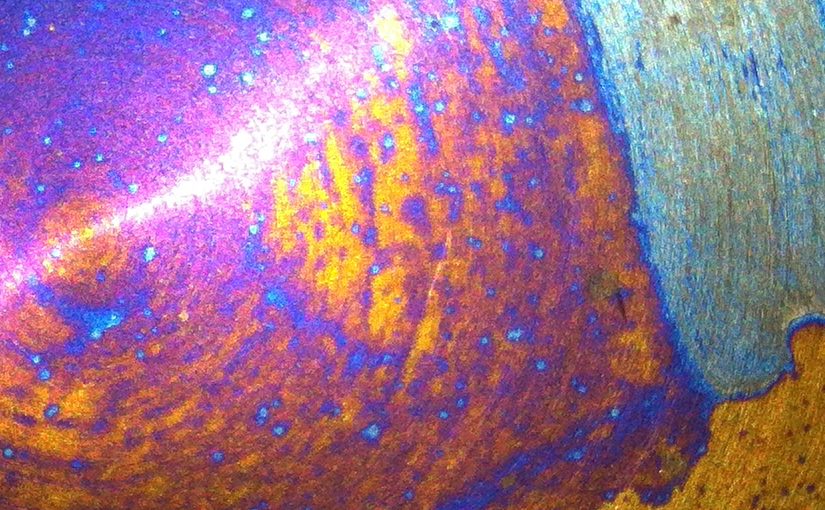
I turned the wrong burner on, heated an empty soup pot. A various shine stepped up out of the metal. How did the pot hold all that use in memory?

Pot’s still knocking on the stove.
I turned the wrong burner on, heated an empty soup pot. A various shine stepped up out of the metal. How did the pot hold all that use in memory?
Pot’s still knocking on the stove.
Couple more student blogs for ya. They’re having some trouble, truth be told, not all but many are, sustaining their blogs as a steady discipline, without any deadlines from me. I was clear when I concocted this project, that’d be part of the challenge, the drive and momentum would need to come all from them. It’s a 400-level course. They’re to go out in the world soon. The work here is maturation and self-direction.
Now, I get it, I do. They’ve got accumulating loans, part- (or, incredibly, full-) time jobs, crazy heavy course loads, personal crises, roommates melting down. Too they’ve grown up in a multifactoral technological surround that makes concentration well nigh impossible. But, counterargument, to stay in distraction’s a choice, you can turn off the iPod, walk away from the roomie.
There ends my highminded plaint, of the “kids these days” variety.
Want also to say, the group’s gelled really nicely, even if I’m a bit pissy on the state of the blogs. Some of them have been having a hard time; I too have been having a hard time. It seems to have made us good to, appreciative of, each other. How nice is that.
So here are a couple of blogs I think have found their natures well.
One takes bread, the making and breaking and sharing of bread, as its metaphor for what happens in poetry, communion in words. It also has a lot of fun finding faces in toast.
Jacob has a lively quirky slantwise imagination – he may be a distant cousin of M. Dada – and his cutups and breakdowns are very worth checking out. If I have a hope for this blog, it’s that heel (sorry!) find something verbal to do with or near the toastposts … they’re fun and pleasing in themselves, but I feel like there’s some mischievous potential here, not yet tapped into.
If the one blog points back to anciency, our oldest communion, this other points into futurity, asking what the book might be, once fully undone by digitality. Donald’s proposal, and think he’s right, is that we haven’t thought the question very far through.
E-books are not the future. E-books are just the past put on touch screens, it’s still black on white, left to right, top to bottom. And that’s not bad. But I think we can do better….
Why must books be linear? Why do they have to be the same every time? Why does reading have to be a solitary endeavor? At one point they stop being books and become something else. Something untapped, unrestricted and undone. Untapped, because there is more to books than books. Unrestricted, because they are given freedom from the restrictions of physicality. Undone, so they can be redone.
I give you, then, the concept of the UnBook. A book unleashed by technology.
Thinking on the question is going on, though. UbuWeb doesn’t have a dedicated section on digital texts but possibilities are scattered all through. And my own English Department’s Bellingham Review has an online issue in the works, due out fall 2016, on “The Kinetic Page.” So stay tuned all y’all.
I’ve felt ashamed, in the face of Paris, Homs, Beirut, drowning seas off Turkey and Lesbos, murdered and maimed Frenchwomen and men, Syrian migrants around whom walls of the mind have now reached further skyward, to have been vexed by my little troubles – though for whatever reason, surgery, readiness, the fall’s brought them forward for my study.
But harm is harm. Sometimes we confuse the perspectives of justice and mindfulness. From the perspective of justice (redress) one harm does weigh against another, more, less. From that of compassion, though, there’s maybe just whatever’s in you, filling the cup. To weigh a present this against a remembered that is it-consciousness (Buber). And it-consciousness is the original harm.
What is sin? Distance from God. Don’t believe in God yet I believe that.
I don’t get to separate. That’s the meaning, as I take it, of the precepts my teacher gave me. (He told me the meaning of my name, endless spring, and asked Do you understand. I have the pine needles he brushed my forehead with on my altar.) It means the assholes gunning down concertgoers in a club in Paris are me. The lost boy in Roseburg executing his schoolmates in coldness is me.
I don’t mean I know what it’s like to be them, that would presume. I mean what they’re burning in, I’m burning in.
Shit, I’m going all Christian sounding, or Eliot or something, because I don’t know how to express something I feel as dimly as I do strongly. I just feel it matters how I take care of my undone karma, the busted-up places, even if to a calculative eye, my trials are small to nil.
I don’t get to separate from any of it. All I get is to choose whether or not to create craziness. I’m not ever, as this body, going to pick up a gun. I doubt I’m ever, as this body, going to even punch anyone. But I already have, as the gunner, goddamn him, as the suicide bomber, goddamn him and him and him, and him and him and him – God I want to cut their throats – given up to my craziness and slaughtered scores.
Of course I’m ashamed, of course I’m stricken.
So I’ve been wondering, is there any art, a possibility of art, in my dim stumbling efforts to take charge of my own karma. Harms I’ve received and want not to make more harm of (than I surely already have).
Not an art found by sifting and refining records of those efforts. Rather, could those records, taken whole in all their roughness, with minimal alteration, move. Could there be beauty, insight, transport, in the very awkward transparent mostly untransformed material mess of them.
Here’s one such, a journal entry, lightly edited. It begins as a memory that became an episode of lucid dreaming – the transition is around where “I” kick out the handle of the car door.
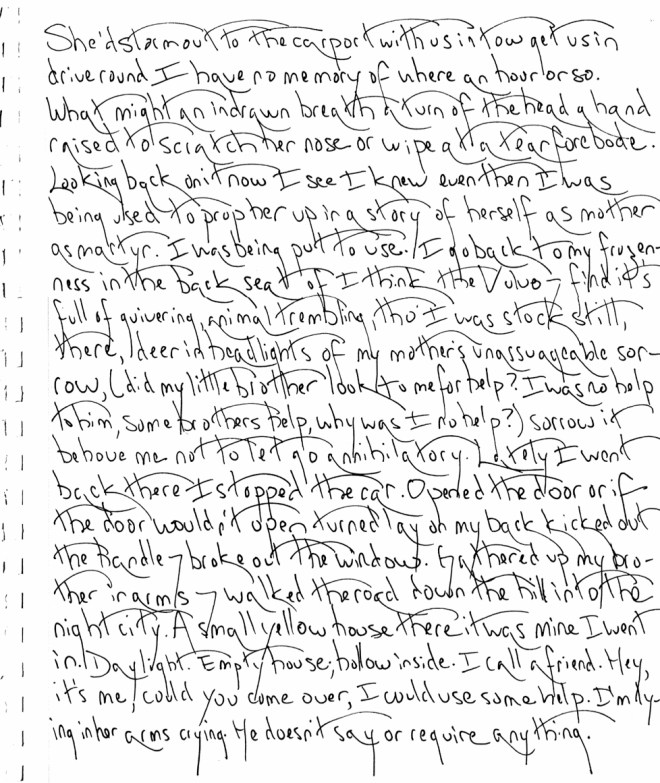
I mean it as a visual poem. It has to be handwritten – doesn’t work typed. Every cross-stroke is a jailbreak, the force of the kick breaking the boy free.
For context, since I’m disclosing bravely here, this was a little bit of solo EMDR work. EMDR’s a protocol for working with traumatic memories that instead of describing in detail I’ll just link to here. I picked a memory that was charged, but not too charged, because I’m still learning how to handle this practice, and can easily get overwhelmed by it.
I’m so curious the friend morphs gender. The friend’s my mother and father, I think so, as I knew they could also be. Not as I would get them to be if I were good enough – fuck that, done with that. But as they are now, somehow, in me. 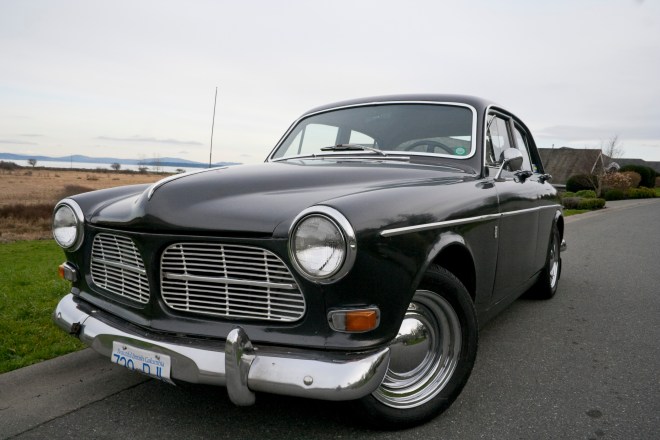
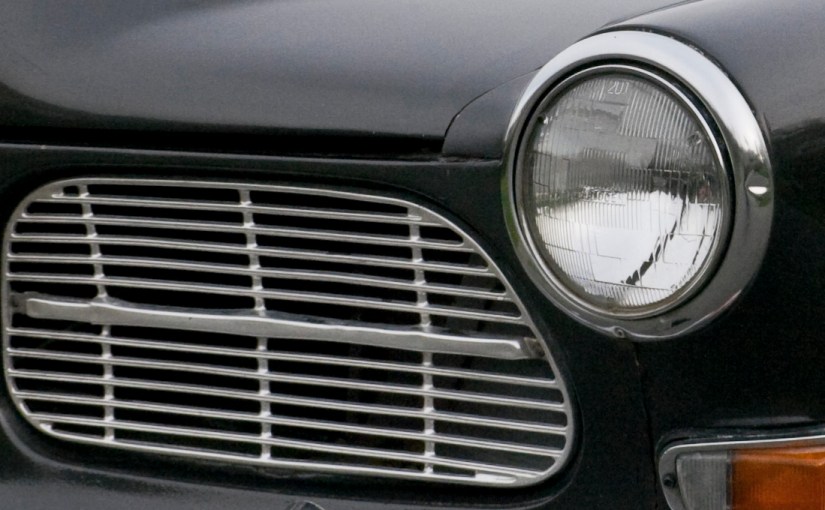
To end, an image I found online, eerily like the very car. Right navy/eggplant colour. BC license plate though the landscape looks more Delta/Surrey than West Van where the memory lives …
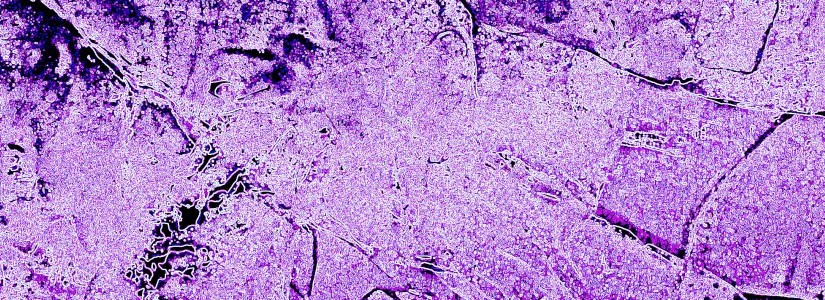
ADDENDUM. Came to feel, in the setting of Overject, the text needed more alterity – to be more other to itself. Started playing with moving it on the photocopier glass as the blue light bar moved along under the glass gathering in the image. And found, this was nice, that when I induced the movement that the text, its content, and yes my students I do still care about content, that the text induced in me, waving or trembling or rocking or whatever – that was the image that felt most true.
In the case of the page above (reinscribed) that was this.
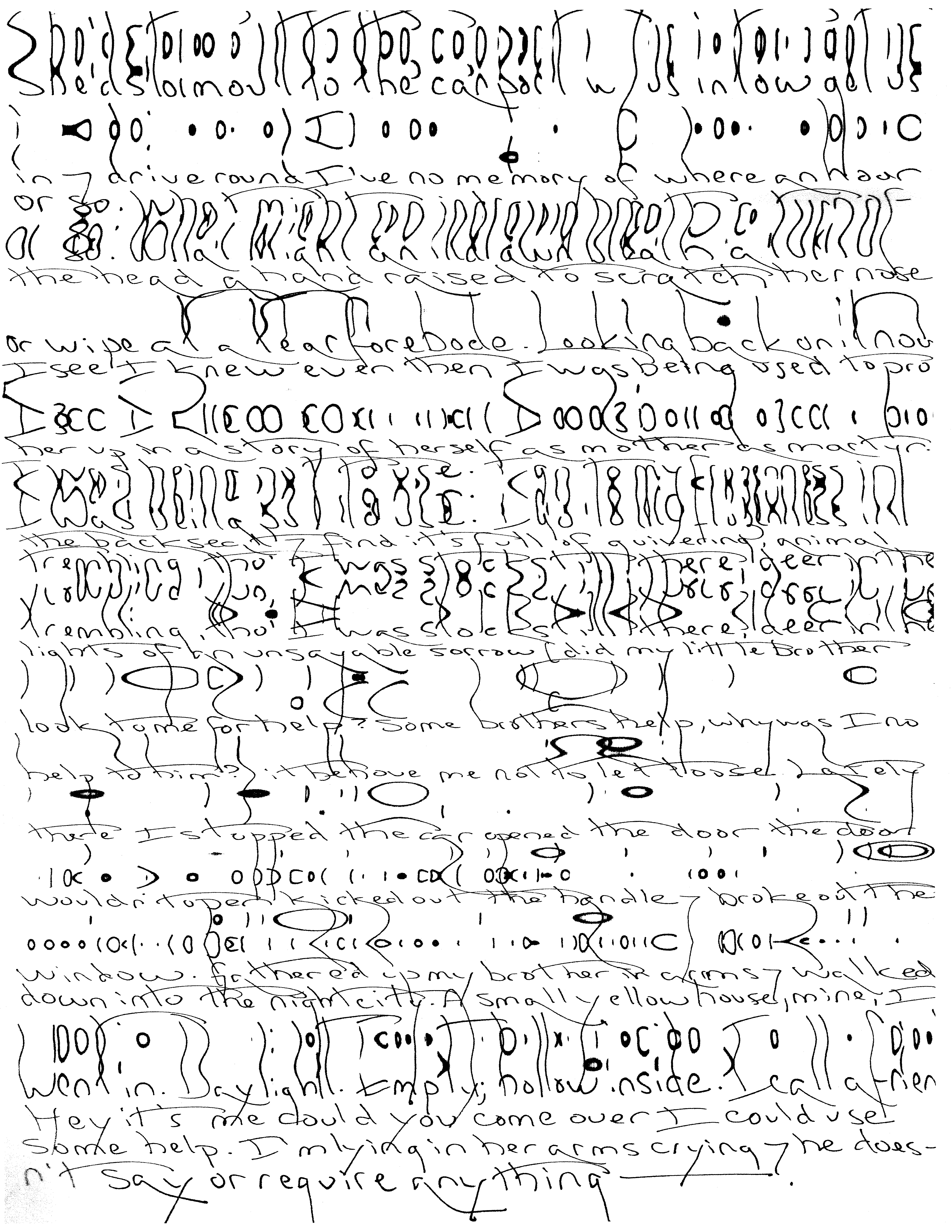
Not asemic writing, properly, because it has legibility (versus “is legible”). Aasemic writing?
There are nouns one might hear as verbs rather. Living processes we make things of. Reify. Not that there’s anything wrong with things. Some of my best friends are things. But things are just actions sitting still a moment.
Life as a verb. Okay.
Death as a verb. Oh shit.
Self as a verb. Oh my.
Peace as a verb. “There is no way to peace, peace is the way.”
Blog as a verb. Oh get over it.
Ernest Fenollosa, in The Chinese Written Character as a Medium for Poetry:
A true noun, an isolated thing, does not exist in nature. Things are only the terminal points, or rather the meeting points of actions, cross-sections cut through actions, snap-shots. Neither can a pure verb, an abstract motion, be possible in nature.
Is nature a noun or a verb. Yes.
But we of the West weight the noun. BEING, eternal forms, ειδοσ, Plato, that crapola, so to recover the living act, transmutation, you and me in flux, Heraclitean, who knows what comes in the next instant – terrifying, marvellous, necessary –
Let’s get it edgier. Benjamin Lee Whorf, in Language, Thought, and Reality, with some composting.
[A member of the Hopi nation] has no general notion or intuition of TIME as a smooth flowing continuum in which everything in the universe proceeds at an equal rate, out of a future, through a present, into a past. At the same time, the Hopi language is capable of accounting for and describing correctly all observable phenomena of the universe.
The Hopi metaphysics has its cosmic forms comparable to those of the West, past, present, and future, in scale and scope. It imposes on the universe two grand cosmic forms, which we may call MANIFESTED and MANIFESTING (or, UNMANIFEST) or, again, OBJECTIVE and SUBJECTIVE.
The objective or manifested comprises all that is or has been accessible to the senses, the historical physical universe, in fact, with no attempt to distinguish between present and past, but excluding everything that we call future. The subjective or manifesting comprises all that we call future, BUT NOT MERELY THIS; it includes equally and indistinguishably all that we call mental – everything that appears or exists in the mind, or, as the Hopi would prefer to say, in the HEART, no only the heart of man, but the heart of animals, plants, and things, and behind and within all the forms and appearances of nature in the heart of nature.
Don’t know how good this is as anthropology. Could be Whorf’s wet dream of an escape from Plato’s noun. Or a projection of Heidegger onto decimated tribes. But there is at least dimly an intuition of alterity in it, salutary.
A hard spell. More than a bit PTSDy after my surgery – anxiety waves, wanting to cry lots, panic in the grocery store. Halloween freaked me the fuck out, roving packs in darkened streets and shouts and bangs at all sides.
The trauma’s been here many years, but hasn’t surfaced like this in a while … all the work I’ve done, it’s done some good. But maybe no surprise a minor surgery (hernia repair) brought it back? A knife’s an insult the body knows of, unconsciousness or no, and frozen there, can do nothing about. And this knife in especial was working not very far, in Mitchell’s translation of Rilke’s of Apollo’s of original fire, from that dark centre where procreation flared.
A line from ago I never used and suddenly remember: “Shouts in the street were pieces of me in the mouths of dogs.”
Rousseau had it, I’m sure of it.
[A] word to speak, the least trifle to perform, appear an intolerable labor; everything alarms and terrifies me; the very buzzing of a fly makes me tremble. (Confessions)
This morning I went to the Farmers’ Market and saw Rich and Kendall, also Sean, a former student, and chatting was nice, good. I was looking for herbs to plant in my newly landscaped (or still landscaping) front yard but found instead some apple cider and a chocolate croissant. This afternoon I went to the grocery store and got a flu shot and an anxiety pulse. Tomorrow I’ll drive out to Cloud Mountain Farm and look again for herbs, also fruit trees, apple, plum, frost peach.
My workouts have become meditation by other means – access to inward, when I’m otherwise too distracted or resistant to tune in. So it’s good to be back on the treadmill. Not running, yet, but walking hard up a steep pitch, hard enough for a heartmind opening.
Today it was this. (And tears came in a jag. Which no one can see, nor will anyone, even, if a sob comes loose. Workout a perfected disguise.) There’s a core wound. You can hold it as what’s given to you to hold. Or you can keep living out of it and creating craziness.
This post is actually about a question of genre. Because I can write about this stuff, directly, apparently, in a blog post. And it’s not impermissible either in nonfiction, in memoir. A bit edgy, maybe, but hardly forbidden. But in poetry … no, you can’t do that in poetry, put it in an image, please.
Don’t want it in an image. Want the banal exposed awkward inarticulacy with which it came to me. Because that’s my subject. So fuck peach blossoms and fuck the objective correlative. Here’s what I wrote in my journal when I got home –

– and here’s the notecard I did, yes, transpose it to:

I look about in vain for precedents. Loads of treacly banal sentiment dumps in verse, sure. But I mean legit artistic practices drawing straight from how you speak to yourself about your own feelings and what you do with them and they with you. George Oppen makes concrete poetic objects out of carefully configured abstract surfaces set at colluding angles –
The sad marvels;
Of this was told
A tale of our wickedness.
It is not our wickedness.
– but his concerns are moral and ontological not psychological (“The self is no mystery …”). In many of Frank Bidart’s poems the speaker wrestles semi-articulately with a tormented inner life –
An adult’s forgiveness of his parents
born out of increasing age and empathy
which really forgives nothing,—
but is loathing, rage, revenge,
yet forgiveness as well—;
– but the poem gets its charge from the distance cut open by a persona.
Is what I want, direct speech of and from an emotional life without resort to irony or persona, just inadmissible in poetry? Why permissible in memoir, but not in poetry, when in so many other respects, they’re known to overlap? And where lives the voice, anyway, that says impermissible?
I wonder how I’ll feel about my little notecard when a few days have passed.
I can say this. It belongs, in intent, to Overject as a whole, which means to translate every feature it can of its source text, a minor didactic Old English poem, into the current moment. For that poem is, I have come to feel sure, a trauma document, full to brim with opacities, deferrals, fractures, hapless power moves, inadvertent tender disclosures.
This too I’ll say, writing it has mattered, as writing about it has mattered.
Before you decide my little notecard belongs in the dustbin of banalities, read it for the thoughts and feelings between its phrases and clauses. Those are the ones I took the most care to articulate.
Can’t resist. Heard it on As It Happens and had to search it out. I had surgery recently and taught while on painkillers and every time I said something off colour or inappropriate, I got to say, That wasn’t me, that was the Percocet.
As in, for instance, when I mocked the Republican candidates as a sardine can of moral dwarves, I could say, That was the Percocet talking. Apparently, Percocet’s a Democrat. In which spirit, this.
Guys, I still love this guy. I might come 2016 spoil me ballot and write him in.
Thought I’d share too, since I think here out loud about pedagogy, the note I just sent my compost class.
I’m hoping, so you know, to do a few things by sharing your blogs publicly, and advising you of it. One is to let you know, the work you do matters, beyond our little campus. Another is, to say a few words, in the language I use as a writer outside the classroom, about how your work impinges on me. And a third is, to keep you in touch with each other’s work, so your blogs can be models for each other, inspiration, goad.
The theme here is: seamlessness. Which is compost, but less messy.
I’m struck by a couple of differences in how I teach poetry and how blogging.
One is, I would never proclaim one student’s poem over another. But here I have, implicitly, their blogs. I do mean to praise and publicize every student blog to the world before the class is done. Still, though, I’ve picked one, and another, to go first.
The fact is, some students have nailed it, right off, and I want the others to learn from them. And by saying, these guys have nailed it, I make that more possible. And by making my praise public – worldwide, technically, if very sparsely – I raise the stakes.
I have two motives in teaching, in some tension, and the tension’s laid bare here. One – do no harm. Two – push them as hard as I can get away with.
A poem is a tender creation. Has inmostness. A blog is probably less so. Has, more likely, a thick skin. So, no guarantee, but I’m less likely to do harm by offering or withholding praise. Am willing to risk stinging just a bit, even, if it will, like a nettle, nourish.
The other diff. This blog here. I don’t want my poetry students reading my poems! But I’m fine if my blog students read my blog. What up with that?
Maybe it’s that I know well how to teach the craft of poetry through other poets’ poems. Blogging, I want to teach best practices quick, by showing five or six good ones, and if mine’s in their fields of awareness that’s just fine. Then they can get down to the content, the good stuff.
Maybe it’s that bad examples of blog form are so much more available than bad examples of poetic form.
No. It’s that form and content aren’t intimate in a blog the way they are in a poem. They’re involved but not intimate. And so I’m teaching the form as a technique, an efficiency, and the content as an art. Get done with the one, so we can focus on the other.
It’s ok, blog world, you’re only 10 years or so old. Check in when you’re 10,000.

Another student blog for you, come into its own, right here, on the threshold where the inmost being we are, touches the public sphere we move about in. Clothes, hair, eyes, lips, limbs, and how we make up and dress down, pierce and dye, stain or tear, tattoo or don’t. For, as Evan rightly says, not to is every bit as much a choice, as to.
I say this as one uncomfortable caring at all about how I look. So much more important to me how one sees. And yet it do matter don’t it. We are moving at all moments through a web of codes.
Merleau-Ponty noted, I think it was he, I’m taking this from my memory of David Abram‘s Spell of the Sensuous, that the eye can’t see without also being seen – can’t do vision without entering the visual. To see is to be seen. More, to see is to be seen seeing. A phenomenology of flirting might begin here. (Maybe also one of voyeurism, which maybe feels dirty because it breaks out of that reciprocity.) That, anyway, is our social being, to see and to be seen and to be seen seeing.
Is why we do not all wear Mao suits. Or, if we do, we want to look this good.
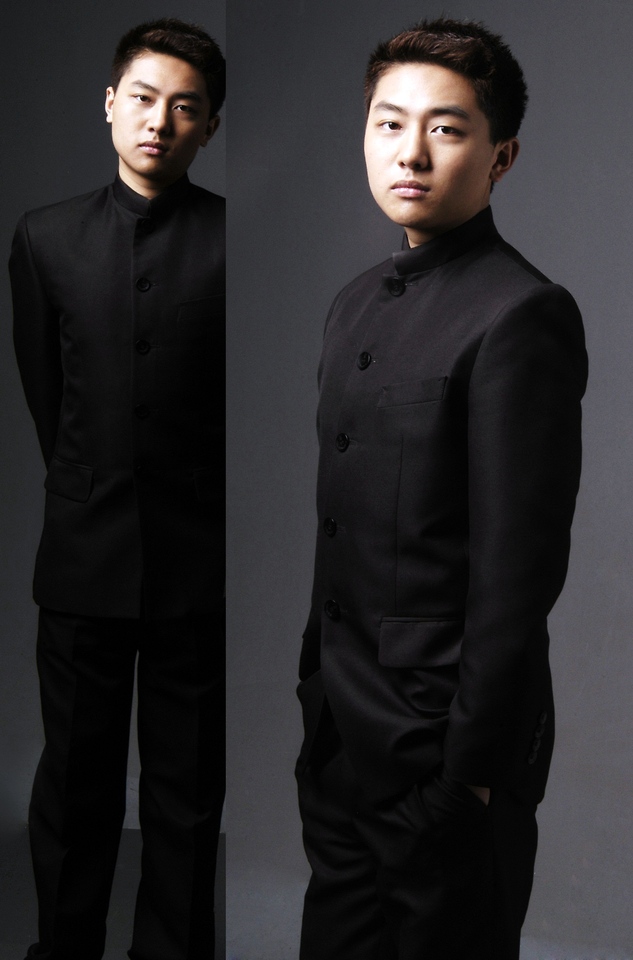
Evan’s got a fine and punchy style going, a good model of, one, how to do blog prose, and, two, how to marry personal and social awarenesses. Light touch, nothing didactic. I mean it feels seamless to me, how her awakeness to her own life, and her wondering how the world goes, meet. Check it out.
My Art of Compost students are hard at work on their blogs and I mean to post links to them as they come to life. Here’s a first. A lively deft insightful blog on postmodern art and culture, with an emphasis on pop art, and theory consonant with same. Andy Warhol, Jean Baudrillard, french yé-yé pop, The Cure. I hope Benjamin and Barthes to come. Scared yet? Good. But for real, it’s an excellent resource, Michelle’s really done, doing, her homework, and giving it away to all.
Most excitingly, to me, she’s bringing her own creative work into the mix. She’s a wonderful photographer, and the more she manipulates the images, the more she “problematizes” their “authenticity,” the more they belong.
Here’s one I stole from there to draw you on. Meant all four scare quotes yes.
Third and last of the aleatory proposals is mine. Strikes me as dullest of the three. Buzz goes, buzz buzz. And with that ringing encomium – read on.
I’ll present on Overject, an exercise in total translation – translation that holds every verbal and visual trace that can be caught of how a poem refracts as it passes through its translator. The project performs various manipulations on its source text, a minor mediocre didactic Old English poem, to investigate the role of the translator’s impurities and opacities in the activity of translation. While the project may not appear classically aleatory, it turns out to encounter and depend on accident at every turn.
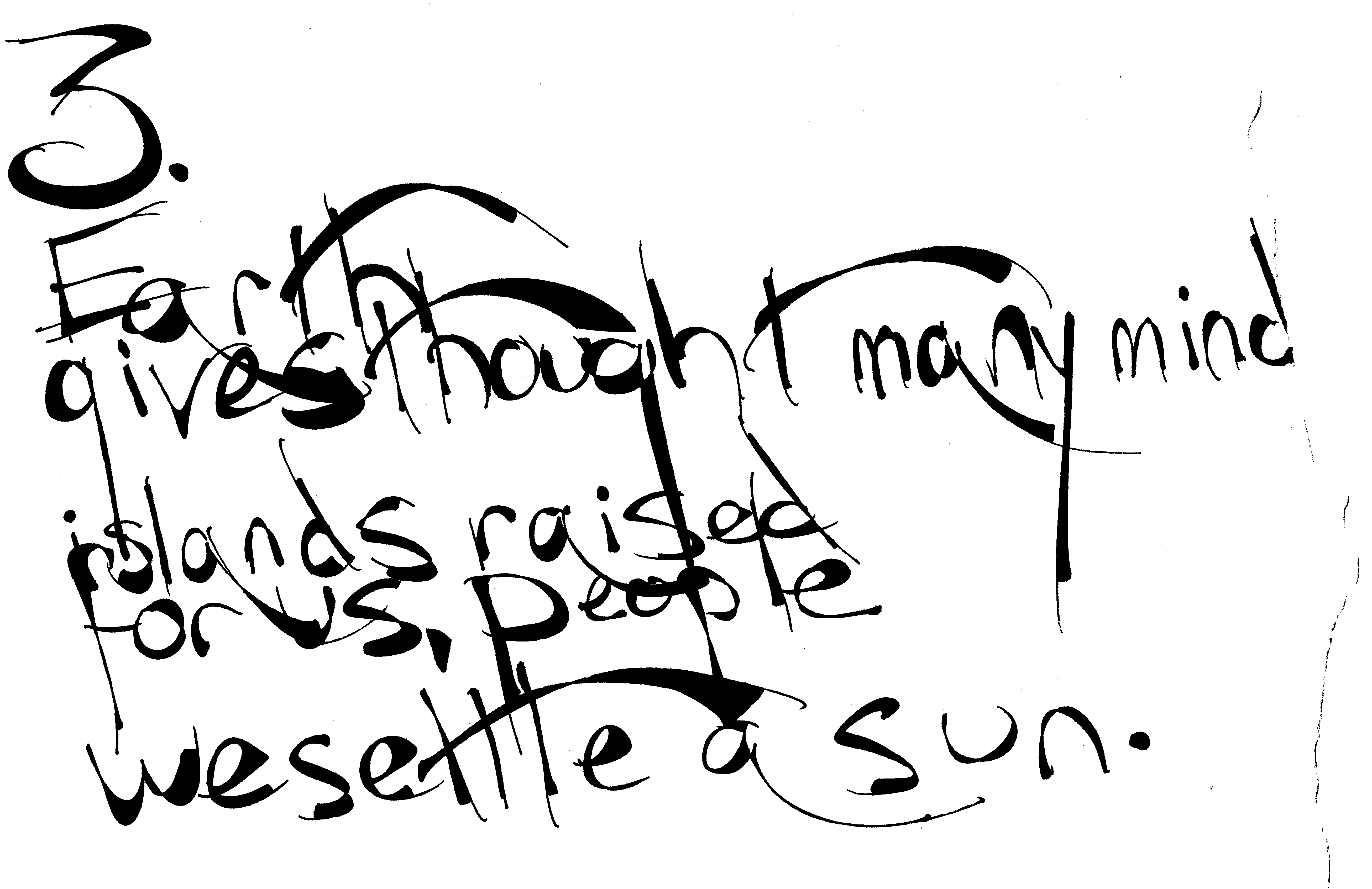 Most of the poems are hand-written, and contingency hangs on the inscription of each character. I set each one down fast, too fast for thought, and a second time just as fast. Then meticulously I ink in the spaces left open between the two passes. The gangly pseudo-graffiti that results is a gestural translation of the scribe’s stately calligraphy. The practice may not be aleatory, strictly speaking, for no random element from outside the poet has been introduced. But although the forms are laid down by my own hand, I experience them to appear from outside my will intention and control. I decide the process, as the aleatory poet decides to roll the dice, then submit to the results. And I take from the practice all the joy and constraint, freedom and burden, the aleatory is famed to offer.
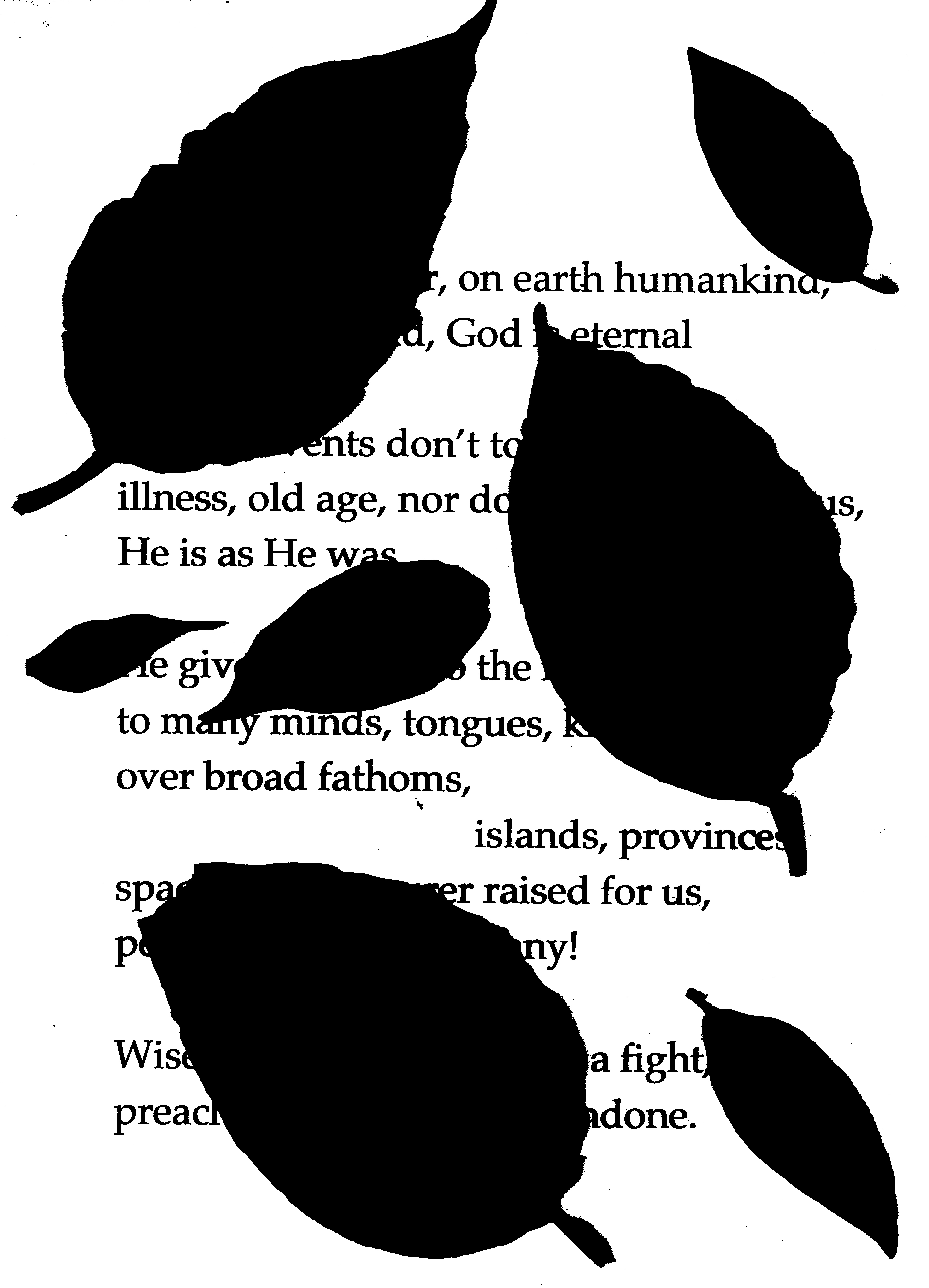 My work with my materials – leaves paper cellophane – also has aleatory respects. Leaves first entered the poem by accident at the corner of my eye, a dogwood in the wind out my window. I picked some and dropped them on a page and that became a thing. Their placement as masks over semantic translations is a mix of chance and design: they fall as they will, then I get to nudge them around, but a little. Meanwhile, most images, after they’re drawn and before I scan them, are put at risk, torn on all sides. What course the tear takes is not altogether up to me. Nor can I say which parts of the tear line will appear, and which will stay invisible, when I take the scrap to my scanner. Lines of scanner noise that become hills and clouds, the very lay of the land.
Questions I expect to address or at least brush on: How do aleatory practices intersect with proprioceptive elements (the embodied gesture) and objectivist concerns (the thingliness of the poem)? Burroughs said that all writing is cutups – is there a meaningful sense in which all writing is aleatory? Does a practice count as aleatory when the random factor comes from the poet herself or himself? What sympathies exist between the drive to the aleatory and longings among our poets for the organic, the spontaneous, the irrational, the impersonal?
Yeah whatevs. To come soon, student blogs. Some are striding into readiness, a few yes are trudging, a couple have fleeted there. Links to those last, anon.




 The Art of Compost