A Bookworm

The final poem of Unlikeness Is Us. Undereating the whole thing.


A Bookworm

A moth ate words. Which seems
splendid to me. Think of the wonder
that worm consumed, riddles we wrote,
a thief in darkness of our deep musings;
the stiff parchment too – and the thief not
a whit wiser for the words it swallowed.

A Bookworm

Moððe word frǣt.°          Mē þæt þūhte
wrǣtlicu wyrd,          þā ic þæt wundor° gefrægn,
þæt se wyrm° forswealg          wera gied° sumes,
þēof in þȳstro          þrymfæstne cwide
ond þæs strangan staþol.          Stælgiest ne wæs                         (5)
wihte þȳ glēawra          þe hē þām wordum swealg. ⬩

Commentary

This one’s based on an ænigma (no. 16, “Tinea”) by Symphosius:

Littera me pauit, nec quid sit littera noui.
In libris uixi, nec sum studiosior inde.
Exedi Musas, nec adhuc tamen ipsa profeci.
                    (Glorie 637)

Letters fed me, but I do not know what letters are.
I lived in books, but am no more studious for that.
I devoured the Muses, but still have not myself progressed.
                    (Cavell trans., n.p.)

Not a translation but a transmutation of a Latin precursor. It has digested a prior poem, one by Symphosius, to arise remade in a new language, and a new rendering. So the poem about a bookworm is a bookworm. Intertextuality is the modern word for this ancient preoccupation. It’s as old as writing is – older, in fact, as old as spoken stories are, which change as they change hands and minds, recombining each time they’re told. That interchange is pretty ordinary in an oral tradition and doesn’t warrant a lot of special attention. When writing fixes speech, though, tries to make it a thing durable, its ongoing decay on all sides becomes something to talk about.

One challenge in this riddle is to figure out whether the words eaten are oral or written (Cavell n.p.). The word gied (3) “song” suggests the former. How do you eat a spoken or sung word – by hearing it? Two lines later, strangan staþol (5) “strong foundation” points towards a thing that’s read, parchment, binding. You could eat that by reading it, but it’s clear this consumer’s no reader. How to reconcile one gesture towards voice and one towards written form and frame? John Niles (121–22) suggests we go with written song – specifically the canonical psalms of King David. The Song of Solomon, with its secret visits in the night, akin to thievery, also comes to mind. Whatever you take the text consumed to be, the consumer is usually thought a bookworm: that’s how to eat writing without getting it. Its work isn’t profitless though. Worm becomes moth, matter’s made energy, parchment flight. Not a whit wiser, but a marvel; and the worm knows what readers forget, that the text is a thing in the world, storehouse of energy.

Just as “bookworm” is metaphor for a certain sort of reader, though, some readers of that sort, scholars, will burrow into the bookworm for a meaning more hidden. I’m drawing from Megan Cavell’s post on The Riddle Ages and her thoughts on the Latin ruminatio, which worked dually, just as our word “rumination” does. It’s how a cow chews and chews, also how one mulls an idea, pre-digesting it. If the poem’s written with this sort of slow absorption in mind, it’s possible it does, in addition to its lateral metonymic work of turning parchment to worm to moth, also some vertical metaphoric work. Who else in its world chewed dumbly awaiting metamorphosis? The moth is cast across a region of unlikeness towards, perhaps, some poor monk or student with bad teeth, breath, acne. And the likeness that carries us with it across the lie? Moth and student are both larval forms, in waiting. (Isidore of Seville would enjoy it that in our English only one letter separates pupal from pupil.) A creature chewed uncomprehendingly on words, and now, having gone off, witless and winged, it’s gained some sort of mastery. A professor?

Notes

1     Moððe word frǣt. Williamson: “the initial half-line contains a double disguise: moððe for wyrm and word for bec” (285). The worm presents as its future as a moth, the book as the words it contains. Projective, metonymic.

2     wundor. In the OE, it’s the fact of consumption that’s a marvel, not a wonder that’s consumed. More faithful to the letter would be: “What a wonder! That the worm consumed words someone wrote.”

3     wyrm. Note the play among near-homophones, word, wyrd, wyrm. Word, fate, and worm bound together in orþoncbendum, skillful contrivance. ¶ gied. Usually “song.” Cavell (n.p.) translates this verse “a certain man’s song.” However, gied can also mean “riddle,” and to an uncomprehending worm, the whole library would be insoluble, if digestible.


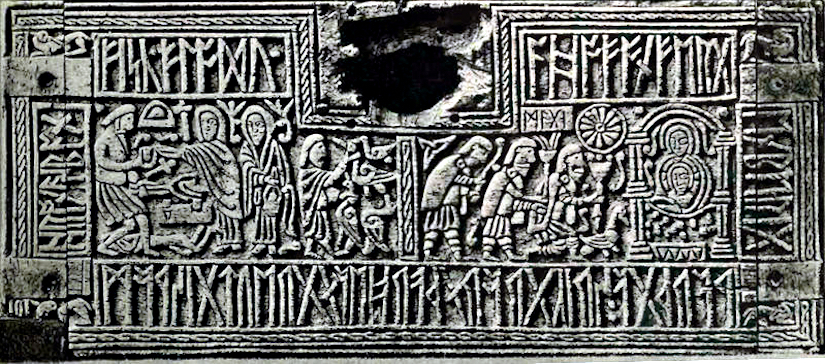
The image atop is the front panel of the Franks Casket – riddled with holes, graven with a runic alphabet whose import as a whole’s up for grabs. Consider the opening paragraph of the online article that accompanies the image

One of the more vexing problems facing scholars of Anglo-Saxon art is the simple fact that we often do not know precisely what it is that we are dealing with. I am speaking not so much of the questions of dating and localization that hamper the study of medieval art. Rather, it is that we cannot even say for certain what many of our most famous objects even are, or were intended to be. The Franks Casket, for example, has been identified as a treasure chest or a book shrine, and was used in the later Middle Ages as a reliquary, but all we can say with any certainty is that it is a box that likely originally had a latch.

Riddle me this. This here worm, had he the time, would read it all. But bed.

The Swan

From Unlikeness Is Us. With thoughts on the Anglo-Saxon riddle as a threshold genre, and how can the more-than-human speak in our rather human poems.


The Swan

My dress silent when I walk on land,
or house myself, or stir up the water.
Sometimes my clothing and the air
lift me above the human dwellings,
and for that all the powers of cloud
bear me on – my white vestments
sound loudly and resound sweetly,
sing clearly, when I rest on neither
earth nor water, wandering spirit.

The Swan

Hrægl mīn swīgað°          þonne ic hrūsan trede,
oþþe þā wīc būge,          oþþe wado drēfe.
Hwīlum mec āhebbað          ofer hæleþa byht
hyrste mīne          ond þēos hēa lyft,
ond mec þonne wīde          wolcna strengu°                         (5)
ofer folc byreð.          Frætwe° mīne
swōgað hlūde          ond swinsiað,
torhte singað,          þonne ic getenge ne bēom ⬩°
flōde ond foldan,          fērende gǣst°. ⬩   :⁊

Commentary

There are ninety-five riddle poems in the Exeter Book. Give or take – a few short poems, whether or not they’re riddles is an open question. A few haven’t been solved for sure; some effectively announce the answer in the first line. In some the thing speaks for itself; in others it’s described by a curious or bemused third party. Most are marked by compact wordplay, many by playful, occasionally salacious banter. Some end with a challenge – name what this is.

“The Swan,” like many of them, offers speech to a thing we would have thought speechless (a kind of prosopopoeia). What to make of that depends on how hard you look. Pressed lightly, the poem is a happy game of make-believe. “Imagine a swan could speak!” And it’s nice to find a ludic impulse in a body of work often thought wholly gloomy in its celebration of heroes done in by wyrd. Read at this pressure, the riddle poems show a debt to a post-Classical genre that dates back at least to Symphosius (ca. 4th–5th C.), whose three-line, apparently extempore Ænigmata inspired translations and imitations by Aldhelm (639–709), bishop of Sherborne, and Tatwine (ca. 670–734), archbishop of Canterbury, among others. The influence of these precursors, all in Latin, can be felt in the Exeter riddles, but the latter aren’t for the most part translations or imitations; they tend to be longer, more detailed, and more playful stylistically than their forebears (Marsden 310).

Look harder, the ludic becomes lucid, as the brute world is found to be sentient. A swan speaks; later in these poems, a cuckoo does; elsewhere among the riddles, mead, a tree, a mail coat, a reed pen. The poems recall for us an old human premise we’ve forgotten or grown unconscious to – the sensuous surround of stones and trees and birds and bugs is awake, articulate. Maybe in these poems the notion was just taken down from a shelf in the mind for use in a verbal parlour game; maybe it also touched on grave true belief. Compare an earlier instance, both playful and earnest, an Archaic Greek cup on which the words are inscribed, “I am Raven’s wine cup.” Robert Bringhurst writes of it:

[What] the Lindos cup asserts, apart from its owner’s name, is its own articulate vitality: “I am.” This is an animate, vocal drinking vessel, likely to cry for help if you should put it in your pocket and walk off. (175)

That cup, this poem, belong to an animist inheritance, the final human universal.[1] The first-person riddle poems take it as a given that our minds engage in a larger network of minds endowed with sense and speech and reciprocal responsibility. In this they rebut the Seafarer and the Earthwalker, who in their ascetic commitments aim to leave earthly being behind; for them the meaning that matters is not in matter – is, as for Augustine, immaterial and indefinitely deferred. But even they, lonely and cold, can’t help but take birdcalls for human chatter, the birds themselves as human comrades. They can’t escape their own imaginations, any more than they can be not an animal, or evade having been born.

All objects potentially subjects. The notion sits near the heart of the objectivist mode. You see it especially in the Objectivist poets after whom the mode is named. When George Oppen avows the life of objects in “Of Being Numerous”

So spoke of the existence of things,
An unmanageable pantheon

Absolute, but they say
Arid.
           (“Of Being Numerous”)

or Lorine Niedecker lays for that pantheon a sensate material ground

“We have a lovely
          finite parentage
                    mineral

vegetable
          animal”
                    Nearby dark wood –
                               (“Wintergreen Ridge”)

they’re stepping into a way of thinking the riddle poets walked before them. The habit of mind went underground, not away.

That’s one side of it – the object is hallowed.

The other is, it’s hollowed out – appropriated, made to speak with a human tongue, of human things. The swan has not feathers but hrægl “garments,” which are later seen as frætwe “ornaments” – as if a bird had clothes and vanity and the social energy for all that. As it rises from the world we know, flood and field, it calls itself fērende gǣst “wandering spirit,” or else fērende gæst “wayfaring guest” – terms that connote the soul, a guest on earth, fleeting in flesh before it ascends to Heaven. The living creature is made to do a job in a Christian sign system, and in this respect, it’s made a tool. The swan is here to shed light on the human world, its social and ecclesiastic arrangements. This is the mind of resource extraction, alert to use-value. That that value is cultural, then production of meanings, rather than grossly material, the production of food or drink, tractors, iPhones, matters not so much. The swan belongs to us, it has been baptized, domesticated. [2]

And, yet, some of its swanness hangs about it still. Made a tool, it’s not reduced to tool. Put in human terms, it’s marked by its distance from human realms: not on land, not on water, far above our dwellings. The sky it flies across calls to mind Heaven but stays a material sky. And the swan is only crossing, notheaded upward, as the soul we might  want it to stand for would be. As it leaves our sight and the poem, if we feel the affirmation of a Christian construct, we feel as much a visit from outside our constructions. And even as it is made to speak human (how else could the poem make it understood?) its words make the sounds its wings would in flight: swīgað, swōgað, swinsiað – sounds that also point, as Lockhart notes, to its name, the riddle’s answer, OE swan. In the sign-realm the swan is put to work, as said, doing our heavy lifting; in the sound-realm it sends, by onomatopoeia, a coded message, one true to its name in human speech, but also to the swish of its wings. Is it ours, then, or not ours, an it or a thou?

The poem’s a cross-section through a dialectic unfolding on a threshold. The human realm commodifies a non-human mode of being for tool-use, even as that more-than-human being brushes us with meanings not our own. Abiding on that threshold is how the poem appears to tremble. The riddle poems draw their other into the borderlands of human use, where the mystery of what it was before contact with human hand or mind (a tree, a seed, honey, the inside of an egg) still hangs about it as aura, and the mind of utility, seeing a tool (rune stick) or food (onion) or drink (mead) or sign (cuckoo) possible, works to harvest the mystery.

The poem is a look at that work, right at the moment of naming, when the name is a shining new thing, as for Adam.


I wanted to go somewhere with unclosedness: that language, though inescapably human, in its indeterminacy leaves gaps the non-human comes streaming in thru – thinking especially of that gǣst/gæst play at the end, how it multiplies meanings and leaves something unresolved, uncompletable. Because rhizome. But it’ll have to wait for another day. Got a heap of other poems to comment on & a tight deadline.


Notes

1     swīgað. Marsden notes a play between this word, “be silent,” and swōgað (l. 7) “make sound.”

5     wolcna strengu. “Power of clouds (or skies).” A kenning for wind.

6     Frætwe. Literally, “ornaments.” In other contexts, fields that cover the earth and armour that covers a warrior’s body are described as frætwe. Here the word refers to the bird’s plumage.

8     The punctum, appearing mid-sentence, emphasizes the speaker’s absence, ne bēom. In an MS without line breaks, it also, with the punctum that follows, sets off the last line as a compositional unit:

flode ond foldan ferende gæst

9     gǣst. Vowel length is unmarked in the manuscript, so this word may be read as gǣst “soul, spirit,” as gæst “guest,” or as both.


[1] An exercise I used to give: “Take a pencil and paper and make a quick sketch of a friend. Include whatever makes them them to you – how their hair curls, their unfashionable glasses. Now take your pencil and stab the eyes out. Stop. No need to do it. Instead just notice what happened in you the moment I asked you to.” We’re all still animists. I don’t think there’s any art without it. I stopped giving students the exercise because it made the point too well, disturbed all of us.

[2] What men want to learn from nature is how to use it in order to wholly dominate it and other men. That is the only aim. There is to be no mystery. And this disenchantment of the world is the extirpation of animism. In time the multiplicity of forms is reduced to position and arrangement, history to fact, things to matter. —Theodor W. Adorno and Max Horkheimer, Dialectic of Enlightenment (5–7 passim)

Small incidental find

The Anglo-Saxons got ear wax out same as the rest of us (sans Qtip)

Screen Shot 2017-06-26 at 9.26.26 PM

Warms my heart, the thought of it. Some warrior, in his downtime back in the ranks, helmet off, little finger reaming his ear out.

Don’t need Game of Thrones to make the medieval real. Just need Bosworth & Toller. (Though when the first of the new season airs I’m there.) Next is look up nosepicking. I mean, they must have, right? a word for it?


Caught then not

Got caught in a post-breakup jag of self-hate for a bit there. No one loves me, no one will want me, why should I bother. You know, that drill. It can be pretty compelling; it can be a rock fast at your head; a rock sunk fast in your head.

For me – I’m noticing this more and more lately, and wonder if it’s a lumpy fruit of years of practice, zazen, psychotherapy, artmaking – it was powerful but also clear-edged, I couldn’t push it away but it couldn’t take me over, either. Like, I can’t repress much anymore, walls of the mind don’t work so well anymore. What arises, I gotta suffer. But as recompense, what arises doesn’t wash me away either.

Or is it just getting older? Anyway, it came with a migraine, there was that much wave to it, and as I lay on my bed in the afternoon, near naked with the sun on me and the cat beside me, window wide open and the wind in the dogwood outside, and all the little birds, and traffic sounds, a thought came, and it was, the world wants you here. And another thought came, and it was, the evidence is, you’re here.

That is all.


Summer teaching once more

Decided last week to dumpster my course design for Intro to CrW. It’s gotten old and tired. Was real fresh and alive when I started it (as an overhaul like this one it happens) cuz I made it day by day in relation to what I sensed from my students, who they were, what gave them life. And then, over the next few years, I institutionalized it, why, cuz I belong to an institution, and it presses on me, walls, ceiling, floor, in the form of hours demands infighting and discouragement. Well fuck that shit. I can’t ask my students to keep it fresh if I don’t. So I’m pitching the design and going back to the unknowing my own work comes from.

It’s scarier and it burns more brain glucose, which I want to hoard for my own creative work, but I think a mistake we make in the profession is to feel we’re in a zero sum game. In fact if I’m feeling on a live edge teaching, that enlivens my creative activity, too. As I said to a friend at a little fest held this weekend to mark the vertical publication of the first part of SCRO, the visual poetry courses I’ve taught have fed and informed my own work in visual poetry – have made, in a sense, my current work possible.

So here’s the bit of my syllabus where I explain there’s no plan for the class.

(Overheard at Menace as I write: “Are you really worried about rhizomes?”)


Course Outline

There is none. I’ve taught this course many times and it’s grown hidebound. So I’m doing the same thing with my course design as I tell a student to do with a story or poem or essay when they’re bored with it: throw out your structure, your idea of where it should go, and discover from the materials at hand what it’s supposed to be. It’s scary fun and way more real, as a way to write, a way to teach.

We’re going to wing it, figuring out, class by class, what we’ll do during our time together, and what your assignments are for the next class. I’ll be making the decisions at first, but I expect that, as we come together as a crew, you’ll collaborate in the calls we make. Rest assured, we won’t be structureless; we’ll just discover as we go the structure natural to our being-together. And, by the end of our six weeks, you’ll have met and grappled with most or all of these creative writing constructs:

General

showing and telling
concrete significant details
triggering and generated subjects (Hugo)
diction and etymology
“the writer’s antennae”
using found material
revision and editing

Poetry

sounds
the poetic line
poetry and Poetry
imagery
simile and metaphor
metonymy
making sense less

Fiction

dialogue
characterization
point of view
story structure (inverted checkmark)
text and subtext (Hemingway’s “iceberg”)

Creative Nonfiction

scene and exposition
truth and truthiness
questions of ethics
nonfiction forms

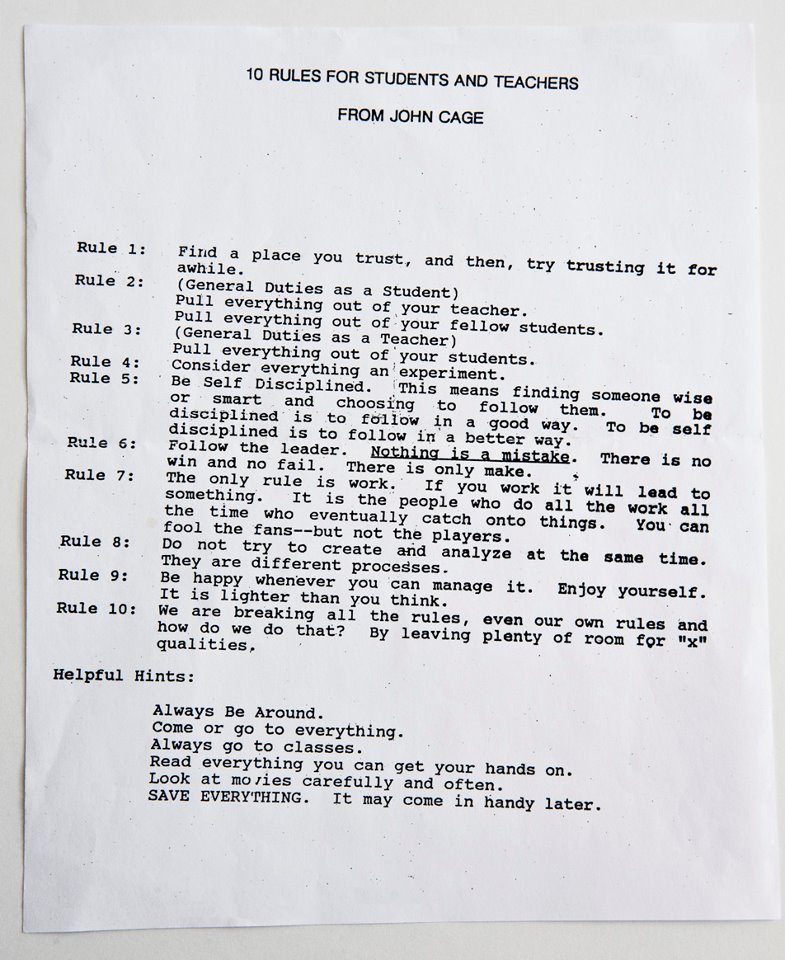
That’s for the worrypants. May send ’em, first day, to Cage’s guidelines:

cagerulesteachersstudents

It’s all just organic form in pedagogy, not so scary.

The Wolf

What I been working on. With a deadline pushing. Speaks tonight to my condition too, a bit lone a bit ferocious. So a bite from Unlikeness Is Us, fourteen carried o’er from the Old English, to come from Gaspereau fall 2017 2018!


THE WOLF

As if one had made the people an offering.
They will receive him if he comes in violence.
      Unlikeness is us.
The wolf is on an island. I am on another.
Mine is secured and surrounded by marsh.
The men on that island are glad at war—
they’ll receive him if he comes in violence.
      Unlikeness is us.
I have borne a wolf on thought’s pathways.
Then it was rainy weather and I sat crying.
When the war-swift one took me in arms,
the joy he gave me, it was that much pain.
Wolf—my Wolf—thoughts of you
sicken me. How seldom you come
makes me anxious, not my hunger.
Listen, overseer, to our miserable whelp
     wolf bears to woods.
Easy to make two what was never one;
     our song together.


THE WOLF

Lē­odum is mīnum          swylce him mon lāc° gife.
Willað hȳ hine āþecgan°          gif hē on þrēat cymeð.
      Ungelīc is ūs.°
Wulf is on īege,          ic on ōþerre.
Faest is þæt ēglond,          fenne biworpen.                                   (5)
Sindon wælrēowe          weras þǣr on ige;
willað hȳ hine āþecgan           gif hē on þrēat cymeð.
      Ungelīce is us.
Wulfes ic mīnes wīdlāstum          w­ēnum dogode°.
Þonne hit wæs rēnig weder          ond ic reotugu sæt.              (10)
Þonne mec se beaducāfa          bōgum bilegde,
wæs mē wyn tō þon,           wæs mē hwæþre ēac lāð.
Wulf, min Wulf,           wēna mē þīne
sēoce gedydon,           þīne seldcymas,
murnende mōd,           nāles metelīste.                                          (15)
Gehyrest þu, ead wacer°,           uncerne earmne hwelp
      bireð wulf tō wuda.°
Þæt mon ēaþe tōslīteð          þætte nǣfre gesomnad wæs,°
      uncer° giedd geador.


COMMENTARY

More commonly “Wulf and Eadwacer.” A woman speaks. She’s pregnant and her people are hostile to the father of the child. Not much else is settled about the poem. Wulf may be a raider from another clan; is their encounter a rape, as has often been thought? That makes her longing for him awfully hard to account for. Something more mutual then. Still though the poem is riven with her ambivalence – she wants him to come, and wants him not to come, and the doubleness in her thought sickens her.

Her ambivalence streaks the poem with ambiguities. A refrain, Ungelīc is ūs, as odd in composition and placement as Stein’s “The difference is spreading.” A female speaker whose relation to the masculine warrior ethos is intimate but aslant and has, for us, only a few interpretive helpmates in the Anglo-Saxon corpus (primarily “Her Case”). Verbs that appear nowhere else in the literature and must be defined in a context as nearly unprecedented as they are. A scribal practice of leaving names uncapitalized that makes it difficult to discern person from epithet from animal. When is wulf a wolf and when is it her Wulf? An oral tradition, not long left behind, in which the utterance “wulf” could function without trouble as both. The scribe, following his lowercase practice, could preserve this ambiguity, but a modern editor has to decide.

I take ead wacer as an epithet, not a name, which plucks out the third party usually thought to be involved – a husband cuckolded by the raider Wulf. That’s extra, a late entry throwing off a poem exquisitely balanced dramatically. Her people and her own mind are opponent enough. Other readers have doubted this third party too: one has, for instance, read the compound as an epithet for Wulf himself, “joy guardian.”

In this translation, which is literally anachronistic, ead wacer is the one who gehyreþ the spoken poem, the wacer of the written poem, the listener, the reader. Not that we’re her imprisoner exactly – but if we weren’t here, she wouldn’t be, either. She’s been hurt into a consciousness so sharp it tears the fabric that gives it voice. Tears the air or page that binds her to, as it divides her from, her first and last interlocutor, us.


NOTES

  1. lāc. Offering or gift, especially in a ritual sense. A sacrifice; in some contexts a message.
  1. āþecgan. The verb appears to mean “receive” in the sense of food, with a suggestion of killing, destruction, consumption.
  1. ungelīc is ūs. Literally, “(it) is different (with) us” or “(it) is different (between) us.” Disagreement whether the difference is between the speaker and Wulf, or between speaker-and-Wulf and the speaker’s people, or both.
  1. dogode. Possibly the past tense of an otherwise unrecorded dogian, meaning something like “to suffer” or “to follow,” maybe here in imagination (Marsden). Some amend to hogode, past tense of hogian, “to consider, to dwell upon” (Muir). My translation draws from both senses.
  1. ead wacer. Most take this as proper name, that of the speaker’s husband. Ead, “riches, prosperity, joy, property.” Wacher, “watcher.” A possessive spouse and enemy to Wulf. However, because the scribe does not use capital letters to distinguish names, the compound can also be taken as an epithet; one reader reads the compound as an epithet for Wulf himself: “joy guardian” (Marsden). I’ve translated something I hear near the core of the phrase, a sense of being thronged by eyes all round. Note that she calls on the watcher not to see but to hear. She will rip him if she can out of his crowning sense function.
  1. bireð wulf tō wuda. The verb, “bears,” may be in either the present or the future tense. Is she crying wolf here or naming her Wolf? Which is it carries, or will, her newborn whelp to the woods and to what end?
  1. Þæt mon ēaþe tōslīteð | þætte nǣfre gesomnad wæs. Literally, “The man easily tears apart what was never joined.” The line doesn’t alliterate. Muir: “[It] has the ring of a gnomic utterance, and may well be an Anglo-Saxon rendering of the biblical ‘Quod ergo Deus coniunxit, homo non separet’ [Therefore what God has joined together, let no one separate] (Matt. 19:6), which might account for its not following an accepted alliterative pattern.”
  1. uncer. First-person dual genitive – “of us two.” Ours as in yours and mine.

Image atop, a belt buckle recovered from Sutton Hoo burial site. Shining instance of orþoncbendum, inborn shaping, cunning clasping, what I am more and the more finding in these poems. Sneaky snakework of this mind.

“How will this project contribute to your artistic development? advance artistic practice?”

From, ho hum, another grant application.


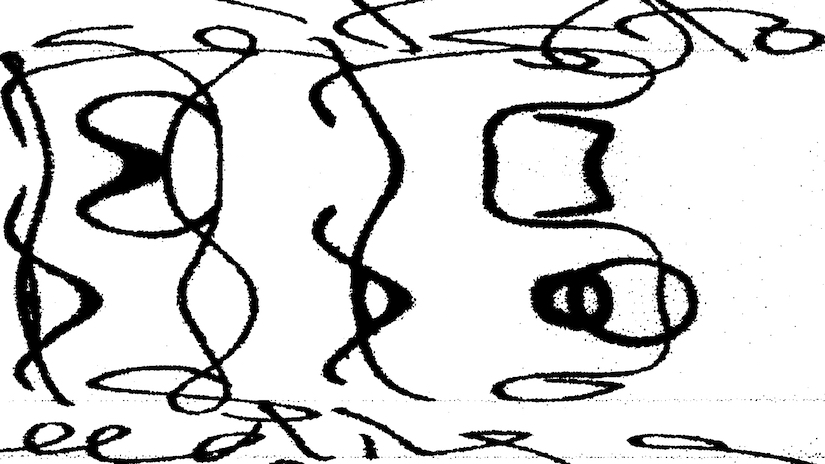
I’m certainly entering new terrain as an artist with SCRO. In earlier projects I’ve experimented with visual poetry and with handwriting, and worked on the threshold of legibility, but I’ve always been bound to the page, 8.5 x 11, and to the still image. The only sound I’ve brought to bear has been my own reading voice occasionally. In SCRO, projecting images on a surface, I work with the relation between embodiment (the movements that make the writing and the rocking that creates the distortion) and disembodiment (so many photons on a wall). Putting those images in motion, I have a whole new language in which to think and feel through time and change. Conjoining images with sounds, scriptural marks with audio tracks of household noise, I can create juxtapositions that are not narrative or expository but lyrical, syncretic, and happenstance. The relation of image to sound is a bit like the relation between the singing voice and the played instrument that was once the mainstay of lyric poetry: complementary and complicating. Except here the singing voice is visual, and maybe a bit ’pataphysical, a nonce botanic script.

SCRO is for me a lyric poem. If it advances artistic practice, it does so by testing the range of what’s possible or admissible in the lyric. It goes to the edge of illegibility, then pulls back a step, so its words get to mean by fits and starts – what, it asks, is the feeling tone of that? It takes chance operations, grown cold in the hands of some conceptual poets, and brings them to bear on emotionally hot material – family trauma, the degradations of old age. Can it be a conceptual poem even if (pace Goldsmith) it demands to be read? Can it be a lyric poem even when there’s really no “reading” it? The poem has no coherent “I” to hold it together; he dissolved early in the process of distorting the memoir. Can the 16:9 frame in which nameless shapes come and go do the work of an “I” – be attention, be sentience? If so, is that the acme of lyric experience, or its abolition? I don’t have answers to these questions, just instincts and biases, but faithful attention to SCRO might raise them in some viewers.

Broke stick

I miss my lady. Got my coffee, books piled round me, sun on me through the big window as I work, some beautiful songbird being ceaseless on the patio, it’s all good. And I miss my lady. And it’s still all good. And still I miss her.

Painting of us, hers, angel as broke stick.


On being drawn in

Attended this evening, with two dear friends, the opening of the Bellingham National 2017 exhibit at the Whatcom Museum. An excerpt from my video poem SCRO is in a show on the theme of “Drawing Practice.” The curator, Catharina Manchanda of the Seattle Art Museum, has gone past the usual sense of drawing – an implement marking a markable surface – to investigate all the senses of the verb. What’s it to be drawn on? to be drawn to? to be drawn out? to be drawn into?

There are drawings there in the usual sense. Also torn canvases, their matter physically drawn out.

Kirk Yamahira. Untitled (stretched); 2017. Acrylic, pencil, unweaved, deconstructed on canvas.

And sheets of paper drawn across abrasive surfaces. And one video I loved drawing the lens over road lines at traffic speed. Another video watched light draw on water it appeared raw crude had blotched.

What all my favourites (here’s another

Jenna Lynch. Traveling Within, Feeling Through, Dreaming Beyond; The Lines. Watercolor on paper.

) had in common was a quality of absorption. I was drawn in. There was a mind there, its evidence made it over to my mind, and drew it in closer.

My own piece was caringly placed, in a nook of its own, with – am I imagining this? – a bench to sit on and watch.

I feel a bit of an imposter in a gallery, identify as a poet not a video artist, but I guess I do because it suits me to. “Oh I just stumbled into this by accident, I don’t really know what I’m doing …”

Gimme a break. No one knows what they’re doing. It’s no excuse.

p 7 detail

Seven one-minute vids are up. Check ’em out if you’re in town. And, fourteen still to make, so let me know what you think, if you feel so moved.

Link to the exhibition, and the pieces by Yamahira and Lynch, here.

Writing Exercise: Erasure, Interference, Noise, Distraction

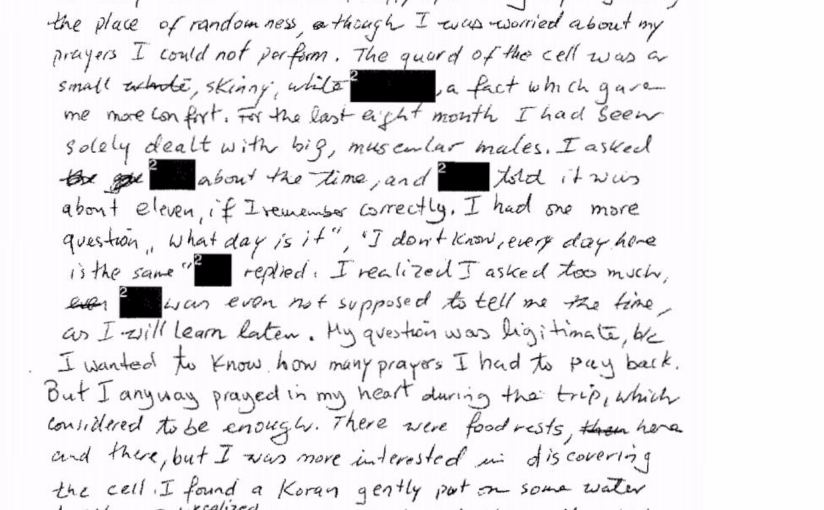
Last exercise for my advanced creative non-fiction workshop. We’ve been reading Mohamedou Ould Slahi’s Guantánamo Diary – riddled with redaction marks a government that couldn’t find him guilty of a damn thing, yet could not for 14 years see him to be innocent, saw fit to strike his voice through w/.

An ex on the eloquence of silence; on wrenching eloquence out of silencing.


First, to remind you of the assignment for your fourth and final essay, it’s

a text that incorporates erasure, interference, noise, or distraction. You can put a text of your own (it must be written for this course) under erasure like this or like this: ████. You can take another’s text and put it under erasure to elicit new meanings from it. You can do an audio essay and overlay a second track that makes your voice difficult or impossible to hear at key junctures. You can compose a hypertext that instead of offering a linear reading becomes a garden of forking paths. The possibilities are myriad. Crucial though is that your essay draw erasure, distortion, noise, or distraction into its formal body. In this way it becomes a study of how we make meaning at all.

For this exercise, make a first experiment towards that essay. No more than one page – if it’s on paper at all. I can’t imagine all the possibilities for you here. I can only say, I’m looking for language, written or spoken, that gets interfered with somehow, visually or aurally, in a way that sheds light on how we go about making meaning. (The redaction marks in Slahi’s book, included the way they are, do that, yes? How does Slahi insist on what he means, his humanity, when he’s shut up – imprisoned, silenced? He cracks jokes. He answers absurdity with absurdity. He writes, and gets his writing out there, replete with the redaction bars that speak his silencing.)

Learn too from examples posted – Johnson, Phillips, Bervin, Foer, Strickland, Wave Books. Ask yourself too, what’s missing from these examples that I wish were here? What could you add to this assemblage of interferences?

You could go entirely paperly, erase and/or illuminate a text, your own or another’s. If you erase someone else’s text, be sure to credit the source, and sure your work upon it’s transformative. You need not confine yourself to negation; consider illumination, á là Phillips; hands-on cutting or tearing, á là Foer; other ways of turning gap and omission into a sort of presence.

You need not pin yourself to paper either. I’m open to audio essays, hypertext essays, multimedia enterprises. Interference, noise, distraction can take the form – as we said today – of static, crowd noise, a robotic voice intoning “redacted,” many many things. (The MTA’s “mind the gap” comes to mind.) Our roundtables next week will be a chance to think through options.

I’d like to take these in Thursday, but if you are working off the page, and would like till next Tuesday to make that happen, I can give you till then.


I’m curious what they’ll come up with. It’s been a curious class, invented one week, enacted the next. Improvisatory. Creating a world one step ahead of what you see. I don’t mean I am, we are.