Student blog: Postmod

My Art of Compost students are hard at work on their blogs and I mean to post links to them as they come to life. Here’s a first. A lively deft insightful blog on postmodern art and culture, with an emphasis on pop art, and theory consonant with same. Andy Warhol, Jean Baudrillard, french yé-yé pop, The Cure. I hope Benjamin and Barthes to come. Scared yet? Good. But for real, it’s an excellent resource, Michelle’s really done, doing, her homework, and giving it away to all.

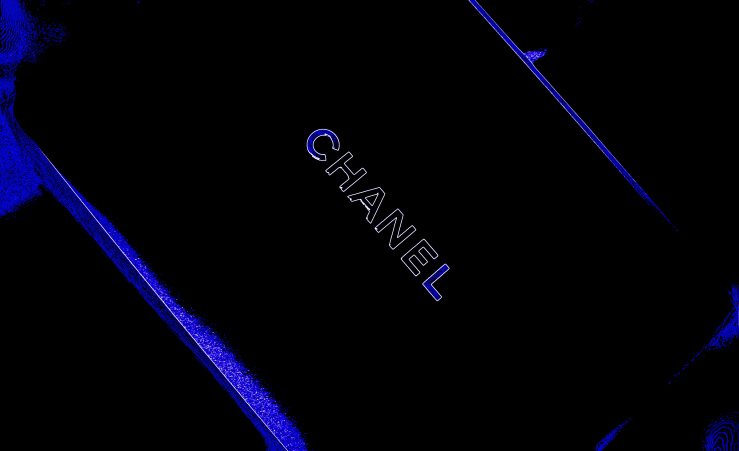
Most excitingly, to me, she’s bringing her own creative work into the mix. She’s a wonderful photographer, and the more she manipulates the images, the more she “problematizes” their “authenticity,” the more they belong.

chanel

Here’s one I stole from there to draw you on. Meant all four scare quotes yes.

To translate the translator

Third and last of the aleatory proposals is mine. Strikes me as dullest of the three. Buzz goes, buzz buzz. And with that ringing encomium – read on.


I’ll present on Overject, an exercise in total translation – trans­lation that holds every verbal and visual trace that can be caught of how a poem refracts as it passes through its translator. The project performs various manipulations on its source text, a minor mediocre didactic Old English poem, to investigate the role of the translator’s impurities and opacities in the activity of translation. While the project may not appear classically aleatory, it turns out to encounter and depend on accident at every turn.

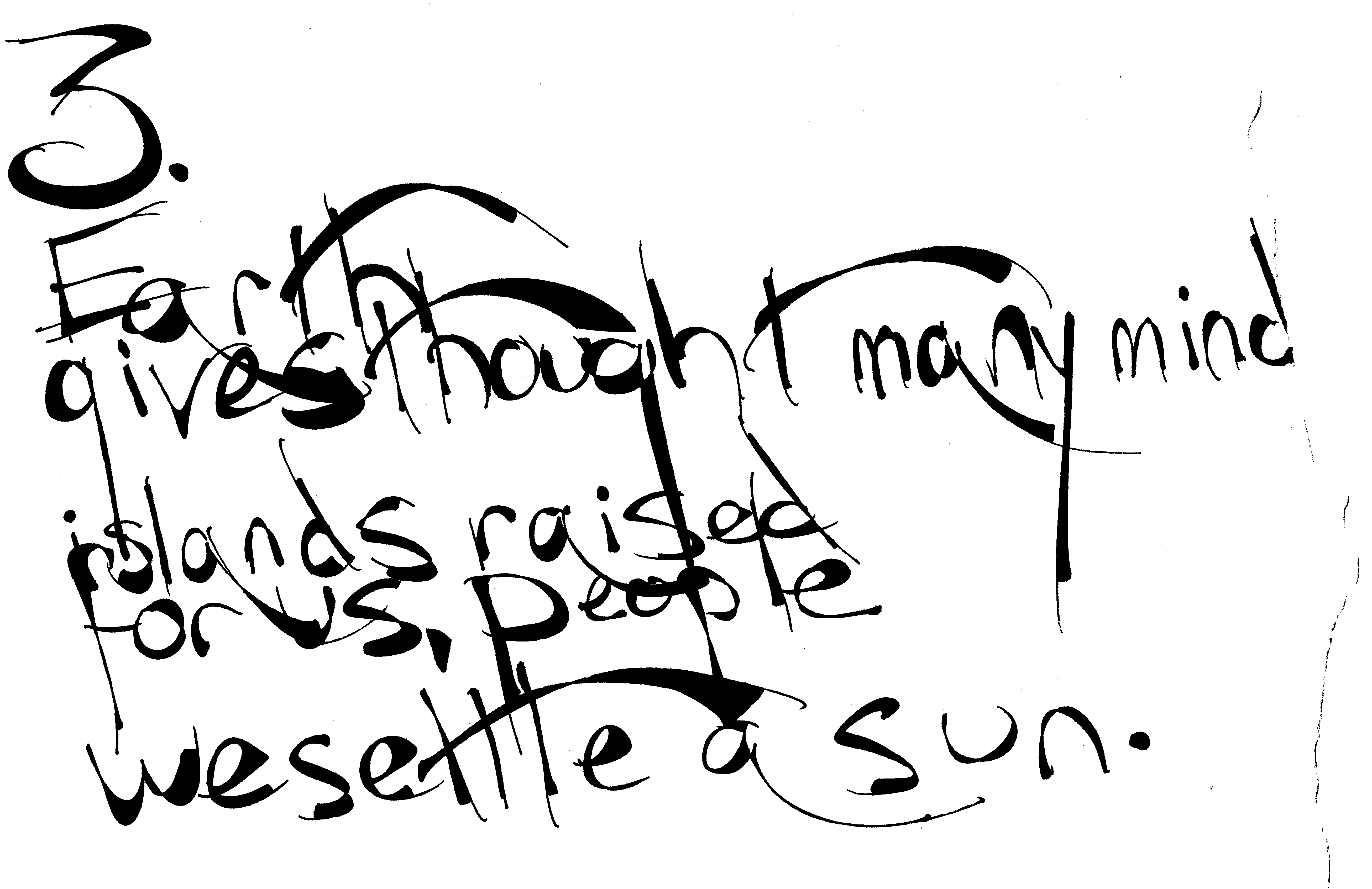
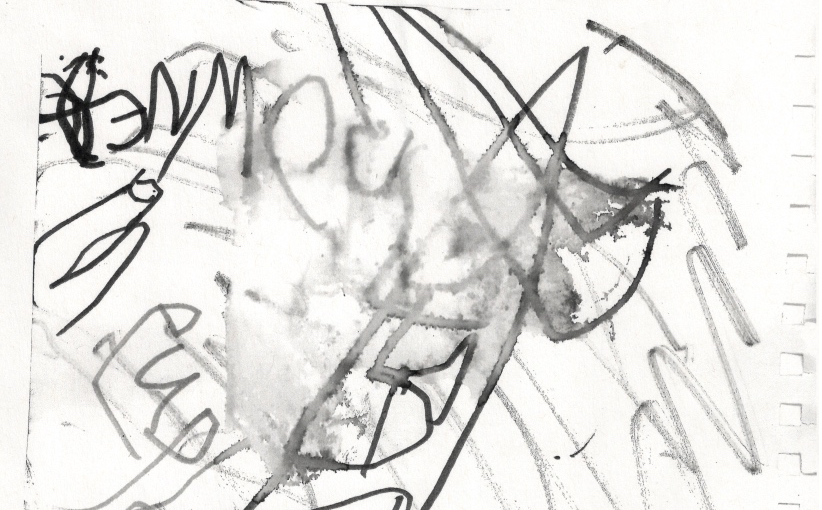
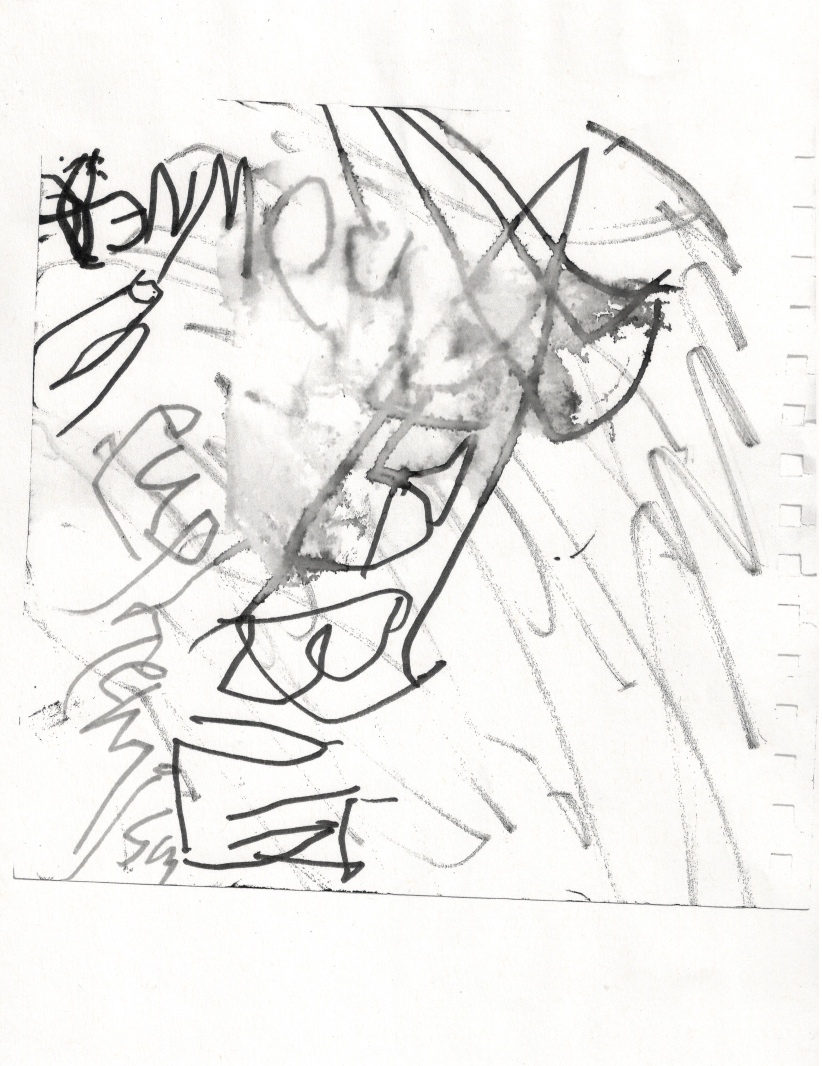
SI 3 (89R) - text - newMost of the poems are hand-written, and contingency hangs on the inscription of each character. I set each one down fast, too fast for thought, and a second time just as fast. Then meticulously I ink in the spaces left open between the two passes. The gangly pseudo-graffiti that results is a gestural translation of the scribe’s stately calligraphy. The practice may not be aleatory, strictly speaking, for no random element from outside the poet has been introduced. But although the forms are laid down by my own hand, I experience them to appear from outside my will intention and control. I decide the process, as the aleatory poet decides to roll the dice, then submit to the results. And I take from the practice all the joy and constraint, freedom and burden, the aleatory is famed to offer.

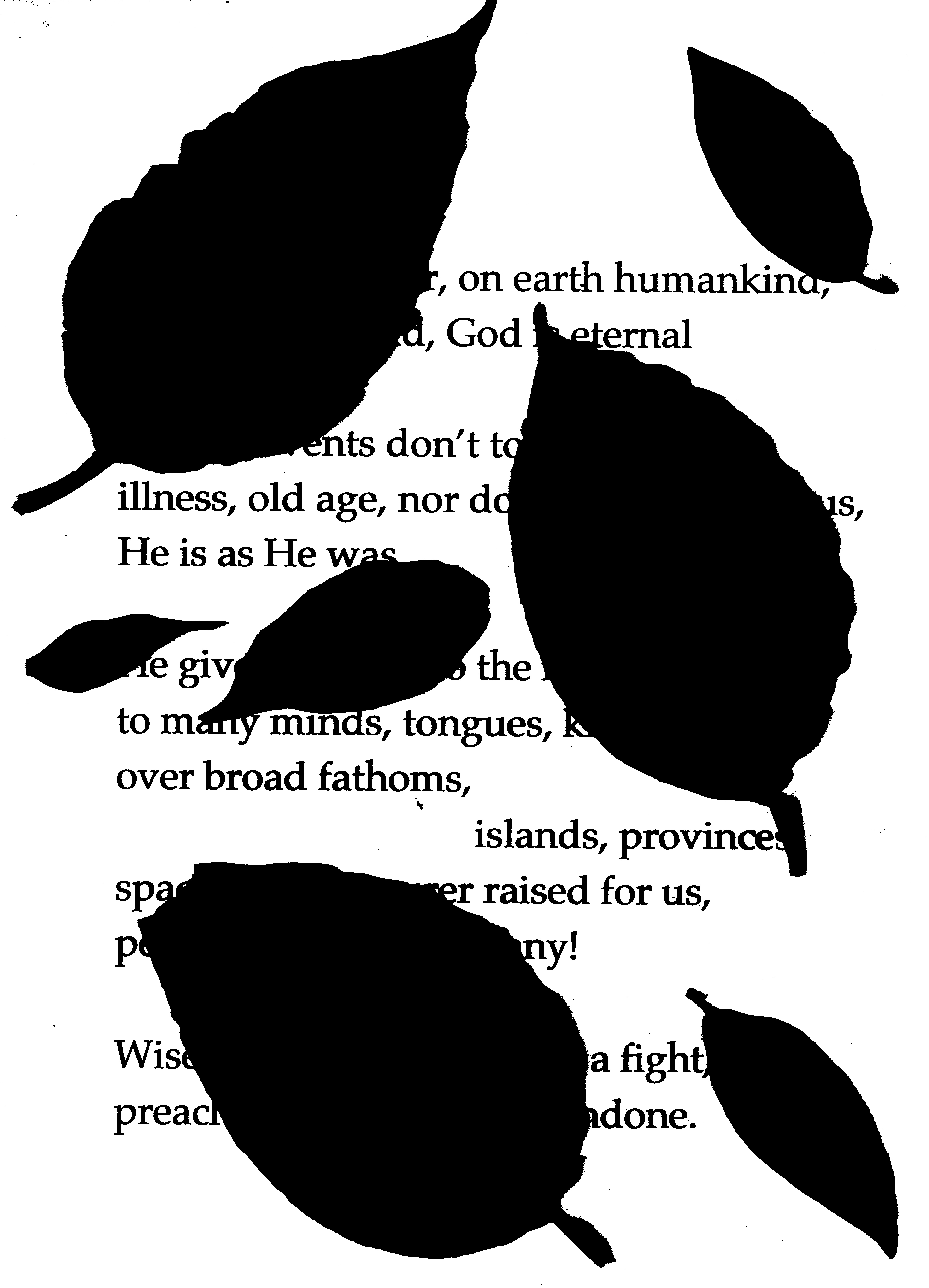
FT 3 (89V)My work with my materials – leaves paper cellophane – also has aleatory respects. Leaves first entered the poem by accident at the corner of my eye, a dogwood in the wind out my window. I picked some and dropped them on a page and that became a thing. Their placement as masks over semantic translations is a mix of chance and design: they fall as they will, then I get to nudge them around, but a little. Meanwhile, most images, after they’re drawn and before I scan them, are put at risk, torn on all sides. What course the tear takes is not altogether up to me. Nor can I say which parts of the tear line will appear, and which will stay invisible, when I take the scrap to my scanner. Lines of scanner noise that become hills and clouds, the very lay of the land.

Questions I expect to address or at least brush on: How do aleatory practices intersect with proprioceptive elements (the embodied gesture) and objectivist concerns (the thing­liness of the poem)? Burroughs said that all writing is cutups – is there a meaningful sense in which all writing is aleatory? Does a practice count as aleatory when the random factor comes from the poet herself or himself? What sympathies exist between the drive to the aleatory and longings among our poets for the organic, the spontaneous, the irrational, the impersonal?


Yeah whatevs. To come soon, student blogs. Some are striding into readiness, a few yes are trudging, a couple have fleeted there. Links to those last, anon.

Confessions of a random researcher

Another guest post on the place of chance in poetic practice, this by Stephanie Bolster, another longtime coconspirator. And need I even say dear friend.


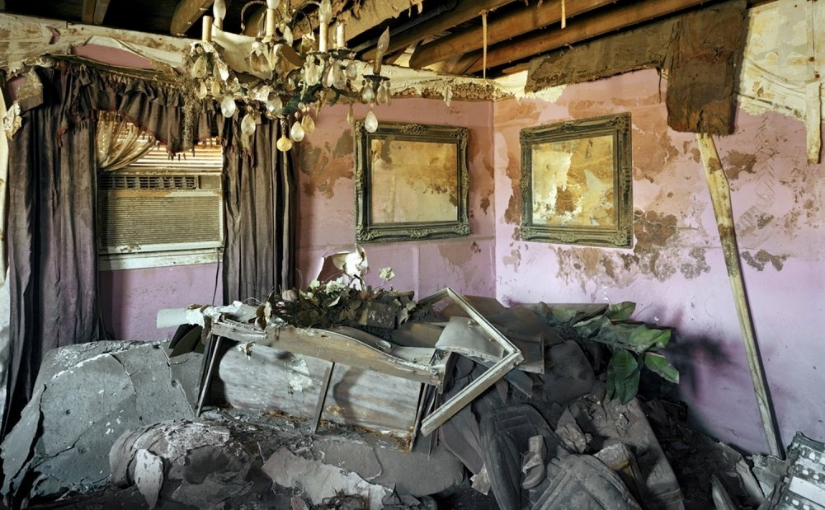
Being a guilt-prone perfectionist (she writes) may make for a strong work ethic, but it rarely makes for strong poetry. It’s when I give up – stare out the window, leaf through a book, check e-mail, scroll through Facebook for five minutes before starting my writing commitment – that I find the living stuff. Someone mentions a poem by George Oppen which, when Googled and read, opens up a universe and suddenly I’m writing and remembering a lake I can’t remember if I swam in with a friend to whom I haven’t spoken in years, but who will call my parents just days after I’ve written her into the poem. Or, more prosaically, a truck rattles past, laden with construction equipment destined for the new development at the end of the street, where a forest was, and the rebuilding of New Orleans post-Katrina, about which I’ve been writing for the past few years, is a little more tangible. Coincidence is my gold star.

Disappointment, too. Knowing a little kindles the imagination more than knowing a lot. What scholars didn’t find when seeking evidence that the site of Vermeer’s “The Little Street” actually existed gave me a found poem. Although I’ve described my research methodology convincingly enough to get a research-creation grant for a trip through old zoos in Western Europe, what I found was rarely what I said I sought. W.G. Sebald’s Austerlitz led me to the Nocturama in the Antwerp Zoo, but wasn’t the fact that it was closed for renovations more Sebaldian than a glimpse of some eyes in darkness? In Jersey, they were an aye-aye’s eyes that met mine in the five panicked minutes when I thought I’d been locked into that nocturnal hut for the night. That zoo I went to because the writer Gerald Durrell built it humanely exists in a poem as that moment only.

When the Wikipedia article on the Chernobyl disaster’s remark – “This page may be too long to read and navigate comfortably. Please consider splitting content into sub-articles and/or condensing it.” – becomes advice for the poem about Chernobyl and Katrina and Robert Polidori’s photographs of both places I might not be writing about had an exhibition of his work not happened when and where it did, I’m on the right track.


Aside, Steph mentioned, in an email this morning, she’d got a Google alert of this Polidori photograph up for auction. And remarked, though she’s not going to bid, how “the language used to describe the painting is problematic in ways I want to write about.” Dude, check that language out. Graced. Captured. Romanticizing (unironically). Hell, in that writeup, dwell is problematic. Artworld assholes. Not, Steph, to pluck your thunder.


I’ll discuss (Steph again), with readings from recent work, how following the contingencies of live and virtual research has formed my poems. What happens when a poem’s image of a bare field and going-nowhere driveway in New Orleans – seen onscreen a year or two earlier after Googling the address of one of Polidori’s ruined rooms – gets displaced on Google Street View by a street of fresh houses? The poem as process takes on a new life, its own, not mine. Is following accident, distraction, disappointment, always the poem’s true course?


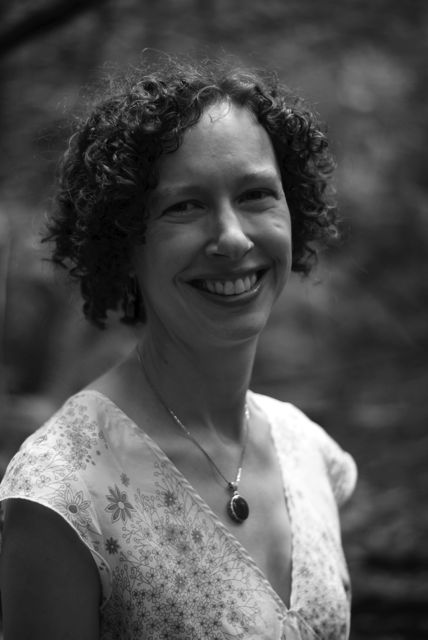
Stephanie Bolster is the author of four books of poetry, the first of which, White Stone: The Alice Poems, won the Governor General’s and the Gerald Lampert Awards in 1998. Her latest book, A Page from the Wonders of Life on Earth, was a finalist for the Pat Lowther Award. Editor of The Best Canadian Poetry in English 2008 and co-editor of Penned: Zoo Poems, she was born in Vancouver and teaches creative writing at Concordia University in Montréal, where she also coordinates the writing program.

Divination: Every poem a hundred small contingencies

A few days hunkered at home. Having been scissed and stitched inside am recuperant. But’ve had it in me to assemble a panel on chance operations in contemporary poetic practice. Here’s a propose and very fine, as guest post, from Barbara Nickel. (I’ll pepper in some links rhizome-style.) (Why when I say that do I think of Psy.)


I’ll present on projects from Consider the Ear, my poetry manuscript-in-progress being written in the village of Yarrow, British Columbia. My presentation will consist of a collage of mini-talks and readings, each led off with a guiding central image. I’ve listed below a series of points and paths that will circle or lead to or away from each image. I’ll select – possibly randomly (e.g., strips of paper from an envelope) – these points for each image and expand upon them at lengths to be determined by the presentation’s time limit.


Yarrow

The story of my choosing to live in Yarrow by meeting Lois in her garden.

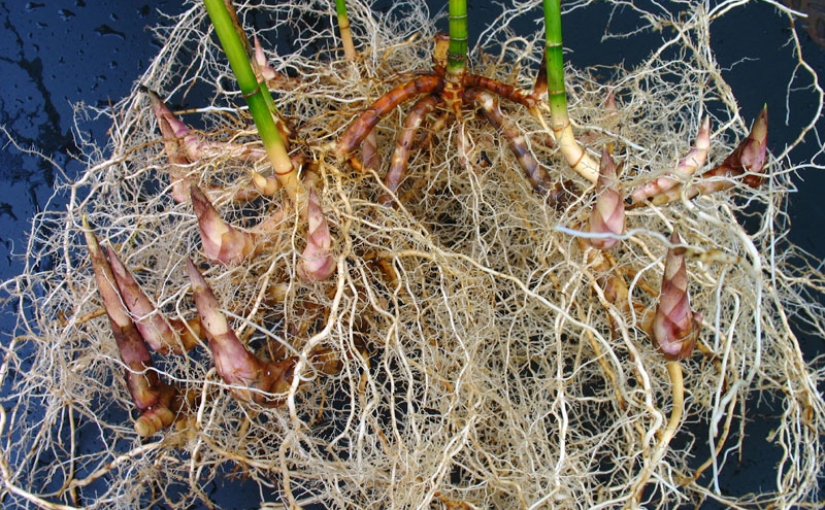
Yarrow, Achillea millefolium, its stalks used for centuries in I Ching divination practices (involving numbers of changing or unchanging lines), its profuse growth along the dyke by my house and Lois’s in a village named after it.

Dykes, places of growth for yarrow, built by my Mennonite ancestors in the Vistula Delta and coincidentally also in Yarrow.


Torn page

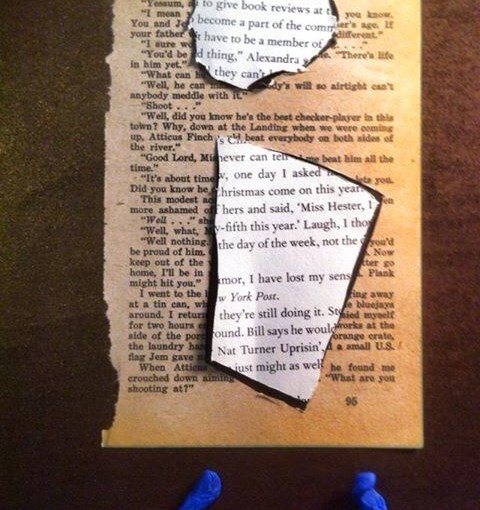
Old books on Mennonite theology written by Mennonite men are taken from a pastor’s library after his death to a thrift shop where Lois is employed.

A random meeting of the three poets of this panel in a graduate poetry workshop at UBC in 1992, how one of them years later begins a blog, “The Art of Compost,” in which he describes a poetry exercise called “Torn Page.”

My “Torn Page (‘(old men)no books’)” project as “divinations twice over” (Patton), written in a room of Lois’s house.


Witch hazel

A witch hazel treeHamamelis, planted by the former owners, growing right outside my home in Yarrow, blooming every January.

Witch hazel twigs commonly used as divining rods (for ground water, buried metal, gemstones, oil, gravesites), the conflict in naming between the Latin Virgula Divina (divine rod) and the German Glück rüt (luck rod).

[Can I just say? About that last link? Bad form, to speak to a link? I just got me some fat insight as to where my students’ bad writing comes from. Portentous dialogue & crappy plotting.] [That was CP not Barb.]

Heaney’s description of water diviner as “figure who represents pure technique” in poetry in his essay “Feeling into Words” (Finders Keepers), mentioned in an e-mail by Stephanie, another of this panel’s three poets, also met at UBC in 1992.


A death in January

The story of “Witch Hazel” sonnet, where its path intersects above paths.


Abandoned house

A random decision on a road trip to take an old, forgotten highway instead of the usual route.

A random glance back at an abandoned house not seen previously anywhere or time.

The curious story of a sonnet, “Saskatoon to Coaldale, July, Highway,” written in Lois’s house.


Ear

The ear (in rhyme and metre and “verbal texture” (Heaney)) as divining rod in the projects chosen for discussion.


Questions that grow from the mini-talks, to be explored in the presentation:

What tension grows from the roots of “divining rod” – in Latin, “divine,” in German “luck”?

In other words, in each of the poems and the paths and intersections of paths leading up to them, what is the balance of miracle and luck, divination and design?


Next to come [CP here again] the random differently undertaken by Stephanie Bolster.
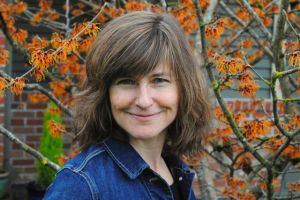

BarbNickel3Barbara Nickel is the author of two books of poetry, The Gladys Elegies and Domain, and the recently published A Boy Asked the Wind, illustrated by Gillian Newland. She has received numerous awards, including the Pat Lowther Award, and her poems have appeared in such publications as The Walrus and Poetry Ireland Review. Visit her website at barbaranickel.ca. Also check out that witch hazel.

Poetics of the Rhizome

Been a while. Here, a post that takes composting (repurposing) (ok cutting and pasting) to heart – coarse description for my winter poetry workshop. And, cuz the Puritan in me says LAZY BOY for plopping this down, I’ll put in some links, rhizome-style, to what I hope’ll be pleasing surprising ties.

By the way? Rhizome, from Deleuze and Guattari’s “Introduction: Rhizome” from A Thousand Plateaus, which, as I said today to my colleague Oliver, I’d never make an undergrad actually read, though in fact it’s durn pretty cool.

By the way also? Rhizome’s a complicated way of saying Indra’s Net.


English 453: Creative Writing Seminar: Poetry: “Poetics of the Rhizome”

A plant that grows by rhizomes spreads laterally underground, sprouting new plants where chance prompts it or opportunity allows. A rhizomatic plant lets go of where it came from. It extends indefinitely. Sprawls and breaks the rules. Makes its own rules and it don’t look back. Diverse and plural, not a voice but voices, it connects and connects some more. Think aspen, orchid, ginger, bamboo. Think poison oak, horsetails, bunch grass. We’re past good and evil here, beautiful and ugly, the rhizome’s where shit gets real.

In this class, we’ll meet the poem, poetry, as rhizome – a conversation without edges – messy sprawling webs of language that circle the globe, link human prehistory to the present moment, and embed human speech and action in a more-than-human world. Our focus will be student work, but we’ll touch in with ways of thinking-about-poetry, feeling-through-poetry, sympathetic with rhizomatic mind. The post-colonial turn from Anglophone canons to literatures of cultures at the muzzle end of empire. The work of ethnopoetics, fruitful but troubling, to recover pre-techno­logical ways of being and seeing. And the work of ecopoetics to divine, through the dowsing wand of poetry, a human place in the green and toothy world.


Full disclosure, with whine. Do I have time to check out all the links mischief has me propose? Are you kidding? With my working life? You know I make about minimum wage, right, when minimum wage is actually a living wage, as it is in, say, SeaTac? And here I am at 9:50pm eating Coop lasagna from the microwave and drinking a cheap but really not bad Grenache and spending entirely too long on a blog post … well, point is, I’ve given the links a quick scan, they seem fun, but be your own judges. Century of Scatter.


The intent here’s intimately practical. How to widen our notion of the possible in poetry? So count on lots of provocative reading, frequent writing exercises, and thoughtful responses to your work and that of your peers. Too, be ready for conceptions of the poem you hadn’t thought before: poem as prayer, incantation, manifesto, compost pile, neural net. Grades will be based on assigned exercises, writing journal, final portfolio, active and generous participation. Poetry by W.C. Williams, Robert Creeley, John Taggart, Ghandl of the Qayahl Llaanas, Will Alexander, Adonis, Jean Valentine, Coral Bracho. Poetics essays by Williams, Charles Olson, Denise Levertov, John Cage, Charles Bernstein, Lyn Hejinian, Adonis, Adrienne Rich.


More of the promised links to come, friends, but I gotta call it a night. Rhizome mind is hard work. As all ferns and their fronds know.

teaching portfolio

that scamp’s still in the know

Some fine high play here with mockingbirds and finches. A reminder that for all that’s at stake morally and spiritually and politically in Lee’s so powerful novel and its latterly published and from all reports really pretty indifferent draft, her characters are ink on paper stirring forms in mind, there is no Atticus about whom to uncover shocking truths. Well that’s what I mean I don’t know if it’s what Theresa means. But her compositions here are provoking and provoked so check them out.

Roseburg OR

So when you become a Buddhist you take some precepts, and one of them’s don’t be angry. That’s a precept, not a rule or a prohibition, in other words a live edge no one can tell you what means, at a given moment, or whether you’re being true to or not, but you.

One of the things I find me wondering tonight is, when does keeping the precept mean, yeah, be stinking mad. I went to my President wanting righteous anger (lead, man, lead) and did get some –

He’s a good man. And doing better now he’s unelectable. But I want flames out his eyes. I want Old Testament prophet apocalypse. I want leave no prisoners in righteous fury. What kind of insanely deformed social contract could imagine, let alone allow, let alone allow so often we’ve grown used to it, battlefield weaponry in the hands of a gravely mentally ill young man?

I teach. What if it happened here, on my campus, what if he’s in the hallway outside my classroom? Would I fold up, or would I have the cool command I want to think I would? (I faced down a grizzly once, how about a gunman?) I’ve never touched a gun. But in my imagination of this moment, my whole body and mind is a gun, and one purpose, cease the threat to my kids.

I’d kill to save my children if I had children. I think I would.

My whole body and mind a gun. I’m not a peaceful man. That’s why I need the precept. Too, we’re all animals, we’ve all got some fight in us, and that’s as it should be, isn’t it? There should be room for flames to come out our eyes.

Also there should be no such thing as guns.

But, since there are, there should be real gun laws, don’t you think?

Write to someone in that sort of power. See if we might make it so.

Selections from One-Star Amazon Reviews of Cormac McCarthy’s Blood Meridian

This post has given me a new idea for a compost writing exercise …

Biblioklept's avatarBiblioklept

[Editorial note: The following citations come from one-star Amazon reviews Cormac McCarthy’s novel Blood MeridianI’ve preserved the reviewers’ original punctuation and spelling. More one-star Amazon reviews.].


It may be art.

Damn McCarthy.

I find him boring.

unrelenting nihilism

The story is thin at best.

Are we supposed to enjoy it?

I felt abused by Blood Meridian

not a traditionally enjoyable book

this book is simply just not “all that”

wordy, over the top speechy dialogue

endless streams of dependent clauses

I am a devout fan of Cormac McCarthy.

The characters are not really sympathetic

He is obviously a sick man psychologically.

all about violence and no plot what so ever.

if I was a trained geologist I might like it better.

too many words that are not in standard dictionary

I guess people think he is cool because he writes so violent.

This one guy peed on…

View original post 676 more words

Marlise’s portfolio

Friends. (Oppen said something like, the poem that ends as it should, “ok,” the poem of the world. Tonight for me, it’s the post that begins as it should, “friends.”) I’ve meant to share with you a portfolio by one of my vis po students from this spring. She rides a badass wheelchair and her work is images of and round and beyond her condition, Friedreich’s Ataxia, a truly shitty degenerative neuro-muscular disorder.

I don’t mean to be sentimental here. That’s cheap to those who live with a disability. From here it seems, there are some who live with such visible cruelties, I’m using Marlise’s so apt word here, and others who bear cruelties invisible to all until they flame out horrible, and some who have the bad luck to be lucky till they’re not, and then they know not what the fuck to do.

Even all that considered though. This young woman has moved me no small measure with her guts and her mischievous gleam. So, here are, with her permission and a bit of anonymizing, some words and images of hers.


“One of my passions, my goals, and perhaps my purposes, is to help arts by and/or about the physically-disabled population to gain at least culturally standard recognition. This course has made me see visual poetry as a wonderful and effective forum to achieve this.

Portfolio-3“In creating my pieces, I was most inspired by our course text Nox, by Anne Carson. She delivers poignant messages about grief through photocopies of memorabilia about or featuring her late brother, while still leaving the concepts of familial love and loss open-ended and undefined.

Portfolio-5“Being physically disabled myself, I often think of myself and my as audience members, just insignificant observers of my disease’s progression, effects, and affects. This ‘outsider’ perspective is what I interpret as Carson’s purpose and message behind Nox, and it’s what I have striven to elicit for disability in this project.
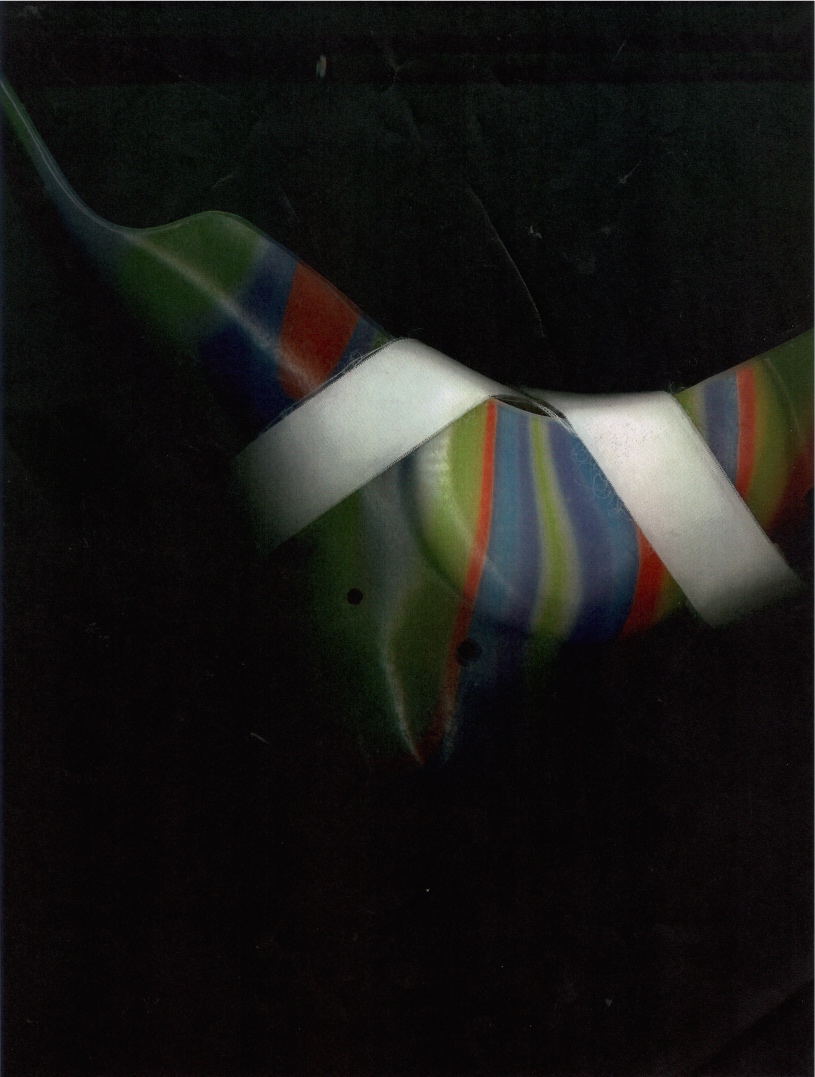
Portfolio-2“I’ve explored the photocopy technique, implementing forms of handwritten pieces and material objects. Attempting to play with my method of choice in new ways, I photocopied in the ‘negative’ setting a couple of times to convey the stark labels put in visibly-disabled people, Another way I twisted the work via the photocopier was selection of reflective objects to photocopy.

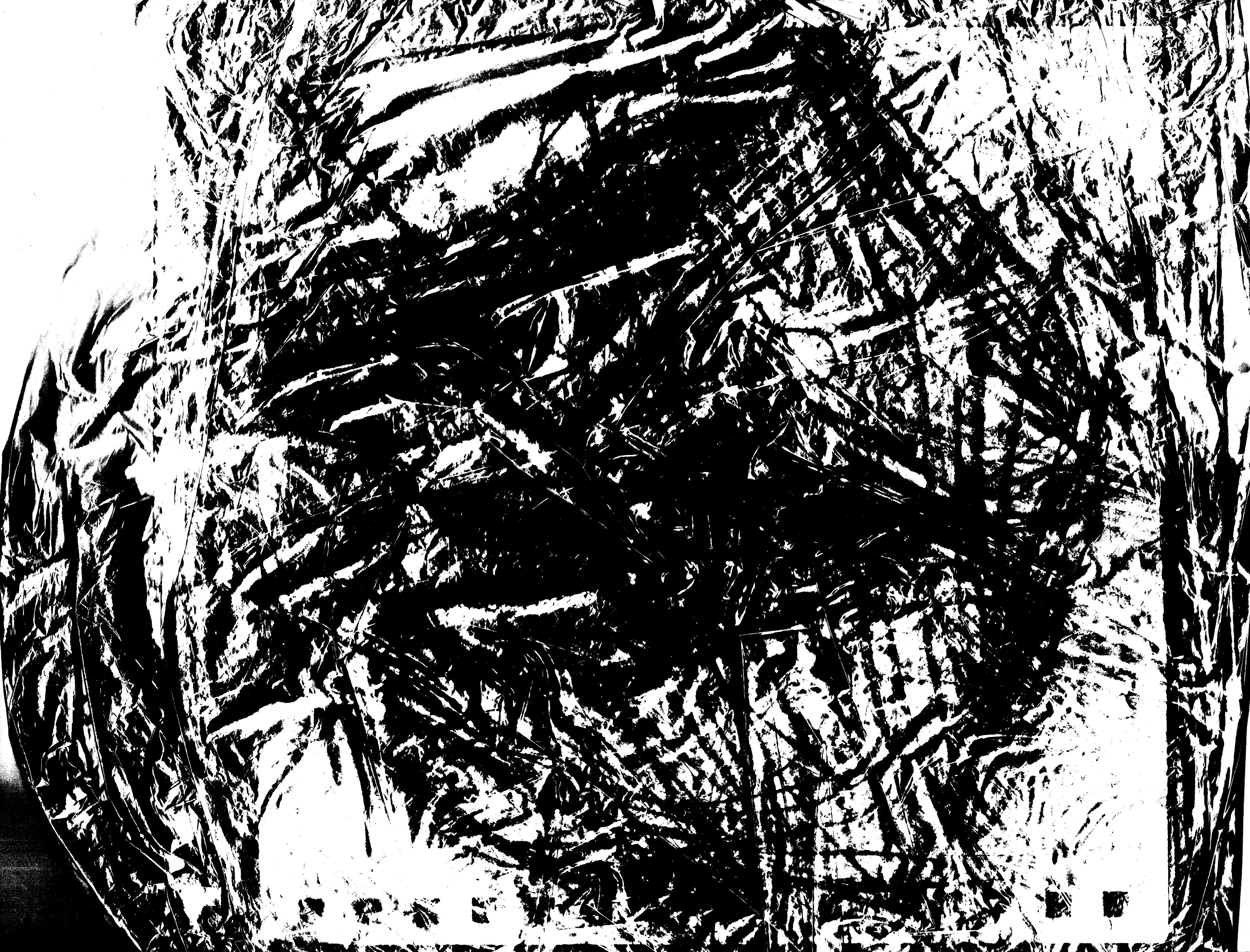
“The first artifact displays the title of my disorder, Friedreich’s Ataxia (FA), through a bag that has one transparent side and one opaque, turquoise side. I chose this to hold the piece because I knew the photocopier because I knew the photocopier would reflect off the bag, and the resulting glare I wanted to evoke the unapologetic cruelty of my handicap.

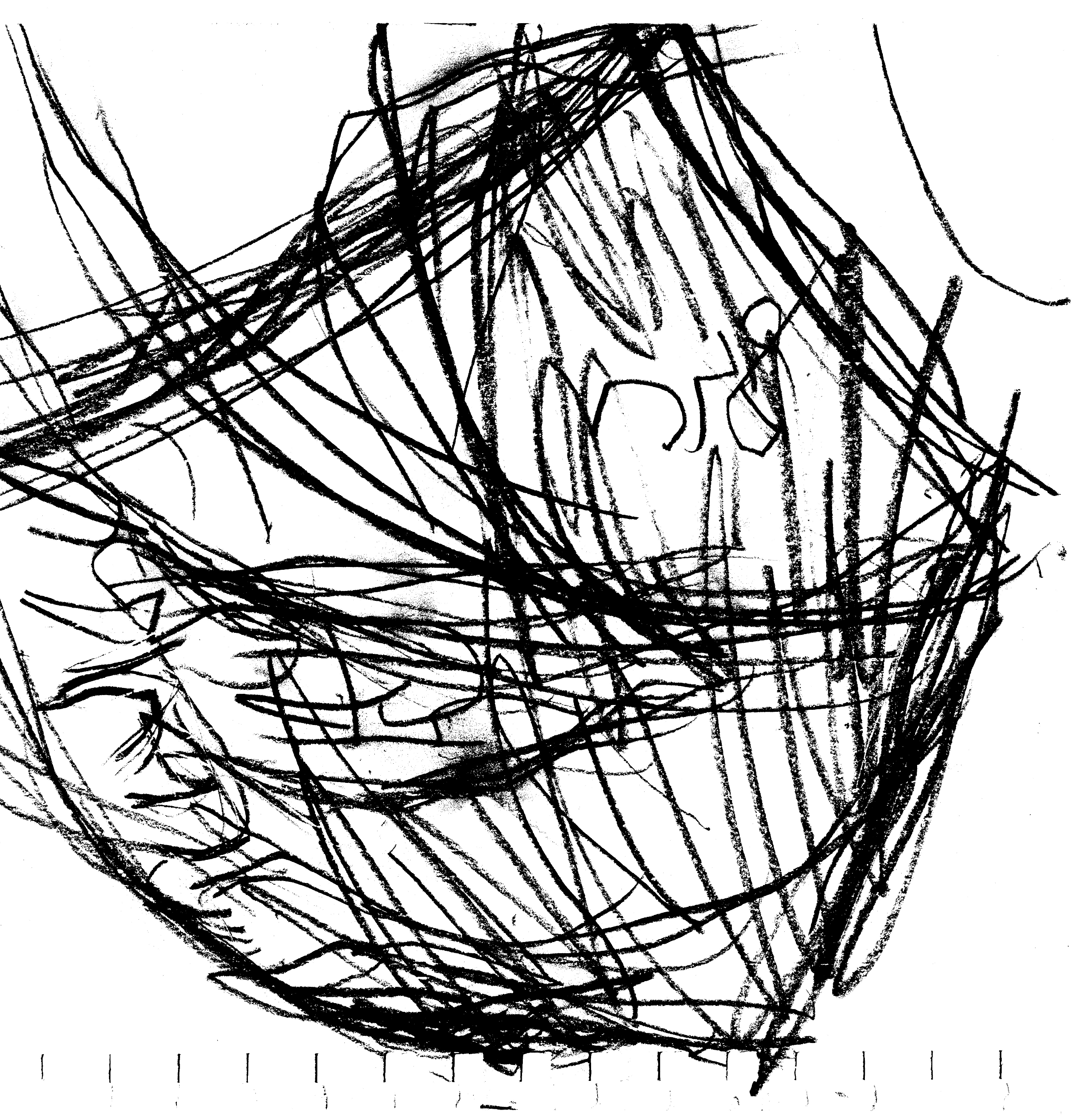
Portfolio-1“Also, I thought the bright turquoise backing worked as representation of the crippling sadness or unashamed joy underlying nearly every part of disabled life. The writing is done in charcoal, and then smudged, translated to be the destruction of effort. Where I placed the artifact in the photocopier cut off the top fails-at-drawing-a-straight-line of th F, leaving a single, straggling line reminiscent of lives cut short by means of physical disability, including mine. Finally, I inserted the page into its sleeve upside-down to distance and simultaneously inconvenience the viewer, like disability effects everyone involved in the victim’s life.

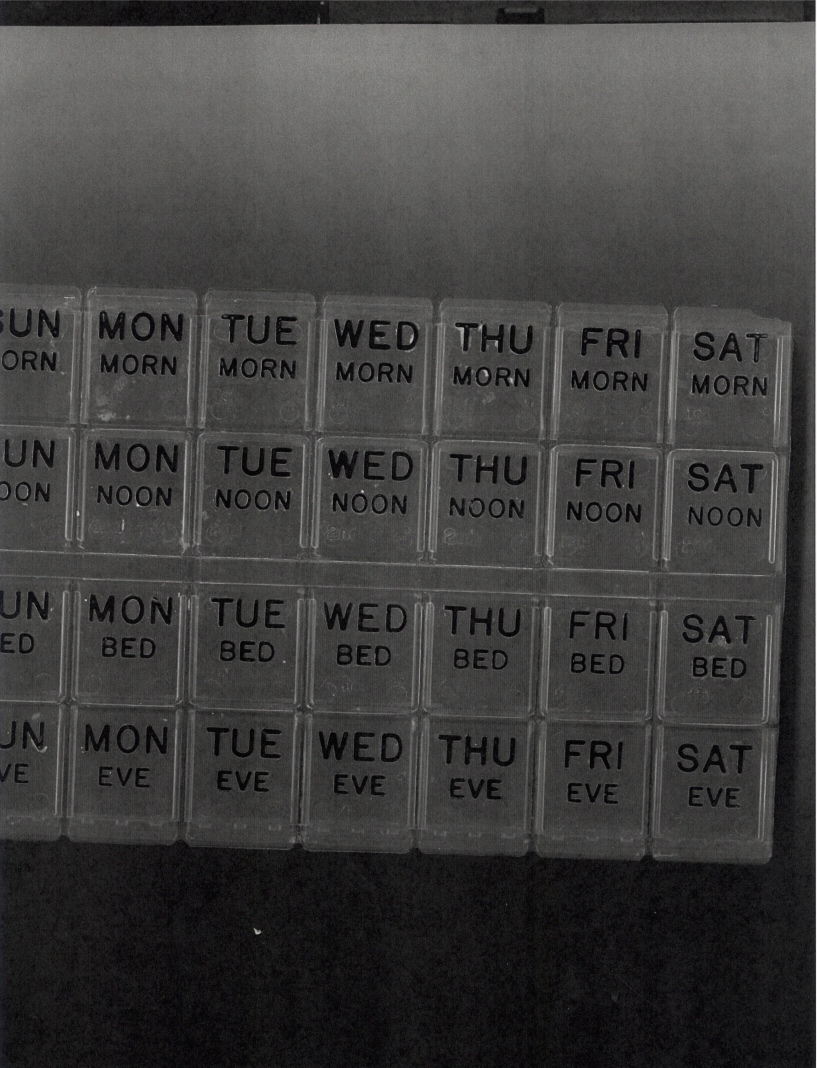
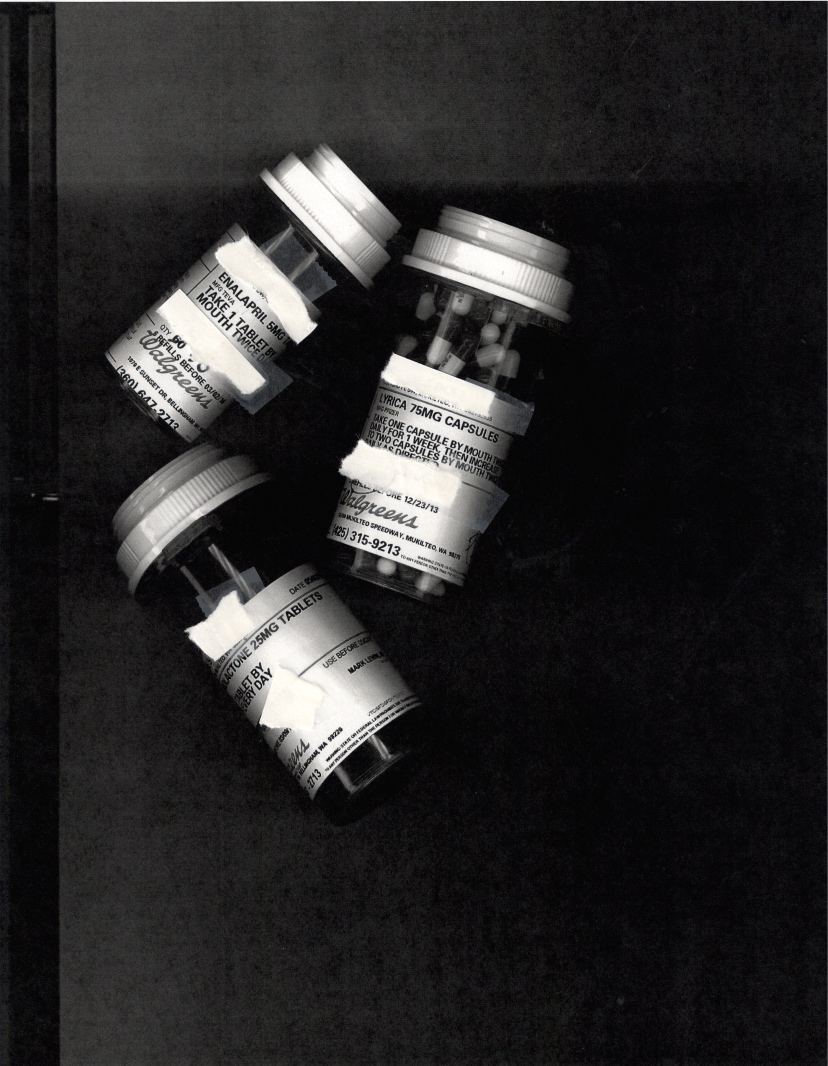
Portfolio-4“As a visual element, I will steer the viewer’s attention to the cover art. There I have my prescription-medication bottles, showcasing the nameplate-labels. Not only do I associate paid-for treatment with disability, but I see this photocopy of personal and yet widely recognizable objects as the prime subject to introduce this portfolio, too. It compartmentalizes disability, and also starts the project’s accessible journey of disabled interpretation.”

Portfolio-0


POSTSCRIPT. The cellophane technique I’ve been playing with BTW is thanks to Marlise, who on a handwritten poem assignment took my encouragement to view her handwriting as differently beautiful and handed this in –

Handwriting 3a

– but because the charcoal was bleary handed it in, considerately, in a plastic bag, which gave me an idea, so when I scanned it I scanned it in said plastic, with all those unanticipable opacities –

Handwriting 3b

Whoever says teaching creative writing sucks from their creative work needs to check what they’re teaching.

Everywhere Is Aleatory: Chance Operations Where You Ain’t Expecting

A proposal on aleatory poetics to go soon to a conference. Developed in collaboration with poets Stephanie Bolster and Barbara Nickel.


Dice. A coin toss. Yarrow sticks and the I Ching. Newspaper cuttings in a brown paper bag. N+7. Google Translate. There are countless ways to get chance or near-chance into the poem. Many are provocative – seem, indeed, meant to provoke. Tristan Tzara, for instance, must have provoked his first readers, as he still does undergrads the world round, when he assures you that, having cut words from a newspaper article, tossed them in a paper bag, drawn them out blind, and glued them down in the order drawn, you’ll have proven yourself “an infinitely original author of charming sensibility, … though unappreciated by the vulgar herd.” Shock, mischief, irony – maybe a little elitism, even once the irony’s accounted for. But this much seems clear: the aleatory strain in avant-garde poetry shares in the sensationalism of its century.

Without casting any aspersion on these forms of the aleatory – what is complacency for if not to be nettled – our panel will consider the aleatory in some quieter forms. Three poets will discuss projects underway in which accident is drawn into the inception, creation, or operation of the poem far enough for it to be pervasively marked by chance, though the text that results may not look aleatory in the usual ways.

Aleatory practice opens a route around the tyrant ego – a tap into the unconscious, the world spirit, the Duende, wherever you want to say poems come from – and in these projects, such practice is compounded with other methods of bypassing intention or self-expression. So we’ll investigate edges where the aleatory meets the documentary, the prosodic, the projective. Research practices where fact-checking with Google Street View yields news that transforms a poem, or a night at the theatre offers a missing link in a project that had started to close down its parameters. Divination practices in which one glance back at an abandoned house uncovers a sonnet’s path or the holy pages of ancestors are torn into new and pleasing jumbles. Visual poems where the fall of a leaf or how a torn page expresses as photocopy noise can’t be predicted or where the speed of a gesture produces spatial forms the poet feels as accidental.

When contingency is spoken of in documentary, prosodic, or projective practices, it’s usually treated as adventitious, and soon naturalized to the old story of the solitary poet expressing a coherent inmost self. Our notion is that such practices are, or at least can be, quietly more chaosy than that. The aleatory has a gift to give, a way round the demanding demeaning ego, and this panel asks whether the gift functions only in the noise and lights of a blowout surprise party, or whether it may be as quiet as a friend saying to another, Hey, I thought maybe you’d like this. Contingency in the poem as friendship not showdown.