Cometh full circle, worm eateth tail, and blog begot of course begets a project for that course’s progeny.
My composters are set to be bloggers. Here’s their guidance.
In our third week, you’ll create a blog, and for the rest of our time together, you’ll nourish it with regular posts.
As a blog is an organic thing, growing in response to its environment, so too is this assignment. So while I’m laying out the general expectations here, some particulars are yet to come. For instance, I might a week from now, as I see how your blogs are developing, abruptly declare, Okay, all your blogs have to include videos of two non-human species interacting hilariously, and your commentary on that. Silly example. But be ready for me to add (non-capricious) requirements.
The basic requirements though are:
A blog that is up and running by the end of our third week – name, subject, and theme decided (these can be amended, somewhat), first page and post published.
At least three posts a week for the remainder of the quarter. (Some variance here is fine but no posts for two weeks and then ten posts in our last week, not fine.)
A serious engagement with your neighbours in the interwebs – hyperlinks, reblogs, comments, conversations.
A serious engagement, thereby, with our theme and substrate, compost.
Aesthetic care. Remember it’s a fine arts course. Choose your theme, your colour scheme, your words and phrases and image galleries, attentively, heartfully.
It will already, because it’s a blog, manifest compost in its form and method (though whether it does so less or more is in your power, and I keen you toward more.) It should too express a sense of compost in its matter – which is in every other respect up to you.
Thought experiment. How might one make blogs on these matters maximally composty?
Remember the basic gist of compost. Breakdown, blending, reformation. Any sort of mixing and melding that belongs on that arc – is likely like to compost.
Conceptual poetry, not so good maybe at the lugubrious emotions, sundry melancholies, but sure good at giddy, it digs gid. I mean not a disease of sheep but the happy slippiness of speech.
To wit (to whit, to woo), early in the compost course, an exercise in homophonic translation, the full of which you can read here.
And bold preconceptionless forays by a new brave company (I like them! very much!) from which a few excerpts, and thoughts on them, forthwith.
This one drifts, as a number here do, some way from the sounds of its source. The title e.g.
La dulce boca
becomes
La Dual, Say Broke Up
A strength of this approach is that, as fidelity yields to association, some inspired phrases come to be.
Okay, a Jupiter minister elder zone dead
No turquoise sea quietly vetoes
Those are gems that could find a setting somewhere. A cost is, the limbo bar’s been raised to let the dancer get under. I laugh but also feel let down when I see aljofaradas y olorosas rendered as “hiatus seen multiple-sclerosis.”
To stay closer to the sound source, spurn the edges tween words. Com, that is, post them. A puritanical homophonic translation of
La dulce boca
might be
Lad duel, Ché book, ah
One chose German, a grievous challenge. Fünfundzwanzig? OMG. Again a considerable drift from the sounds of the source – so that
Die Sonne ging um fünf
becomes
Season going on foot
rather than say the more rigid or rigorous “Die, son. Gingham? Pff!” But here I’ll touch on my other major notion about making a homophonic translation that will win fiends and influence poppies.
If one is, ignore and abuse the bounds between words in the source, the other is, imagine and impose all sorts of phrase articulations in your destination.
Here the student arrived at
Season going on foot or soon funds van zig off, also why men ought to through her all some dean stack …
and it feels, undifferentiated, an impenetrable thicket. A thing strong translations of this sort have in common, Zukofsky’s Catullus, Melnick’s Men in Aida, is very short sharp telegraphic phrasing. My own efforts have come pretty quick to the same strategery.
I could dilate why but I’d rather lay out more student work. Here it seems to me a little phrasal articulation would do a lot
Season going on foot. Or soon funds van zig off. Also, why men ought to through her all? Some Dean Stack …
This one made similar calls, and arrived at a nice refrain, from
Et il m’aime encore, et moi je t’aime un peu plus fort Mais il m’aime encore, et moi je t’aime un peu plus fort
getting to
Ay eel lemon core aim-wash tem unpopular for May eel lemon core aim-wash tem unpopular for
Again I was curious what a more puritanical adherence to sound – a recklesser disregard for word bounds in the source – and a fiercer phrase articulation in the target – might have got. From
Alors tu vois, comme tout se mêle
from which the student derived
Ah lore too voila come to so well
another possibility might have been
Ah, lore. Tuvak, om. Too, some ell.
Moving a bit quicklier or I’ll be here all night! This one feels caught in a between-world, somewhere on the way from its faux-Latin source to a mock-English target.
Dues Israel epp say true dare it virtue tem et
might for instance develop into
Dues? Israel up. Say true, dare it, virtue Tom et.
This one made v. bold w/ its source, bossed it, nor let it boss her, round. Never mind the author worked with’s Cervantes.
En un lugar de la Mancha, de cuyo nombre
becomes
A noon Lou guard – day lemon. “Shah Day cool, yo.”
Gnome bray Nokia …
Another fave moment from this one:
“Did your, uh, low stomach go consume Ian?”
Lost Stress Parties Day; halcyon. Duh.
This brings to the fore a core diff. Respect your source text wholly and let it shove you round not at all. From hacienda, “halcyon. / Duh.” Okay she added an ‘l’ sound. It’s still pretty tight.
Here’s one with loads of good language substrate, just in need of some of that phrase articulatin’, and maybe shiftin’ a few vowels accordin’
Layin’ trouble masquerade a ponder we a soup-up a gamier shoe heir Adele guy in square tone “lay, double add-in trough.”
might become
Lay in trouble. Masquerade? Oh, ponder we a sou, poop. A gamier shoe heir, Adele, guy in square tone, lay double odd in trough.
This one stayed close to source sounds, so that
Tú para mi
became
Too paw raw me
but wanted perhaps again bolder rearticulations, so that for instance
A kay in may pray sent oh con me, sir
might have been remastered as
Okay. In May, pray send, oh con me, sir.
Or half a dozen other possibles. The thing is just to make it wholly your own.
This student hit on a tellingly brutal translation of love, one face of it, from
amo
to
Awe mow
and a bit more articulation would have drawn all the potential in it out. From the source text,
Te amo mujer amo tu historia, amo tu vida, y amo tu paz
she got to
Tea ah mow moo hair Awe mow to history ah Awe mow to feed duh He awe mow to pass,
And it strikes me that the insight in amo —> awe mow is not quite fully realized here. With a few tweaks you might get to
Day awe mow moo hair. Awe mow to history. Awe, awe mow to feed. Awe, he awe mow to pass.
One of course of just a dozen ways it could go, a dozen dozen. (The change from “tea” to “day” seems slight to me, by the by, cuz it’s from unvoiced to voiced of the same mouth shape.)
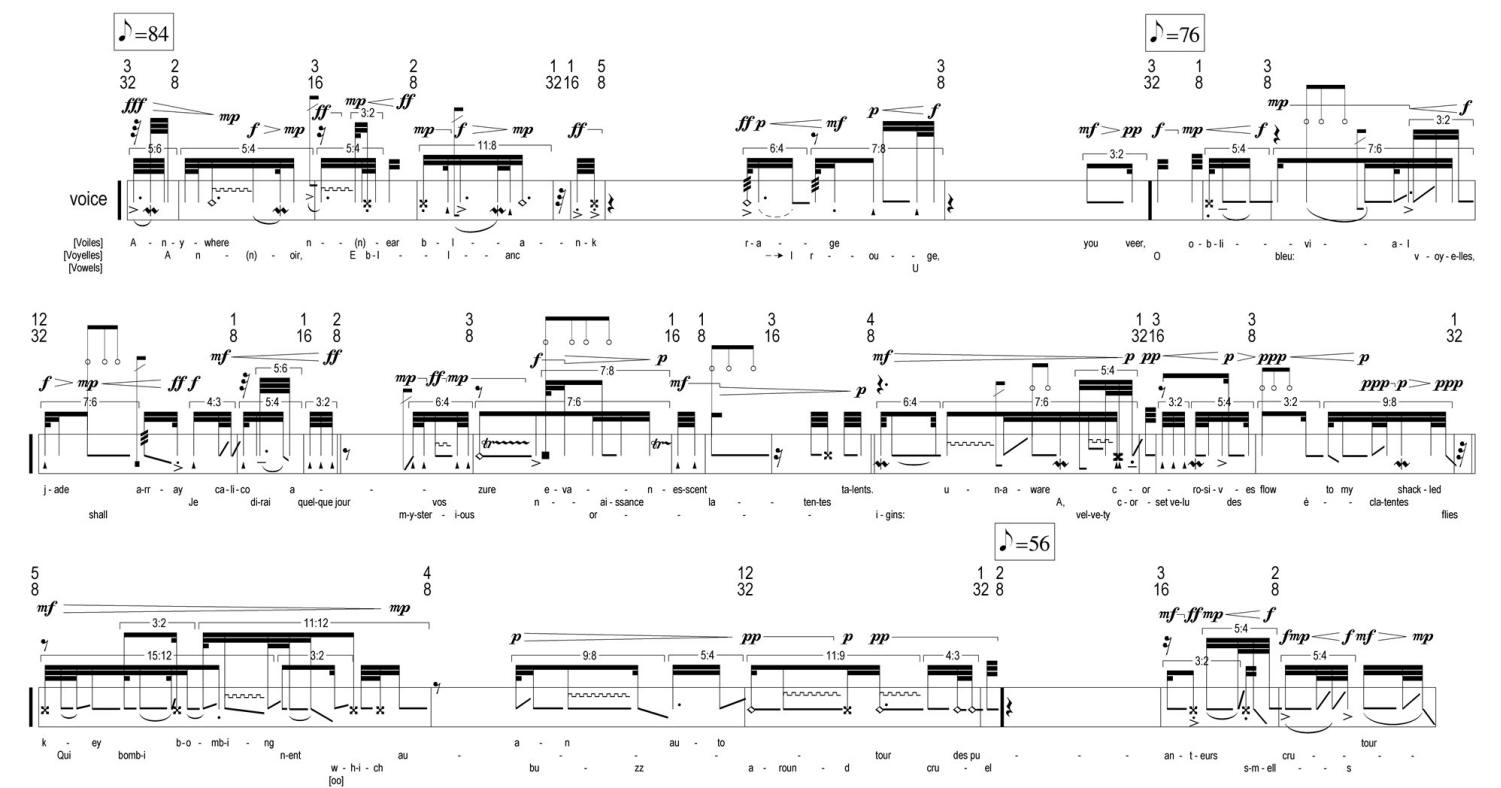
The image by the way is a text I’ve yet to explore, I, purples, spat blood, laugh of beautiful lips by Aaron Cassidy, who describes it as a product of Rimbaud’s “Voyelles,” Bök’s Eunioia, and a tangle of semantic and homophonic derivations of those. Look forward to getting to know it better.
Click on me for some mathematical sublime
Okay a few more. This student from
Si la vida es amor, bendita sea!
got
Seal feed a, is armor. Bend it as me.
And from
Donde la mano
got
Don day, lamb an oh!
This one played fast and loose with phonemes but was also willing to compost words and impose word bounds the source author n’er had thought of, so that
Cordoba Lejana y sola
becomes
Kurt, oh baa. Leia, Han, huh? Pee Cola.
– laying the complicity between Lucas Studios and Coca Cola Corp. bare for once & all. Later the poet turns luna to tuna, fudging grapheme more than phoneme, but okay, hells, y not.
Here too though a bit more articulation? Exercise, where’s a good spot to put a period in this line? I can see at least four. Five if you strike an ‘l’ from “Llama.”
Llama ate a neigh is tough mirror and dough.
This student took on no less than the Universal Declaration of Human Rights, which en francais reads, article 26.3,
Les parents on, par priorité, le droit de choisir le genre d’éducation à donne à leurs enfants.
And perhaps as a comment on how much good it’s done, it becomes in translation, and I’ve articulated it just a little more,
Less parents on, pair parrots, Lee. Do it day chaser, Lee. Genre? Day education at diner allures infants.
Homophonic translation tends to draw out the unconscious of language, its polymorphic perversity, if you’ll let it. “Perversity” in a not bad sense, just etymologically, as in turnings off the straight and narrow path. This one makes bold to find such gists in an ordinary Spanish-language newspaper article –
Yo, no karaoke Margarita! Clod, dickhole! These interest, dear, scatter my pain. Yo, karaoke Lo Mein tie, never! OH! Penis? Okay. Meaty? Okay, sir. Arrow lad, a cone, laps are a toy. Lace: track her. EEK! You an asset, ran, sit. Oh? See affect area.
That seems to be about, whatever else also, its own activity, the queering of language this exercise seems ineluctably to go to.
This last one departs far from the sounds of its source text, and also comes to compelling lines in English, and I can only make out traces of Spanish, but have some feeling that the author has fell into Zukofsky’s own practice, of mingling homophonic and semantic translation at will. I’ll just give ya the first line –
Cuerpo de mujer, blancas colinas, muslos blancos
Aquarius day, new hair, blanket colonies – new blankets,
– and the last –
como una flecha en mi arco, como una piedra en mi honda.
Come oh one a fellatio in me on top.
And that there’s the unconscious of language, right there, remembering for us we’re in bodies, prideful, all.
As it feeds on bygone texts, conceptualism may be marooned in the bottoms of a melancholy attraction to dead zones. How various are its ruins: consider decorative ruins, as in Elizabeth Clark’s graphically pretty reduction of Raymond Roussel’s New Impressions of Africa to its punctuation; exhausting tabulatory ruins, archived debris, as in Brian Joseph Davis’s compilation of 5,000 film tag lines; abstraction ruins, witness Dworkin’s Parse (2008), which cannibalizes words about grammar with the grammatical terms for the words; arbitrary-emphasis ruins, as in Goldsmith’s obsessive compilation of phrases ending in “r” sounds or, in a reverse move, the graphic de-emphasis in M. NourbeSe Philip’s Zong! (2008) and Rachel Zolf’s “Messenger,” their barely legible 6–8 percent gray font; and, to make an end, ruins by over-extension, including paragraphs or stanzas deliberately stupid with repetition. (“Against Conceptualism”)
What’s the line, question to self, between ruination & compost?
This too from Bedient, on a day when the nation’s highest court has affirmed that whole principalities of desire once loathed belong wholly now to our body politic. That this many more faces of our libido belong now to human dignity.
[D]etachment from affects means … suppression of the psyche’s outspokenness, which is vital to its health, and a stop to the sociopolitical usefulness of both the libido and the rougher emotions. These emotions fuel what Stéphane Hessel, one of the shapers of the UN’s Universal Declaration of Human Rights, celebrates as “indignation” in Time for Outrage, Indignez-vous! (2011). This new neutrality also stultifies the creation in art of major new aesthetic affects, distinct universes of feeling: Moby-Dick putting forward one affect, Wuthering Heights another; Rilke his, Rothko his; and so on.
Each work we call great is its own cri de coeur. Wonder if that much at least great art and great legal cases have in common.
This not just in (2013) from Calvin Bedient on conceptual poetry:
Writers who pride themselves on conceiving projects and executing them according to plan – thus relatively indifferent to the intrinsic value of what is produced and to the quality of the production itself – neglect life values, which include a trembling web of receptivity, sharply interested observation, the ability to make instant adjustments, and organic developments within a constantly changing context, all properties as important to lyric poets as to cats. (“Against Conceptualism”)
And I am, like a tree with two cows in it, of two minds here. I quiver like a plucked lyrestring to notions of a “trembling web of receptivity” and organic alterations responsive to a “constantly changing context.” I’m also coolly alert to how the phrases are calculus to make me quiver and bow to them.
If it’s that conceptual is a way to do poetry, I’m down w/ that.
If it’s, conceptual is the way to do poetry, got no patience w/ that.
Can never say what its fans are fanning, which article, for sure.
This one is just, okay, sweet. I mean it’s kind, gentle, open, bighearted, fun and funny. So maybe also it’s got a rigorous generative procedure behind it and also linguistic resonances available only to initiates. Who cares, it offers its pleasure to any willing to inhale, to inspire.
EPIC
porcupines
(Craig Dworkin, Remotes)
I’ll write more on this one maybe at a later mote. For now just this. Sometimes the cells walls between conceptual poetry & affective poetry & autobiographical poetry (the dedication: “for Miles, and / the time being”) & visual poetry (these are typewritten and every ‘s’ and ‘d’ is twice struck, plurals, pasts) are porous unto nought.
This wee gist has thought & heart & eye & ear & a moving body. I think Craig might assent to calling it a “conceptual poem”? But it affirms everything Bedient says conceptual poetry refuses.
And. Yet. For the most part I’m with Bedient there. Hells yeah.
Thinking about aleatory poetics, that is, chance operations, the acrobatics one does to get will or self or intent out of the way. Whether that’s rolling the dice, or opening a silence to ambient sounds, or transcribing a day’s traffic reports.
Well the thought was this. “Let the universe compose the part of the poem proper to it.” A relief not to have to express yourself!
Thought that came a bit later was, “The trick is telling what part’s proper to it and what part’s proper to you.”
Then I found I wanted to put “it” and “you” in just those scare quotes. Where does the one end and the other begin?
Cage might not have needed his cageyness, nor Heidegger all that wildering swirliness, had he trusted the emptiness more wholly.
Like I’m one to talk. Whimpering about my achy gut.
My other wonder’s about the the title Against Expression that Craig Dworkin (for whom I feel true affection) and Kenneth Goldsmith (with whom I feel true amusement) gave their anthology of conceptual poetry.
Could be argued that in it, expression isn’t opposed there so much as front-loaded – the expression’s in the inception, the inceptive idea, then the rest is allowed to unfold either deterministically or chancewise, which is fine and fun and sometimes beautiful and very often a vital corrective to a navel-gazing aesthetic consensus. And it lets the cosmos show its chops.
But it’s still expression. And it tends to be an expression of will and intellect and even a kind of control and mastery – at least it has a sort of coolness to it often that suggests, I master the inception, I need not master the rest. I, poet, watchmaker god.
I dunno. I’m just thinking out loud here. I’m drawn to these practices and offput by them too. They offer a way out of the nutshell of the self. But it seems a way of intellect and will, coolness and mastery, wit and a kind of Classicism, and for all that their productions, some of them, turn me crazily on, I’m shut out in the end by the paucity of impulse in them.
They seem the place where the animal in us goes to die. Seem to renounce rather than transform what in us pisses fucks and shits. Am I wrong? Have I missed it?
I want a poetry that weds the animal to the angel in us, the algae to the nebula, not one that subs the higher for the lower (Classicism) or the other way round (Romanticism). Christ I’m sounding like Rilke kill me now.
The aleatory, in our poetry, may be our spontaneity externalized.
Migraine, salmonella, I gotta say, been a crappy week off. Too, though, a sunny Sunday morning, I sit here on the couch sipping tea and eating a few berries, my gut don’t hurt too much of the moment & my cat’s basking in the sun, and so.
The week of serious concerted poem-making I pictured has not happened. (Nor have the coincident weeks of serious gardening or concerted bill paying.) But did come one I’d love to show you.
It began with a glimpse just of a picture poem by Robert Grenier on Craig Dworkin’s Eclipse archive –
– and in particular the overlaying of words: I and my, am and heart, a and is, (something) and beating.
I’ve been working for a while on a script got by writing something over twice – as I’ve written about here. What, I then wondered, if the overtext weren’t just the undertext, shifted. What if a good deal more difference were let in.
As it turned out, I worked with just one phrase, this one that popped up in earlier work on Overject—
I inscribed the phrase over and over, following a protocol dictated by the digits of π, and when that felt done I stopped, and then I started filling in some of the spaces created by the intersections of overlapping letterforms. After a while I got to this.
Don’t honestly know if it’s any good. But it’s, at least, a new method I’m curious of. Click on it maybe to see how the details go. Thoughts?
So it’s give or take, who keeps track, the anniversary of this blog, in which honour, here’s from the syllabus to The Art of Compost, the second coming of it.
SOME LIKEMINDED FOLK
Compost is a way of thinking about life and death and art and thought and act. Not a better way but a really quite interesting way. Also, there’s no such thing as compost theory,but if there were, here might be some thoughts of it.
Now I am terrified at the earth, it is that calm and patient,
It grows such sweet things out of such corruptions. – Walt Whitman, “This Compost”
Beginning again and again is a natural thing even when there is a series. – Gertrude Stein, “Composition as Explanation”
write carelessly so that nothing that is not green will survive – William Carlos Williams, Paterson
Life is natural in the evolution of matter
Nothing supra-rock about it simply
butterflies are quicker than rock – Lorine Niedecker, “Wintergreen Ridge”
It is only the midden heap, Beauty: shards, scraps of leftover food, rottings, the Dump
where we read history, larvae of all dead things, mixd seeds, waste, off-castings, despised treasure, vegetable putrefactions – Robert Duncan, “Nor is the Past Pure”
[You] can go by no track other than the one the poem under hand declares, for itself. – Charles Olson, “Projective Verse”
After a long time of light, there began to be eyes, and light began looking with itself. – Ronald Johnson, Ark
Poetry is biodegradable thought. – Jed Rasula, This Compost
Hey try this out. Where you see “poem” or “poetry,” read “writing.” Does the thought hold?
Sorry for the gap between the posts folks. Rough couple of days in headache land. I have trouble turning off. End of the quarter, all ramped up, grading frenzy, plus madness with the student journal I advise, plus getting prepped for summer compost, and having got it all done, instead of relaxing into a week of sunfull ease – whump.
There I am in line at the Home Depot to pick up my new composter and the sparklies start, migraine’s coming, oh no. (Head, meet composter, headComposter, ha, ha.) Mostly through it now so I can get this bit posted but damn, the body, damn.
Some sympathy let’s for those medievals who reviled it and apotheosized the spirit. Yeah they leave us with a cruddy debit. But just think, boils, cramps, agues, rotten tooth roots, and what did they have to heal yehs? Leaves and leeches.
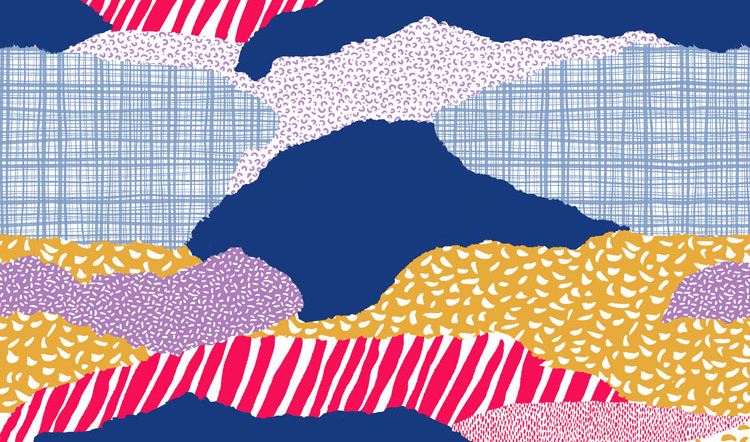
Looking round for blogs for the blog unit for ENG 460 The Art of Compost 2.0 and came to this one. And this pattern, dunno if it fits for the course, but hells it sure is purty, more than purty, it moves and keeps on moving. Earths and skies and more skies and heavens in it your eye climbs. Or rock strata thought drops down thru. What I love most in it’s the move up & the move down in it, are one. Wow & wow.
Last day of my vis po class today. Gonna miss these guys, I am. Not often a group comes together so clear real and kind. Mean to post over the next week or two some of their later works, which have been bright and entrusting as ever.
The exercise:
Either compose a poem with no words in it, or compose a poem that is one continuous line (once the pen tip touches the paper, it doesn’t leave the paper, until the poem is done), or do both!
All that follow follow the former prompt. This time round, the latter didn’t work out, quite so well. (I mean to write, before I’m done with this spring class, on how little it matters whether a given ex has worked out for you or not. For most students most of the exes are enh and that’s fine and expected. And one or two make for breakthroughs and that’s giddy and golden.)
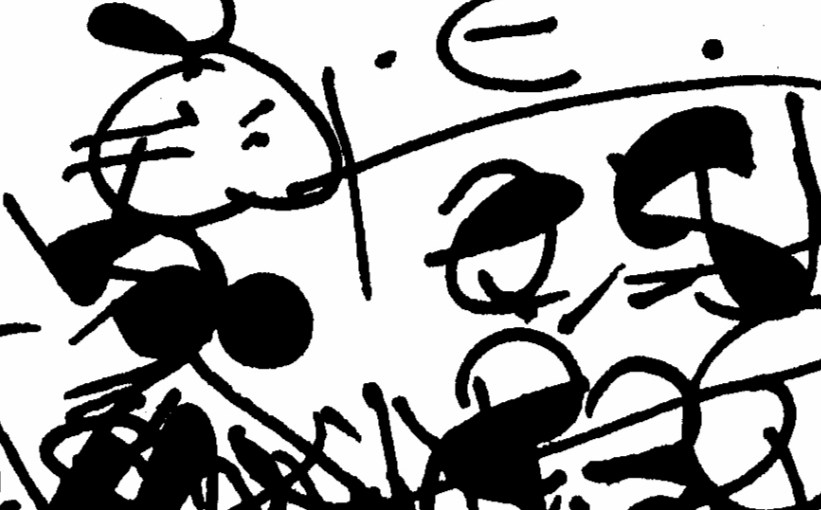
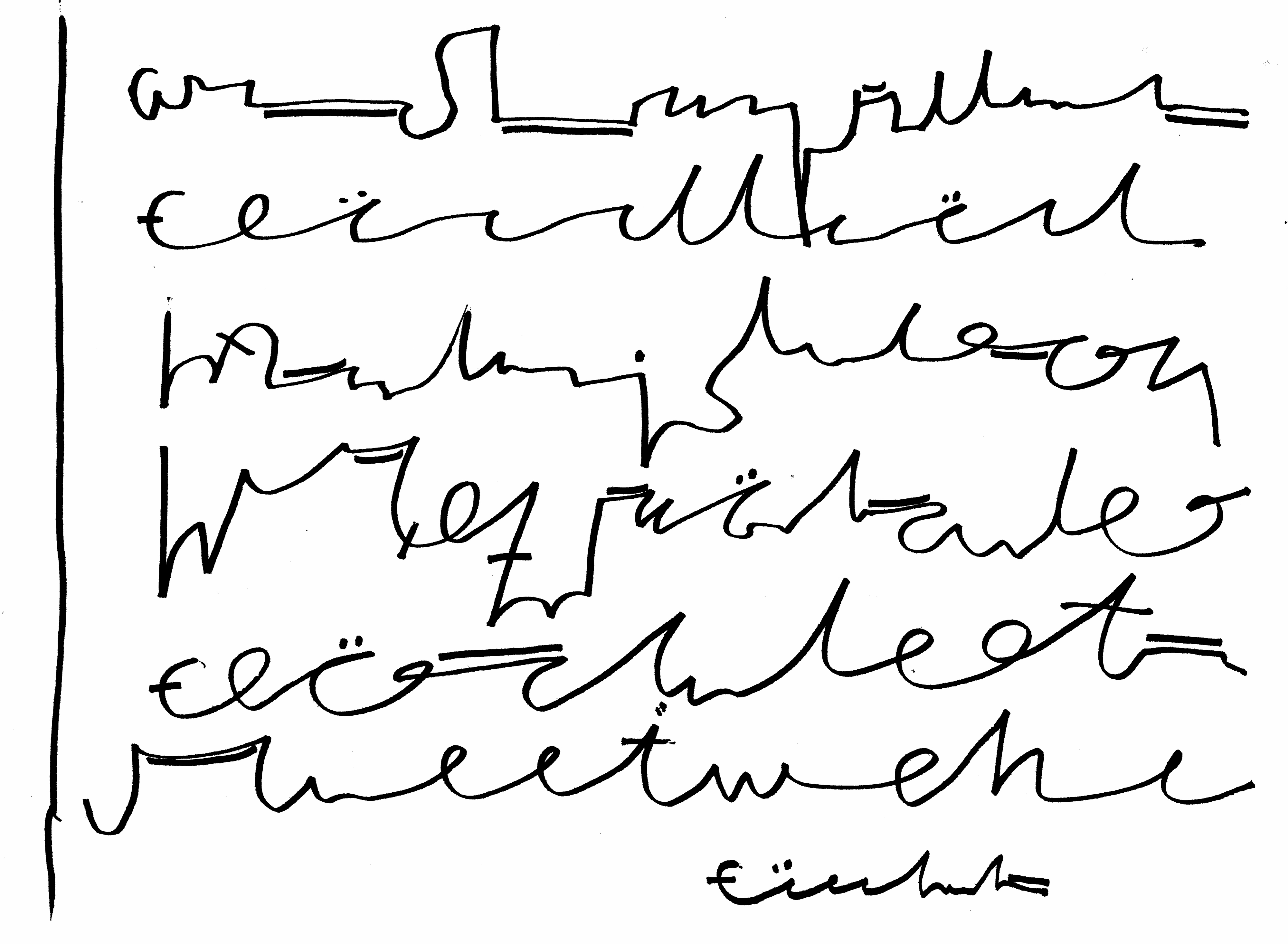
This one harks back to our study of Judith Copithorne’s Runes and’s inflected maybe also by flash presentations on graffiti and calligraphy. Though the semblances most evident to me are Arabic script and maybe even Hélène Smith’s Martian writing though I don’t recall us discussing it.
Anyway it suggests to me that our early exercise on handwriting, which seemed mostly a bust at the time, might have set some seeds long to germinate.
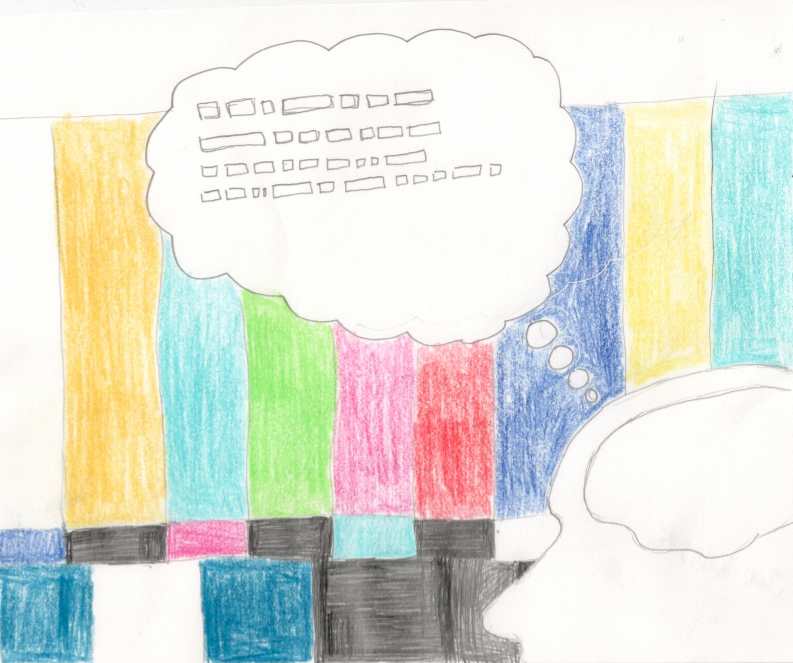
This one’s a culmination of its author’s preoccupation with forces in the culture, ad copy junk food and so on, conspiring to benumb one.
I should mention that the exercise comes in company with our work on Derek Beaulieu’s Local Colour, a reading of Paul Auster’s novella Ghosts that replaces every colour word with a swatch of that colour, all other words with the whiteness of the page.
I could dilate here on the symcomplexity of that project, or on the extraordinary anxiety it induces in some students (“You don’t ask what a waterfall means,” I said today, “why do you ask what the poem means?” “Nature – art,” said one student, and it’s a sound response, and because I didn’t feel like talking about Kant, I went to Bach. “You don’t ask what the Goldberg Variations mean, though, right?, you ask what they do.” Probably not a good pick, but my first thought, Beethoven’s 9th, has words in it, which complicates. A long parenthetical. Gist is, if there’s one, we got into a good discussion of just what one means by meaning, and’s pretty effing giving of a group of graduating seniors, Thursday of Dead Week.), but I’ll just send you to the text itself. Wread it!
Can’t quite put my finger on why this last one blows my mind.
Saw its author today on the plaza and asked her what it was like to make it – was she in the zone, an altered space, and she said she kind of was, there on the floor with her scissors and construction paper. What you Buddhists yo call samadhi, one-pointedness, and it does come through, so we get some of it, too.
There’s something inexpressible comes across in the whorls. Its imperfections are perfections. All that’s clumsy about it’s subtle. Makes me want to cry and don’t know whether w/ happy or sad.
This one’s her breakthrough poem; told her so; she thought that, too. Everyone in the class had one this time round, no one left out, some did early, some late, some with fireworks, some as quiet as a snowflake of exclamation points or a photocopy of onion skins. What a privilege to be a part of, my god.










 The Art of Compost