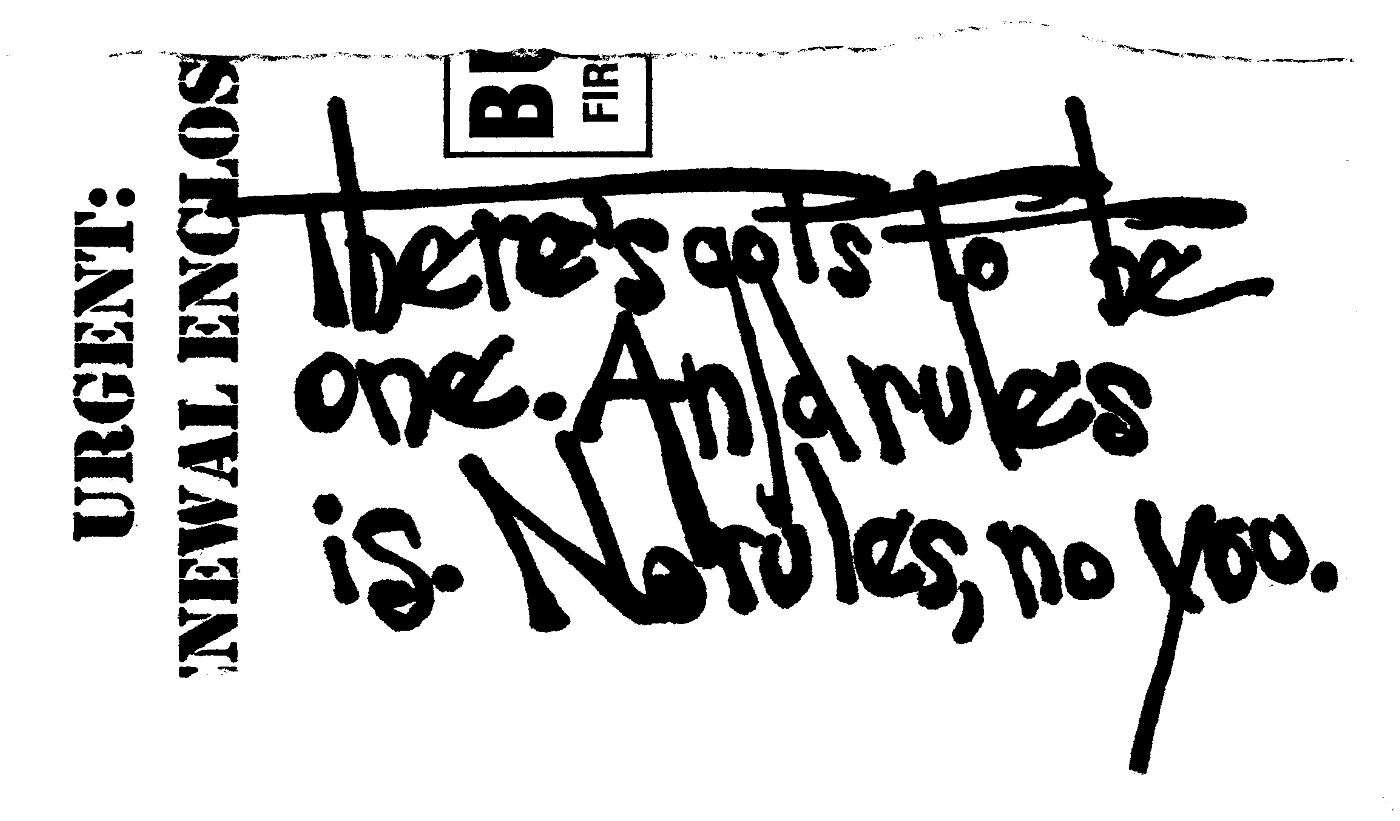
Exercise – Inscription

The second exercise to my visual poetry group. Who keep doing wonderfully – our conversations together, their serious play, astound me. I wish I had leisure to write how much fun it was to talk with them today about Grenier’s Sentences and Cage’s 4:33 and Olson’s “high-energy construct” and Duchamp’s readymades.

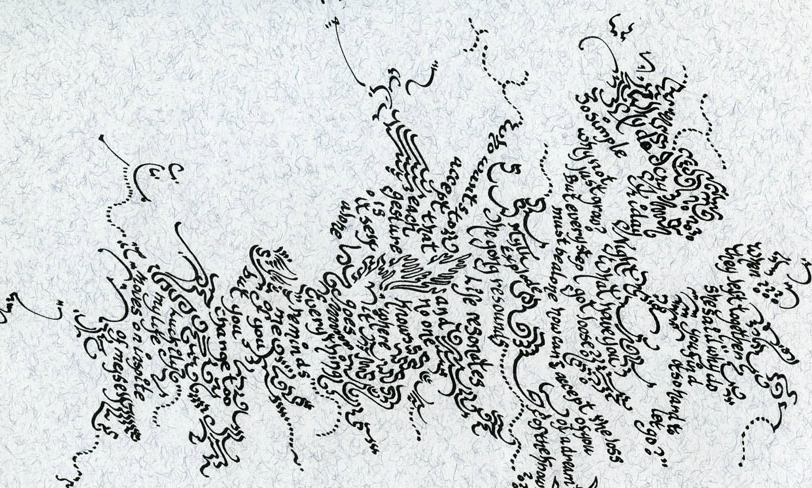
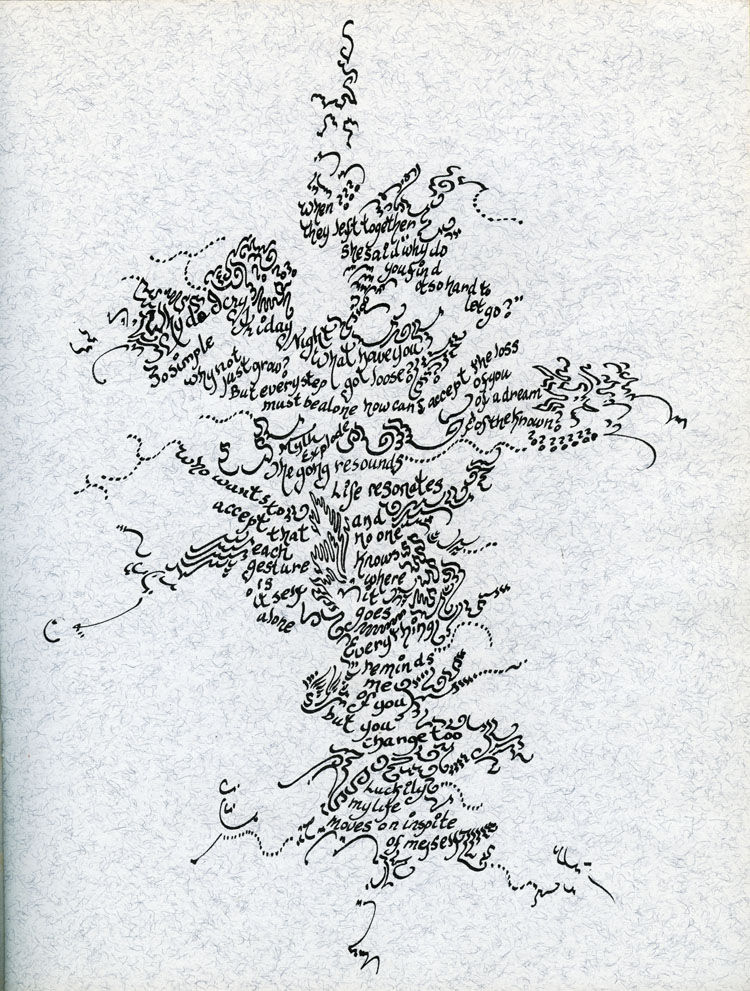
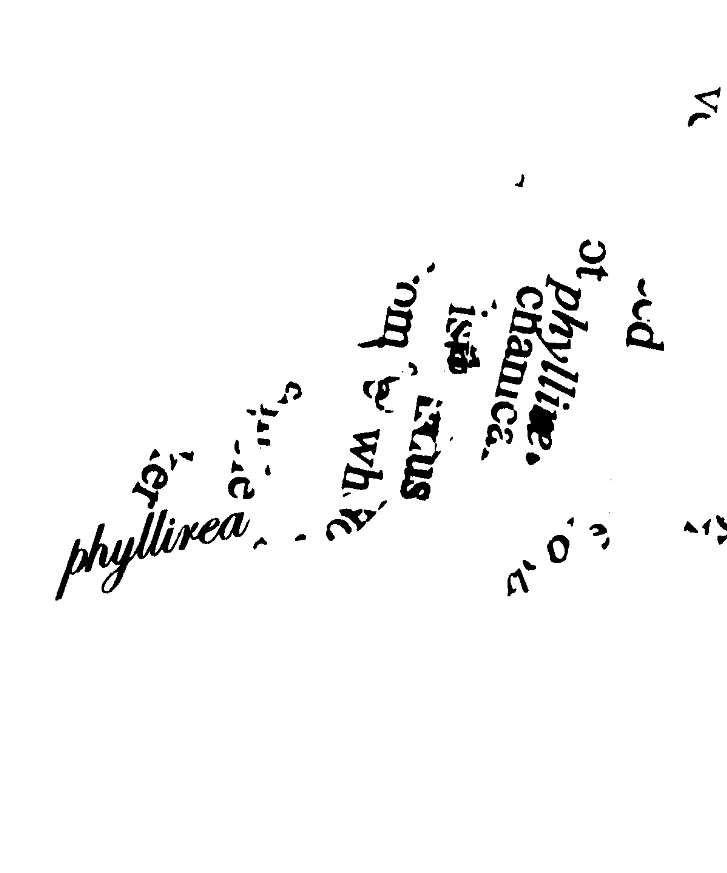
Back. On. Track. An exercise cued by Judith Copithorne’s Runes, rather more obscure than A Humument, but very delicious, and in its way more luscious, an investigation of the threshold where grapheme becomes idly wandering line.

The prompt. Write a poem by hand in which the character of the writing is central to the experience of the poem.

Pointers. Again, by all means, take Copithorne as your model, but avoid slavish imitation. You might start by exploring ways of stylizing your usual handwriting. What happens when the cross-strokes on your t’s, the loops on your g’s, are allowed to run riot?

I’ll post a few of their soon. Till then, a bit from Copithorne (what, BTW, a lovely Norsish name).

Copithorne

Full text of her Runes and some others on UbuWeb.

Trust yr boredom

Well isn’t that interesting. I said I’d post some stuff about my adventures in erasure and now I find I just don’t feel like it. I tell my students over and over – trust your boredom – it’s some of the best guidance you’re going to get. Bored with a line? Cut it. Bored with a poem? Throw it away.

A sour and maybe cranky wakefulness but wakeful just the same. Could I ask of them something I won’t of myself?

face 2The deal I made with me when I started this blog was – write when I feel a wish to and write what I feel a wish to and not otherwise. Lots of duties and such elsewhere. Here I’ll see if what I’ve heard about whim is so, its fructiveness and sufficiency. So far it’s borne out well. Some fallow periods, some heavy fertile swells, an amiable rhythm.

So, having erased erasure, what do I mean to write about? I sat down without knowing. That’s the scary or even terrifying thing about trusting your boredom wholeheartedly. It might tell you what not without telling you what to.
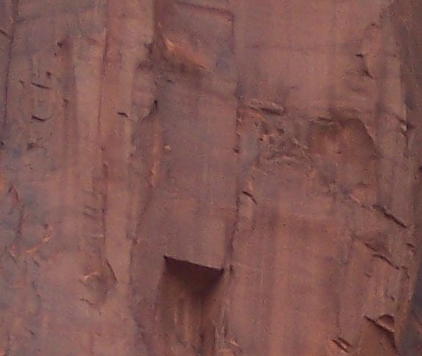
face 3One thing I do, when in this place, and I mean to offer this to my students wherever you are, is just shine an inquisitive light over all the terrain of my mind open at that time, and see what gleams back, even tinily. That might be the place where whatever the counter to boredom is, is waiting.

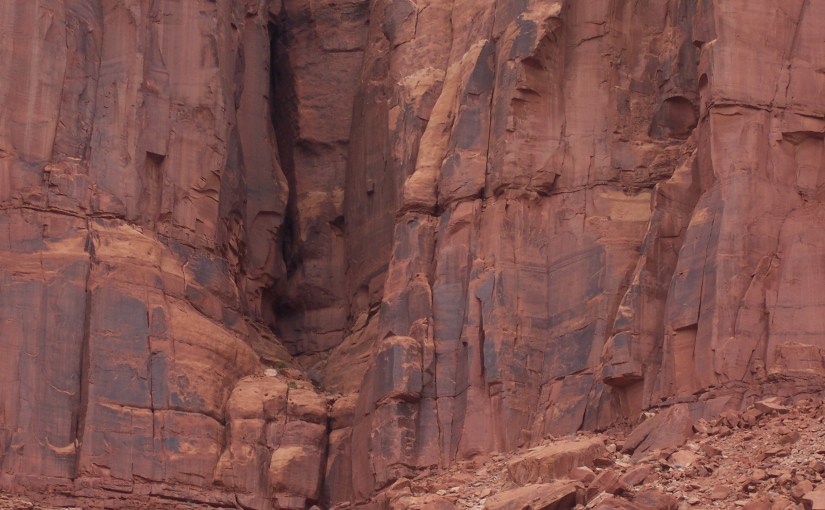
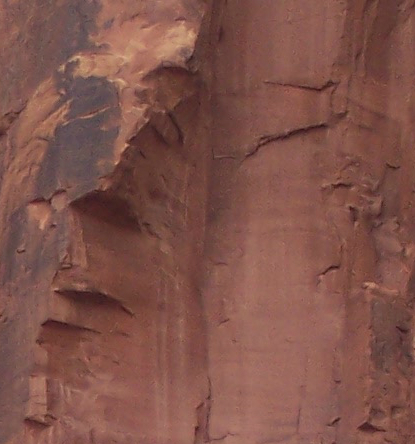
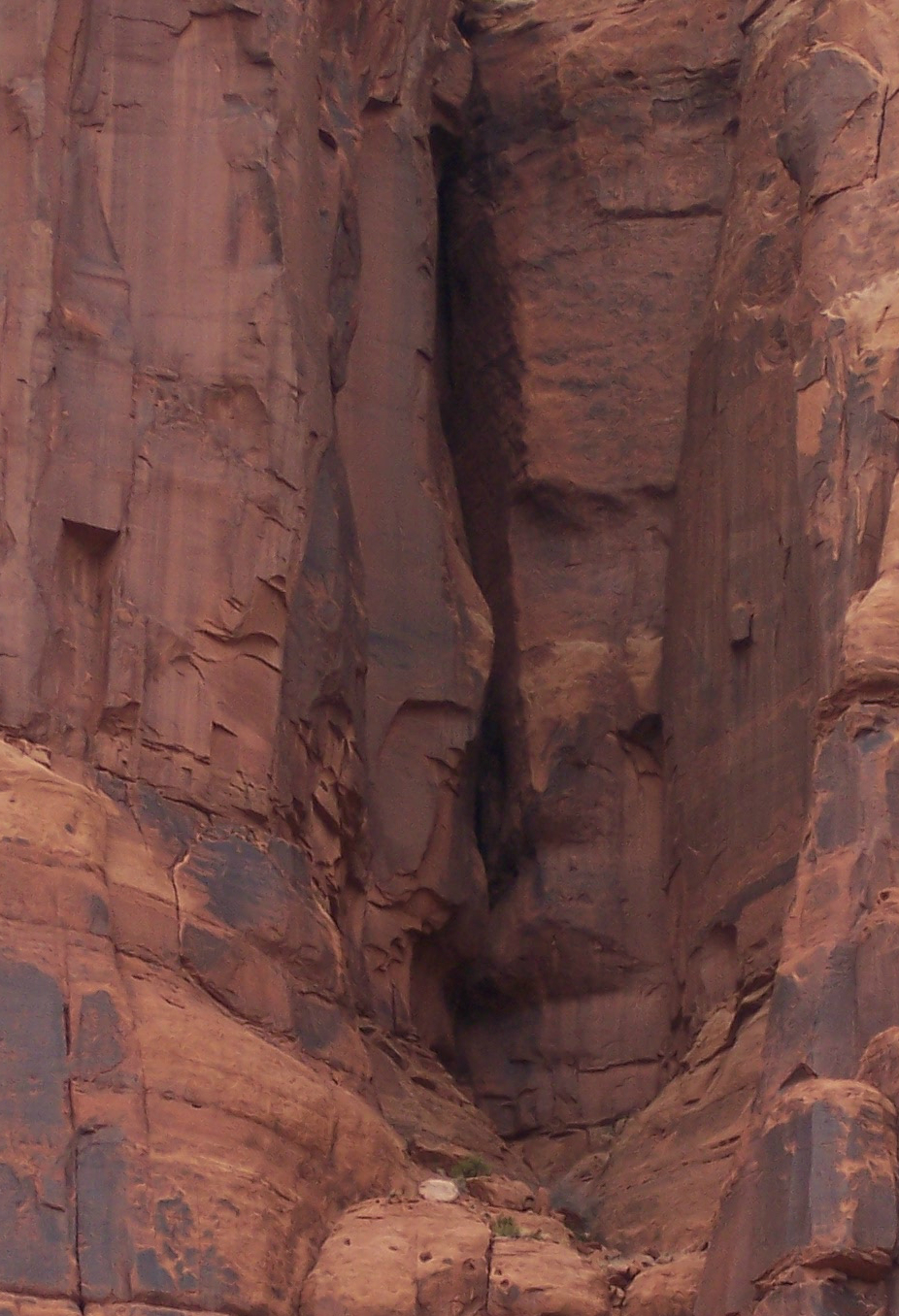
Here what shone back in mind was an image of a red rock cliff in an essay I’d run my eyes over a few minutes earlier, looking for something on erasure I might want to use.

My thought was a propensity for seeing faces where they ain’t, and then my thought was, that’s where I want to go, that’s where the living interest is, the way inert matter makes faces at us, or the way we make it into faces.

face 1

Project onto it a sentience it doesn’t have, if you’re the sort of materialist most people today are, or acknowledge the sentience we intuit it to have, if you’re the sort of postmodern animist I’m coming to give myself permission to be.

Gleaming in mind, I think, because I spent some of yesterday, and today, turning a portion of Dumuzi into a chapbook ms, title Junk Inanna Down, which will go off to a contest tomorrow. The final image, built out of junk mail, is this
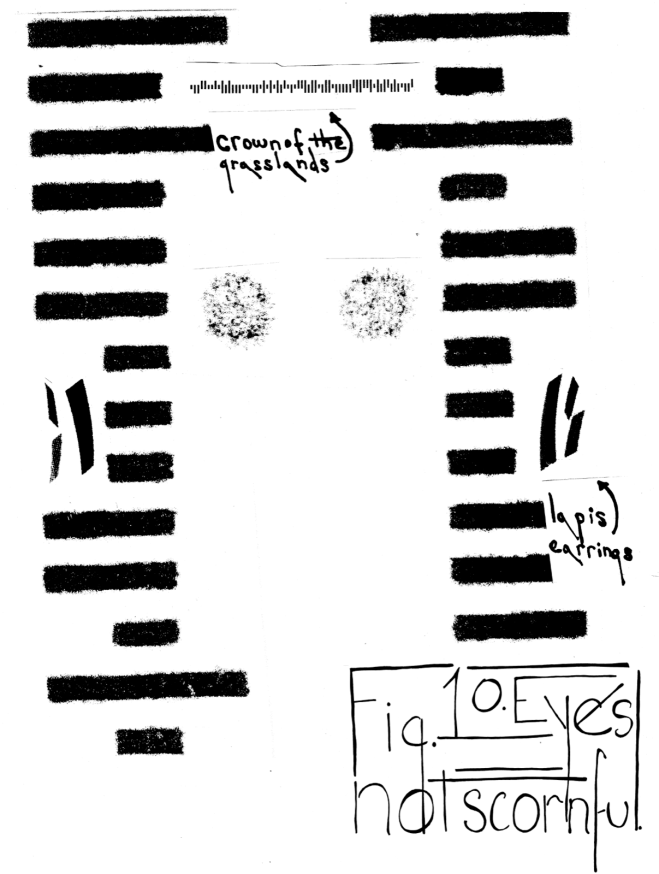
10. Eyes

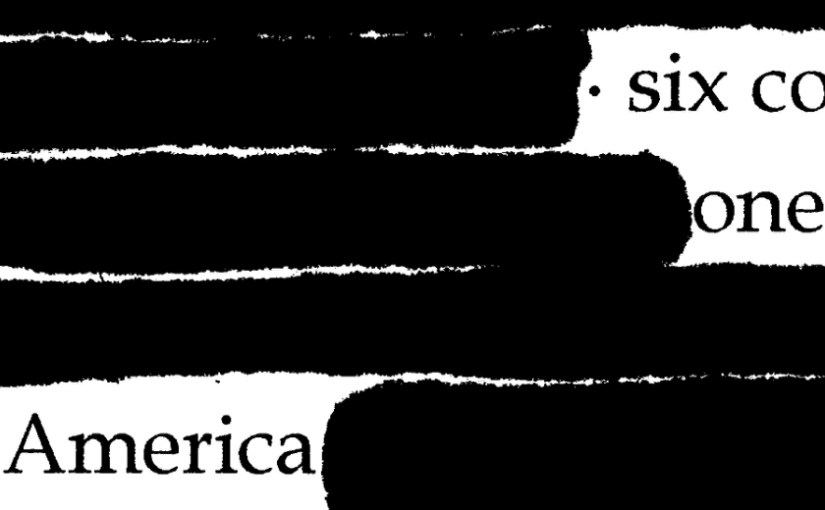
Those eyes move me some. They’re a mother’s looking down at an infant in her arms. They’re Kuanyin coming to poor lowered noble Ezra in that Pisan tent. They’re the trademark stamp on the Bank of America logo blown up about 1600%. Sacred just bitch-slapped profane, ’bout time. Her earrings are the rest of the same logo disassembled. Her headdress is one of those scan codes you see on the front of an envelope a machine reads to shunt its news unwanted to you more speedily.

This one’s for Don, with love.

Erasure and treatment

Started looking round, wondering where to start a post on my own efforts in erasure and treatment, creative demolition and reformation of a source text – a loving demolition, a savage reformation. I sure am not going to subject you, nor endure myself, some blow by blow account of my misadventures. But it was interesting to see where I got started. I’d forgotten.

Salt Lake City circa 2010 and I’m finishing my diss. I’ve read into the shining spaces in Johnson’s Radi Os and been blindsided by the Blakean rainbows of Phillips’s A Humument. I’ve a stash of found matter (NYT clippings) ten years after a day I’ve not been able to write of to around or about. And I understand, post-Bervin, erasure’s growing old, as too 9/11 and poems about 9/11 have some time since grown old. Understand as well my sense of old and the currency of old are not maybe typical of the avant-garde I maybe or maybe not aspire to keep company with.

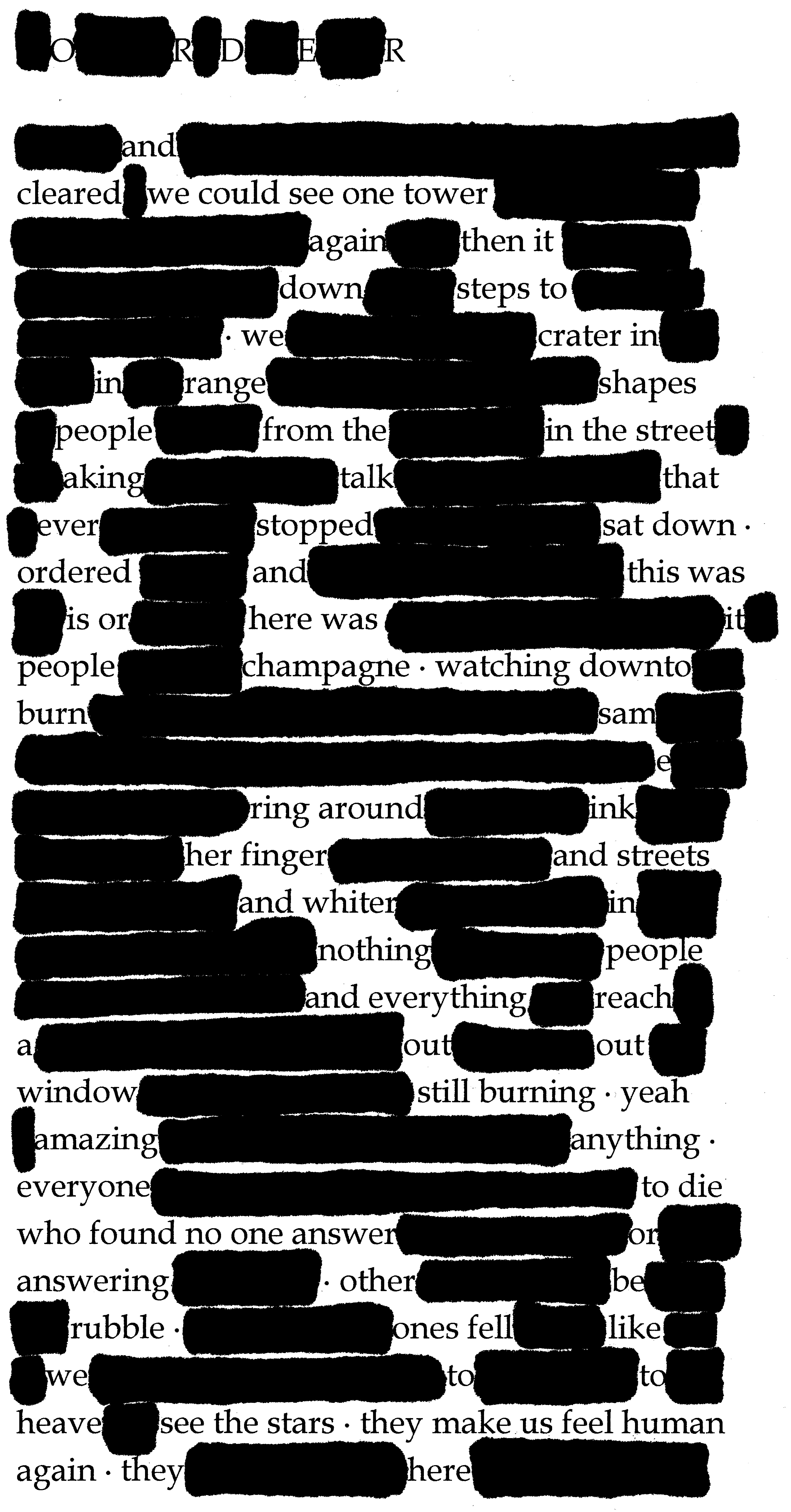
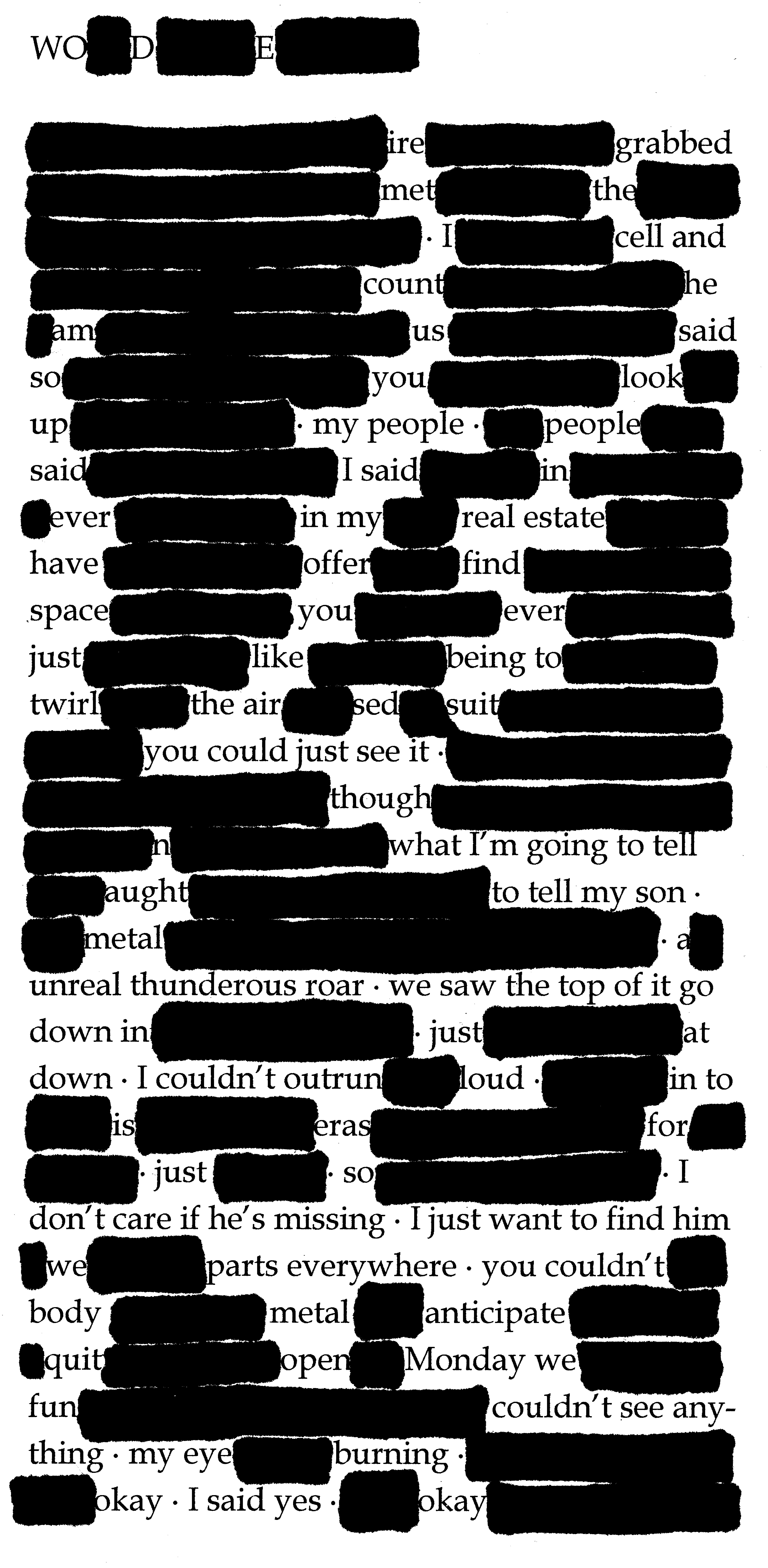
Well anyhoo. Our discourse around 9/11 seemed censorious in all sorts of ways. Repression that made it seem past in ways it was present and present in ways it was past. Repression with political beginnings and a mercantile middle and self-preening ends. And with black bars I could maybe indict the targets both obvious (war crimes of the Bush admin) and subtle (oh come let’s say it liberal friends we can be sanctimonious). Also black bars seemed easy to make even for such graphically mega-challenged as I.

So I went there with the redactors and they there with me. Made a few heaps of found material and did a selection thing derived a bit from Johnson a bit from Phillips and a bit from Bervin.

OrderI never ended up publishing these in any version or trying very hard to. A good friend, one I showed them to early on, was upset by them, and she’s a New Yorker, and that she was offended, though I didn’t get it then, I took serious, and thought best to move on. So maybe Sal you saved me from something stupid. Where Sal by the way ARE you?

WodeAnd well now I do get it. Seems kinda obvious now. Sal I didn’t mean to silence the voices of the victims. I meant that the voices of the victims had been silenced. But yeah thanks for saving me from my stupid. Still though where ARE you?

SillsPretty crude, yes? compared to what my students have been up to. Gonna skip a bunch of steps in my own progress to get to where I’m about at now. That’s the next post.

And then, after that, because onward is always, their next adventure – handwriting. The inscribed line, thick or thin, mischief or dutiful, studied or fleeting, how it expresses a moment of spirit, before and in language.

Student work – Treated page

A few responses to the treated page exercise I gave my students as we met and read and viewed and wrestled with Tom Phillips’s A Humument. All struck me. Each differs from the others plenty. None imitates Phillips servilely. All take care with their erasural gestures, understand them to be, as they are, presences in their own right.

One that foreswears mimesis almost entirely and uses abstract form pattern and colour to expose the ickiness of its source text’s speaker. (A lot depends with this exercise on the right kind of friction with one’s source text.)

Treated page 4

One that goes maximal, takes erasure as a baroque occasion. (I neglected to note the source text here, oops.) It actually has texture under your fingertips. Glitter that bites back.

Treated page 2

And one that goes minimal, erases erasure, or proposes that we omit omission, or something like that, its ironies tangle my head. The source text is Strunk & White’s Elements of Style and it mucks with their most famous pro-imposition, “Omit needless words.”

Treated page 3

A dismantlement of text that can’t help but call to mind Susan Howe’s, as this from “Fragment of the Wedding Dress of Sarah Pierpont Edwards” in Souls of the Labadie Tract:

Howe - wedding dress (A poet I’ve never had the guts to try to teach.) There were others good, wonderful even, or that didn’t in themselves transcend but were important explorations for their fashioners. There’s in fact no knowing what will beget what. That’s why I don’t grade these, they should be done in great spirited freedom.


In a few I’ll hope to write a bit about my own muckings about with treated pages. Nothing so colourful as these. Also want to write about really good discussions we had today on qualities of line (actual and implied, that’s from Taylor) and the non-blankness of the blank page. First though dinner – steak!

Teaching note

Wrestling a bit with the question, in my visual poetry course, whether and how to involve my own creative efforts. My thought has always been, a teacher should keep his work to his own damn self, none of that preening, thanks much to yehs. And yet I’m a living working maker and maybe that could be of help to my students. Esp. since almost every prompt I give them emerges from some struggle I’ve found myself in and found a way at least partway through. Abnegation of ego is more ego.

(Too, I’ve already stretched the envelope, posting their work on this blog. All kinds of sound reasons not to do such a thing. And the effects seem to have been good, benign, affirming, from the signs I’ve been given to see.)

So well my thought is to post, among the prompts I give my students, and some of the works they do in response, a few of my own efforts, recent or distant, with maybe a few comments. Maybe they’ll come see them maybe no.

E.g., recently posted a treated page exercise, soon will post a few of their lovely answers, and might be – helpful?? amusing? cause for benign condescending laughter 106 years hence among as yet unmade inhabitants of star system X93 in galaxy P1945Q? – watch that self-abnegation engine whirr into action – for me to post as well some of my efforts on the same terrain. And so I think I will.

I was cleaning the house, sorting papers, and the itch came to post to my blog, and so here we are.

The treated page I will write about when and if I do:

Laces

(That took me, guys, so you know, months. More, more than a decade, if you go back to the date of the source text – a dream I had of wandering as a child at ease in a marketplace.)

They are such a kind group. I was observed by a tenured colleague on Tuesday, no reason to be nervous, but of course I was, and they did beautifully, bore me up wonderfully, just by being themselves. Mean to tell them tomorrow how grateful I am.

all things bear one up
robins in the high meadow

I am the burning schlub

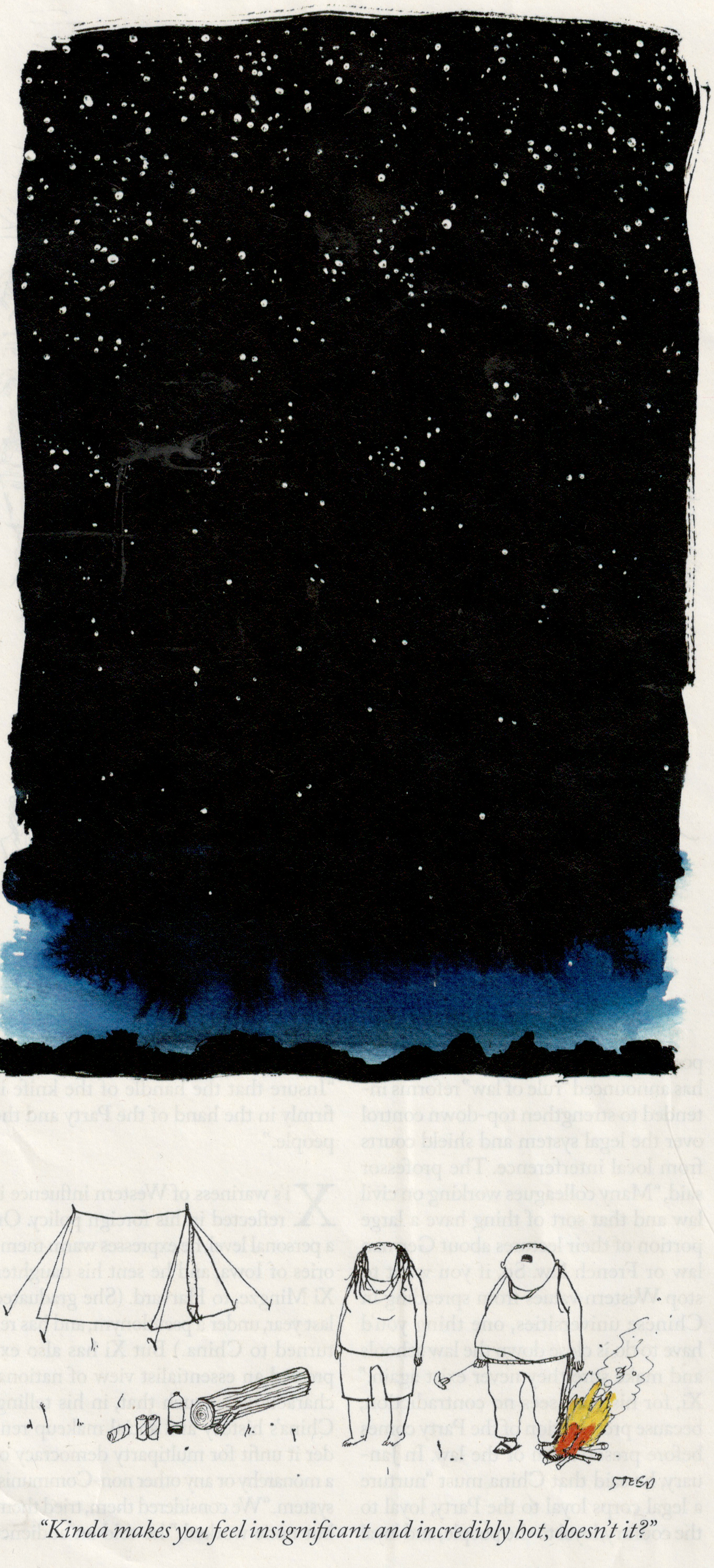
So either this is as funny as I think it is or I am at about a 3 degree slant to the rest of the human world.

New Yorker

I mean, not to kill a joke by analyzing it, but everything is just right here, down to the abortive sexual innuendo of “incredibly hot” (aborted by the peekaboo of its sayer’s bellybutton as much as by the campfire) and the stroked irregular royal purple edge of the sky where (oh dear visual poets in my care do take note) the cartoon reminds us its sublimity is a cartoon’s sublime.

Also I feel I have been in the burning schlub’s place more times that I can number. Eyes on the wonder of the mind field and feet in the good rough bad peace of the real. Thank you, New Yorker, to which I’ve never before looked for spiritual correction, and probably still won’t, but.

Exercise — Treated page

So here’s the first exercise of the quarter for my visual poetry class. Cued by our wandering through Tom Phillips’s well known widely loved yet not for all that at all worn out A Humument.

The book’s an object lesson in the power of powering forward not knowing where the sweet bloody fuck you’re going. Glory of the aleatory. Here’s he in his Blakean vein —

The exercise. Treat a page of a prose work as Phillips has treated the pages of A Human Document.

Pointers. Be inspired by A Humument, by all means, steal moves from Phillips, but don’t imitate slavishly. The composition should feel to you like your process. Do take care with your erasure marks. They should do more than just cross out. They should express, manifest, draw eye and mind.


They’re doing beautifully by the way. What lovely conversations we have. We seem already friends in the free and easy wandering in mind I remember reading of in the Chuang Tzu … lessee if I can find it … nope. But this is as good, Chuang Tzu to Hui Tzu, who’s just told him his words are big clunky useless, like a gnarled and lumpy tree, so everyone ignores it, carpenters, painters.

Now you have this big tree and you’re distressed because it’s useless. Why don’t you plant it in Not-Even-Anything Village, or in the field of Broad-and-Boundless, relax and do nothing by its side, or lie down for a free and easy sleep under it?

The sleep I want for my students when they make their poems.


P.S. Speaking of Cezanne, and Mont St. Victoire, saw a pretty indifferent one in Vancouver, apparently the only one he composed in a portrait orientation, and I saw why. But what blew me away, and made me excited about in and for the VAG for the first time in my admittedly little life, was an exhibit I wandered into mostly accidentally of contemporary Chinese art that poked and prodded and nursed and scowled at the long awesomely durable tradition of Chinese landscape painting.

I’ll hope to write more soon on what I saw there and what it seemed to see in me. For now a link to the curator’s intro for you.

Into the visual wild

Cometh spring, a new quarter, and our entry, I with 20 brave souls, to the wilderness of visual poetry. Typographic cows at leap over sans-serif moons. Overflowering word gardens. Poems with no words in them.

I’ll post some exercises, and I hope some student work, in weeks to come. Inly the shift from intense poem-making to what may be intense poet-teaching is feeling a bit rocky. But I think once I’m at one with the rocks it’ll be smooth going.


Living Writers: Word and/as Image

The written word is always embodied, on paper or in stone, on bone, among electrons. That means it is both visible and tangible. In addition to writing or reading it, we can trace it, paint on it, rough it up, sand it smooth, stretch it, shrink it, erase or deface it. Meanwhile, the visual image often reaches for the sort of meaning words have, asking us to treat it as legible. No one knows what these figures in Blake’s Marriage of Heaven and Hell mean—

Blake strip - MHH

—but most will feel that they mean. In the word-image nexus, meaning is often fugitive in this way, just beyond the reach of your eyes’ fingertips. In this course, we’ll study poems in which signs keep sliding toward picture, and pictures keep morphing into signs. Our primary texts will be those of living writers, many of them Canadian, but we’ll also dip into earlier works, from Egyptian rebuses to Anglican concrete poems to early Romantic prophetic watercolours. Get ready for a wild ride.

Dumuzi at an end

I finished Dumuzi this morning. There are tweaks to come, but he’s ready to start going out, muddy face sheepish grin and all.

The first poem in the book is

At Leaf

A son of my
first mind, was
at leaf, wind on
raw skin, fist
of one thirst
upthrust.
                      Roars
snowmelt where
hemlocks over-
hanging shiver
motherlove.
                             Sur-
round of what
no one had
made, made
of what no
surround
had.

The title poem is

Dumuzi

Let no state be
enemy. Wet, dry, agon.
Work an inmost first
flower mutedly.

Wind blows light about
the life (hemlocks) from
which art is not apart

nor of a part. What a
rock thought to do
was rain and it
rained.

Deer come
out of th
hill.

The oldest lines date back to Nov. 1999. A conversation I mis-overheard on the M.V. Quinsam, a ferry plying the route from Gabriola, an island pinched between Vancouver Island and the BC mainland, where I lived in a summer cottage in the off-season

—they thought they had it all but they didn’t
—oh, once you have that you don’t get rid of it
—Monday she goes, an ontologist,
                     that’s the specialist

The newest lines date back to last night. An uptight but not incorrect galla reminds Inanna of the terms of her release from the underworld.There's gots The last poem in the book is elegy.

paperwhites

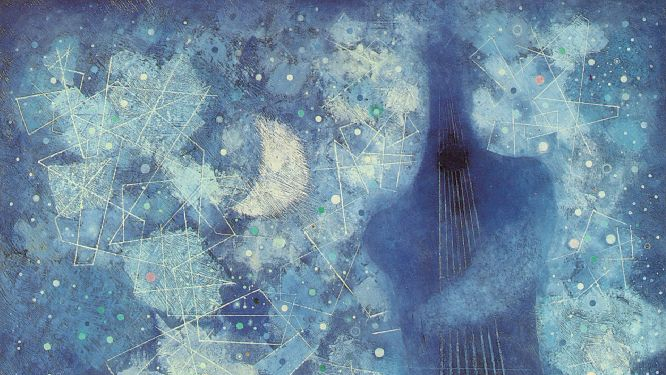
And the image atop is Tammuz by Ardon Mordecai. Sent me years ago by fellow poet and University of Utah alum Timothy O’Keefe. Thank you Tim. I aspire to it as a cover.

And now it’s time to start catching up on what seem years, though are just days, of dishes, laundry, bills. Oh and I believe I have two new courses to teach starting Tuesday. (Really I’m about to start compiling a list of contest deadlines and open reading periods . . . ) Thanks, all, for the kindness of your words, those who have sent some, or of your attending upon these words, which somehow I have felt you doing, I have, and it sustains me, it does.