(Spillover from a job app. Why am I putting it here? Someone might be curious? And, I was having fun with the pilcrow.)
Teaching Statement
The more I write and teach the less I know. In my writing, most of a poem now is found in the moment at hand, in what senses, breath, and mind, each attuned to each, have to say. In that same spirit of unknowing, though, I am less prone than I was, as a young teacher, to think my process a template for my students. More and more they teach me how to teach them. ¶ I teach revision as re-vision, deep new seeing. Some students see newly by reworking one body of words: with each pass they come closer to what they meant, or might mean anew. For others, revision means turning the page; reworking one piece, they worry it to death. So I have students try it both ways, and work with them in conference as they come to a sense of their own practices. ¶ My workshops emphasize non-evaluative feedback. I find that peer comments are more perceptive, and student authors more receptive to them, when praise and advice are set mostly aside. This approach has a downside—the ego wants to be fed and may complain when it’s not—but I find most students come to prefer it before long. ¶ I emphasize the “writer’s antennae”—the capacity for close attention to the texture of your moment-to-moment experience of your own writing. I find that faithful attention to those tingles of excitement, those pulses of boredom, guides composition and revision more reliably than any creative writing precept or external feedback. ¶ And I believe everyone has that capacity, though it’s often obscured by self-doubt or anxiety. A lot of teaching creative writing is showing how to wipe mud off a jewel. All the methods I use in the classroom—peer critique, small group work, class discussion, wacky writing prompts—are meant to foster that process of clarification. ¶ Many also ask students to negotiate differences of background and temperament they might have with their peers. For instance, I often put students in pairs to restore line breaks to a poem I’ve set as a prose paragraph. One is to make sure that the line breaks are expressive, the other that the line itself has integrity. Each has to contact her felt sense of the poem’s language, and to feel through how new lineations will create new patterns of energy. And each has, as she articulates her perceptions, to accommodate the perhaps quite different values and priorities of her partner. In this way, the sort of difference a line break is, brushes on the sort of difference another person is.
POSTSCRIPT. Reading about the pilcrow in Keith Houston’s Shady Characters: The Secret Life of Punctuation, Symbols, and Other Typographical Marks. Good fun and some neat finds. But dreadful editing. Dangling modifiers so thick methinks I need a machete. Come on, Norton, you’re better than this.
(An exercise by Jim Simmerman, taken from The Practice ofPoetry, Robin Behn and Chase Twitchell, eds.Will post some recent strangeness later.)
Give each project at least one line. You should open the poem with the first project, and close it with the last, but otherwise use the projects in whatever order you like. Do all twenty. Let different ones be in different voices. Don’t take things too seriously.
Begin the poem with a metaphor.
Say something specific but utterly preposterous.
Use at least one image for each of the five senses, either in succession or scattered randomly throughout the poem.
Use one example of synaesthesia (mixing the senses).
Use the proper name of a person and the proper name of a place.
Contradict something you said earlier in the poem.
Change direction or digress from the last thing you said.
Use a word (slang?) you’ve never seen in a poem.
Use a piece of false cause-and-effect logic.
Use a piece of “talk” you’ve actually heard (preferably in dialect and/or which you don’t understand).
Create a metaphor using the following construction: “The (adjective) (concrete noun) of (abstract noun)…”
Use an image in such a way as to reverse its usual associative qualities.
Make the persona or character in the poem do something he/she could not do in “real life.”
Refer to yourself by nickname and in the third person.
Write in the future tense, such that part of the poem seems to be a prediction.
Modify a noun with an unlikely adjective.
Make a declarative assertion that sounds convincing but finally makes no sense.
Use a phrase from a language other than English.
Make a nonhuman object say or do something human (personification).
Close the poem with a vivid image that makes no statement but that “echoes” an image from earlier in the poem.
The ones go best that let go, over and over, of whatever one thought to mean. Simmerman comments:
I created this exercise for my beginning poetry writing students who … seemed to me overly concerned with transparently logical structures, themes, and modes of development at the expense of free-for-all wackiness, inventive play, and the sheer oddities of language itself.
I created the exercise in about half an hour, simply listing, in no particular order, a lot of little sillinesses I had seen and liked, or had not seen but thought I would have liked, in poems here and there.
Here’s a poem by Simmerman that completes the twenty projects in order.
Moon Go Away, I Don’t Love You No More
Morning comes on like a wink in the dark.
It’s me it’s winking at.
Mock light lolls in the boughs of the pines.
Dead air numbs my hands.
A bluejay jabbers like nobody’s business.
Woodsmoke comes spelunking my nostrils
and tastes like burned toast where it rests on my tongue.
Morning tastes the way a rock felt
kissing me on the eye:
a kiss thrown by Randy Shellhourse
on the Jacksonville, Arkansas, Little League field
because we were that bored in 1965.
We weren’t that bored in 1965.
Dogs ran amuck in the yards of the poor,
and music spilled out of every window
though none of us could dance.
None of us could do the Frug, the Dirty Dog
because we were small and wore small hats.
Moon go away, I don’t love you no more
was the only song we knew by heart.
The dull crayons of sex and meanness
scribbled all over our thoughts.
We were about as happy as headstones.
We fell through the sidewalk
and changed colour at night.
Little Darry was there to scuff through it all,
so that today, tomorrow, the day after that
he will walk backward among the orphaned trees
and toy rocks that lead him
nowhere I could ever track
till he’s so far away, so lost
I’ll have to forget him to know where he’s gone.
la grave poullet du soir est toujours avec moi—
even as the sky opens for business,
even as shadows kick off their shoes,
even as this torrent of clean morning light
comes flooding down and over it all.
Wrote this up for a job app and thought I’d post it here—after revising blogwise. Medium is so message.
Been working about a year on a manuscript called Six Hungry Ghost Abatement Protocols. It’s a study of creative process done at a crossroads of word and image. In which crash prose passages go through a series of verbal and visual metamorphoses—extraction, precipitation, illumination, inspiration.
My thought here is that even well tamed verbal structures possess a wildness inherent in language. In that wildering I feel less that I am writing and drawing poems than that the poems are drawing me out and writing me down.
Themewise the book takes on the Buddhist figure of the hungry ghost, a being of insatiable hunger, unassuageable suffering, to trace some connections among desire, attachment, loss, release. Process and content are very interwoven here: renunciations asked of the poems in their proceeding, as each gives way to a successor, are kin to renunciations they wrestle with in mind.
The transformations in their turns.
Extraction
I begin with a passage from my journal, streamlined and depunctuated, for instance this dream transcript.
I’m with R. on roads in the mountains ∙ at the
base of a ski hill we are looking at trail maps ∙ a
web or net of red lines thrown down over a
volcanic core ∙ a whole series of them side by
side ∙ each to the left steps back a bit further ∙
takes more in ∙ the gradations so fine I have to
take more steps across to get to the map that
has what I want to show than I thought to ∙ at it
I point to the road or trail on a southwestern
shoulder of a mountain ∙ One branch goes west-
ward ∙ that’s somewhere we’ve been ∙ one goes
rightward across the valley of the Stehekin
though we’re in Colorado ∙ that’s the trip I’m
talking about ∙ somewhere else I am saying how
full the colours were up there ∙ Even in winter ∙
a lake in the mountains ∙ sunlight on it and me
through firs on the far side ∙ bleached wood of
fallen snags half-submerged in the water ∙ in
the foreground tall as I am so I must be crouch-
ing ∙ brilliant red blueberry leaves ∙ a few in a
bare bush ∙ the colours give life to the sun and
to me ∙ then in a car with R. driving in and
away from the mountains ∙ he says he doesn’t
use trails when hiking ∙ he just pulls over to the
side of the road and starts bushwhacking up ∙
because of how his mother taught him hillwalk-
ing ∙ she was crazy or maybe just very intense ∙
I laugh too loud ∙ say ∙ But that was in Scotland
where they cut down the forests centuries ago ∙
do you really want to bushwhack through fir
thickets ∙ I wake picturing different sorts of fir
woods ∙ an impassable thicket of small dead
densely interwoven branches ∙ a stand of ma-
ture trees ∙ spacious and cool ∙ a floor of moss
Next I mine this source material for word clusters that bear poetic charge. Here’s the same prose with the mined bits prominent.
I’m with R. onroads in the mountains ∙ at the base of a ski hill weare looking at trail maps ∙ a web or net of red linesthrown down over a volcanic core ∙ a whole seriesof them sideby side∙ each tothe left steps backa bit further ∙ takesmorein ∙ the gradationsso fine I have to take moresteps across to get to themap that has what I want to show than I thoughtto ∙ at it I point to theroador trail on a southwestern shoulder ofa mountain ∙ One branch goes west- ward ∙ that’s somewhere we’ve been ∙ one goes rightward acrossthe valley ofthe Stehekin though we’re in Colorado ∙ that’s the trip I’m talking about ∙ somewhereelse I am saying how full the colours were up there∙ Even in winter ∙ a lake in the mountains∙ sunlight on it and me through firson the far side∙ bleached wood of fallen snags half-submergedin the water ∙in the foregroundtall as I am so I must becrouch– ing∙ brilliant redblueberry leaves ∙ a fewin a bare bush ∙the colours give life to the sun and to me∙ then in a car withR. driving in and away fromthe mountains ∙ he says he doesn’t use trails whenhiking ∙ he just pulls over to the side of the roadand starts bushwhacking up ∙ because of how hismothertaughthim hillwalk- ing ∙ she was crazy or maybe just very intense ∙ I laugh too loud ∙ say ∙ But thatwasin Scotland where they cut down the forests centuries ago ∙ do you reallywant to bushwhack throughfir thickets ∙ Iwake picturing different sortsoffir woods∙ an impassable thicket of small dead densely interwovenbranches ∙ a stand of ma– turetrees ∙ spaciousand cool ∙ a floor of moss
I compile my extractions to make a shorter stranger paragraph.
The roads in are look thrown down over a side
of them a bit further ∙ so fine I have to map that
too ∙ each step I want more a mountain road to
where the valley of what else I am even in win-
ter sunlight on it and me bleached wood in the
water in a crouch ∙ a lake fallen through firs in
the foreground ∙ brilliant bare red bush ∙ then in
a car with the mountains hiking us ∙ art a moth
taught us ∙ Just be at rest as you hack through a
rent sort of small dead ∙ the trees here really do
wake an interwoven densely spacious impasse
And perform the same extraction operation on this paragraph. This time my record of the process becomes a visual poem in its own right at hang on a threshold between signal and noise.
The roadsinarelookthrown down over a side ofthemabitfurther∙ so fineI have to map that too ∙ each step I wantmore a mountain road to where the valley ofwhat else I ameven in win- ter sunlight on it and me bleached wood in the water in acrouch ∙ a lake fallenthroughfirs in the foreground∙ brilliantbarered bush ∙ then in a car with the mountains hiking us ∙artamoth taught us ∙ Just be at rest as youhackthrougha rent sort of small dead∙ the trees here reallydo wake aninterwovendensely spacious impasse
Extracted text stays black, a corona of greyscale text persists about it, the rest of it’s let fade to the colour of the page.
Precipitation
The second round of extraction yields a material enough enriched for the next transformation—precipitation of a verse poem. In this process material drawn from the prose paragraph descends and settles into verbal strata.
RED KING
Look so fine.
I want what else I am brilliant at.
Red
king, hack us through these
here red trees.
Each step bit them.
Am really in a rough pass.
Winter oven.
I count myself free, making this one, to arrange words and lines as I wish. But only get to use words I can plausibly find in the source paragraph. I interpret “plausibly” often quite and sometimes really very generously.
Illumination
A book made just of these poems seemed a cold prospect, too procedural, not human enough, so I started to think and feel my way towards companion poems—poems born of those already made, but freely, with no constraint or set procedure.
At first nothing came. One morning, though, staring at an extraction record in frustration, I started drawing lines around the black text, then round the grey. I thickened lines and emphasized the faces and forms I began to think I saw. The result was a monstrous assemblage of eyes and mouths, horns and spikes and tusks. Faces predominated, mostly in profile, and I found them both frightening and endearing. They seemed spirits caught up in all sorts of longing and yet capable of illumination.
I decided to trust the weirdness and began to do the same with other extraction records. Sometimes the process yielded a compost of half-formed faces. Other times, I came to a single form, as here, where illumination got me a frog.
The extraction process may be familiar from Ronald Johnson’s Radi Os and Jen Bervin’s Nets, the precipitation process from Srikanth Reddy’s Voyager. Likewise these illuminations owe a debt to the work of Tom Phillips in A Humument. But as far as I know these methods haven’t been combined in this way or directed to quite these ends. Quite possibly for good reason.
Inspiration
The ghosts showed me the way to the fourth poem, the companion poem, which I hear as the voice of their suffering as it grows aware of itself. No constraints now except that the poem share a page with its illuminated precursor.
STAR FROG
The
size of the real
is fly
That we
never were
may be
the only
thing we need
never
fear
say I an unironic self
digesting fly.
The term “inspiration” may want scare quotes. One point here is to challenge our still persistent notion of the poet as a solitary figure fashioning her art ex nihilo. But still I feel that something in these poems draws a deep breath.
All Together Now
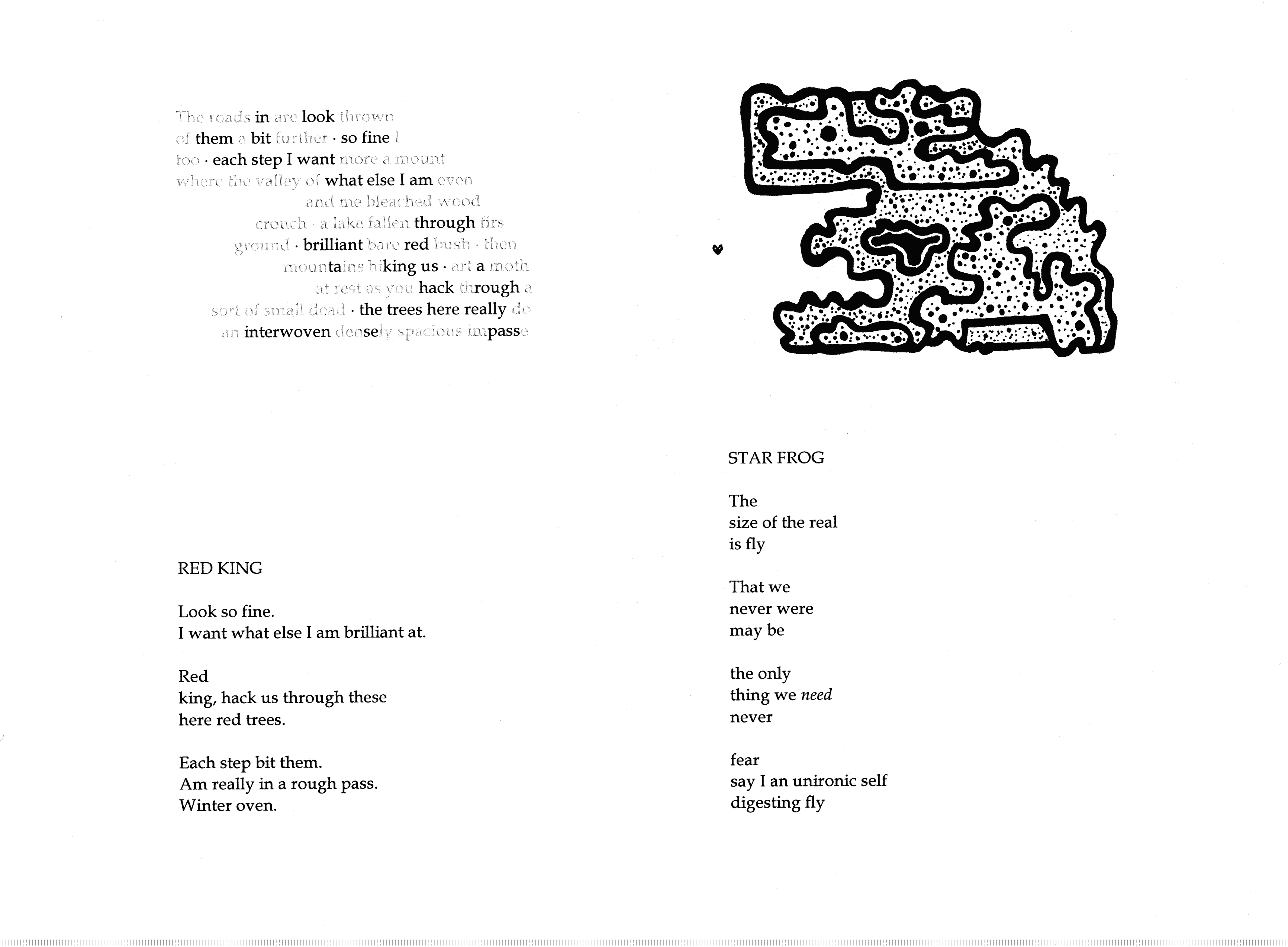
The four poems together make a two-page spread.
Upper left: prose scarred by an extraction process
Lower left: verse precipitated from the extracted ore
Upper right: illumination of the extraction scars
Lower right: verse inspired by the longing of the image
A good, straight, clear, honest question this morning from one of our company. You keep praising, he said, approximately, work that’s weird, kooky, associative, fragmented, with no clear story or theme or argument to make. But what’s the difference between doing that and just spreading random garbage on the page?
And one came up after with another version of that question. You keep encouraging us, she said, to make big crazy associative leaps, but you wrote on my exercise, What’s the arc, where’s the through line? What gives with that? Which is it you want?
Just the questions I want to stir in them. I hope they know they’re doing great. Not sure how robust my answers in the moment were, so am thinking it through a bit more, here.
Will invite them to, and hope they feel moved to, read on.
A first thought. Three images, or words, or sentence fragments, say, can be at a great distance from each other and still make a pattern. In the same way that three stars, 10s or 1,000,000s of light years apart, can still belong to a constellation. In fact, they can’t not make a pattern—
*
*
*
—a triangle. In other words, even three bits of garbage, set out mindfully, make a shape. Could be slogan to the blog.
The triangle is from one vantage the perfect form. The number of points of contact by which a stool cannot not be steady.
And constellations are, besides, maps of human mind, not stars “in themselves.” Epsilon Pegasi has no sense of being part of a horsey.
An essay contrasting perfections of the circle (singular Platonic transcendental annihilatory) and the triangle (multiple immanent ecological). This from Creeley’s “Numbers,” in Pieces—
ONE
This time, this
place, this
one.
…
As of a stick,
stone, some-
thing so
fixed it has
a head, walks,
talks, leads
a life.
Alongside this—
THREE
Here forms have possibility.
…
The first
triangle, of form,
of people,
sounded a
lonely occasion I
think—the
circle begins
here, intangible—
yet a birth.
His priority always the forms the multiple takes. The circle as not singular perfection of the point but rather multiplication to infinitude of the triangle. Creeley as Pythagorean shaman.
But I digress.
Oh yes I do. Not much here yet of use to my students I fear. But must turn to work on a job letter. So, to be continued, and in the continuance, I hope, these.
First words of Tender Buttons. Disjunction as narrative fatigue. As provocation & alarm. As faith in essential wholeness. And probly, cuz I’m going on my nerve, lots I ain’t thought of, yet, now, here.
Some phone number poems by my students. Tinkered to keep their actual phone numbers private! Again I’m struck by how good these are, how dynamic the line breaks, and compact the thought of them.
A clock,
Four chimes until sun Hung lonely on a barroom wall Tick tock. Hank, Red eyes, crooked spine Twelve drinks until the night shift starts, It’s only cycles Tick tock.
What did you do to make them so mad?
Insult their baking skills? Or was it something worse? You can tell me.
Well, I said their baby was handsome. Turns out, it’s a girl.
To be just what I wanted in the past, then here and now
falling down getting up just how I wanted.
Hello there I first saw you last night
Your face was set by moon light Salty misty Air On the beach a glimpse of your Red hair. Hello there, if I may I am in love with a silhouette.
Where is my cat? Is she hiding? She hides in cupboards sometimes. She is an elusive ghosty. Consistently floats around my house like a spook.
Well well well, Lookie what we have here.
An ambassador from my hometown. You thought I’d left?
Negatory. Still here. I called finders keepers on steering a bike with just one finger.
Melody She sings as if it were life
She sighs soft songs as if it were sad- ness her voice silences the audience that comes for her sweet sighing of song
Can’t sleep.
I guess I rarely do. I’m trying to keep my promise. Hope. I wish I could call, I need your help. He needs brothers. The rain comes more often than it did. They tore down the place you saved me.
I saw
no I have not seen it I dreamt it sleeping sideways on route to somewhere white I had not yet an understanding of what pictures could mean I just felt you through the glass door say nothing of truth I know
Write a poem using your own phone number, with area code, as the template. Specifically, the number of syllables in each line should match the corresponding number in your phone number. If your area code is 360, the first line has three syllables, the second line has six, and the third line is blank (a stanza break).
The poem should read naturally—as if it just took this shape of its own accord. Don’t worry about the subject, let the form lead you where it will. An example:
360-650-6354
How did you 3 find your way to this place? 6 0 Oh, I was just thinking 6 one day about toads, 5 0 toads that look like stones, stones 6 that are toads 3 when no one’s looking 5 at them at all. 4
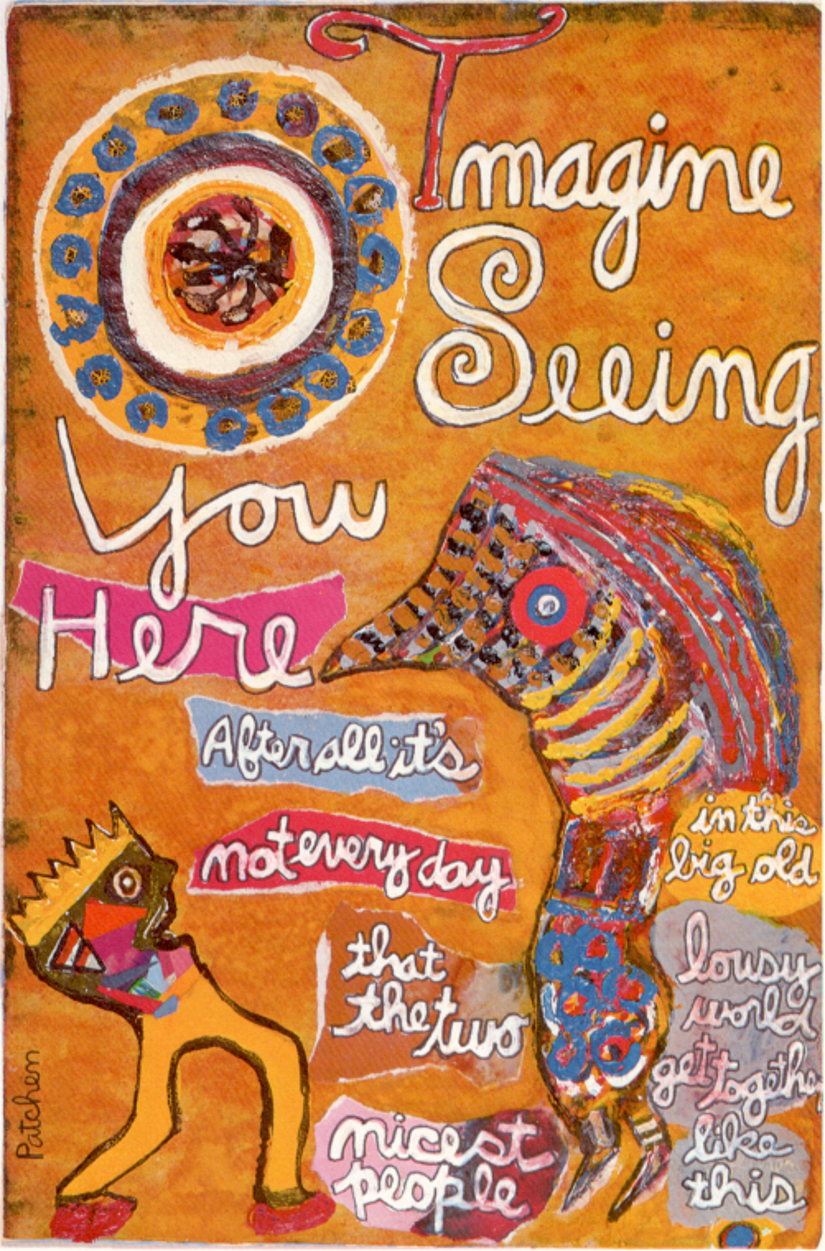
Not anyone’s actual number. Exercise adapted from Janet Burroway’s Imaginative Writing. Image up top is cropped from Kenneth Patchen’s “Imagine Seeing.”
In “The Argument of Innocence” (1976)
Imagine a rotary phone with 16 digits to range among. A computer dreams in hexadecimal . . .
From my students’ found poems (posted with permission). I’m stunned by how good these are. I sense in some a little imitation of the Ashbery I gave as example—but a little imitation’s no sin.
YOU ALWAYS
Every little bone
Lost and found
Some sickness
Coming home
Stretching you
Still I have to wait
Giving you a chance to go on
Source: bits of overheard conversation on local buses.
BUST TALK
Bring it to the boid. Where people do.
Moment of your. Ladies . . . ? Put antlers on my.
Can’t do it without. Don’t want kids.
Girls had to be escorted through the. Tilting it in besides using.
Fairly difficult to. Friends who couldn’t boil.
I can just carry. I lied I said I was.
Sources: the bus, roommates making dinner, the grocery store, a girl talking on the phone in the library, some girls in a parking lot.
(UNTITLED)
My life in the garden. A professional creep.
Measuring mortality. Underestimated desperation.
The God of eggs. Drops hundreds on stupidity.
Leeching souls. Rotting citrus. Raining hedgehogs.
A glottal stop. The crazy’s back.
Can’t trust delusion. In a house of stray cats.
Sources [this list makes a companion poem to the first] [some names changed to preserve anonymity]:
1. Meghan working in our yard
2. Kayla liking to explore attics
3. Liz, population issues
4. Dr. C., on human tendencies
5. Evelyn making snack
6. Me, on calling a lock smith
7. Sam’s dramatic description of a professor
8. Brandin, on the rotting fruit in our fridge
9. Kayla’s friend got a hedgehog, misheard “training hedgehogs”
10. Kayla, it’s a sound in Arabic
11. Meghan, on Arianna’s return to our house
12. Marylin, warning us about Arianna
13. Boston, describing our housemates as kitties.
FOR NEW ZEALAND
For New Zealand and
in Iceland over yonder
a bottle of wine . . . or two
so superficial
off the light like you.
Freaking cute!
My Hawks and future cowboy
perfect comment
so much ass
three times the national rate.
In your prayers, but
years from now
in the dark
a moment at the Texaco
tis the season to fawcking love this.
An Autumnal mood
Monday, like crazy
and outnumbered benefits
yummy Mexican, oh so texty
but fly as shit.
Source: Facebook statuses of friends.
(UNTITLED)
All of us on the road from Scotland to Silverado.
The sound and the fury as I lay dying.
Sex lives of cannibals, basic logic.
Kama Sutra, great expectations.
Two years before the mast. The poisoners. The Italians. The great pyramids.
A tale of two cities. Mumbo jumbo.
To a god unknown. Welcome to the monkey house, beat reader.
Source: a bookshelf.
(UNTITLED)
A dusty room. Deprived of sun.
Melancholy soul. Little sinks.
Against a rule. Being ignored.
The sun to night. To worlds of dark.
Of memories. With setting skies.
The patter of rain. A wound unmended.
Slept through. A candle blown.
Our sorrows in shades. Once a vessel.
And every song. A complicated knot.
About my regret. My every thought.
To never be found.
Source: Love and Misadventure by Lang Leav.
DID YOU HAVE A GOOD DAY?
Letter openers. Cardboard cutouts. Ibuprofen.
Kites everywhere. A nap midday. Chocolate chip oatmeal cookies.
His Hungarian going? Dry erase. Pink computer.
Things that actually kill us. Educated math students.
Happiness shaved off the Neverending Story.
The Hello Kitty blanket tastes like burnt meat.
Sources: The West Wing, overheard conversations at a friend’s house, class lecture.
MESSY PHRASES
Sweet Everlasting Voices. may have Blamed. Word for Word.
left on. Loose Paper. an Aged Man. the Sea swept.
He drew. says the Ghost. live in the Peeling Mansion.
with feeling older. let the Tongue slip. swap our Lies.
They made You. to fear Them. praise this Mess. the Slow Rain.
Source: poems on the Poetry Foundation website.
MEDIA OVERLOAD
Well the situation is
What’s wrong with the kids these
Staying high all the
Let’s forget these tragic
Days long ago
Hello folks
Drugs aren’t the
WRONG ANSWER!
Let’s continue on
With the sex drives of teens
…
Monsters aren’t
The only thing
Giving these all
Away to fairyland
Drug dealers are too
…
So in the end
Nothing makes me
HAPPY, HAPPY, FUN TIME
After this tragic
Floods in Florida
Sources: Listening to two or three media devices at once, tablet, desktop computer, phone, each on a different kind of media. E.g., one playing YouTube videos, one with live and old news, one streaming music.
Write a poem made of foundphrases. “Found” means you don’t make them up yourself—you see or hear them around you. “Phrase” means more than a single word, less than a full sentence. Choose one kind of source to take your materials from. A few possibilities:
bits of overheard (or misheard) conversation
first phrases of poems in an anthology
phrases seen in print ads (magazines, posters, billboards)
Avoid song titles and song lyrics—they tend to be clichéd and to make clichéd poems. Find a source that offers bits of language you feel eager to mess around with.
It’s okay to make small changes (e.g., removing a verb to turn a sentence into a phrase, or changing verb tense to make two phrases line up) but avoid introducing any words of your own.
You may not be able to make the sort of sense you wish to. Let the material lead and you follow. Instead of worrying about making sense—focus on setting up resonances.
An example, from John Ashbery’s “Title Search” (though not in fact a found poem it reads like one):
The Little Red Church. The Hotel District.
I’ll Eat a Mexican. The Heritage of Froth.
The Trojan Comedy. Water to the Fountain. Memoirs of a Hermit Crab.
The Ostrich Succession. Exit Pursued by a Turkey.
In the Pound. The Artist’s Life. On the Beautiful Blue Danube.
Less Is Roar. The Bicyclist. The Father.
Had a brief (5 min) but good (very) discussion in my afternoon section of this bit from Robert Creeley’s Pieces.
Cup. Bowl. Saucer. Full.
We’d talked about integrity of the line, its wholeness, and I asked whether these lines, short as they are, felt complete. Do they offer an experience that satisfies and then releases you to the next experience. I expected great resistance but they so got it.
One saw a telegraphic narrative of breakfast (cereal and coffee). Another one of lunch (a cup or a bowl of soup). Another saw a formal patterning that reminded him of the buildup and falling off of a short story (three letters, four letters, six letters—over two syllables!—then down to four).
And all of the resonances metonymic. A poetry of everydayness.
I can’t hear pieces as not also peaces.
As in, the mind of pieces, is a mind of peaces.
Very different from our sense of “going to pieces,” falling apart, fragmenting, disintegrating. Here, rather, that any part, however wayward, however bereft or stranded, is its own whole.
My old teacher, Daido Roshi, said to us often, You’re perfect and complete, just as you are. He was no softy, he was a dragon, but he said that. I remember one sesshin (meditation intensive) when I was in a hard way, I went in for dokusan (face-to-face teaching) and blurted out, tearstreaky and snotfaced, Perfect and complete under all the conditioning (dumb learned damage we carry), or perfect and complete with all the conditioning? With he said and rang the bell. Creeley’s Pieces brings me back to that.
A beautiful thought of Thich Nhat Hanh. There is no way to peace, peace is the way. Do I harm it, and I hope not, by this variance, there’s no such as peace, there are only peaces.
Creeley had no patience for any zen bs or so I’ve heard. And yet the most dharmic poet I know. Here’s his take on Dogen’s “body and mind falling away”:
Here here here. Here.
And here, the myriad ways of seeing water, Dogen says different modes of being have:
The bird flies out the window. She flies.
.
The bird flies out the window. She flies. .
The bird flies. She flies.
A variance, for sure, on Williams’s old woman, those plums.
A cup, a bowl, a saucer, all full, not in the sense of bearing up some matter, though they might that also, but in themselves, present, there.
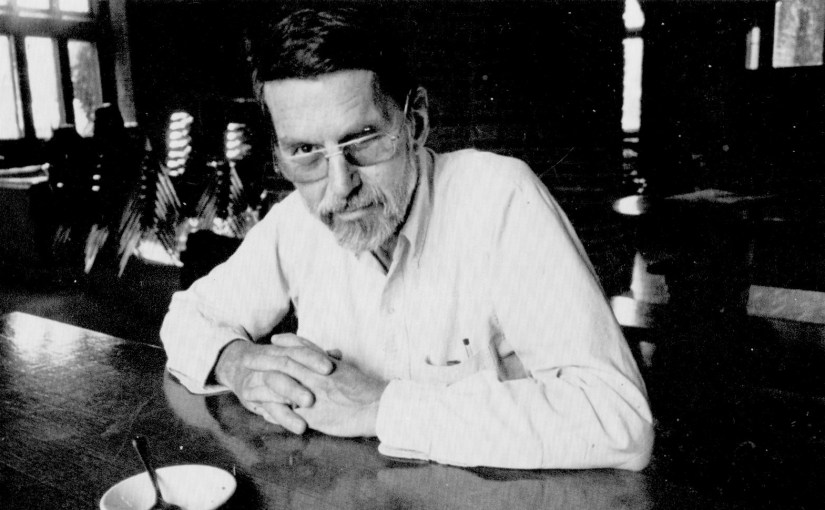
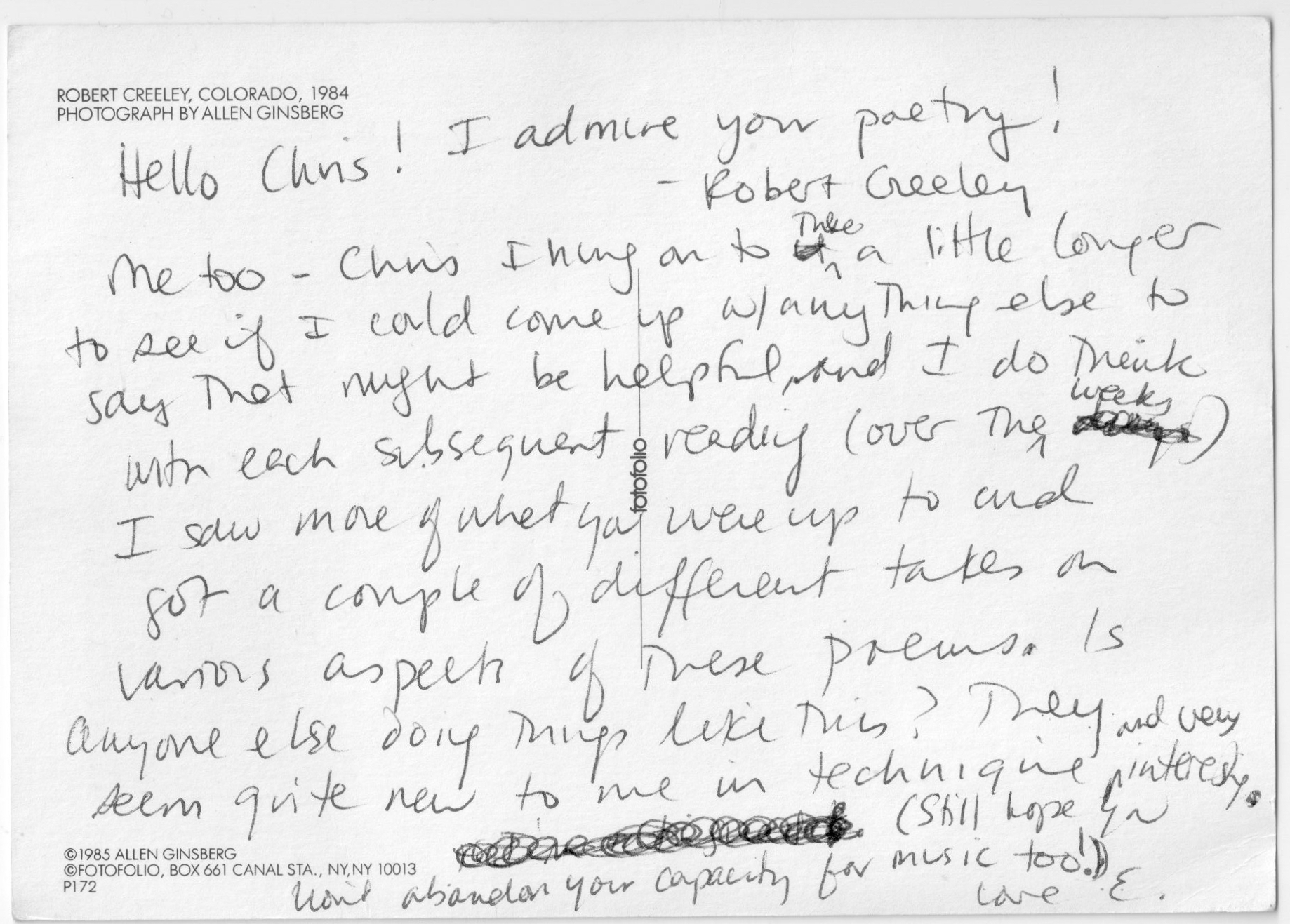
The image up top is a postcard of a photo taken by Allen Ginsberg sent to me by Elise Partridge after she’d turned her own clear quizzical eye to some poems of mine. In its entireties:
A variation on the well known Exquisite Corpse exercise dreamed up by the Surrealists. Begin with the words “I went down the stairs and around.” Each contributor only sees the words written by their immediate neighbour. Each contribution is to
finish the previous phrase
begin a new phrase (not a clause)
keep the sentence going (no periods)
Some were shaky on the phrase/clause distinction, so we didn’t quite get to the octopus (one clause from which innumerable phrases hang) of my dreams. But here’s one we wrote (apologies to my other section, that one got lost):
I went down the stairs and around the bend, then down the womping willow they scoured in their boots and in a moment that was tense, they almost were caught so they pretended to be in the circus with a group of cowboys and cowgirls that learned to lasso these silly bulls that stampeded from the mountain shaped like a monkey’s head which made many bystanders turn their heads and fall to the ground laughing so hard their stomach had an out of body experience while digesting the chili from the diner on the corner of Wall and Broadway, it steamed as though 3 men touched each others’ swords together in a loving embrace that ended in the joining of four souls which ultimately began edging towards the end of bombs and explosions.
Word. Or, phrase. (As in, that’s the unit we were on.)




 The Art of Compost