Exercise: Anagram poem

Christian Bök describes his poem “Vowels” as an “anagrammatic text.” It builds itself out of permutations of the letters of the title. Write a poem according to the same principles. Your title should be a single word.

VOWELS

loveless vessels

we vow
solo love

we see
love solve loss

else we see
love sow woe

selves we woo
we lose

losses we levee
we owe

we sell
loose vows

so we love
less well

so low
so level

wolves evolve

teaching portfolio

On sound (I)

When semantic meaning is eclipsed all sorts of other meaning come out of hiding. In our first class I wanted to get students thinking with their ears about vocables — oral sounds — apart from the meanings we like to grant certain of the shapes they take (words). It’s hard to explain but easy to experience.

I started them off with scat singing (always defined in terms of “nonsense” vocables — slanderous) by Louis Armstrong —

and Ella Fitzgerald:

Only a brute would deny there’s meaning there. Not the sort of meaning we mean when we say “I understand what that means.” Much closer to the meaning we mean when we say “you mean a lot to me.” When someone reaches out to someone and makes contact — that’s a meaning.

We moved on to Christian Bok’s performance of Hugo Ball’s Karawane (a more gravelly doing than the one I played in class):

In some spots it’s a little referential and a lot mimetic — jolifanto calling to mind swaying circus elephants. But at the core it’s what the Russian Futurists called zaum or beyonsense — expression released from reference so its sensuous and esoteric possibilities can unfold. Sometimes comically, as here, and sometimes not.

Some meaning is had. Some meaning is been. And some meaning is done. Our focus here is sound, but I can’t resist a bit of vision, how Ball’s poem steps out to the eye:

Anyway, my students did great with this weird trio, pointing out connections to the proto-articulations of infants (which mean nothing communicable but everything to mom and dad) and the science in non-Western cultures of the spiritual efficacy of sound.

And, less esoteric, the noises we make to get something immediate, embodied, across. Ahhhhhhhh. Oh! Hmmmm.

teaching portfolio

First thoughts fall quarter

Okay, the move’s mostly made, still a bit of unpacking to do, but we’re up and running.

I’m teaching two sections of Intro to Creative Writing this fall. A course I’ve taught lots before but doing a thorough reno on it this go through. Less on core concepts and genre conventions. More on creative mischief and sideways mindleaps. The old version was good on fundamentals but kinda sobersided. And at Western this course isn’t a gateway for creative writing concentrators who need to learn all that good stuff. Rather it’s an elective taken by a lot of non-majors and future elementary and high school teachers. Who’re going to want some ways to get their students excited about the creative import of their own minds.

The first thing they learn about the course (after my office hours):

First premise. There is no one who is not creative. To make art—to sing, dance, shape sound, movement, language, or paint, any medium—is a birthright, as natural to us as our powers of speech and affection are. Second premise. We have not always been well served by our schooling. School may have, in fostering some of our capacities, estranged us from others. Most of us were probably better poets at six than at sixteen. Tentative conclusion. It is one task of a creative writing course—especially an introductory course—to rekindle the spark that connects, not A to B, but Q to oranges, mosses to stars. I don’t know exactly what this course will be—I see it as a work in progress and collaborative—but I hope you’ll feel more awake to being-alive-here-now for having taken it.

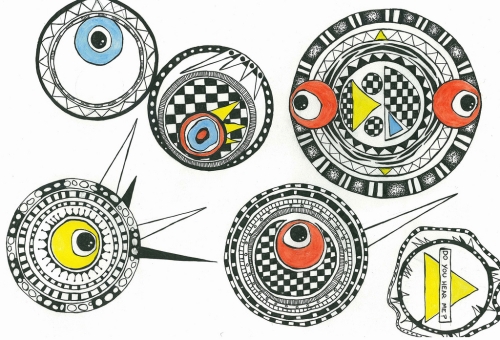
Heavy. Time for a foolish picture.
Cover image (4)

And so our itinerary is, one stop per week —

Sound
Word
Phrase
Line
Sentence
Image
Paragraph
Figure
Person
Shape

My posts will probably fall out likewise.

Howl, phonetical

From bombmagazine:

Seven posters from The Singing Posters: Allen Ginsberg’s Howl by Allen Ruppersberg (Part I), 2003, 14 × 22 inches.

These are pretty. Got nothing much more to say than that right now. Oh and they bring bill bissett’s hypercool phonemes to mind. Oh and they confirm that each line of “Howl” really is a page —

One more torn page

One more from Barb (she’s on a tear).

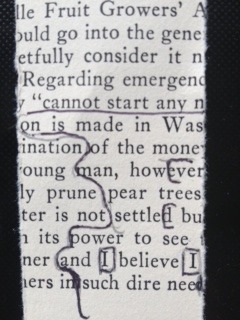
image

And transcription:

(old men)no books (3)

on is made in Was—
of the Mone.

Man how pear trees
settle power

to see and believe.

(such
dire
need)

I think I mentioned I came up with this exercise 10 minutes before the first meeting of my Art of Compost class this summer when I saw in my notes “exercise: something with torn pages” and realized I hadn’t worked out what “something” was.

William Carlos Williams famously wrote, “write carelessly, that nothing that is not green survives.” Not sure the same always applies to lesson planning but here it worked okay.

The pages we tore in class were from a battered second copy I had of his Imaginations.

Final projects: Caitlyn

Caitlyn assembled a source text from found material and then performed an erasure on it to generate

EVE

          She thinks          this is
                      morning,         “I’ve got my

    things, I’m on the
verge.”

                    Guess
                    I  have
                        you

  breathing.

                      Finally, this

                                                two to one

static:

                        I swim across an
                    ocean
                from an         empty

                                                    room.

(Erased from a base text made of the first words of each song on the album Everything in Transit by Jack’s Mannequin.)

One thing I really like here: how the poem combines (composts) two time-honoured practices — the found poem and the erasure poem — in a way that feels seamless and self-assured.