
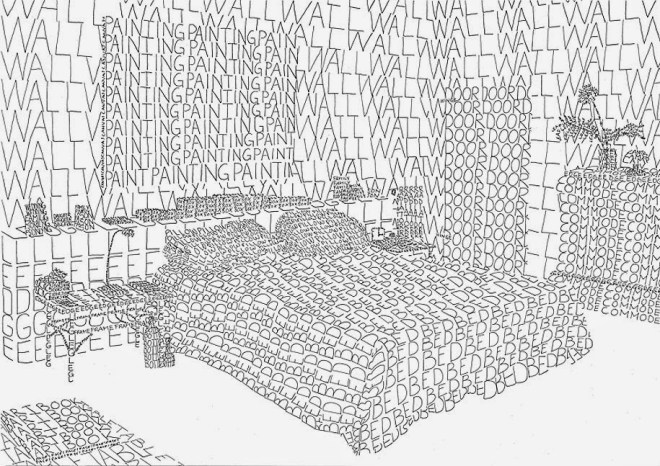
This from visual-poetry:
Literalism, literally.


This from erikkwakkel:
Smart page with string
These pages from a late-16th-century scientific manuscript share a most unusual feature: they contain a string that runs through a pierced hole. Dozens of them are found in this book. The pages contain diagrams that accompany astronomical tracts. They show such things as the working of the astrolabe (Pic 1), the position of the stars (Pic 4), and the movement of the sun (Pic 6). The book was written and copied by the cartographer Jean du Temps of Blois (born 1555), about whom little appears to be known. The book contains a number of volvelles or wheel charts: revolving disks that the reader would turn to execute calculations. The strings seen in these images are another example of the “hands-on” kind of reading the book facilitates. Pulling the string tight and moving it from left to right, or all the way around, would connect different bits of data, like a modern computer: the string drew a temporary line between two or more values, highlighting their relationship. The tiny addition made the physical page as smart as its contents.
Pics: London, British Library, Harley MS 3263: more on this book here; and full digital reproduction here.
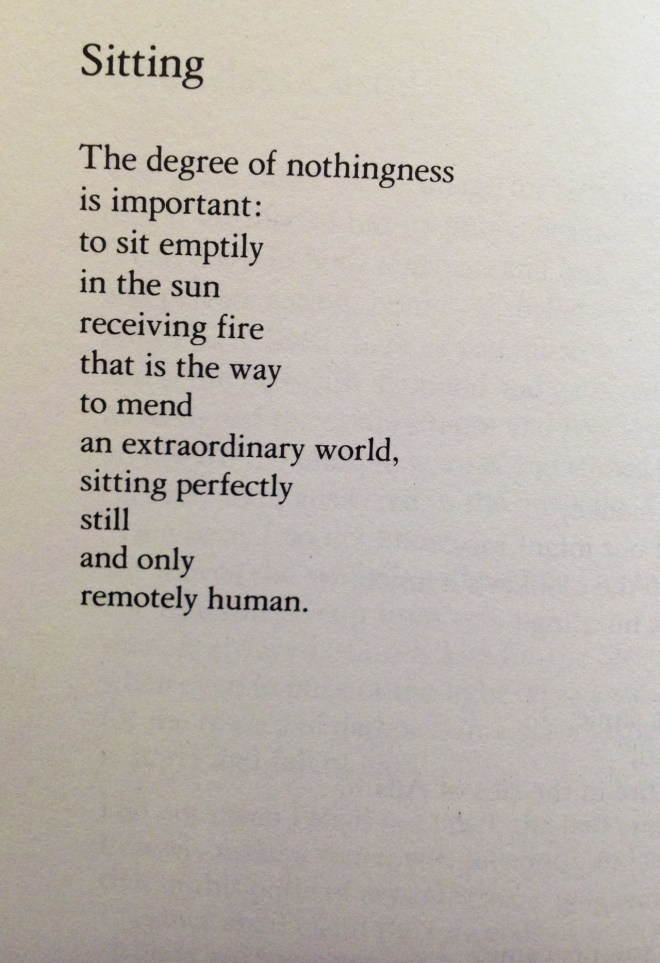
This one just in from shazia-r. “Sitting” by Phyllis Webb. I’m liking how it sits a bit aslant. Leans into its silence.
about growing older. Jean Valentine. John Taggart. They seem to have grown more and more clear and beautiful as souls. That’s aging I can envy or aspire to. Just think! We could have been a Romanian gymnast.
A lovely typo on my birthday from a much loved friend —
very glad that you will be loved ones among
whom to celebrate.
May all my misses be such hits.
We found as a class three things compost does. One, there’s a breaking down of old forms, cauliflower leaves corn cobs egg shells radish greens, they begin to lose the walls that bound them as what they were. Two, there’s a blending and a merging, as the elements released in the breakdown start to wander in search of new figurations. (See mandibles in Empedokles, the clinamen of Lucretius, the fact that matter does wander, that’s its nature, that is nature.) Three, something’s nourished, as nutrients released by the breakdown and rearranged in the blending become the constituents of new forms, new ways of being life.
And found all three at work Carson’s translations of Sappho in If Not, Winter. Just one for now (all things in their times). The first line of the one poem of hers we have whole, called often her “Hymn to Aphrodite,” in the Greek is
Ποικίλοφρον ἀθανάτ Ἀφρόδιτα
Transliterated that is, I think, I have no Greek,
Poikilophron athanat’ Aphrodita
And translated word for word,
Spangle-minded deathless Aphrodite
One character is in question. Where Carson reads phi (φ), others read theta (θ), and that one difference, between a sphere crossed vertically and an ellipse crossed horizontally, is a difference between poikilophron, mind, and poikilothron, throne. Is it the mind of Aphrodite, or the chair she sits in, that’s glinting, variegated, subtle, ambiguous, changeful?
What makes this compost is that the two readings coexist. A word Sappho wrote, or had written, was made by time two words, jostling. We can never get rid of one of the other. Time’s co-author of the poem.
Deathless Aphrodite of the spangled mind
The world wants you here.
Doesn’t mean it won’t end you in an instant.
But it wants you here. You help it to be it.
Tearing and pasting, as in the exercises below, can be the initial ground of many sorts of practice. Susan Howe of course is an adept practitioner.

Now come up with your own variant. One requirement: it should somehow involve physical manipulation of a page.
 The Art of Compost