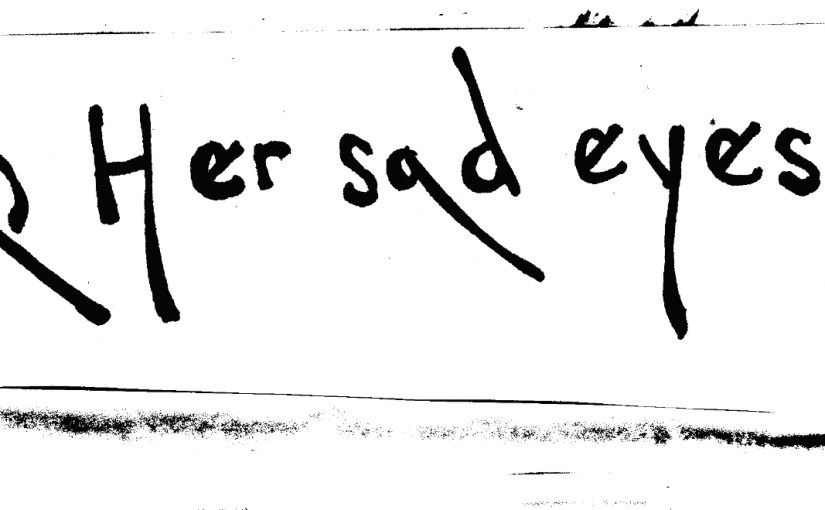
Sad Inanna

I’ve been posting scattershot this and that from Dumuzi and am feeling moved now to be a bit more steady and thoroughgoing at it. So I think I’ll post, as they come into their final framing, the picture poems I’ve made to tell the descent to hell and rescue and apotheosis of Inanna.

She’s the one who drew me into this biz in the first place many years ago. Before my true north turned out to be her rather less empowered but dearer to me now shepherd lover. She for me has been every woman, starting with the first of me, I have wanted to save or hold or leave or be safe with or from. “Devastatrix of the Lands.” O she’s a terror. And too she’s those eyes in the tent with Pound at Pisa not scornful. Kuanyin, what gentles.

So that got heavy. Also this is a comic book built out of junk mail. Anyway I’m thinking here at blog to intersperse the images with the source texts – in a way I won’t be able to in Dumuzi itself. If anyone’s ever fool enough to publish the damn fool thing.


The sequence begins with a word poem I hope gets the hapless awe one feels in the face of powers orders of magnitude huger than anything one could imagine mustering.

Reft

Tears
off a face
in bad

weather
at an altar
torn in

weather of
another
order.

Holy
sweet being
shining

gone
and the mountain
ashes in

flower.

The title came from Pound’s “What thou lov’st well shall not be reft from thee.”

Next, a picture poem.
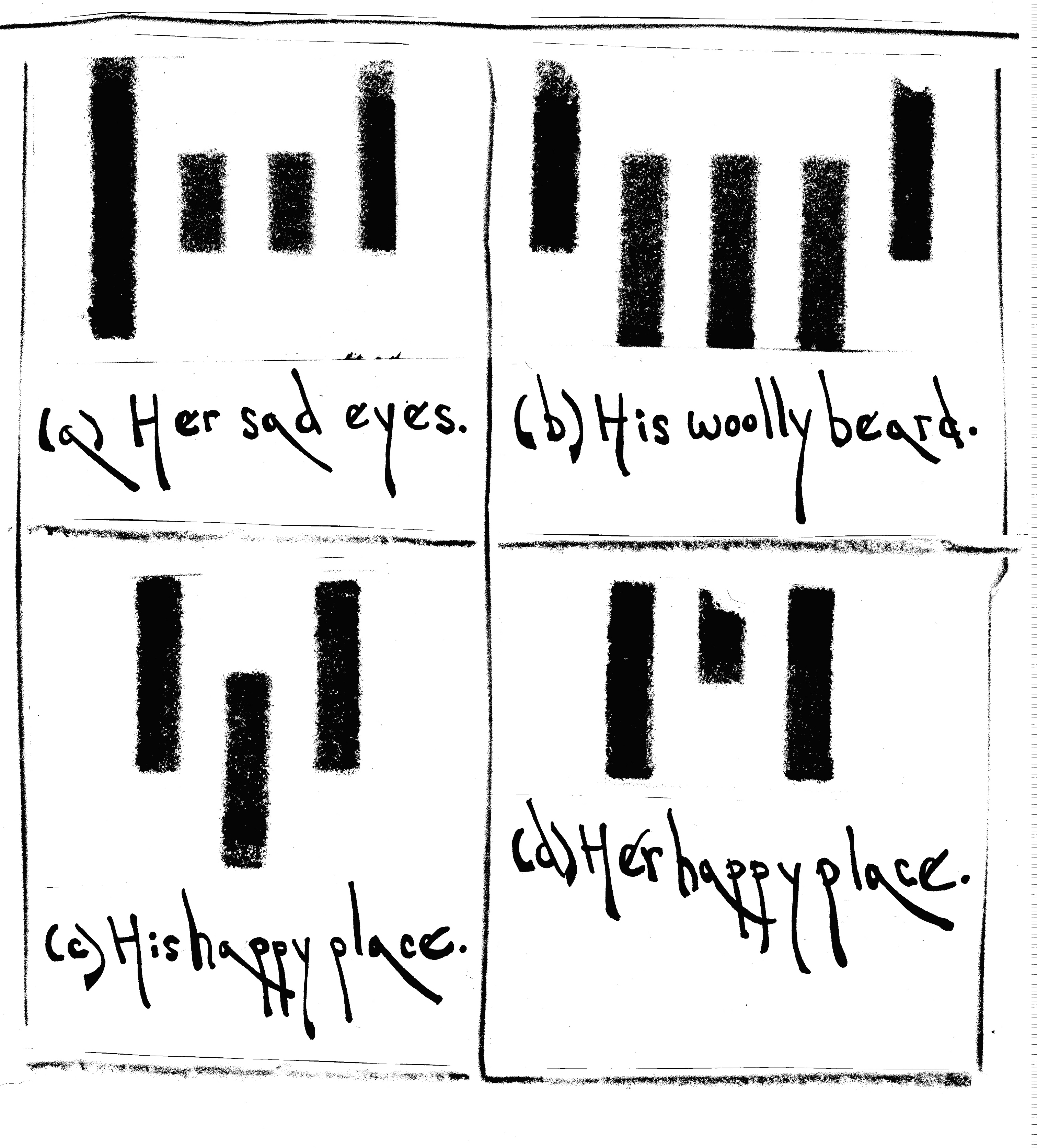
6. The lovers - fig

Kinda porny, I know, sorry. Goes with the territory (fertility myth). Intertitle, to tuck in at lower right, looks like this.
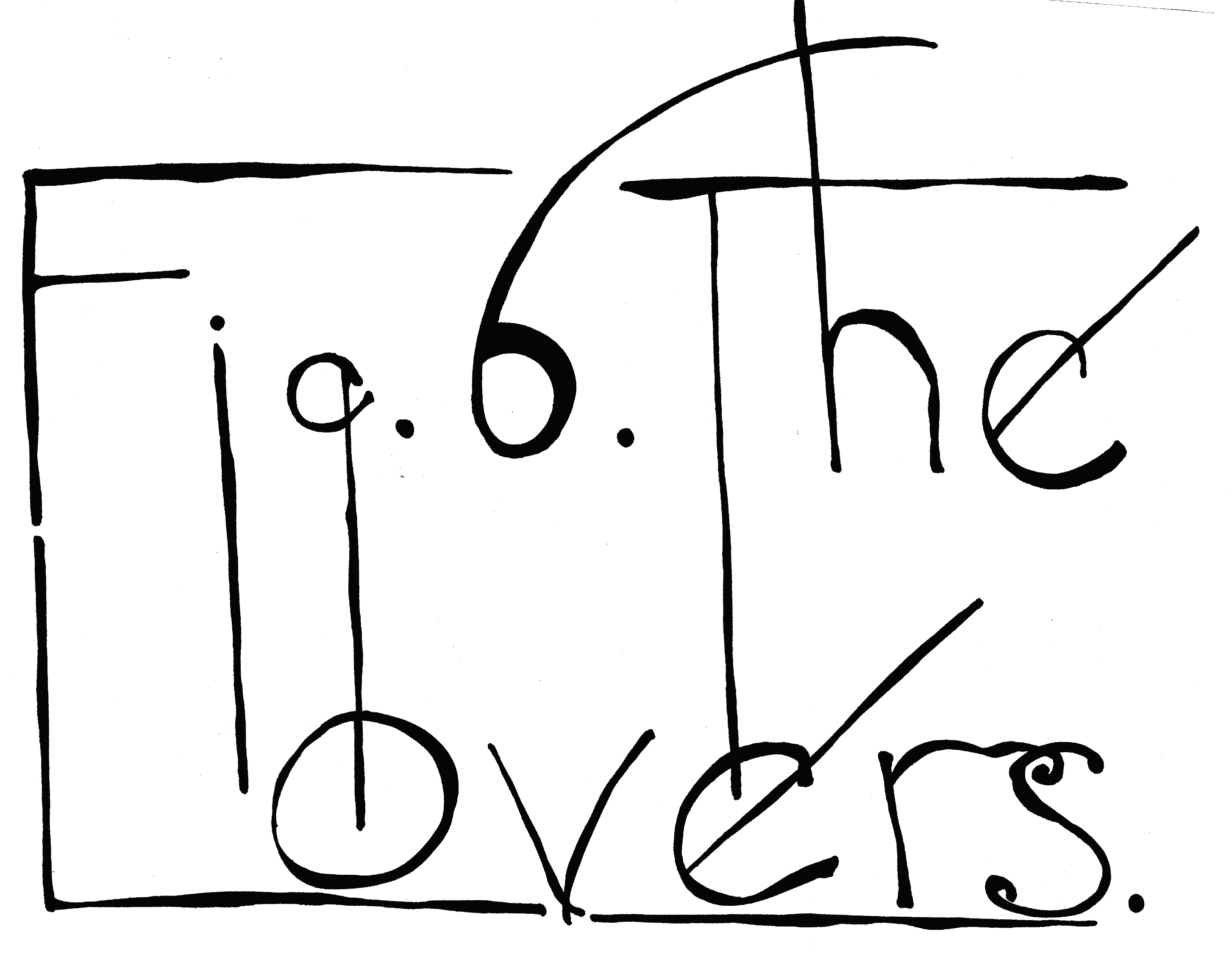
6. The lovers - title

The ground for it, the coitus and the tristesse, looks like this in the source where I first found them (The Ancient Near East: A New Anthology of Texts and Pictures, Vol. II, ed. James B. Pritchard).

The “honey-man,” the “honey-man” sweetens me ever,
My lord, the “honey-man” of the gods, my favored of the womb,
Whose hand is honey, whose foot is honey, sweetens me ever.
Whose limbs are honey sweet, sweetens me ever.

My sweetener of the . . . navel, [my favored of the womb],
My . . . of the fair thighs, he is lettuce [planted by the water].
It is a balbale of Inanna.

Somewhat more felicitous, and just for that more blushful, is Diane Wolkstein and Samuel Noah Kramer’s translation in Inanna: Queen of Heaven and Earth:

He shaped my loins with his fair hands,
The shepherd Dumuzi filled my lap with cream and milk,
He stroked my pubic hair,
He watered my womb.
He laid his hands on my holy vulva,
He smoothed my black boat with cream,
He quickened my narrow boat with milk,
He caressed me on the bed.

I prefer the anatomically more precise term “happy place.” Anyway, as all things must, this comes to dust. Says Inanna:

Now, my sweet love is sated.
Now he says:
“Set me free, my sister, set me free.
You will be a little daughter to my father.
Come, my beloved sister, I would go to the palace.
Set me free . . .”

I gave the restless to her cuz she’s the one to go awandering. That’s up soon. Thanks for scanning.
Intertitles

Funny how one thing connects to another. The mind’s a rhizome. In the mix right now for me so many. My friend Elise’s memorial yesterday. (What’s that you ask. Drafted this the day after never finished and come back to it now.) Voices of twins I woke to on NPR a few mornings ago and couldn’t shake from my head and bought the CD on iTunes (I never do that) and now listen to twice daily entracedly. The intertitles of a sweet fond symbolist early silent filmic confection called The Blue Bird by Maurice Tourneur.

A phrase underlined won’t suffice. Must embed them. My friend:

Read this poet's poems! Click to get to some.
Elise Partridge (click and go to her website)

And these amazing haunting singers, somehow right at the core of a cross where sensual & spiritual & naive & old soul meet (okay little crush):

Ibeyi (click and go to their river)

And the only intertitle I can find online from The Blue Bird:

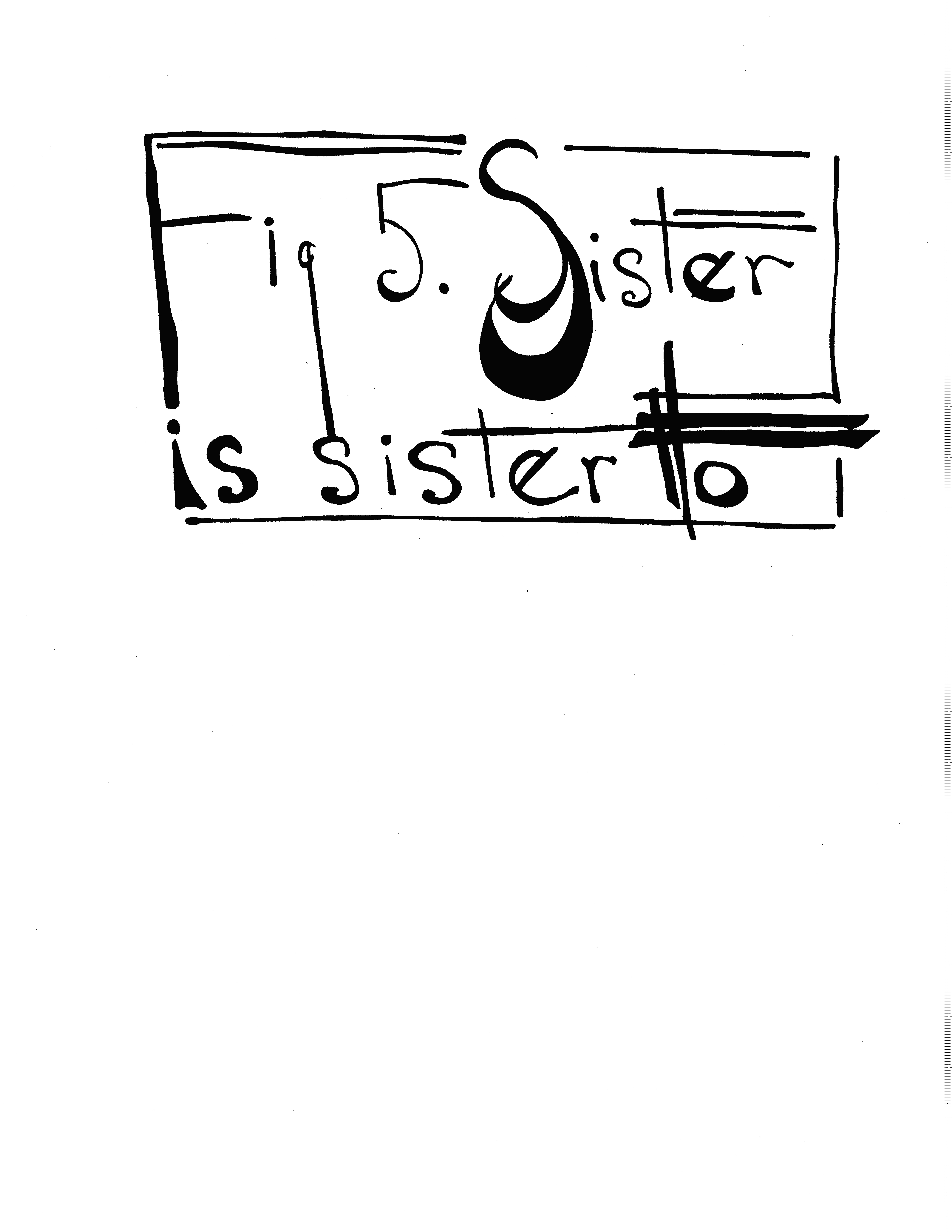
(The sentiment — gah. But — the elegance with which the H curls to encase the quotation mark and the terminal r stretches out to offer shelter to the ellipses. Decadence, sure, but guileless.)


All linking and clicking and clinking in unexpected ways. I have, e.g., and am sure of it, been trying to rescue Elise from the grave by making Inanna of her and bearing her through hell and out the other side. I spoke at the memorial about my propensity for magical thinking but didn’t get into the thick and gristle of it.

I don’t think it’s going to work, I think she’s gone from matter, already metamorphic-indestructible otherwise, but it’s a rite I seem to need to go through. So when I post, in weeks to come, comic book panels collaged out of junk mail depicting Inanna’s trip underearth and back, you can know it’s her, too, my friend, too.


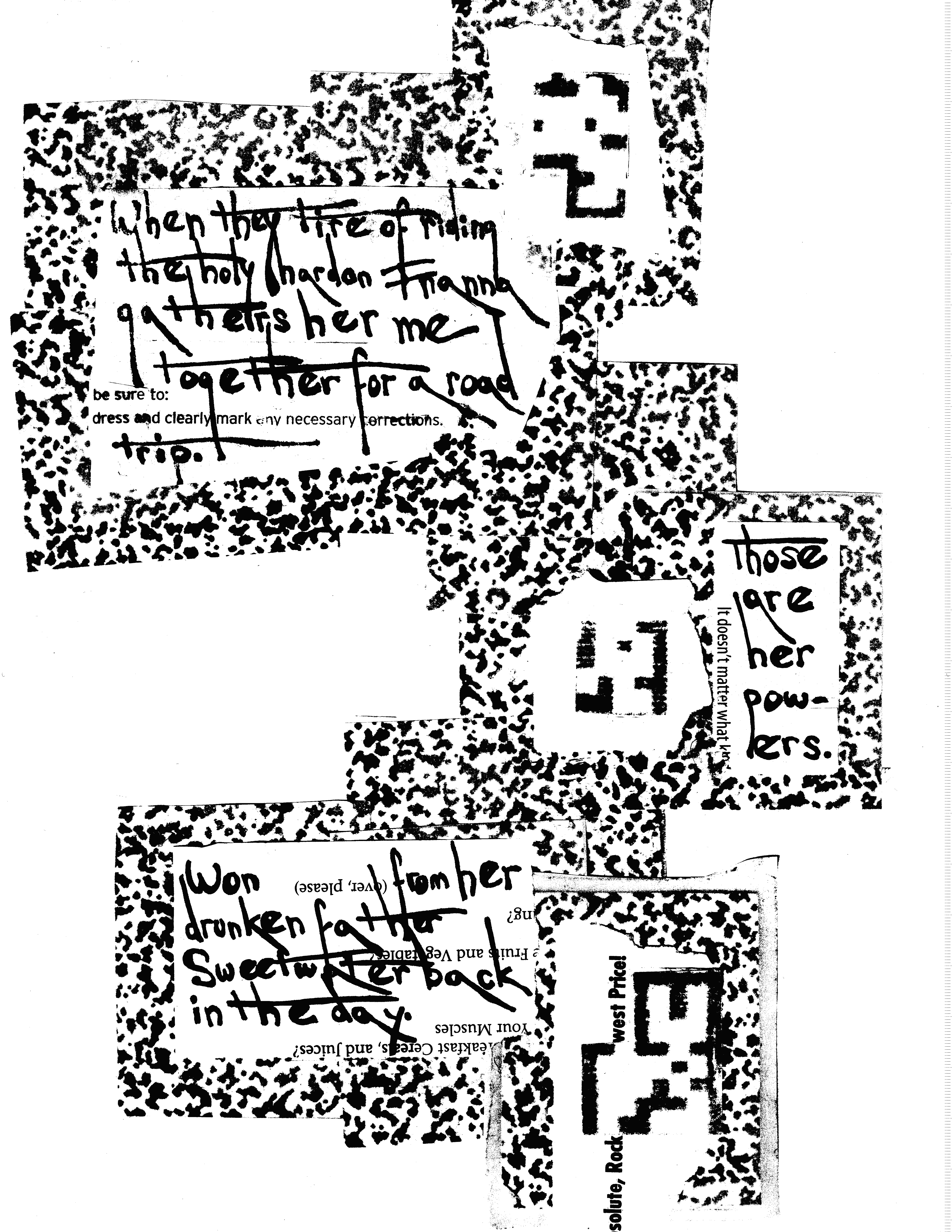
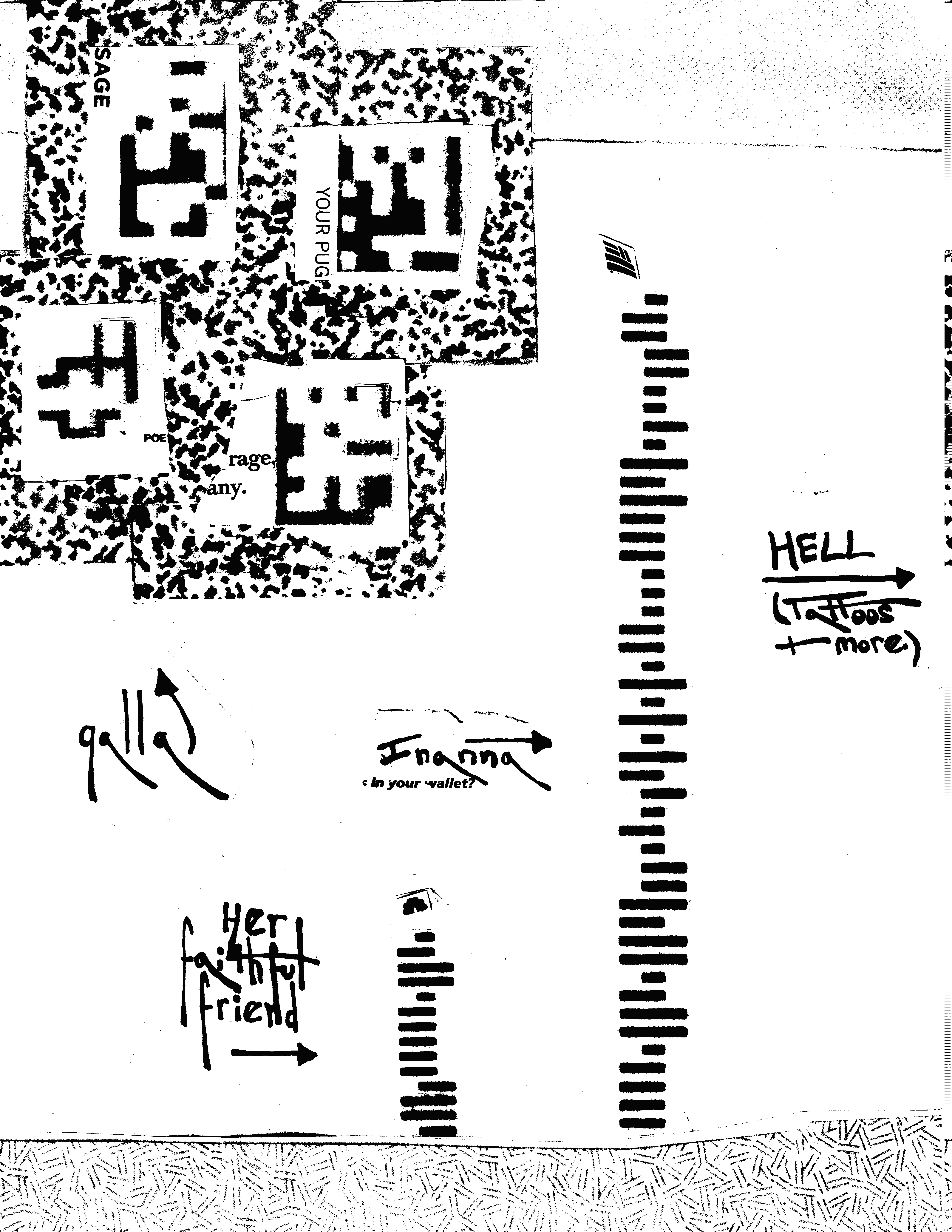
Here are the first two. A bit of opening narration:

1. When they tire

And her setting out:

2. Hell (tattoos)

All the visual elements, script aside, are derived from junk mail, mine or friends’. (Sorry about the crud on the right side, my damn scanner.) Galla: demons come to claim their due.

Going in the script for something a bit like cuneiform and a bit like the scribal hand in medieval Old English manuscripts and a bit like graffiti and with a bit of the energy moving my hand through ascenders and descenders and cross-strokes in the moment of marking. A bit of embodiment that’s been a long time coming and I find me greedy for it increasingly.


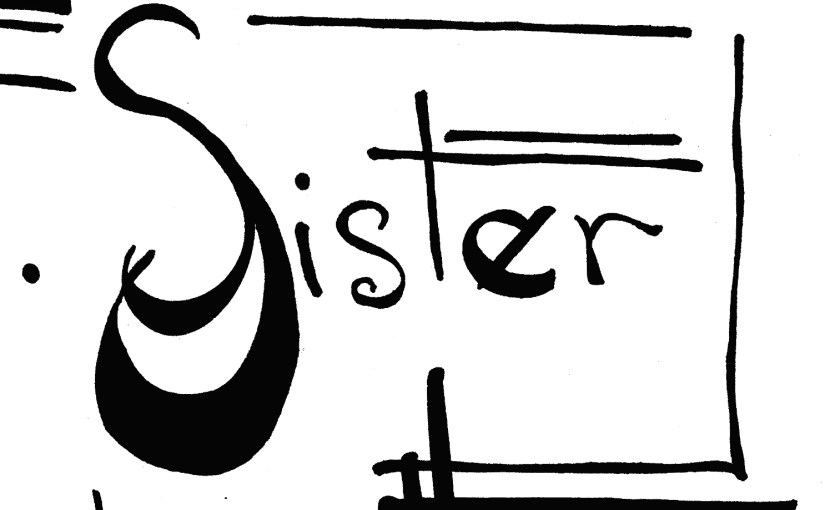
So that’s what Elise has been up to in here. The intertitles? Ibeyi? Together they suggested a possible elegance —

5. Sister is - title

— about which I’ll hope to have more to say later. For now a link to my friend Kaveh Askari’s book on early cinema including Tourneau’s The Blue Bird:

BFI
Read this book!

Junk mail bricolage II

On the far side of an intense burst of poem making. For a few weeks there I could do no wrong. Now though most of what I do is a strained imitation of what came full-throatedly before. If I were one of my students I’d tell me not to worry – time to lie fallow a bit is all. Since I’m me though I say time for some bloggery.


Here’s a fancy word I learned recently. Pareidolia. The tendency to see Christ in burnt toast, the Virgin Mary in soot stains on a wall, a man or a rabbit in the seas (the “seas”) of the moon.

We’re all pareidoliasts. My proof:

O       O

______

If you don’t see a face there you can stop reading – we have nothing in common.

From the Greek, para, beside, near, from, against, contrary to, + eidolon, appearance, image, ultimately from eidos, form, shape – the word Plato uses for his damnable forms. To make art out of such para-forms, and that’s where I’m headed, is give the philosopher an itch he shan’t ever manage to scratch.


Pareidolia coheres most around the human face – we’re made to make it out, and early, so early. Infant to mother, eyes to eyes, our survival in spirit depends on it, as much as our survival as bodies depends on the sustenance of touch those eyes signify.

But it seems to me there are other forms we are prone to see with hardly any prompting – trees, say.

Terror of tall trees

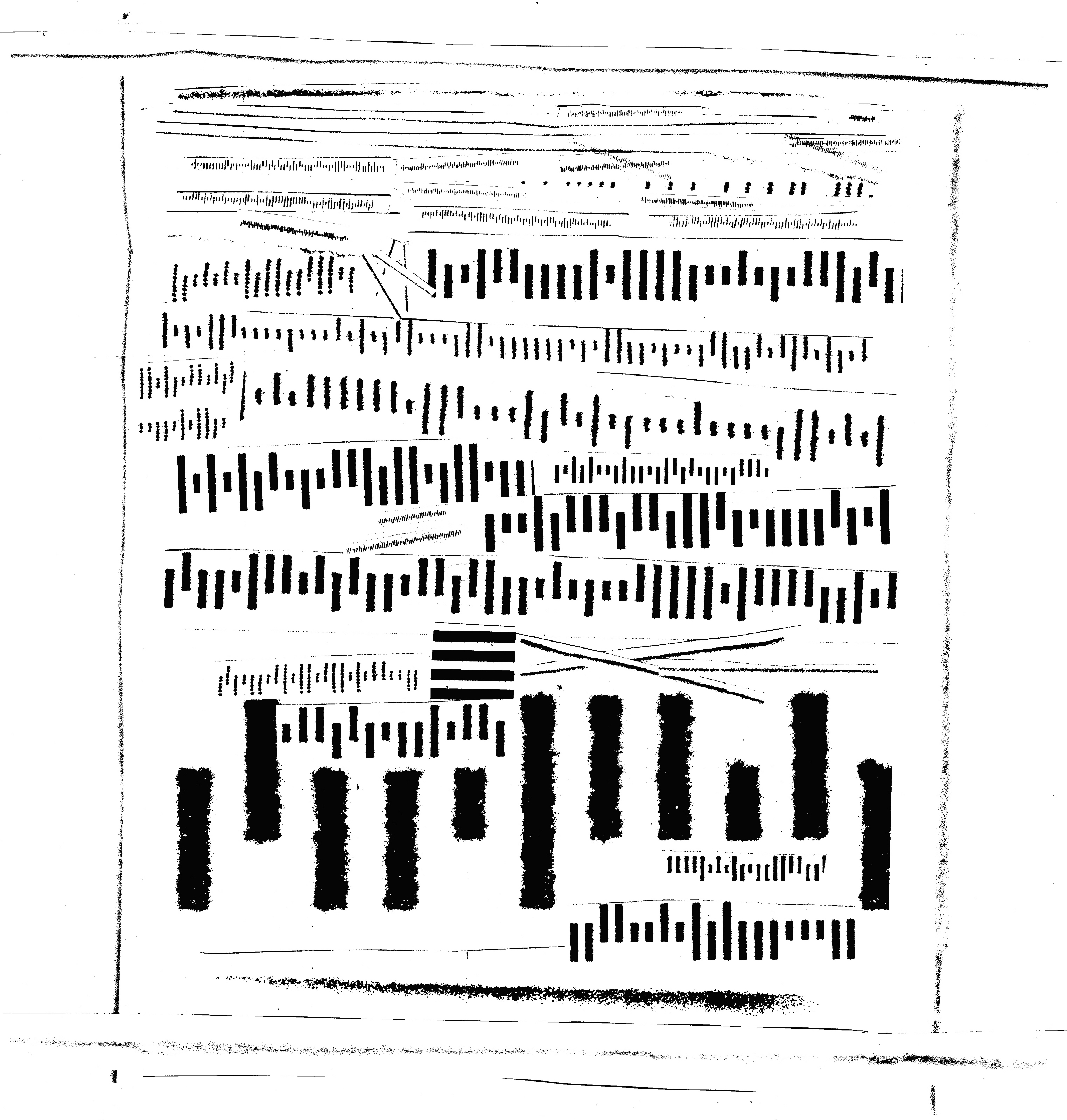
Fig. 1 Terror of the Tall Trees

This image is built out of junk mail bar codes (and the visual noise left behind by the strips of paper the codes are on when xeroxed). It’s the first one to show up in Dumuzi and is meant to sit right on the edge between “burnt toast” and “the ghost of Christ in burnt toast.”

The allusion is to Dumuzi’s dream, which he recounts to his sister, and the signs aren’t good.

Out of Sumer

A bit more about the handwriting sometime later. Working on a pretty/ugly hand that looks a bit like hurried wedged impressions in clay and a bit like clumsy medieval calligraphy and a bit like where my head was at when I make the strokes up to down and left to right.

K so fire

And run he does. Not that it gets he anywhere but deeper to wit

Terror of tall trees – detail

Fig. 2 Terror of the Tall Trees (detail)

And that’s what I got of an evening. Tell me what you think if you have thoughts. All this is new to and for and from and of me. C.

Junk mail bricolage (I)

A few weeks ago I took Dumuzi – a manuscript I had thought pretty much done – back into the shop for an overhaul. Started incorporating handwritten bits, pages of journal writing, fragments of the myth stroked out on scraps torn from junk mail envelopes, and’ve been pretty pumped about where it seems to be headed.

And my feelings in the wake of Elise’s passing, which have surprised me in their intensity, though why should they really, I loved her as a true friend, far from derailing the work seem to have thrown themselves into it for fuel. (I showed her one of them, not posted here today, and true to generous form, she flared, though it was far outside her taste, gladness on my behalf.)

Here’s one. I should say, this is the part of the book that tells the story of Dumuzi’s consort’s, Inanna’s, journey to the underworld, i.e., death and metamorphosis. As she readies for her journey (as if anyone chose such a journey) she gathers her me, her powers, which are all the powers of culture, our being as civilized beings.

her-me-1-3.jpg

And the other.

her-me-2-3.jpg

You’ll see some anger in it. Okay so yeah I’m pissed. Some of it’s, I’m pissed at the world, it took my friend. Even, let’s say it, pissed at my friend, she got took. And, some of it’s anger at, well, junk mail, and a life among and as commodity, even as it’s also an effort to subvert commodification. Sounding like a lit prof now shutting up.


What am I doing here. I don’t know. Something about an elegy in motion. If blog (I first typed glob) as form lets me do something my private journal nor a public statement won’t, too, it’s to do with catching the gist of the feel of the thought on the fly.

Photocopier poems

My paper towel star cluster poems. Made in five minutes on the department photocopier (and then some cropping via Picassa.) Somewhere in here, somehow, is the fact of having watched  Under the Skin, the first half, last night. Kinda slow, but the opening sequence, mating planet and iris, seems to have stayed with.

Exercise: Photocopier poem

Here’s their “writing” exercise for tomorrow:

After “reading” the examples, compose a poem by messing around on a photocopier. You should try out several kinds of manipulation (e.g., twisting, turning, shaking, fluttering) on several kinds of original (e.g., text, image, object) before deciding on a practice and a source to commit to. And then don’t be dismayed if it takes further trials to get to a poem you feel pleased enough with to hand in.

I played around on the department photocopier today (keeping a wary eye out for L. who had just cleaned the glass to a sparkle) with paperclips, paper towels, binder tabs. The paper towel rolls came out best & I’ll post them tonight.

Exercise: Strange surfaces

Write a fragment, prose or verse, on an unconventional surface. In other words, what Emily Dickinson does in The Gorgeous Nothings, you do too, on some other inscribable surface.

For instance, you might take a paper bag and cut a shape from it. Triangle, rhombus, hourglass, angel wing? Make sure it has interesting surface features. Seams and ledges and creases.

Then to write on it a text that heeds the shapes available. Do you ride right over seams between paper zones? Or arrange your thought to accommodate ledges, flaps, secret corners? Does the form of the surface maybe inflect the words you set down there?

The distinction between prose and verse starts to decay here.

FOR ADVANCED USERS (that’s anyone). Pay attention also to your writing implement. Dickinson’s envelope poems leave traces of her process — for instance, some variants were surely pencilled in later, after the whole was composed, if the quality of pencil line (darker, slimmer) is any guide at all.

The word for it’s materiality — that the matter matters.

Etymologically, matter is mother.

Hebrew: Adam = “red earth.”

Haida: human = “ordinary surface bird.”

We’re earth children you and I. Squawk and g’night.

Exercise: Punctuation poem

Next week we turn to the gorgeous Gorgeous Nothings, a collaboration across oceans and generations by Emily Dickinson, Jen Bervin, and Marta Werner. My students’ first exercise will be:

Compose a poem made entirely of punctuation. Then write a short paragraph describing what the poem “means.” Treat the paragraph as a creative extension of the piece — as playful creative nonfiction, not straight-faced literary analysis. Be ready to present both the poem and your explanation to the class.

The examples they’ll have “read” are retrieved from Rasula & McCaffery’s Imagining Language — up next.