The book I started work on in November has become two! The first, Horsetail Rhizome, starts in Sumer & ends with Gerard Manley Hopkins. The second, Occam’s Aftershave – for which I just drafted the text below – picks up where Horsetail leaves off & reaches into a future of quantum-genomic computing long after the Singularity.
I first met the polyvagalmodel of the autonomic nervous system (ANS) when looking for ways to tackle a chronic illness. It now strikes me that, whether or not it helped with my migraines, the model offers an approach to the relation of poetic rhythm – on the scale of phoneme, sentence, or canto – to our beings as innervated mammals.
As conceived by Dr. Stephen Porges, polyvagal theory says that a long branching parasympathetic cranial nerve, called vagus, “wanderer,” for its reach from earwhorl to bowel, gives us three frames (one more than we thought) for responding to stimuli.
Its ventral branch allows rest & digestion & opens us to affection & attunement. It goes quiet when a threat is perceived & the sympathetic nervous system readies heart lungs muscles sense organs &c. to fight or flee. The two we learned in school.
New to the picture is the nerve’s dorsal branch. It’s how a deer freezes in your headlights, or a bird your cat caught in your palm, or you or I raddled by rape or earthquake. Yeats’s rag & bone shop. Destination of every katabasis. The heavy hopelessness I feel a week into Trump’s second term. Freud’s death drive. But last resort of the life force. Can’t fight back? Run. Can’t run? Hide, go small, disappear, dissociate, die inside, for now. ¶ Notice how sentences & fragments, declaratives & imperatives – the ones you just read – affect you differently, bodily. That’s what I’m talking about.
Lot more to it, of course, as a physiological theory of mind. It has helped me some with mine& others I know with their troubles. I’m asking now though about its potential for literary theory. What might it disclose about the physiology of the poem – the poem as it addresses one’s imaginal body (mind’s eye, mind’s ear, mind’s limbs & organs) through kinetic & proprioceptive signals in its language?
Poem as embodied imaginal transcript of journeys up & down the vagal ladder.
I can say this much. I make a poem by enacting transits – lived the moment of making or recalled & relived – across realms of ease, activation, paralysis. I translate animal postures in the world into bodily aspects of human speech – stress pitch duration tempo as they register in mouth chest gut musculature – and image – direction of the gaze to curve line jag field & pattern. I do it, for instance, with the ampersand. I did it just now by omitting one. ¶ In “Weed Flower Mind” I used a fractured lyric form to chart the ups & downs, blisses crises & overwhelms, I met in zazen. ¶ My Dumuzi & Inanna poems make of their motions, from heaven to earth & underearth & back up, mythic correlates for states of attunement & danger & despair. ¶ My script for SCRO attempted the same in a sort-of confessional sort-of stream-of-consciousness.
Here’s the grandiose part. Maybe it’s not my method but the method.
Notes towards expansion of that idea – reductive as poetics in this form – hopelessly impressionistic about the science – maybe worth pursuing even so –
¶Divine Comedy. A vagrant’s journey from arousal (dark wood) to dorsal (Hell) to arousal (Purgatory) to ventral (Paradise) with many loops & sub-loops. To be frozen helpless abandoned by God is Hell. To be wholly at rest in the wholeness of being is Heaven. Beatrice as an icon of the attunement – heart-connection self-connection mirror neurons blazing – ease in the ANS makes possible.
¶The Tempest. Begins with a shipwreck (arousal) then assigns subplots to each nervous domain. Stephano & Trinculo are essentially predators (arousal). Alonso is immobilized by grief (dorsal) & pricked by Gonzalo (executive function) into movement. Miranda & Ferdinand savour intimacies (nexus of ventral & dorsal). Prospero engages in magical combat & is never ruffled (nexus of ventral & arousal). In the end everyone converges in a grand reconciliation (ventral ease). A comic or romantic schema.
¶ “Ode to a Nightingale.” One begins in a murky crossover of ease & numbness (nexus of ventral & dorsal), ventures toward the nightingale seeking attunement in its song (ventral), finds instead the sound of death (dorsal), returns to one’s body more alert (nexus of ventral & arousal).
¶ “To Autumn.” Intimacy with all life (ventral) in heightened alertness (arousal) conducted knowing it’s soon to end (dorsal). The poem stands at the intersection of all three modes. Where its wonderment comes from & how it makes peace with death.
¶ Mrs. Dalloway. Rapid irregular cascades among ventral arousal & dorsal. An interior realism – convincing, compelling, whatever the artifice – because its verbal activity enacts how these states actually play out in the nervous system.
¶Tender Buttons. Every phrase a site of play & heightened vigilance & the insoluble.
It may be no more than warmed-over Structuralism. Or a poorly thought-out update of Aristotle’s catharsis. But I can’t shake my sense of the text as a verbal map of a nervous system – a map in periplum of one transit through a nervous system – a transit a reader can take as a sort of inner guided walking tour – because whatever the accidents shaping a life, we all as human animals have roughly the same nervous system. That system – it seems to me now – is the poet’s real instrument.
Maybe Jung was right about a collective unconscious. Not seated in the brain box – emergent in our nervous tissue, taken all together, as interface, as rhizome.
A piece I wrote for a class this fall on museums & cultural heritage. We were asked to respond to a performance piece by Deborah de Robertis called Mirror of Origin – her rejoinder to Gustav Corbet’s L’Origine du monde.
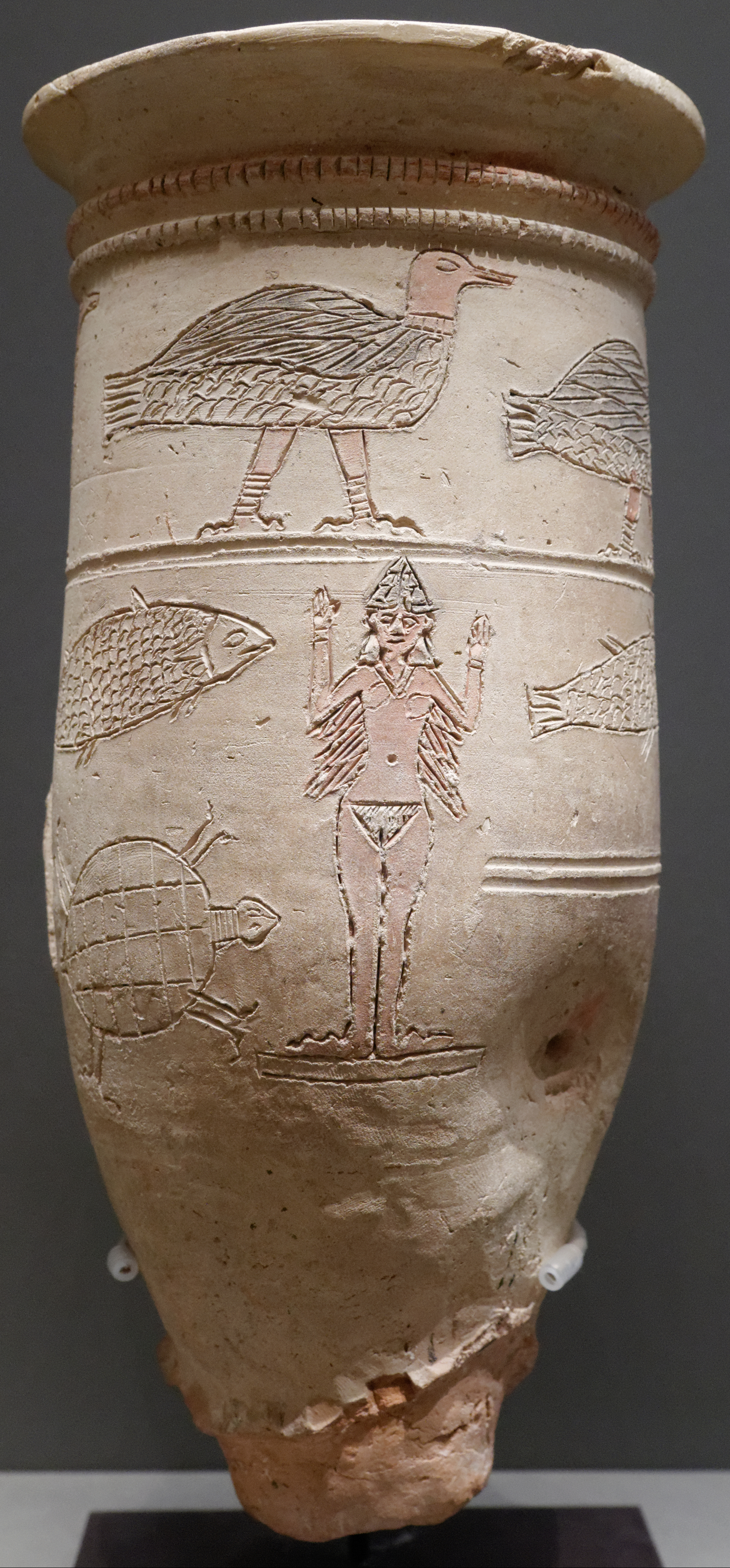
I have in mind an exhibition on the history of looking. One object in it would be a terracotta vase with the goddess Ishtar incised on its face. Her wings look like pubic hair gone mad and mean astral power. The notched triangle where her legs meet, from which the Sumerian cuneiform figure for woman is abstracted , means a coitus so holy it turns the earth. Around her are spokesanimals of the wetlands – fish, turtles, ducks, bits of world she’s origin to. Later a diluvian patriarch will set them out in pairs and rows. After some adventures (my wall text explains) he’ll find a jewelled necklace in the sky – the goddess set it there in remorse for drowning the people (Gilgamesh XI) – and mistake it for a rainbow saying The creatures are all yours now (Genesis 9:1–3). In denouement, a son sees him drunk and naked, Dad gets pretty pissed (Gen. 9:20–25), banishes his seed.
Noah’s story is a parable of the birth of patriarchy from the morning star’s recession, Ishtar’s clay flower fading. The vase is borrowed from the Louvre where it lives behind glass and alarms. It wants to be held, filled, poured from! though I too must guard it. If seeing it nonetheless feels almost like touching it – as if your eyes had fingertips you could brush against its face – that’s because our sense experience just is manystranded.
[A] raven soaring in the distance is not, for me, a mere visual image; as I follow it with my eyes, I inevitably feel the stretch and flex of its wings with my own muscles, and its sudden swoop toward the nearby trees is a visceral as well as a visual experience for me. The raven’s loud, guttural cry, as it swerves overhead, is not circumscribed within a strictly audible field – it echoes through the visible, immediately animating the visible landscape.
That’s David Abram, Spell of the Sensuous, giving voice to Maurice Merleau-Ponty, who took our everyday perceptions to be both synaesthetic and participatory.
My senses connect up with each other in the things I perceive, or rather each perceived thing gathers my senses together in a coherent way, and it is this that enables me to experience the thing itself as a center of forces, as another nexus of experience, as an Other.
Setting outer creatures in order, Noah set the inner creatures in order. The recession of the morning star is among other things a straitening and sorting of perception. Think of an exhibition that has only one right order of encounter.
Before Ishtar was Inanna, goddess of Sumer of everything human. An impression obtained from the Oriental Institute:
Inanna-Ishtar with morning star. Akkadian cylinder-seal ca. 2254–2193 BCE. Oriental Institute.
She took by guile the me, the gifts of civilization – bladework, lamentation, carpentry – from her father Enki, god of the floodwaters, to give to her people. The story of her world-onsetting theft begins:
She leaned back against the apple tree. When she leaned against the apple tree, her vulva was wondrous to behold. Rejoicing at her wondrous vulva, the young woman Inanna applauded herself. (“Inanna and the God of Wisdom”)
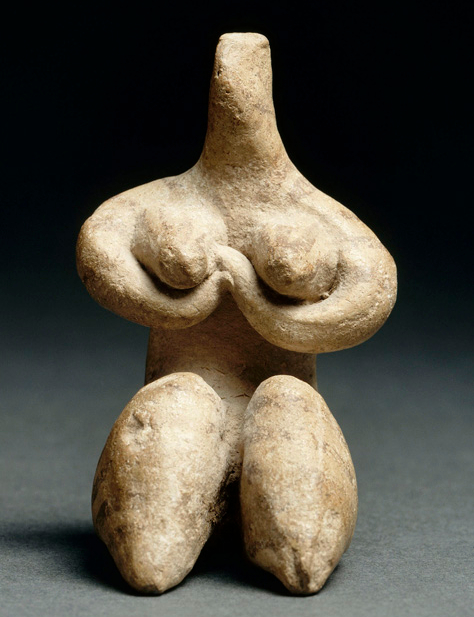
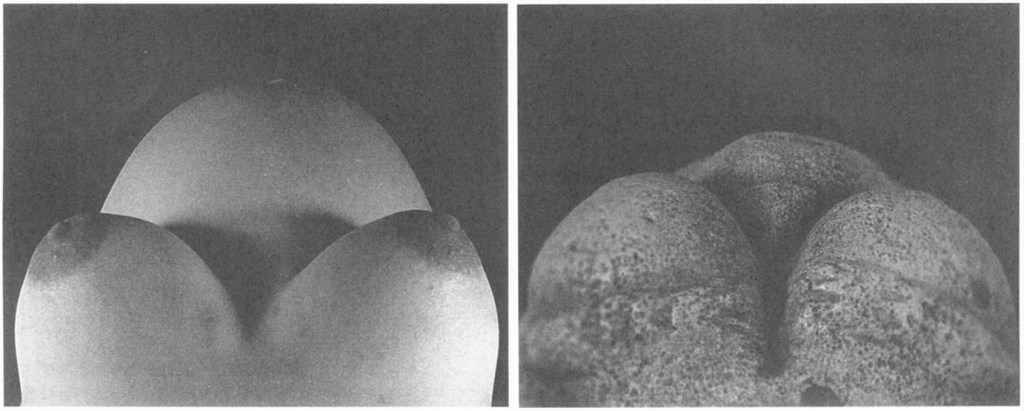
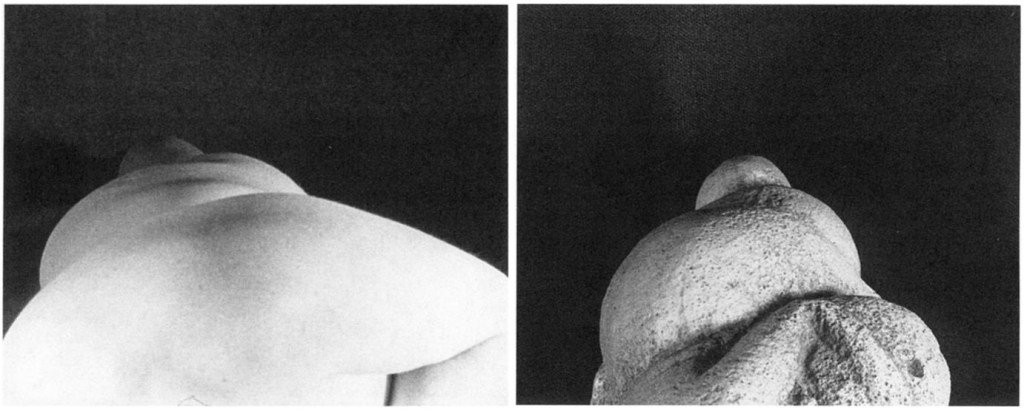
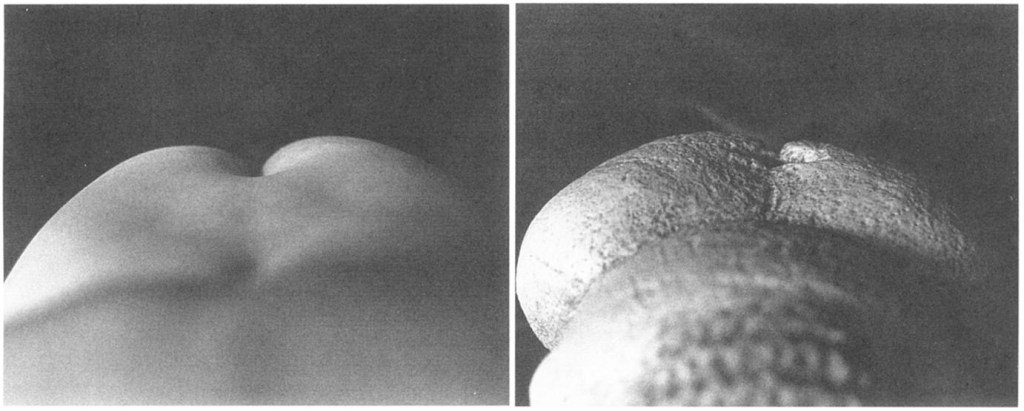
Inanna is the sharp edge of a stone tool most of whose facets are lost to us. A Neolithic figure, filched from the Louvre, hints at how they angled. Its apparently distorted features, bulging breasts and thighs, tapered head and feet – a “lozenge form” – has led its owners and handlers to take it for a fertility idol. But these ubiquitous figures from the late Stone Age are only “distorted” when seen from outside. See them with their own eyes and they’re wholly naturalistic. According to Catherine Hodge McCoid and Leroy D. McDermott, they’re simply a woman’s body as “seen by a woman looking down on herself.” One figure joins multiple perspectives: looking down (your belly looms large), bending forward to look down (your thighs are foreshortened, feet furthest off), turning to look at your backside (the top of your buttock is foreshortened). The face is indistinct because without a mirror – recall de Robertis’s title – you can’t see your head with your own eyes, any more than a pen can write on itself.
The apparent misrepresentation of height and width in the figurines results from the visual experience of [the] anatomical necessity [of bending forwards to see her toes]. The location of the eyes means that for an expectant mother the upper half of the body visually expands toward the abdomen, whereas the lower half presents a narrow, tapering form.
Frontal view of her body by a woman 5 months pregnant. Willendorf figure from same vantage.
Her view of the side of her own body. View of Willendorf figure from same vantage.
Her view of her buttocks. View of figure from same vantage. Images: McCoid & McDermott.
These figures are objective offerings of one or more women’s self-relation: from her sight of her own body, she made an object she could hand to another, to think about with their own hands. Or reflect on herself – McCoid and McDermott propose the figures had pragmatic use, maybe as obstetrical aids, “the relative sizes of the abdomens helping women to calculate the progress of their pregnancies.” Their work suggests that, long before Picasso or Gris, Neolithic women were assembling, out of divergent viewpoints, a perspective that is coherent, singular, and relational. (Picasso had to break women up to get his perspective to cohere.) They made a perspective as novel as the retreating lines of an aristocrat’s lands converging on an abstract horizon, or a Cubist collage breaking things apart to return to the eye its multiplicity.
In another room, Europe, stung by Noah’s rebuke, is revisiting the human form it got from Greece, working out, with the aid of oil paint and linear perspective, how to clothe a naked figure in the seeing of it. Nude women you can touch with your eyes become a cottage industry. Most of them look like merchandise. John Berger: “What distinguishes oil painting from any other form of painting is its special ability to render the tangibility, the texture, the lustre, the solidity of what it depicts. It defines the real as that which you can get your hands on.” The European nude confirms the male gaze in its patrimony. Oil paint, exploiting the synaesthesia of vision, and linear perspective, confirming the landowning individual as sovereign viewpoint, together clothe the naked form in a form of looking.
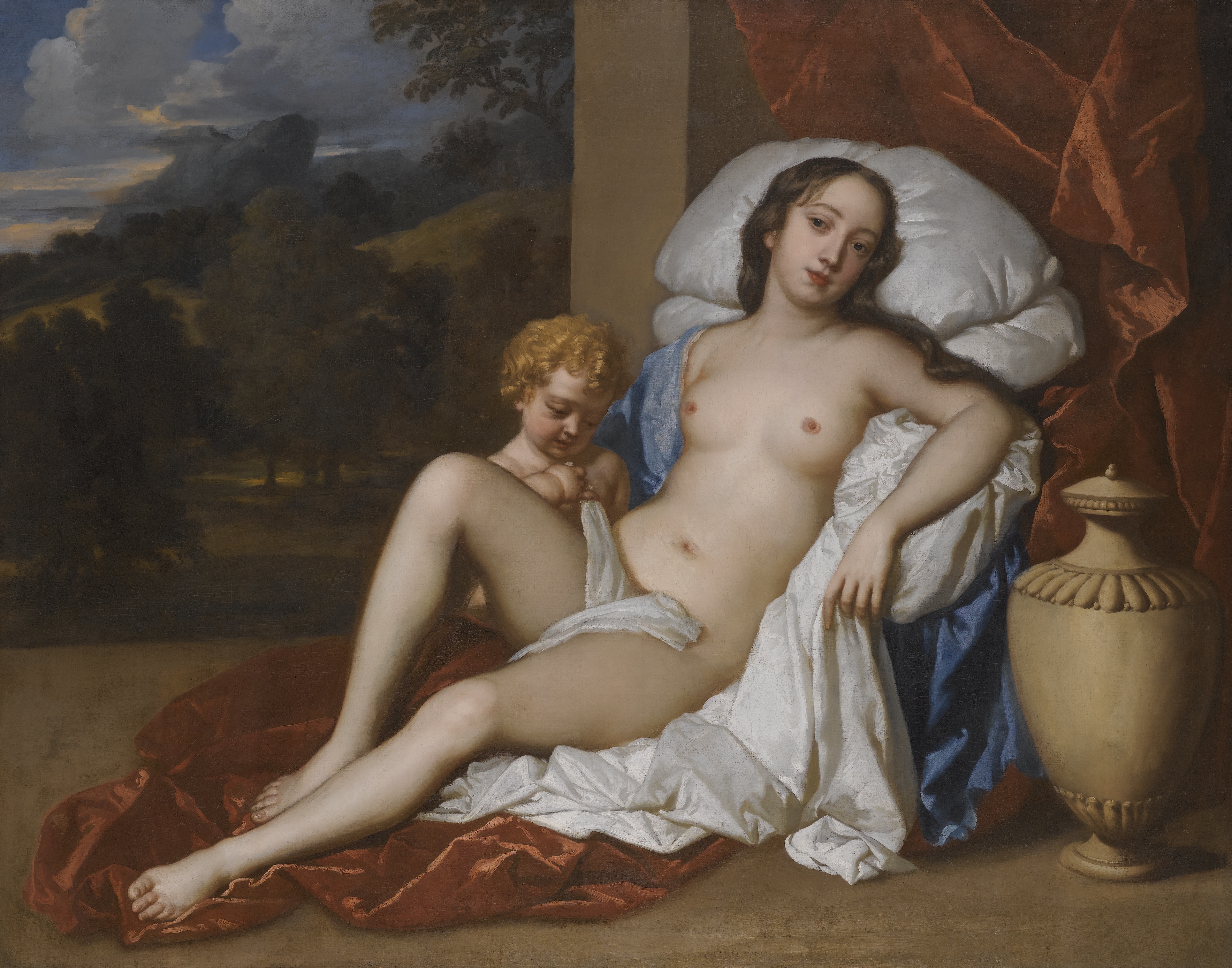
Sir Peter Lely, Nell Gwynne, mid-1600s. Private collection.
Berger uses a painting by Sir Peter Lely, most likely of Nell Gwynne, lover of Charles II, to make the case. Two gazes can be seen here and a third cannot. The child, ostensibly Cupid, looks down in reverence or mischief toward a corner of the white silk bedclothes draped over the woman’s sex. Gwynne, thrust into the role of Venus, looks with a languid, unfocussed gaze toward the viewer. It could be dreamy interiority, but her pose, reclining, passive, unclothed and turned near-frontal, suggests her inner gaze is self-surveyal on behalf of an owner-spectator she’ll never meet. In other words her inside is not hers. Berger again:
Whilst [a woman] is walking across a room or whilst she is weeping at the death of her father, she can scarcely avoid envisaging herself walking or weeping. From earliest childhood she has been taught and persuaded to survey herself continually…. The surveyor of woman in herself is male: the surveyed female. Thus she turns herself into an object – and most particularly an object of vision: a sight.
I would add that the erotic power of her look depends on being both available and not. So Gwynne’s head turns to the left as her eyes look forward and a little down, as if she were a bit too shy, or just coquettish enough, to meet your gaze. The fabric across her pelvis achieves the same effect, withholding something also promised. The man’s gaze is the third here and is set out of sight. Just as you can’t see light, only what it lands on, the gaze is invisible, known only by its evidences. And while evidence of the woman’s gaze and the child’s may be found in the painting, that of the man lives outside the frame, where history is.
The woman’s looking and the child’s looking are fixed realities, nounal, paintable, while his looking acts, verbally, as it were. It would take a form that moves in time, a book or a piece of performance art, to make such looking palpable.
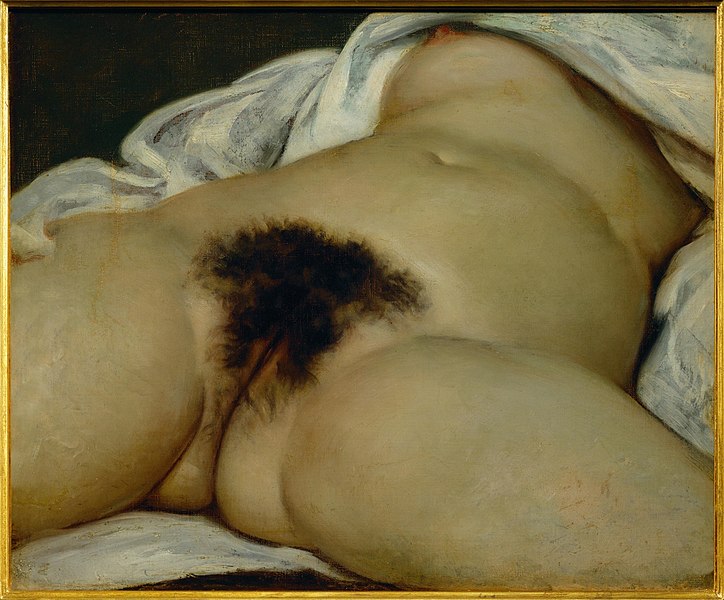
Gustav Courbet intervened in the tradition of the nude when he painted L’Origine du monde. His model has no hands she could work with, nor feet to walk off with, nor mouth to speak, nor eyes to convey an interior or create resonance with a viewer. The frame only takes in enough to define her by her sexual attributes, breasts and vagina. In another context, the bedclothes that frame her might look like tissue paper round a gift just now unwrapped, but here they are at least half a shroud.
Gustav Courbet, L’Origine du monde, 1866. Musée d’Orsay.
Whatever the critics have said, the painting is in no way erotic, having dispensed with the illusion of a mental interior. I was relieved to learn I’m not the only one to find it deathly:
The pallidness of the skin and the mortuary gauze surrounding the body suggest death. This body … cannot see us and never will. Whosoever buries their head “there” is implicated in a game of necrophiliac orality that ignores the violence and the optical objectification laid out in the painting. (Uparella & Jauregui)
Going down here really is going down. Inanna, at her journey’s nadir, is made a corpse and hung on her sister’s kingdom’s wall, and this is pretty much that.
In Courbet’s intervention, all the erotic possibility that the European nude has, for centuries, mobilized by arranging in pigmented oil illusions of an in/accessible interior, is transferred to the title. The Origin of the World. It’s magnificent, grandiose, risible, sublime. You cannot say for sure whether it’s earnest or ironic, truth or hyperbole, mythological or anthropological or satirical. Does this title, an invisible frame hovering between the painter and all viewers, make the truncated form of Courbet’s model, Joanna Hiffernan, who herself painted and drew, though she never showed her work (Jiminez), a goddess of stone or earth, or an avatar of Inanna, or an anatomy poster, or a capitalist meat machine? The painting is celebrated for its realism – finally a thatch of pubic hair true to life! But the ambiguity Courbet’s realism has drained from the painting has filled the title up.
On May 29, 2014, an artist named Deborah de Robertis enters the gallery of the Musée d’Orsay where The Origin is hung. Wearing a gold-sequined cocktail dress, she walks briskly to the painting, sits down below it, and spreads her legs to show her vagina, holding her labia apart with her hands. Her pubic hair is the colour of Hiffernan’s; her dress matches the gilding of the frame. Her videographer holds the camera’s gaze shakily – it’s the video of an amateur, such as anyone there might make. Within seconds, guards arrive. They engage her in discussion, sometimes blocking the camera’s view of her. We hear the other visitors begin to applaud. The camera swings to take them in. Once in clumps of private contemplation, they stand now in an arc focused on her. The camera pans back to her. One of the guards has taken up a position in front of her, hiding her from view: a shin in the role once given to diaphanous fabric. Another guard comes to consult. All the guards thus far are women. They are affronted by this violation to museum decorum, but they also seem a little protective of the violator. There on the floor, artist and model at once, de Robertis has the placid expression of models before her, but her eyes blink and rove as they please. The guards begin to try to escort the audience out. Soon there are more guards in the gallery than visitors, one or two of them men. Someone has fetched a screen the colour of Courbet’s bedsheets. By the five-minute mark the energy in the room has begun to falter. Scattered applause. The camera starts to have trouble finding her. The performance peters out indefinitely.
The task of controlling access has passed from the Musée d’Orsay to the disembodied gallery of YouTube.
No – it disperses, leaving the gallery as its participants do, in twos and threes. The piece includes the museumgoers who applaud her and the guards who obstruct her, and it spreads ever more broadly, to include the video made of the performance, the interviews and reviews, the lawsuit two guards later file against her for “sexual exhibitionism.” De Robertis does not break persona for any of it – she continues to perform herself for the papers, in the courts, and on social media platforms. The piece includes its aftermath. She has torn a page here from Fluxus, whose artists incorporated into their work happenings “outside” the work: chance elements, audience responses. And I’m reminded of John Cage, for whom the audience shifting in their seats, the street sounds through cracked windows, may be the composition – though for Cage, the aleatory is a formal occasion, for de Robertis, a political one.
A stilled object on the wall becomes, as our eyes travel down from the painting to the floor, a living subject, autonomous, with agency. Then the gaze disperses without dissolving: the work reaches out into the public sphere, dismantling the erotic mechanism the tradition of the European nude had built. The artist’s self-exposure is an act of aggression (against the male gaze), of transgression (against museum rules and decorum), and of commonality (with all the female models and artists before her). It has none of the come-close–stay-back of Lely’s portrait, or the countless nudes it keeps company with, or the French lingerie and Superbowl beer ads that have followed in their delicate footsteps.
It might seem de Robertis wants to demythologize the vagina. And yet, having launched her work from Courbet’s, subverting it, rebuking him, she takes his most grandiose claims and doubles down on them. Her account of her work in the press implies a metaphysical scope that eclipses Courbet’s:
The painter shows the open legs, but the vagina remains closed. He does not reveal the hole, that is to say, the eye. I am not showing my vagina, but I am revealing what we do not see in the painting, the eye of the vagina, the black hole, this concealed eye, this chasm, which, beyond the flesh, refers to infinity, to the origin of the origin. (Sutton)
The realist who painted is not realistic enough (in fact the painting is not so accurate anatomically), the artist who titled, not metaphysical enough. Is she trolling Courbet? Her look in the video is as placid as Inanna’s on the vase across the streetacross the room. One of its three audio tracks confirms the work’s mythological dimension:
I am the origin. I am all women. You haven’t seen me. I want you to recognize me. Virgin like water. Creator of sperm.
Like Inanna, gambling with her drunk uncle, de Robertis fools the hoarder of power into handing it over. In turn, she gives it to other people, and in being given, it grows larger.
The holy me were being unloaded. As the me which Inanna had received from Enki were unloaded, They were announced and presented to the people of Sumer.
Then more me appeared – more me than Enki had given Inanna. And these, too, were announced, And these, too, were presented to the people of Uruk. (“Inanna and the God of Wisdom”)
Inanna claims and shares and adds to the powers of culture. De Robertis, her daughter, claims and shares and furthers the power of looking. Our senses cohere in her, the way the me cohere, sitting on the pier.
Cohere and disperse, the way light does on a gold-sequined dress. Gold holds light – why it’s called illumination in old books – while sequins scatter it. The artist, likewise, has drawn and held then scattered our gaze. The camera movements (jerky, handheld, amateur), the dispersal of the museumgoers (each in their own shell of looking), the continuation of the artwork across locales and discursive genres (video, interview, legal filing), they all scatter our looking, while holding it whole. Against the monolith of the singular “male gaze” washes this dispersed and democratized looking. Is it going too far to think de Robertis has, with her Fluxus compeers, created a new perspective? A perspective scattered and broken like the Cubist one, but coherent and whole when taken for that of a crowd. It’s a strange, tenuous whole, but we recognize it: in the internet age, a thought or a conversation is whole in the same way, though spread out in time and housed by servers on several continents. Like her Neolithic forbears, she makes a coherent form for the autochthonous gaze. In those figures, the gaze is compact, discreet, singular, and solid across time. Today being what it is, de Robertis’s is dispersed, multiple, collaborative, and fluid over time, changing forms as it ripples outward from a gallery in the Musée d’Orsay and spills into the streets.
Print works referred to
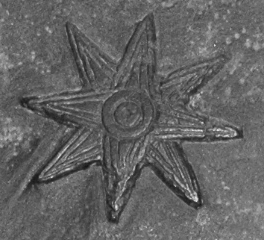
Ishtar’s eight-pointed star ca. 1180 BCE. From the stele of King Melishipak I. Wikimedia Commons.
Abram, David. The Spell of the Sensuous. Pantheon, 1996.
Berger, John. Ways of Seeing. Penguin, 1973.
Cuneiform for “woman.” Nicholas Fay, T. Mark Ellison, and Simon Garrod, “Iconicity: From Sign to System in Human Communication and Language.” Pragmatics & Cognition, vol. 22, no. 2 (Dec. 2013), pp. 243–62.
“Inanna and the God of Wisdom.” Inanna, Queen of Heaven and Earth, edited and translated by Diane Wolkstein and Samuel Noah Kramer. Harper & Row, 1983.
McCoid, Catherine Hodge, and Leroy D. McDermott. “Toward Decolonizing Gender: Female Vision in the Upper Paleolithic.” American Anthropologist, New Series, vol. 98, no. 2 (June 1996), pp. 319–326.
Jiminez, Jill Berk, editor. “Joanna Hiffernan.” Dictionary of Artists’ Models. Routledge, 2001, pp. 275–78.
Uparella, Paola, and Carlos A. Jauregui. “The Vagina and the Eye of Power (Essay on Genitalia and Visual Sovereignty).” H-ART. Revista de historia, teoría y crítica de arte, no. 3 (2018), pp. 79–114.
Zazen last night at Red Cedar for the first time in some weeks. My mind was a drifty sleepy jello, nothing new there. I moved from following my breath to following sounds. No alertness for me there so I switched to taking refuge
I take refuge in the Buddha
I take refuge in the Dharma
I take refuge in the Sangha
one on each exhalation. Just the utterance for itself, not trying to connect with what it means, I don’t know what they mean, honestly I don’t. I mean, I could try to explicate it, but phhhht. Nothing special happened and I left before service, tired after a long day and under the weather.
What we want’s so simple. To be loved. It’s so little and so much.
This morning, two poems by Jean Valentine, facing pages, saw me face to face.
OPEN
I lay down under language
it left me and I slept
—You, the Comforter, came into the room
I moved my head—
my blood, my mouth
all buttoned away—
Makers of houses, books, clothes-
makers, goodbye—
and
A LEAF, A SHADOW-HAND
A leaf, a shadow-hand
blows over my head
from outside time
now & then
this time of year, September
—this happens—
—it’s well known—
a soul locked away inside
not knowing anyone,
walking around, but inside;
I was like this once,
and you, whose shadow-hand
(kindness) just now blew over my head, again,
you said, “Don’t ever think you’re a monster.”
That Comforter, that kindness, I know them, & not just in memory.
& not only, please let it be, their recipient.
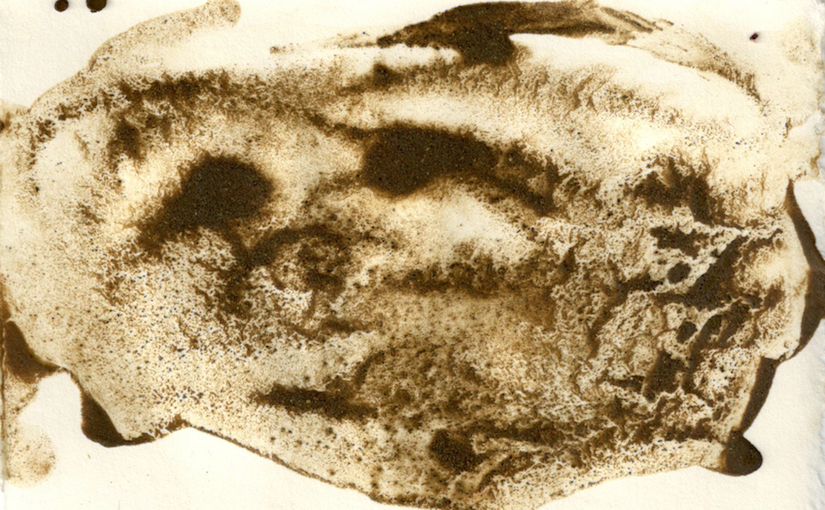
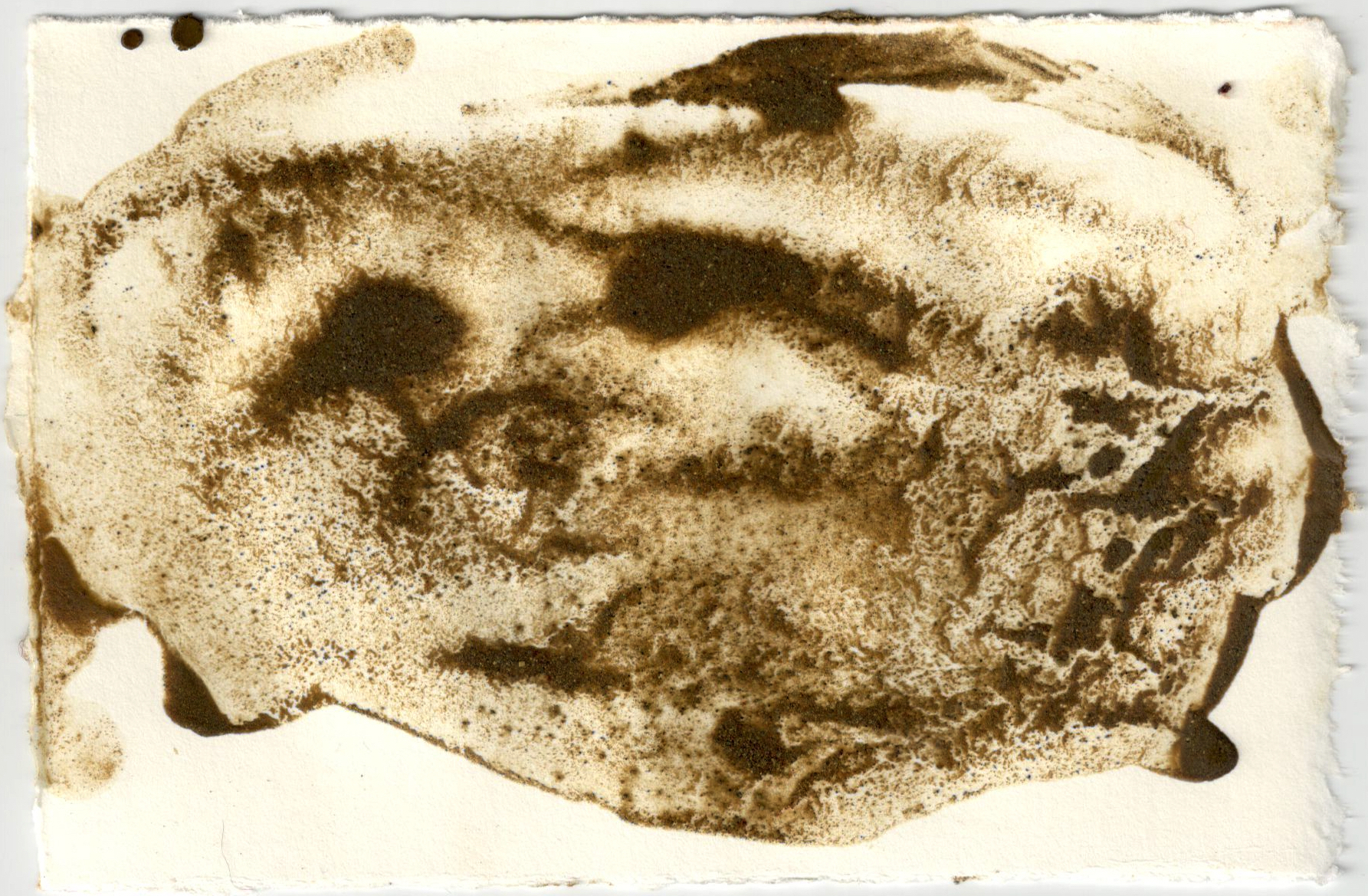
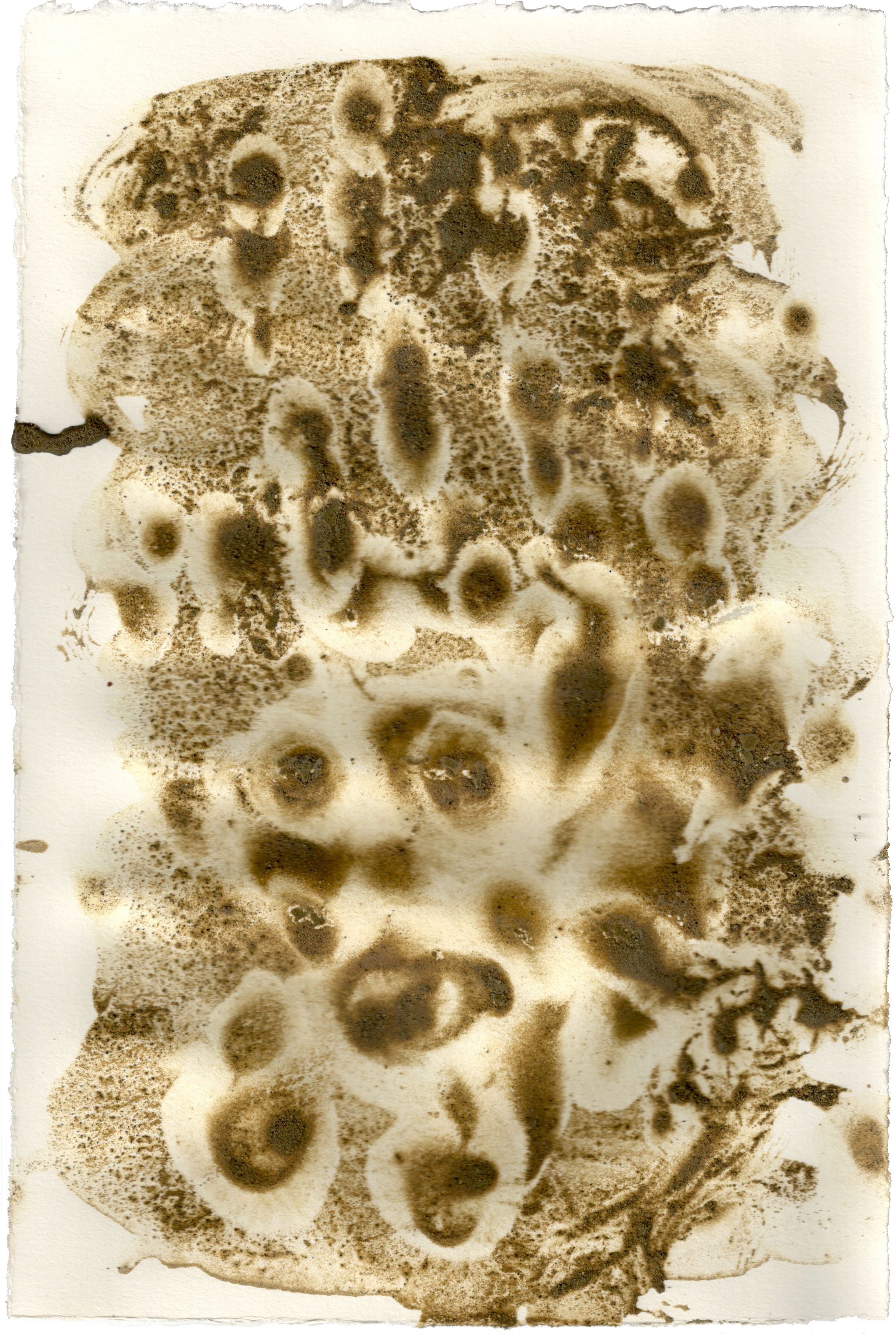
Image above, from a work still incipient, Dura Mater. Click to go bigly:
Sumas Mountain ochre, olive oil, egg yolk, water on paper.
Took the day half off from Unlikeness. Slept in a bit, read a bit. Wrote a bit too. Then attended to a garden prolific in my negligence of it. Today’s harvest
And this evening’s meal (11:03 and it’s still simmering the liquid down)
Got some Italian sausage to pop in there before I’m done. This post has unofficially been not about politics nor about writing neither. Good night.
P.S. But here’s a image to feed the spirit
You know what it is right? what we need & hope for, goodness overwhelming.
Been working on a new project, Dura Mater, tough mother. Membrane enveloping and protecting the brain and spinal cord. First poems to come have been visual. A cruddy ochre salvaged from nearby Sumas Mountain, ground under the tutelage of H. in mortar and pestle, watered and binded with some eggyoke, and smeared on wetted paper by finger and rocked about a bit.
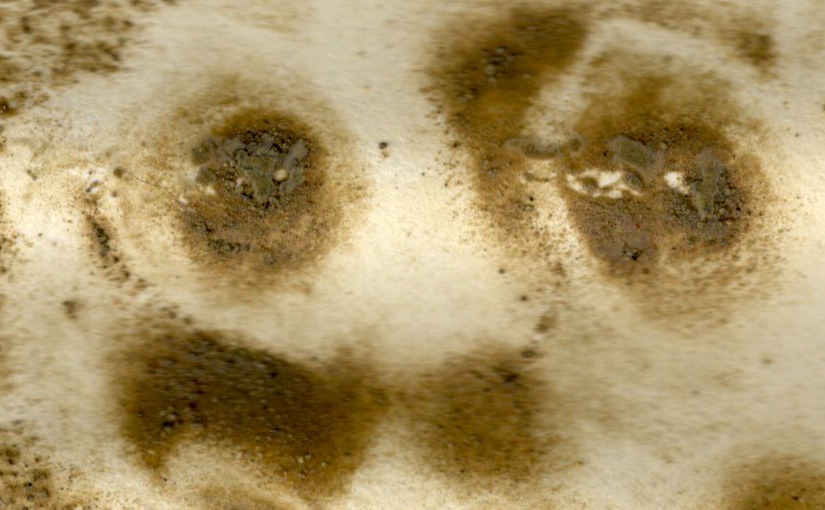
This one wasn’t coming right so I planted my whole palm on it, the way I do sometimes on my mother’s frameless photo on my altar to comfort her, as if by magic I could somehow, and that again – patting, petting – and beings began to come. Click once for some granularity, again for more. Some text to come.


 , means a coitus so holy it turns the earth. Around her are spokesanimals of the wetlands – fish, turtles, ducks, bits of world she’s origin to. Later a diluvian patriarch will set them out in pairs and rows. After some adventures (my wall text explains) he’ll find a jewelled necklace in the sky – the goddess set it there in remorse for drowning the people (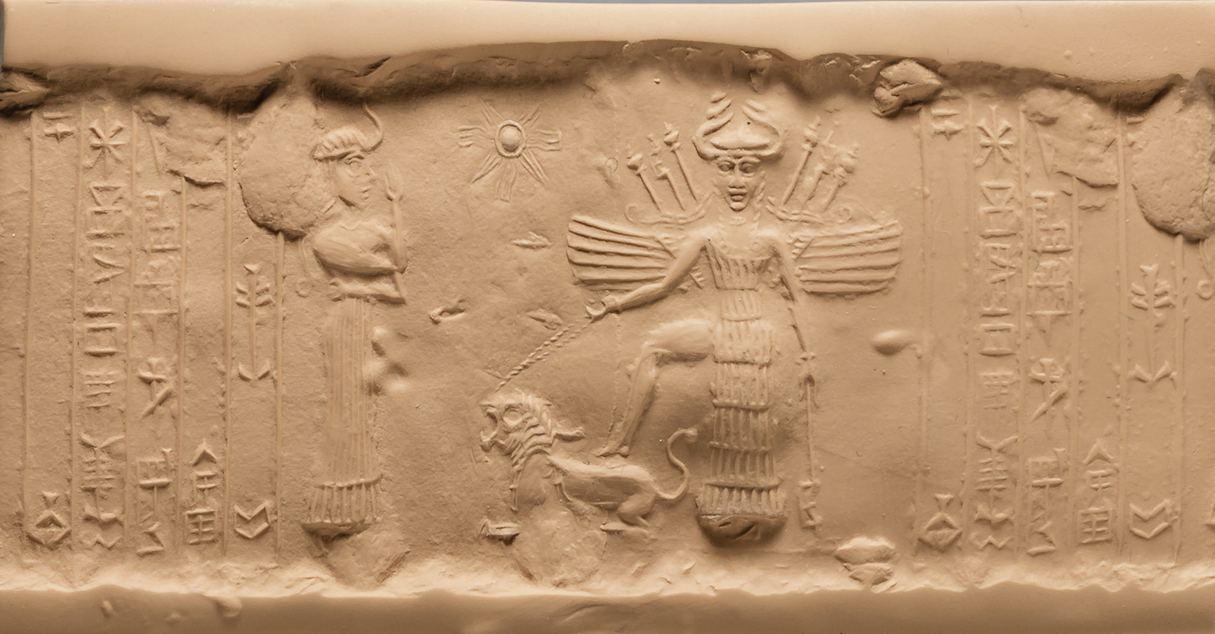




 The Art of Compost