Artist’s statement (SCRO)

My first sub to a gallery’s call for entries. Writ with the help of a mist friend.


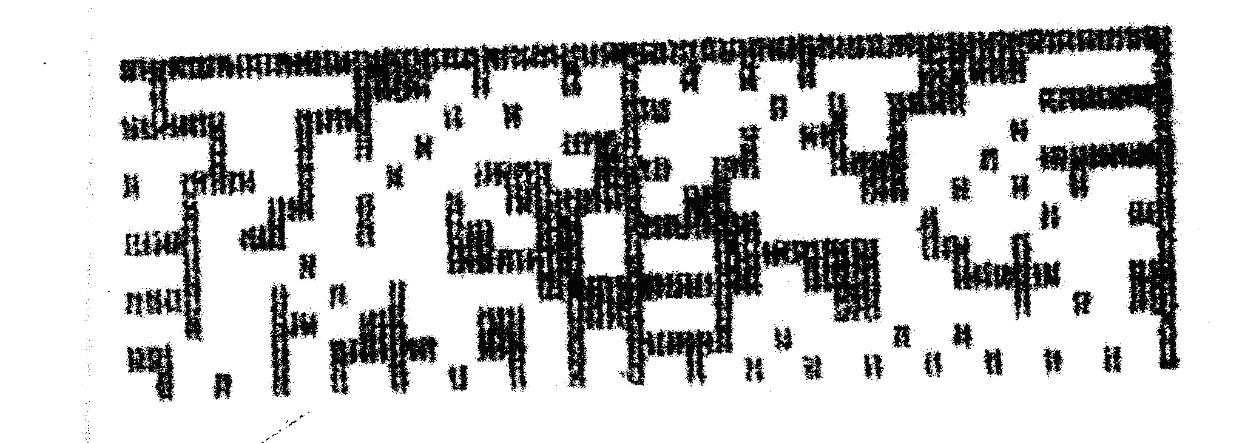
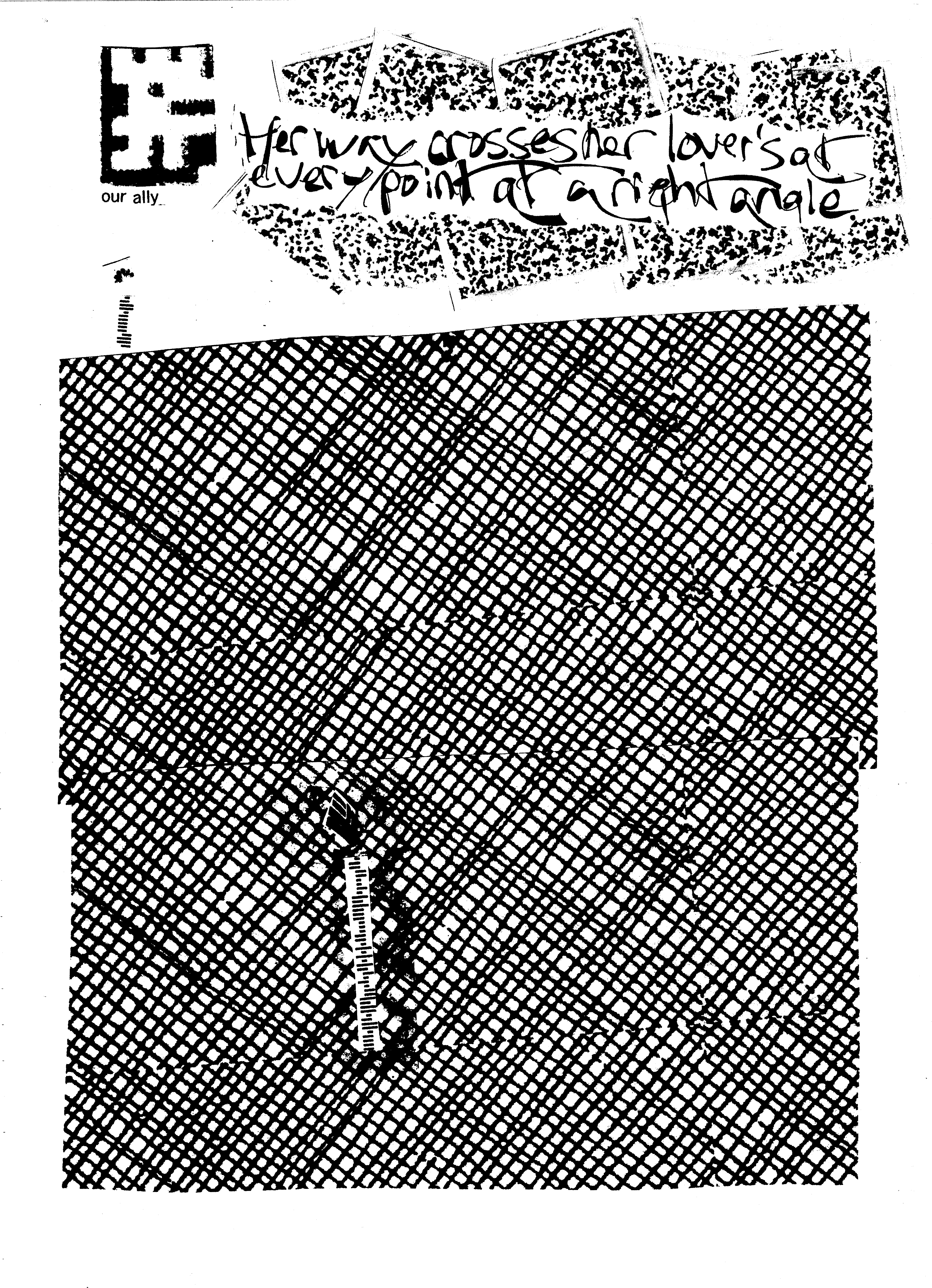
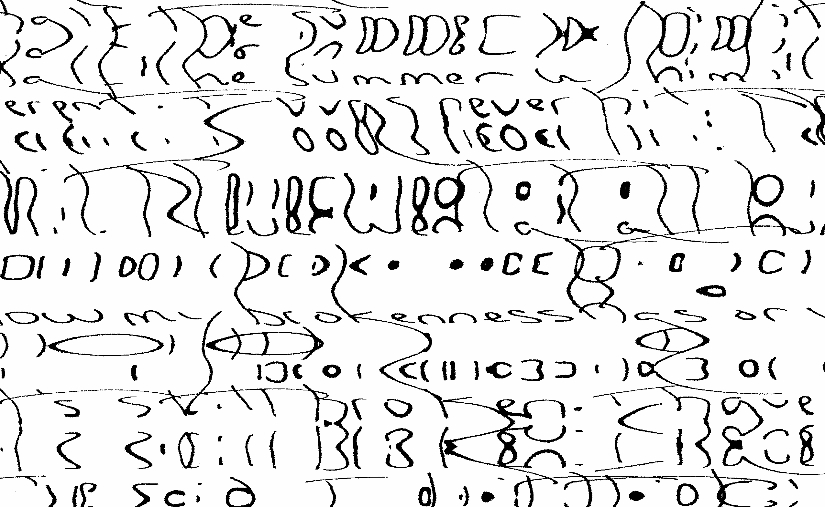
SCRO begins with a handwritten text about my relationship with my aging father. A single paragraph over 24 pages, one for each hour of the day. I manipulate the text on a photocopier, scan the resultant distorted images, and crop those to compose short video poems, 24 of them, each a minute long. The length of each frame determined by chance. The text distressed for my fear of his mental decline. Also for how hard it is for son to know father, or father son, or either one himself. The heart of the practice is my distortion of the ascenders, descenders, bowls and cross-strokes of my written hand. Visual forms, latent in the text, are literally drawn out of it as the words are composted—broken down and let re-flower in proto-signs, pseudo-glyphs, half-made faces and botanic forms. The soundtrack is ambient noise in and around the house for which my father co-signed the loan. He’s made me able to live, here. SCRO, the overlap of “scrotum” and “escrow,” both derived from words for to cut.


The stills I sent:

This slideshow requires JavaScript.

And here’s one of the things themselves.

Dear Canada Council, love, C.

A grant application I done sent.
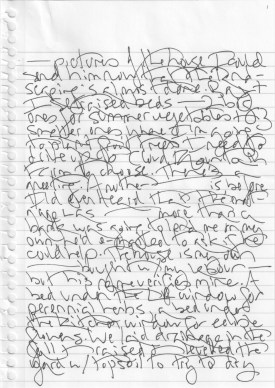

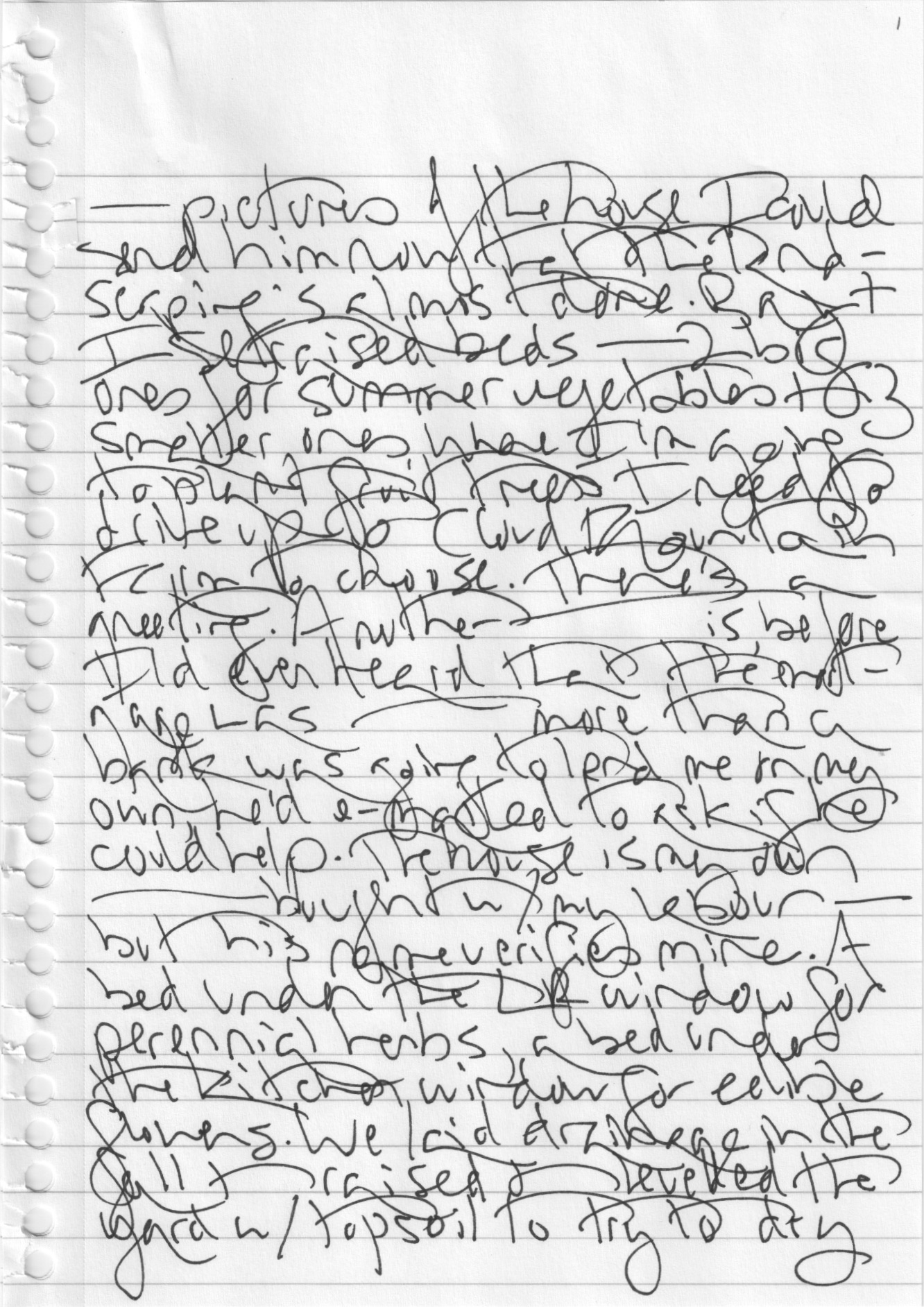
Page 1 base textSCRO began after a visit to my father, 84 years old, in California. I wrote many pages in my journal, worries and fears about his health and state of mind, thoughts on our relationship, childhood memories of him. In time I arrived at a base text of 24 handwritten pages, one page for each hour of the day. To the right is the first. Wandering in time and space, thought and feeling, the text comes home time and again to my little house, which my father, co-signing a loan, made me able to buy. “SCRO,” a truncated form of escrow. Also of scroll – one form the poem will take. And the title can’t fail to call to mind scrotum. The poem’s a study of father and son, and whatever manhood is, and continuity and rupture. Scroll and escrow both derive from a Germanic root meaning “shred.”
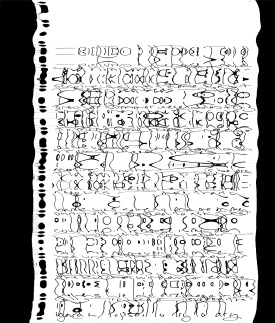

p 1 600 cropped
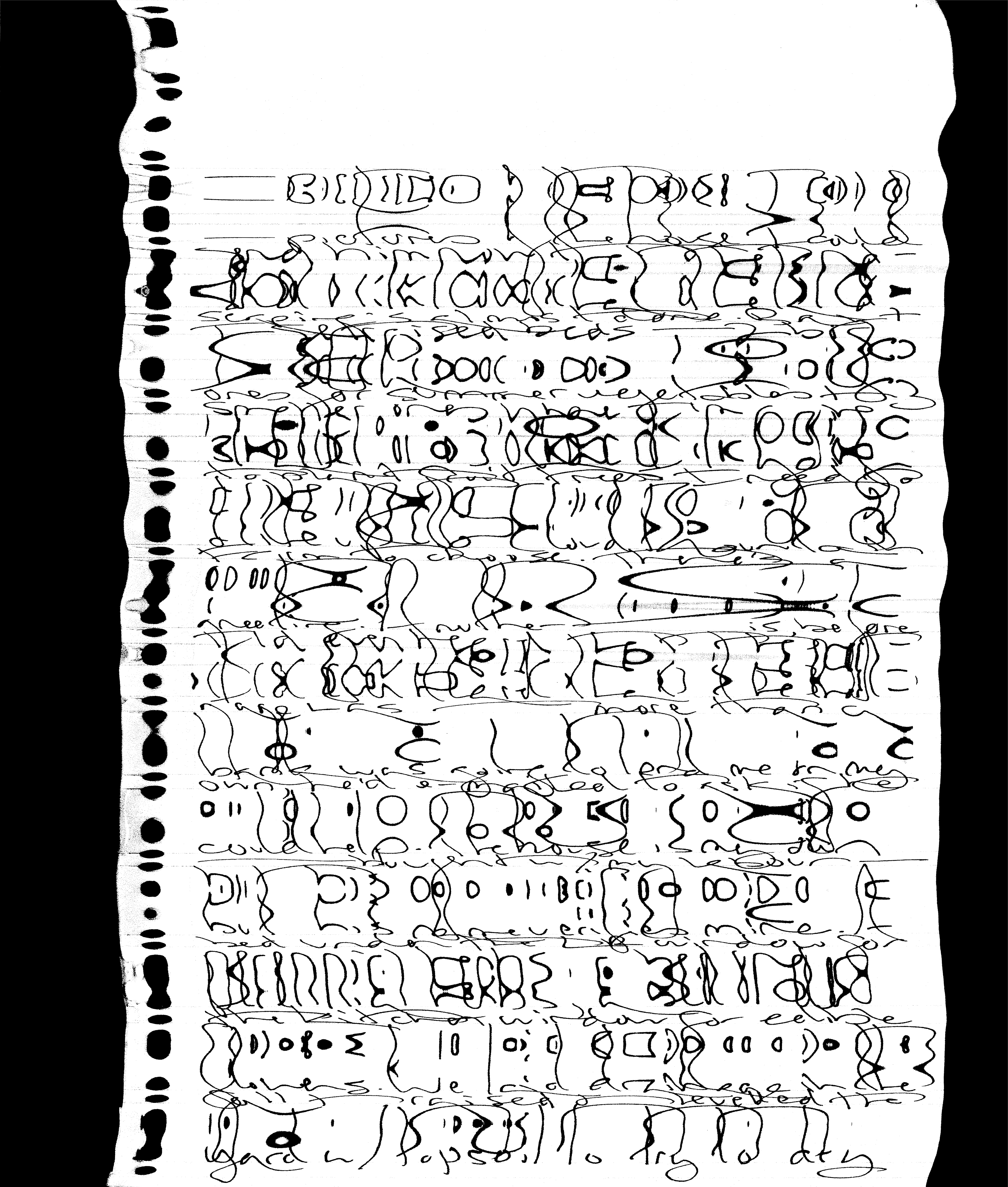
Next I distort the handwriting on the photocopier, rocking it up and down as the scan bar moves underneath, gathering in data, losing information, abandoning and reforming context. Poet Tim Gaze coined the term asemic, one a, for unreadable writing that calls your sense-making apparatus into play without letting it resolve on any given meaning. Steinian indeterminacy on the level of the grapheme. I’ve in turn coined the term aasemic, two a’s, the negative negated, for writing you neither can nor cannot read. I want for these texts to hang on the threshold between signal and noise. Why threshold. Because I’m afraid my father’s going to where he’ll be unreachable; unreadable. Because of how hard it is to know each other at the best of times. Because how of hard it is to read yourself, what you even feel, at same. Most of a given moment’s unintelligible. And, something happens when the mind somehow eases anyway into that state of things, just not getting it. These are experiments toward such ease.

SCRO will have two lives, at least. One, a scroll built of 24 aasemic panels like the one above, flown seamlessly together. That will take some time; the base text is written, but the asemic pages need to be re-generated, most or all of them. Then I need to build a mock-up scroll before I begin to approach publishers.

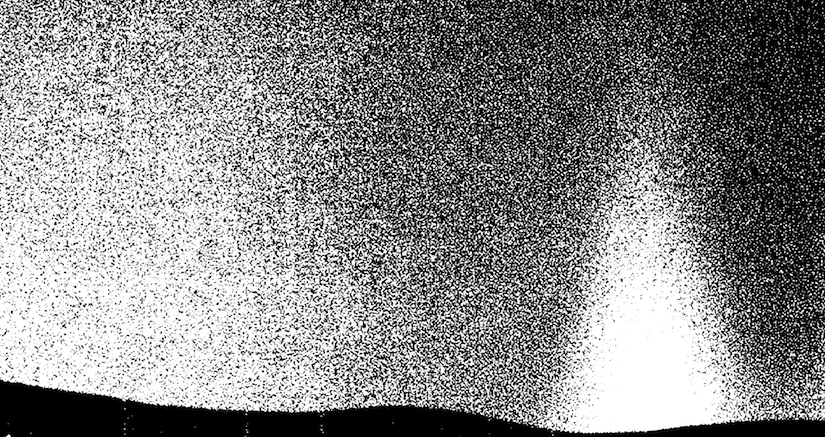
The other is a series of 24 one-minute video-poems. I start with close-up stills from the aasemic panels described above.

While the panels, as wholes, are to be flown into a scroll, the close-up stills drawn from them are enlisted in brief, meditative animations. Chance operations dictate the length of each clip. Why chance. Because letting in the accidents – patterns not of my choosing; patterns I inherit, my father’s kar­ma, my father’s genes – not my choosing or his. And so, given 60 seconds to fill, I take the factors of 60, excepting 1 and 60, which are 2, 3, 4, 5, 6, 10, 12, 15, 20, and 30, and choose at random from that sequence how long each still will last. If a given choice pushes my total over 60 seconds, I throw that choice out and I select again. For instance, the stills for 6:00 am are 2, 3, 15, 3, 6, 6, 2, 2, 15, 2, and 4 seconds long. Made this way, each one-minute video gets to a rhythm I’d not have on my own. The world is rhythmic I find if I let it.

I use two freeware programs, GIMP and Audacity, for image and audio editing, and iMovie to compose the video. The last is limited but its limits guide me the way her rhyme scheme does a poet prone to sonnets. The audio track is quiet but integral: ambient sound, household or neighbourly, recorded the hour of the day the asemic page was made.

How will these video poems find a public. Easy to shove them around online of course. But I want to throw them big and severally on gallery walls, let them be embodied again, with persons in their bodies moving among, stopping between a projector and a receiving wall to interrupt my images, occlude my words, to intercede – for what, for whom? From whatever I thought to mean. To join in the play on the edge between real and ideal, material and im.

I picture a large or warrened gallery space, each of the videos set separate, a big one here, small one there. Each cast on its bit of wall, far enough from others for its companion sound to adhere to it. As you move round the space the sounds mix up. Soundtracks spare enough for the mix not to muddy.  The effect would be like that on the mind in meditation – relaxing into the hereness of a shape, sound, texture, mixture thereof you have no name for as it passes.

Coupla updates

Friends. Just updated a couple parts of this blog, thought I’d let you know.

New words about my two current projects, Overject and SCROhere.

A portfolio of my adventures in visual poetry here.

The latter turned into a narrative essay of sorts. Writing it, I learned a few things about what I think I’m up to. Cool when that happens. Please enjoy –

C.


Occam’s Razor 2016

Celebrated the launch of Occam’s Razor with its faithful dedicated brilliant editorial staff this evening. Wow they done good. So proud of them.

I’m faculty advisor, which in some situations might mean doing lots, but here’s mostly meant saying, “you, go be you; oh and keep a style sheet.”

Soon, a link to the online issue, in all its glory. For now, a TOC to titillate or intimidate you – maybe both – and brief remarks I made at a podium.


Check these Western moves out.

  • The Beneficence of Gayface
  • Domestic Violence Lethality Assessment Screening
  • The Historical Biogeography of Phototropic Consortium
  • Perspectivalism and Blaming
  • Nonalcoholic Fatty Liver Disease: Cause to Treatment
  • Deterministic Chaos: Applications in Cardiac Electrophysiology

And what I thought to say, or close to it.

Ockham’s Razor. Called a razor because it shaves away the excess, the unnecessary. Named for William of Ockham, a medieval Scholastic theologian whose shapeliness of mind may still be of help to us.

An early form of his razor goes like this. “Plurality must never be posited without necessity.” Got that?

Or – other things being equal, the simpler explanation is the better one.

Or – don’t add entities to your story of what happened you don’t have to.

For instance, when your iPhone stops working for no reason you know, you could blame leprechauns for it, but you don’t, because that would be extra.

In other words – cut through bullshit, your own or another’s, as best you can, in every way you can.

The world is complex enough; don’t add needless complications.

The more complications you cut through, the more the magnificent complexity of the life we share here together steps out.

And these guys get that. Their work shines forth their understanding of it. Look at this cover, at the edge of this cloudbank here. It’s complex. Puffs and crannies. And you know that if you zoomed up to it, it would be just as complex, six inches from your face. Wisps and droplets.

The only way that works – the only way complexity can resound like that – is when everything unnecessary has been let fall away. Look at this design. Clouds and empty space and a pebble moon. Complexity meets simplicity, and right at that edge, there’s life, and light.

Anyway, heeding Ockham’s principle, I’m going to be brief.

Does this journal matter? Is it more than just a needless complication?

I think it is. I think it does. Students at Western are doing some phenomenal work in their classes, their research, their independent projects. And all too often it gets handed in, graded, filed away, forgotten. No one in their class sees it – let alone other students in their department, other departments, other colleges.

I think of Occam’s Razor as the geekiest coffee shop on earth. It’s the place where the papers and projects that otherwise might not meet come together, share the same space, relax a little, caffeinate a little, share their intelligence with each other. Calculus chills with social science methodology. Cultural studies flirts with chaos theory.

Geeky coffee shop, or, the university, remembering why it came to be. There are no grades in these pages, no student learning outcomes, no bureaucracy of any sort. This is inquiry not institution. Curious, restless, meticulous.

I’m honoured and grateful to have been a small part of it.

Inanna, a chapbook

Some nice news! A swatch of poems from Dumuzi will be published as a chapbook by Little Red Leaves. I’ve loved their books (fabric covers, hand sewn, venturesome poems) since I first came across them. Sew colour me thrilled. (Sorry, terrible.)

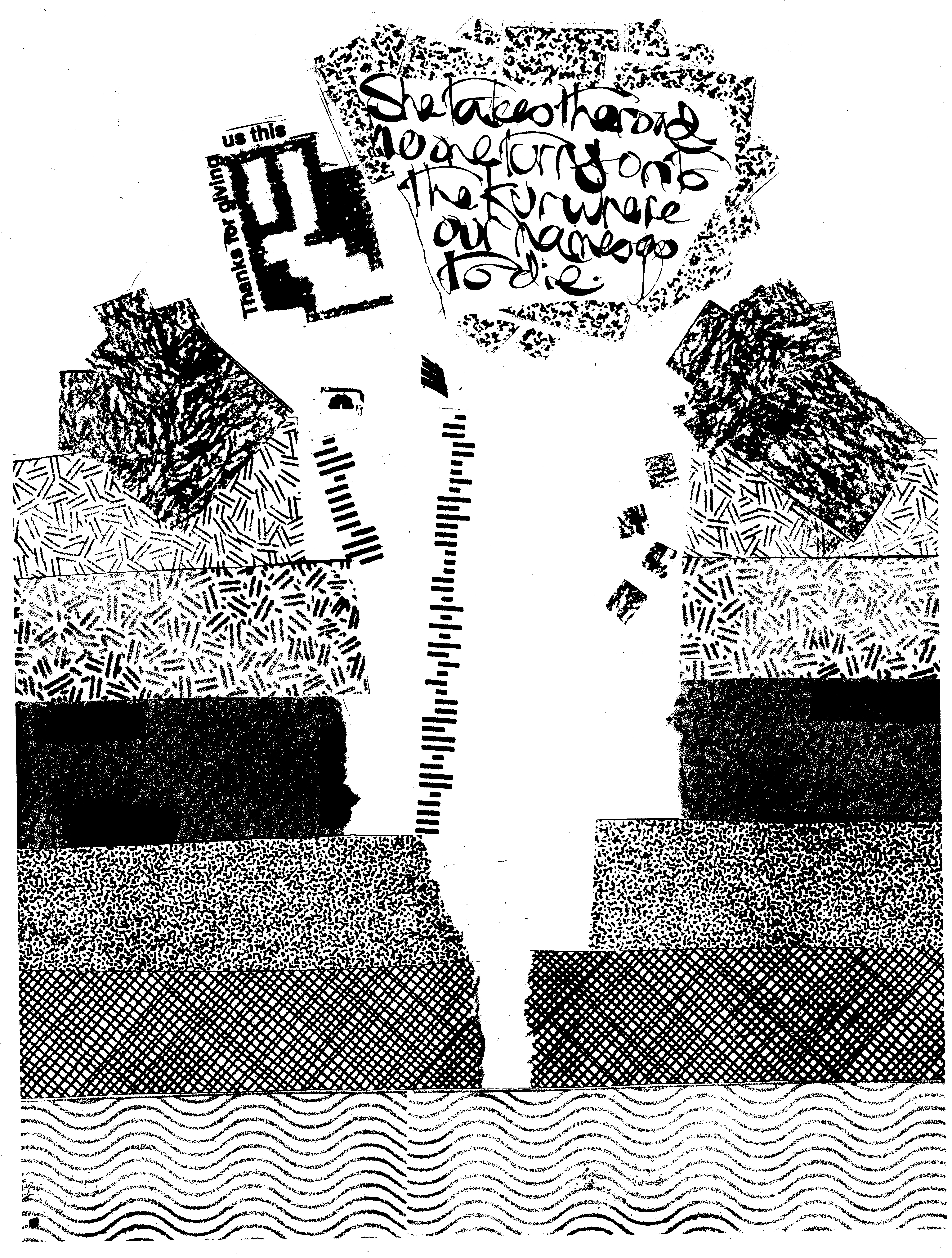
Title to come but I’m thinking simply Inanna Sent. The poems are a graphic novella, collaged out of junk mail, that tells the story of Inanna’s trip to the underworld. Thought I’d post a few panels, final versions. Here’s the first –


Panel 1

The strata are the linings of security envelopes. Inanna and her sidekick, the scancodes you see on autosorted mail. Her jaunty cap, the Bank of America logo, while he sports the NBC paycock (Pound’s spelling). The speaker is one of the galla, demons of the underworld; to them’s given the work of narration. They’re all blown up out of these:


scan code

If you get your pareidolia on, that can look like a postmodern Roman frieze, gods, monsters, epic struggle. Next panel.


Panel 2
As Inanna gets deeper in, her logo-feather-flame hat dirties and darkens. Small serendipities: with each new panel, I lifted the logo from the last with a letter opener and taped it down on the new one. Each move brought more scuffing, each layer of tape more obscuration and road dust. One more.


Panel 3
Scancodes and photocopy noise. Have written some more about Inanna, what and why she means to me, the space I was in (an intense one) making these poems, here and here and here and here. And a bit at the end here. If curious. (Old images there, the script far less open, but in the spirit of blog, I’m going to leave as was.)

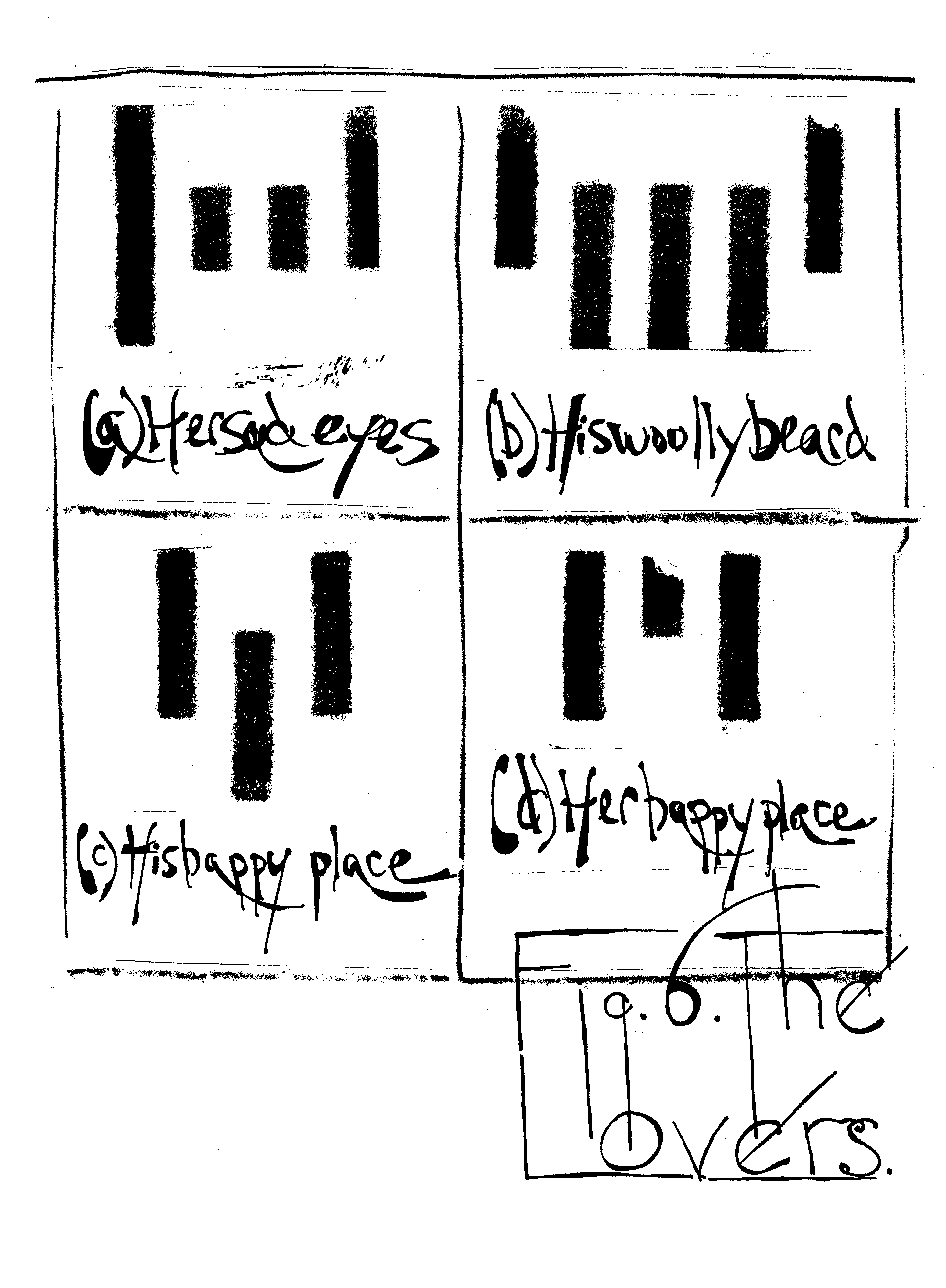
Oh and the grainy oblique smudges above “Her sad eyes”? Bits of pinewood, my writing desk, pulled up by scotch tape I’d stuck there momently while I spotted a paperscrap just right. The meaning of the whole is, make peace with your accidents. (Not in a hey-do-this sort of way. In a note-to-self sort of way.)

Tried to explain the desk splinters to Stephen Burt when he asked me about my work. Talk about happy accident! But, he seemed not so impressed. Oh well.


If you’ve made it this far, thoughts on the title? I sent it out as Junk Inanna Down. That now feels like a hostile mouthful. Do you think so too? What about Inanna Sent? Too mild? Comment away …

The Making of a Book

In the spirit of reuse – the description for my summer course.


ENG 459: Editing and Publishing: The Making of a Book

Making a book takes work—and it’s not done when the writing’s done. Still to come, the queries, the subs, the pitches, the proposals. The rejection slips. The acceptance letter! Revisions. Cover art, layout, permissions. Galleys, copyediting, proofs and proofreading. Marketing. ARCs. The launch party. The book tour. Would you believe it’s actually kind of fun? (It’s your book.) (Whether you’re author or editor or designer or marketing intern—it’s yours.) (Also at key points there are wine and cheese.)

This course is designed with two sorts of student in mind. One, those who’d like, when the time is right, to see their own work in book form—knowing that books can take a gazillion forms, from mass market paperbacks to e-books to small–press run poetry volumes to one-of-a-kind artist’s books writ in oxblood on paper made of pond algae. (Wondering why the hyphen between “small” and “press” looks too long? It’s an en-dash. Wonder why it’s there? Take this course, you’ll find out.) Other, students interested in careers in the publishing industry. And here, while the book will be our focus, it won’t be our bound; knowledge you gain, skills you develop (e.g., copyediting, proofreading), will be useful in careers across the publishing industry.

Expect lots of hands-on exercises; in-class work on your peers’ drafts; student presentations on how books come to be; student-designed lessons on grammar and punctuation; and a final research project in which you explore a possible path for yourself, as author, editor, agent, designer, or TK, in editing and publishing. Likely texts: Suzanne Gilad, Copyediting and Proofreading for Dummies. Sarah Parsons Zackheim and Adrian Zackheim, Getting Your Book Published for Dummies.


Now I’ve got to design the damn thing.

Aasemic writing

Asemic writing is writing you can’t read. Semic writing is writing you can. (A back formation, there’s no such word.) I am at play, finessing the difference, with aasemic writing.

A joy of asemic writing is that it draws all the promise of meaning-making, all the whole multifoliate interpretive apparatus, into activity, w/o resolution or conclusion. It’s Steinian indeterminacy, in not the syntax but the graphemes. It’s the made mark as blastocyst, as stem cell, as potential to become. Is it a Deleuzian plateau? Maybe, still sweating that concept out.

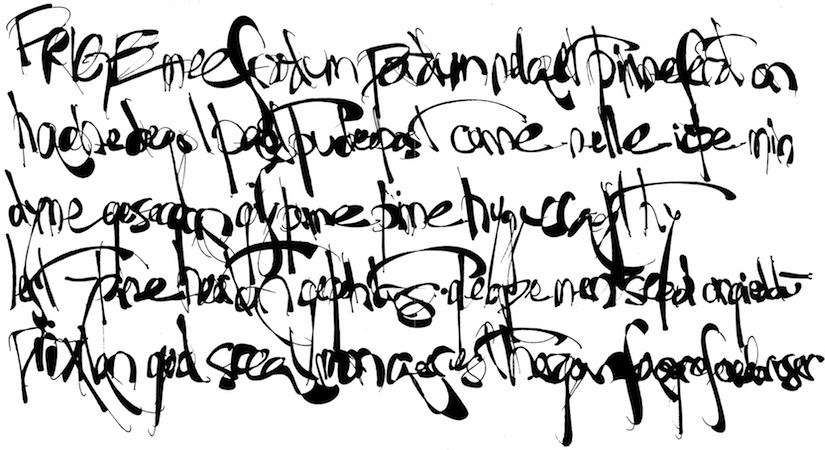
So the aasemic script I’ve been playing with is neither indeterminate nor determinate. (GOD you can take this non-dualist thing too far, mm? how’s this not just centrist squish?) It starts with a journal page transcribed in a projective hand – descender a plunge, cross-stroke a jailbreak. Then I wave or shiver it over the photocopier light bar as it slides under, gathering data in.

All this is lead in to say, The New Post-Literate has posted a few, and that makes me happy, cuz they’re the first bits of Overject to be published, other than here, which don’t count. Here’s the link.

And here are a few other recent offerings there I think especially cool.

The home page of The New Post-Literate where it’s all to be found.


A lot of my trouble w/ academic parlance comes from trying to translate Buddhist vocabulary and values to a non-Buddhist circumstance. Most of the rest of it comes from being a lazy and a lousy Buddhist. (The latter’s 90%.)


Feste to Viola, Twelfth Night, “I am [a] corrupter of words.” After they’ve just rung their changes on live, stand, lie. I compared the move on lie to a triple-axle – Viola to Feste, “yo watch this move” – and one of my students found a sextuple axle in it, bam. Post-structuralism, its insights, e.g., words’re banana peels, dates back at least to Shakespeare, if not to Jesus? “On this rock I build my church,” that’s a pun, Jesus is making a funny, I told them, explaining the finger joints of a dactyl, by way pterodactyl. Petros (Peter), petra (rock). Long live the rhizome. Weed shoot that cracks the rock.

One more for Elise Partridge

Hello friends. A three-way conversation between Barbara Nickel, Stephanie Bolster, and myself on the life and work of our loved friend Elise Partridge has now gone live at the Winnipeg Review. It’s to be found here.

And, if you’re curious, I wrote a bit about the challenge and wonderment of the conversation itself here. You can read some more about Elise herself here. And Barb’s wonderful blog is here. Steph doesn’t have a blog but here’s her publisher’s page here. Enjoy, please, do.


I hope Elise’s spirit won’t mind me appending this.

I was invited to a celebration of Rosh Hashanah tonight and we were asked as part of our lovely evening to express an intention for the year to come. Mine was, to be more patient with others and myself. What’s this have to do with Elise? She wasn’t especially patient with herself or others. In fact I loved her impatience, it was was wise, it was holy! At least when she was skewering someone’s pretensions it was, very.

But my impatience is most often crap. (And that, that’s impatience with impatience. Yeah baby gotcha.) And I’ve just now started sitting zazen again, after years off the cushion, and I’m feeling what a difference it makes to be okay with not getting it exactly right all the time. And a little bit more patient with me, I’m a little more so with some other, too. Does seem to go that way.

Came as this a few ago

TD 90V - imageKshanti paramita = the perfection of patience, or patience beyond patience. Patience so sunk in itself you might not recognize it as patience. That was Elise, too. Barb, Steph, tell me, wasn’t it?

Occam’s Razor

The student journal for which I serve as faculty advisor is, a bit belatedly, hanging out among the electrons. Occam’s Razor, we got Burroughs’s cutups, Harry Smith’s psychedelic animations, Coriolanus, social media in China, diatoms in your gas tank.

These guys done a great job in, oh let me tell you, some trying conditions. Or I’ll skip the tell you and you’ll trust me. For reals though check it out. Asses are kicked in it.