
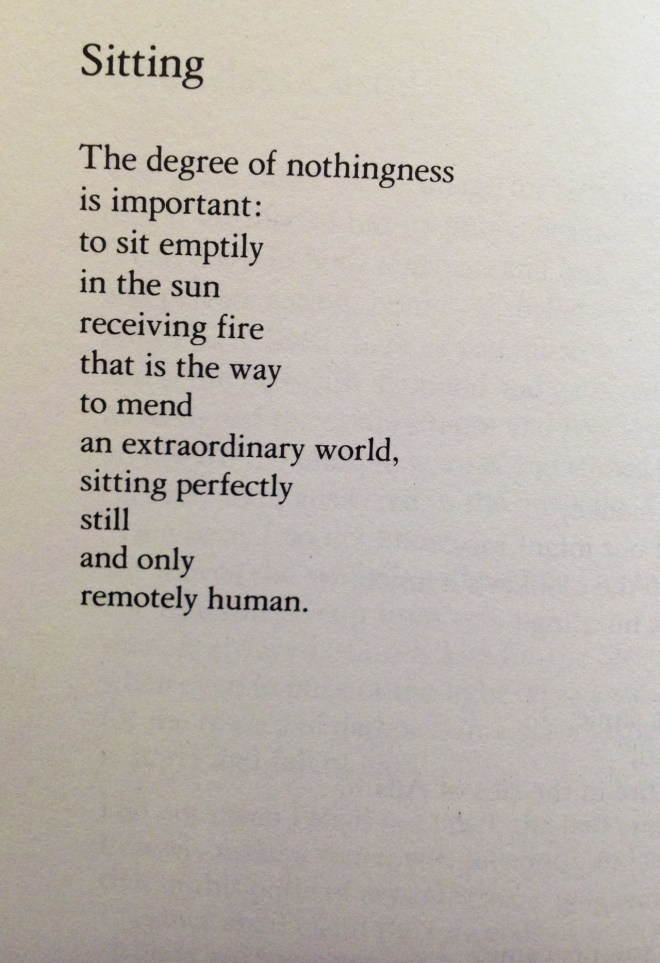
This one just in from shazia-r. “Sitting” by Phyllis Webb. I’m liking how it sits a bit aslant. Leans into its silence.
This one just in from shazia-r. “Sitting” by Phyllis Webb. I’m liking how it sits a bit aslant. Leans into its silence.
about growing older. Jean Valentine. John Taggart. They seem to have grown more and more clear and beautiful as souls. That’s aging I can envy or aspire to. Just think! We could have been a Romanian gymnast.
We found as a class three things compost does. One, there’s a breaking down of old forms, cauliflower leaves corn cobs egg shells radish greens, they begin to lose the walls that bound them as what they were. Two, there’s a blending and a merging, as the elements released in the breakdown start to wander in search of new figurations. (See mandibles in Empedokles, the clinamen of Lucretius, the fact that matter does wander, that’s its nature, that is nature.) Three, something’s nourished, as nutrients released by the breakdown and rearranged in the blending become the constituents of new forms, new ways of being life.
And found all three at work Carson’s translations of Sappho in If Not, Winter. Just one for now (all things in their times). The first line of the one poem of hers we have whole, called often her “Hymn to Aphrodite,” in the Greek is
Ποικίλοφρον ἀθανάτ Ἀφρόδιτα
Transliterated that is, I think, I have no Greek,
Poikilophron athanat’ Aphrodita
And translated word for word,
Spangle-minded deathless Aphrodite
One character is in question. Where Carson reads phi (φ), others read theta (θ), and that one difference, between a sphere crossed vertically and an ellipse crossed horizontally, is a difference between poikilophron, mind, and poikilothron, throne. Is it the mind of Aphrodite, or the chair she sits in, that’s glinting, variegated, subtle, ambiguous, changeful?
What makes this compost is that the two readings coexist. A word Sappho wrote, or had written, was made by time two words, jostling. We can never get rid of one of the other. Time’s co-author of the poem.
Deathless Aphrodite of the spangled mind
Tearing and pasting, as in the exercises below, can be the initial ground of many sorts of practice. Susan Howe of course is an adept practitioner.


This from erikkwakkel:
Norwich pattern books
These happy-looking books from the 18th century contain records. Not your regular historical records – who had died or was born, or how much was spent on bread and beer – but a record of cloth patterns available for purchase by customers. They survive from cloth producers in Norwich, England, and they are truly one of a kind: a showcase of cloth slips with handwritten numbers next to them for easy reference. The two lower images are from a pattern book of the Norwich cloth manufacturer John Kelly, who had such copies shipped to overseas customers in the 1760s. Hundreds of these beautiful objects must have circulated in 18th-century Europe, but they were almost all destroyed. The ones that do survive paint a colourful picture of a trade that made John and his colleagues very rich.
Pics: the top two images are from an 18th-century Norwich pattern book shown here; the lower ones are from a copy kept in the Victoria & Albert Museum in London (item 67-1885), more here.
Love this. The swatches put me in mind of the colour stripes on resistors that tell you just how much resistance they put up in ohms.
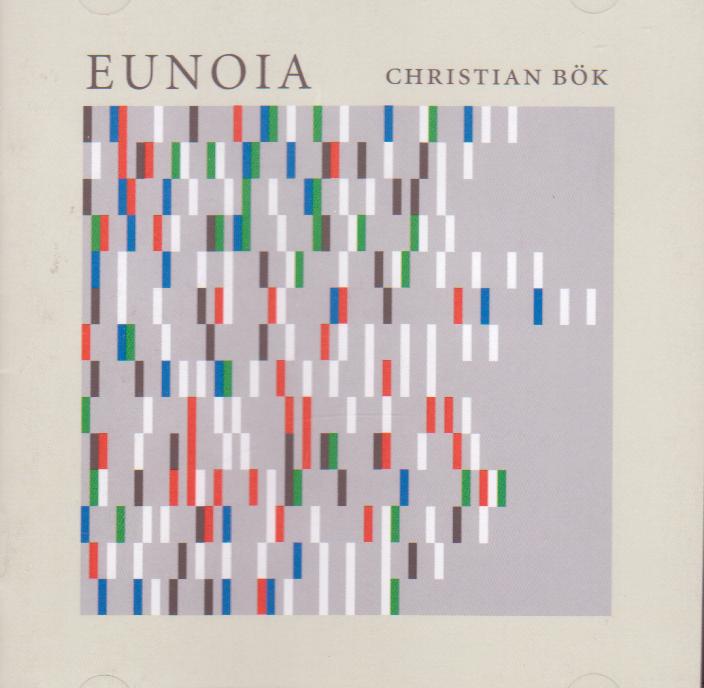
Too, the cover of Christian Bök’s Eunoia, a sound-to-hue translation of Rimbaud’s “Voyelles.” Here’s the image.
Here’s the poem it translates.
A noir, E blanc, I rouge, U vert, O bleu: voyelles,
Je dirai quelque jour vos naissances latentes:
A, noir corset velu des mouches éclatantes
Qui bombinent autour des puanteurs cruelles,
Golfes d’ombre ; E, candeur des vapeurs et des tentes,
Lances des glaciers fiers, rois blancs, frissons d’ombelles;
I, pourpres, sang craché, rire des lèvres belles
Dans la colère ou les ivresses pénitentes;
U, cycles, vibrements divins des mers virides,
Paix des pâtis semés d’animaux, paix des rides
Que l’alchimie imprime aux grands fronts studieux;
O, suprême Clairon plein des strideurs étranges,
Silence traversés des Mondes et des Anges:
— O l’Oméga, rayon violet de Ses Yeux!
Bök translates each vowel in the poem according to the equivalences laid out in the first line. Consonants make the grey field. He calls perversely the sum of it “Of Yellow.”
Ronald Johnson, Ark
Norman’s talk this morning has me thinking about Blake and vision and metaphor. The myth he made, I want to say from scratch, but in fact through some sly composting, offers to our minds four, I want to say worlds, but really, visions. Four ways of seeing that express themselves as worlds.
Blake felt sure one lives in such a world as one makes in mind. Thus the “mind-forged manacles” of “London.” His letter to Thomas Butts (previous post) lays the four out one way. In the prophetic poems he sets them before us as Eden, Beulah, Generation, and Ulro.
I asked this morning if “birds are forms of attention” is a metaphor or literal. Maybe the answer might depend on what realm one’s in that moment.
In Eden, the sentence is an insult to birds and attention. Not untrue but vulgar to say. In Beulah it’s a literal truth. In Generation it’s a metaphor. In Ulro, hell, it’s a lie. Them’s my thinks of an evening.
 The Art of Compost