Birds of attention

One thing I love at Samish Island are the birds. Great blue herons, bald eagles, barn swallows, robins; all through a day of sitting your mind is woven into and out of by robinsong. And today, on the drive back, a redtail hawk on a power line, and the sheer abundance in the eye of two goldfinches on a wire fence.

An old thought came back, birds are forms of attention, sometimes the mind twits and chitters, others it floats on thermals, others it dodges cars eating road carrion.

When I say that, birds are forms of attention, is that a metaphor. I don’t think I mean it as one. I’m thinking I mean it literally.

If any thing is also every thing, then metaphor’s no longer a lie, but maybe too it’s no longer metaphor. It’s just a different mode of literal.

Blake’s fourfold vision in the back of my mind here — probably because Norman talked about Blake, his “Fly” and his “London,” this morning. More on that soon but first to the gym.
“The New Thing”

A link to Stephen Burt’s essay on the “new thing” poetry. Or the new “thing poetry.” Need to reread it, but what I remember is, how grateful I am to find a name for what I’ve thought to be up to.

He sets as an epigraph a favourite passage by a favourite poet.

The self is no mystery, the mystery is
That there is something for us to
stand on.
– George Oppen, “World, World —”

Oh and just for funs, since I’m about to head back down to Samish for the last of Norman Fischer’s dharma talks, let’s put Oppen beside Dogen.

To study the Buddha Way is to study the self.
To study the self is to forget the self.
To forget the self is to be realized by the ten thousand things.
– Eihei Dogen

Grasses trees and broken bricks reach out to wake you up.

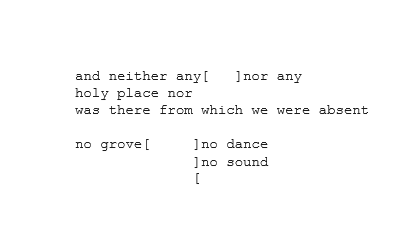
Robert Grenier’s Sentences

A digital version of Robert Grenier’s seminal Sentences. My students have a great time with it and the questions it raises—what’s part and what’s whole? what’s the function in a poem of silence and empty space? how does dispersal of the poem as a digital edition affect its prior existence as a pricey handmade edition? when he writes “bird,” does he mean a bird, or does he mean “bird”?—keep us happy and hopping a long time.

Whalecloth’s home page, with a bit of context for the poem.

Robert Grenier’s Sentences

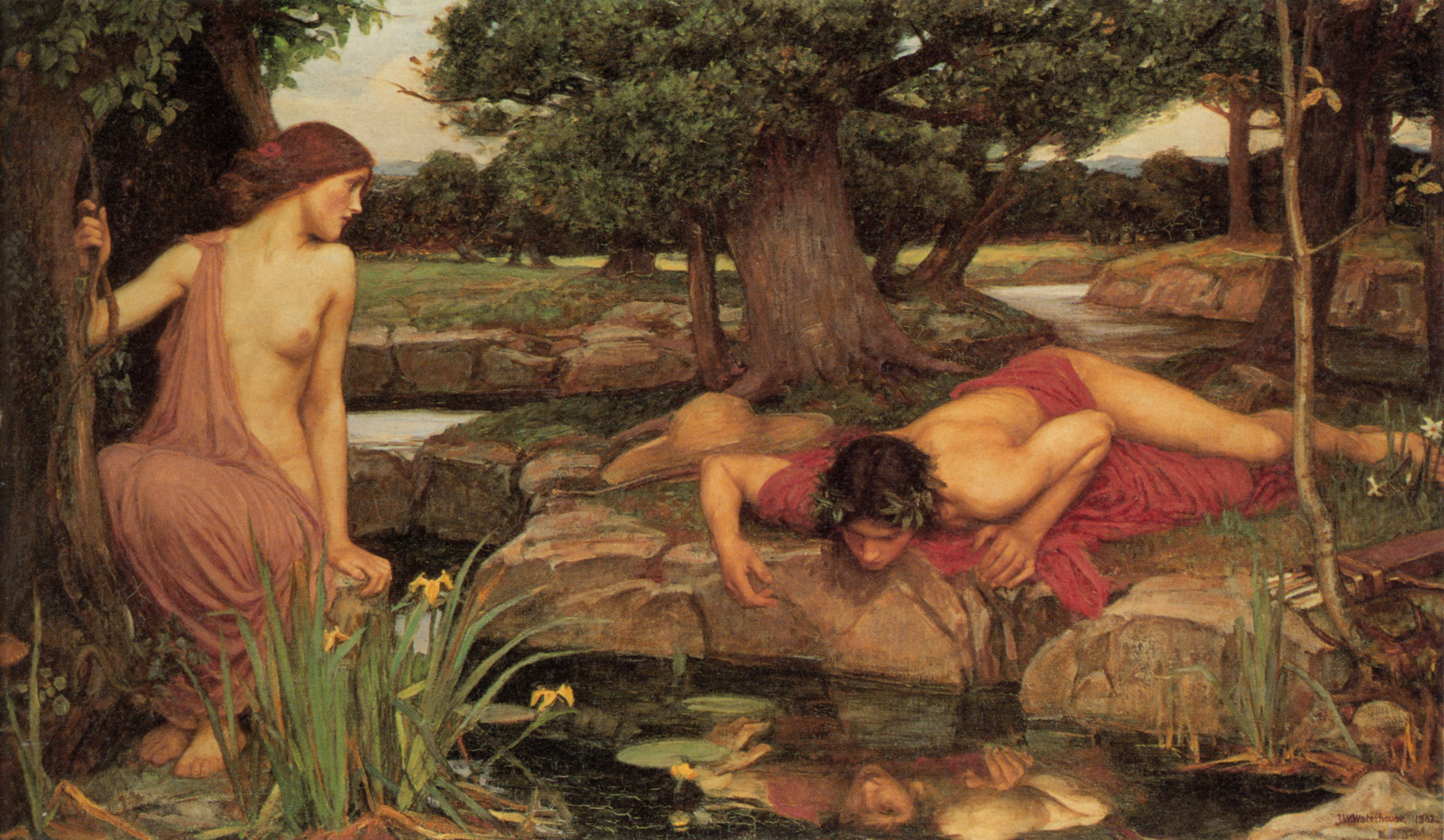
No Narcissus

Drove down to Samish Island this morning for a dharma talk by Norman Fischer. A bit remains with me from the life of Dongshan. He was walking up in the mountains, newly a teacher, chewing on the question of suchness, his teacher Yunyan’s “just this,” came to fastmoving stream and was startled by his fastmoving reflection in the water.

“Wherever I go,” he wrote in the poem the moment gave him, “there he is, with me. He’s me. But I’m not him.” Norman, I hope I have that right.

Drove away with a feeling for the dreamlike spaciousness of the country around—green fields, tidal flats, starlings in the road, hawk on a powerline. If I could amend it, it would be to say, “He’s me. And I’m not him.”

A few points of contact. Narcissus staring at his reflection in the water. Chuangtzu’s butterfly. (Was I Chuangtzu dreaming I was a butterfly, or am I a butterfly dreaming I’m Chuangtzu?) And the spacious light of Sappho’s fragments (rereading them for my compost course) in Carson’s translation:

]
]
]
] thought
] barefoot
]
]
]

(She won the Griffin Prize this year, as did Brenda Hillman, on the international side. Wonderful.) More to come on Carson’s Sappho, how it seems to me compost might be a way to speak of them.

Opening the field

This by Robert Duncan, in Rasula’s This Compost, out of the body of which many of my thoughts here take sprout.

It is only the midden heap, Beauty: shards,
          scraps of leftover food, rottings,
          the Dump
where we read history, larvae of all dead things,
          mixd seeds, waste, off-castings, despised
          treasure, vegetable putrefactions
– Robert Duncan, “Nor is the Past Pure”

Speaking of the opened field. I’ve found a good prompt for working a way into Olson’s “Projective Verse” with students is to ask them just what that “field” in “composition by field” might be. Last time I did it I was way taken by the breadth of their answers. The page. The sensuous surround at a given perceptive moment. The expanse of possible questions.

I’m paraphrasing here, but my gist is, they helped me see how “composition by field” is itself composed by field, meaning at multiple vectors fruitfully.

Butterfly & rock

Here’s a similar thought to Olson’s (below) but somehow delicater. Olson’s bears down, you can feel the weight of the town crouched on the stone. Niedecker’s comes up through the butterfly and with its lightness.

Life is natural
       in the evolution
              of matter

Nothing supra-rock
       about it
              simply

butterflies
       are quicker
              than rock

– Lorine Niedecker, “Wintergreen Ridge”

What I been areading. NiedeckerNorth Central.