Selections from One-Star Amazon Reviews of Cormac McCarthy’s Blood Meridian

This post has given me a new idea for a compost writing exercise …

Biblioklept's avatarBiblioklept

[Editorial note: The following citations come from one-star Amazon reviews Cormac McCarthy’s novel Blood MeridianI’ve preserved the reviewers’ original punctuation and spelling. More one-star Amazon reviews.].


It may be art.

Damn McCarthy.

I find him boring.

unrelenting nihilism

The story is thin at best.

Are we supposed to enjoy it?

I felt abused by Blood Meridian

not a traditionally enjoyable book

this book is simply just not “all that”

wordy, over the top speechy dialogue

endless streams of dependent clauses

I am a devout fan of Cormac McCarthy.

The characters are not really sympathetic

He is obviously a sick man psychologically.

all about violence and no plot what so ever.

if I was a trained geologist I might like it better.

too many words that are not in standard dictionary

I guess people think he is cool because he writes so violent.

This one guy peed on…

View original post 676 more words

One more for Elise Partridge

Hello friends. A three-way conversation between Barbara Nickel, Stephanie Bolster, and myself on the life and work of our loved friend Elise Partridge has now gone live at the Winnipeg Review. It’s to be found here.

And, if you’re curious, I wrote a bit about the challenge and wonderment of the conversation itself here. You can read some more about Elise herself here. And Barb’s wonderful blog is here. Steph doesn’t have a blog but here’s her publisher’s page here. Enjoy, please, do.


I hope Elise’s spirit won’t mind me appending this.

I was invited to a celebration of Rosh Hashanah tonight and we were asked as part of our lovely evening to express an intention for the year to come. Mine was, to be more patient with others and myself. What’s this have to do with Elise? She wasn’t especially patient with herself or others. In fact I loved her impatience, it was was wise, it was holy! At least when she was skewering someone’s pretensions it was, very.

But my impatience is most often crap. (And that, that’s impatience with impatience. Yeah baby gotcha.) And I’ve just now started sitting zazen again, after years off the cushion, and I’m feeling what a difference it makes to be okay with not getting it exactly right all the time. And a little bit more patient with me, I’m a little more so with some other, too. Does seem to go that way.

Came as this a few ago

TD 90V - imageKshanti paramita = the perfection of patience, or patience beyond patience. Patience so sunk in itself you might not recognize it as patience. That was Elise, too. Barb, Steph, tell me, wasn’t it?

Whitman, “This Compost”

Source o’ the source o’ this blog.

Biblioklept's avatarBiblioklept

“This Compost”

by

Walt Whitman

1

Something startles me where I thought I was safest,
I withdraw from the still woods I loved,
I will not go now on the pastures to walk,
I will not strip the clothes from my body to meet my lover the sea,
I will not touch my flesh to the earth as to other flesh to renew me.

O how can it be that the ground itself does not sicken?
How can you be alive you growths of spring?
How can you furnish health you blood of herbs, roots, orchards, grain?
Are they not continually putting distemper’d corpses within you?
Is not every continent work’d over and over with sour dead?

Where have you disposed of their carcasses?
Those drunkards and gluttons of so many generations?
Where have you drawn off all the foul liquid and meat?
I do not see any of it…

View original post 395 more words

So little depends on William Logan

OMG this makes me mad. I’m delighted the source for Williams’s Red Wheelbarrow has been putatively found. But this? THIS?

“When we read this poem in an anthology, we tend not to think of the chickens as real chickens, but as platonic chickens, some ideal thing,” William Logan, the scholar who recently discovered Mr. Marshall’s identity, said in an interview.

DO YOU NOT KNOW HOW TO READ A POEM SIR.

I do not wish to wish to commit violence against any person nor semblance of one. I propose instead we strike the pronoun “we” from the human vocabulary. Then he couldn’t utter such crud.

Oh, read the article (scription or paywall bust needed), see if I’m wrong. Strikes me as one in which every sentence is superficially right and the whole’s deeply benighted.

Then read the poem (free to all the world). Strikes me as one in which each word magnifies its neighbour to infinity.

Platonic chickens! Maybe send us some platonic rain?

Addendumum

From Bedient again –

As it feeds on bygone texts, conceptualism may be marooned in the bottoms of a melancholy attraction to dead zones. How various are its ruins: consider decorative ruins, as in Elizabeth Clark’s graphically pretty reduction of Raymond Roussel’s New Impressions of Africa to its punctuation; exhausting tabulatory ruins, archived debris, as in Brian Joseph Davis’s compilation of 5,000 film tag lines; abstraction ruins, witness Dworkin’s Parse (2008), which cannibalizes words about grammar with the grammatical terms for the words; arbitrary-emphasis ruins, as in Goldsmith’s obsessive compilation of phrases ending in “r” sounds or, in a reverse move, the graphic de-emphasis in M. NourbeSe Philip’s Zong! (2008) and Rachel Zolf’s “Messenger,” their barely legible 6–8 percent gray font; and, to make an end, ruins by over-extension, including paragraphs or stanzas deliberately stupid with repetition. (“Against Conceptualism”)

What’s the line, question to self, between ruination & compost?

DEAD ZONES . . . . . . ADZE NODES

Addendum

This too from Bedient, on a day when the nation’s highest court has affirmed that whole principalities of desire once loathed belong wholly now to our body politic. That this many more faces of our libido belong now to human dignity.

[D]etachment from affects means … suppression of the psyche’s outspokenness, which is vital to its health, and a stop to the sociopolitical usefulness of both the libido and the rougher emotions. These emotions fuel what Stéphane Hessel, one of the shapers of the UN’s Universal Declaration of Human Rights, celebrates as “indignation” in Time for Outrage, Indignez-vous! (2011). This new neutrality also stultifies the creation in art of major new aesthetic affects, distinct universes of feeling: Moby-Dick putting forward one affect, Wuthering Heights another; Rilke his, Rothko his; and so on.

Each work we call great is its own cri de coeur. Wonder if that much at least great art and great legal cases have in common.

Stray thought or three more on conceptual poetry

This not just in (2013) from Calvin Bedient on conceptual poetry:

Writers who pride themselves on conceiving projects and executing them according to plan – thus relatively indifferent to the intrinsic value of what is produced and to the quality of the production itself – neglect life values, which include a trembling web of receptivity, sharply interested observation, the ability to make instant adjustments, and organic developments within a constantly changing context, all properties as important to lyric poets as to cats. (“Against Conceptualism”)

And I am, like a tree with two cows in it, of two minds here. I quiver like a plucked lyrestring to notions of a “trembling web of receptivity” and organic alterations responsive to a “constantly changing context.” I’m also coolly alert to how the phrases are calculus to make me quiver and bow to them.


If it’s that conceptual is a way to do poetry, I’m down w/ that.

If it’s, conceptual is the way to do poetry, got no patience w/ that.

Can never say what its fans are fanning, which article, for sure.


This one is just, okay, sweet. I mean it’s kind, gentle, open, bighearted, fun and funny. So maybe also it’s got a rigorous generative procedure behind it and also linguistic resonances available only to initiates. Who cares, it offers its pleasure to any willing to inhale, to inspire.

EPIC

porcupines

(Craig Dworkin, Remotes)

I’ll write more on this one maybe at a later mote. For now just this. Sometimes the cells walls between conceptual poetry & affective poetry & autobiographical poetry (the dedication: “for Miles, and / the time being”) & visual poetry (these are typewritten and every ‘s’ and ‘d’ is twice struck, plurals, pasts) are porous unto nought.

This wee gist has thought & heart & eye & ear & a moving body. I think Craig might assent to calling it a “conceptual poem”? But it affirms everything Bedient says conceptual poetry refuses.


And. Yet. For the most part I’m with Bedient there. Hells yeah.

Stray thoughts on aleatory poetics and conceptual poetry

Thinking about aleatory poetics, that is, chance operations, the acrobatics one does to get will or self or intent out of the way. Whether that’s rolling the dice, or opening a silence to ambient sounds, or transcribing a day’s traffic reports.

Well the thought was this. “Let the universe compose the part of the poem proper to it.” A relief not to have to express yourself!

Thought that came a bit later was, “The trick is telling what part’s proper to it and what part’s proper to you.”

Then I found I wanted to put “it” and “you” in just those scare quotes. Where does the one end and the other begin?

Cage might not have needed his cageyness, nor Heidegger all that wildering swirliness, had he trusted the emptiness more wholly.

Like I’m one to talk. Whimpering about my achy gut.


My other wonder’s about the the title Against Expression that Craig Dworkin (for whom I feel true affection) and Kenneth Goldsmith (with whom I feel true amusement) gave their anthology of conceptual poetry.

Could be argued that in it, expression isn’t opposed there so much as front-loaded – the expression’s in the inception, the inceptive idea, then the rest is allowed to unfold either deterministically or chancewise, which is fine and fun and sometimes beautiful and very often a vital corrective to a navel-gazing aesthetic consensus. And it lets the cosmos show its chops.

But it’s still expression. And it tends to be an expression of will and intellect and even a kind of control and mastery – at least it has a sort of coolness to it often that suggests, I master the inception, I need not master the rest. I, poet, watchmaker god. 

I dunno. I’m just thinking out loud here. I’m drawn to these practices and offput by them too. They offer a way out of the nutshell of the self. But it seems a way of intellect and will, coolness and mastery, wit and a kind of Classicism, and for all that their productions, some of them, turn me crazily on, I’m shut out in the end by the paucity of impulse in them.

They seem the place where the animal in us goes to die. Seem to renounce rather than transform what in us pisses fucks and shits. Am I wrong? Have I missed it?


I want a poetry that weds the animal to the angel in us, the algae to the nebula, not one that subs the higher for the lower (Classicism) or the other way round (Romanticism). Christ I’m sounding like Rilke kill me now.


The aleatory, in our poetry, may be our spontaneity externalized.

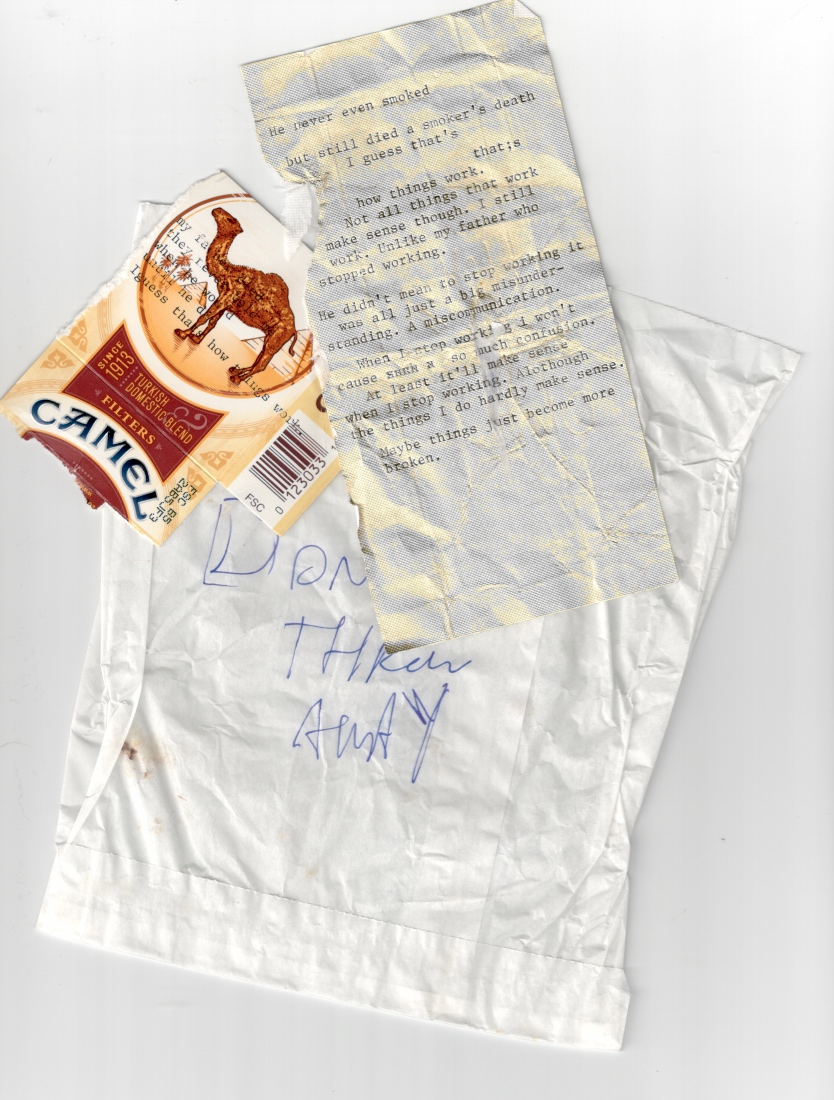
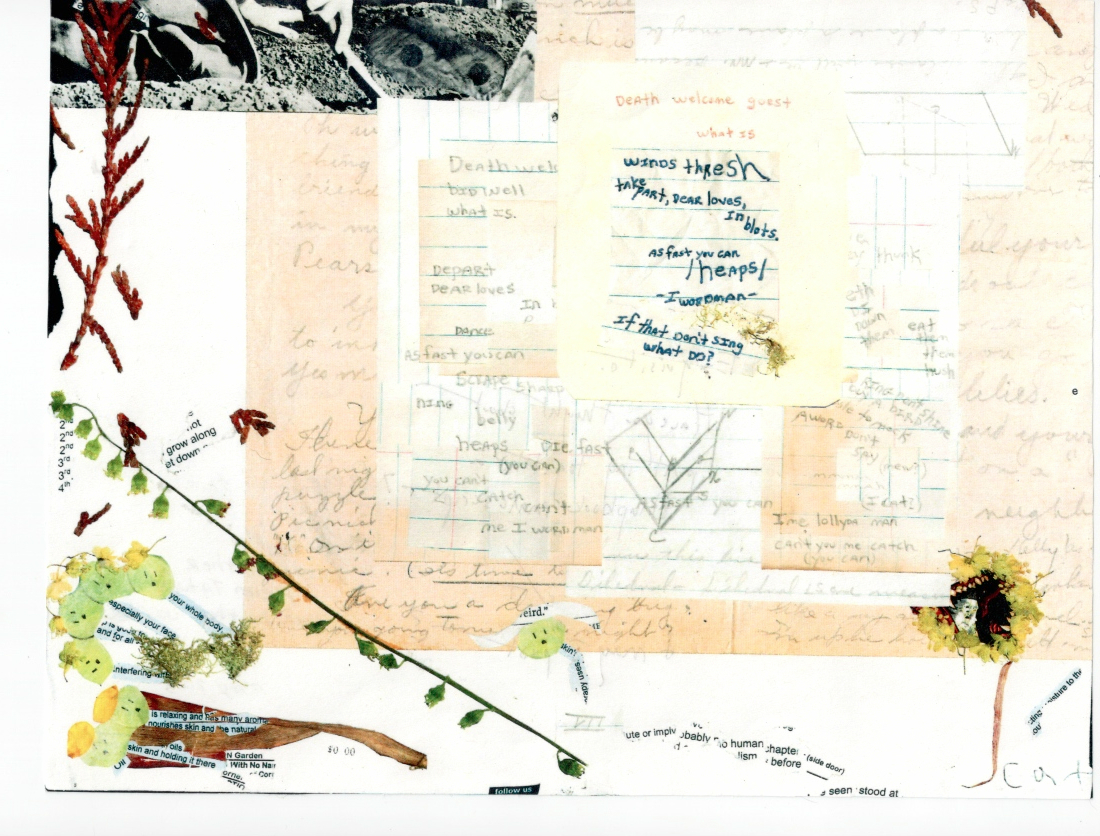
Student work – Scrap elegy

The exercise, upon reading Anne Carson’s Nox:

Build an elegy out of scraps, fragments, parts. At least some of its text should be found text.


Nox a text I admit to some mixed feelings re. Gorgeous seductive reproductions of crinkled scraps. You can see the shadow where the slip lifts off the ground it rests on. The tears and stains are palpable. The thing ages afore your eyes. A sepia principle squared and resquared perhaps. Apotheosis of mimesis.

Nox - CI

First day discussing it, a tenth or thirteenth point threeth muse came down upon me, and I held the faltering accordion o’er my head, and cried out, “is document porn, people, document porn.”

I meant, it promises all the satisfactions of actual cotton fibre, passionate tears, coffee stains or such under your fingertips, but it’s mere dissembly. A 2D picture plane w/ a pretence to texture.

Yeah, I know, book’s an elegy, and first and last elegy for itself, and eros is longing for what’s gone missing, yadda. Porn knows it’s porn’s still porn.

Not, in the words of a comedian or three, that there’s anything wrong with that. But there are other options.


My students, bless’em, haven’t the production budget of a New Direction behind them, but their work on this exercise’s been wonderful. All sorts of elegy, acknowledgement of lack and loss and longing, and done without making their scraps into fetishes. (Admire Carson lots. Lots structural in Nox I love. But not its slick mimesis which makes me sort of sick.)

Herewith a gallery of their deft encounters.


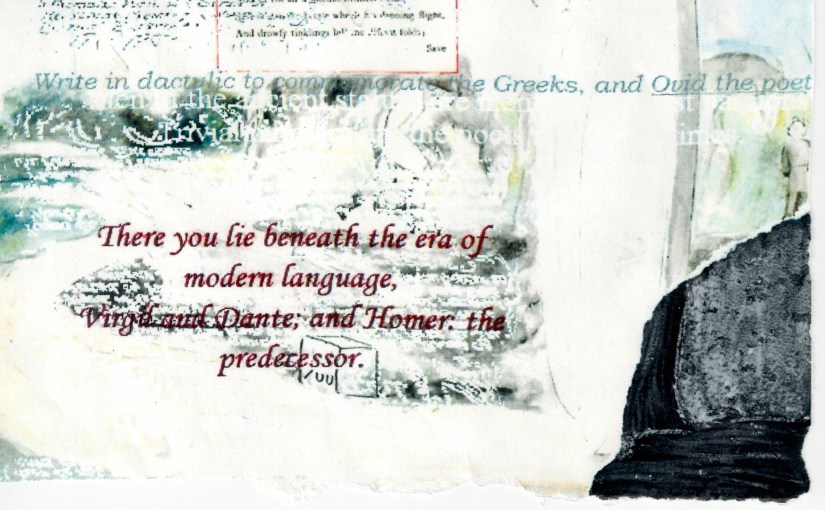
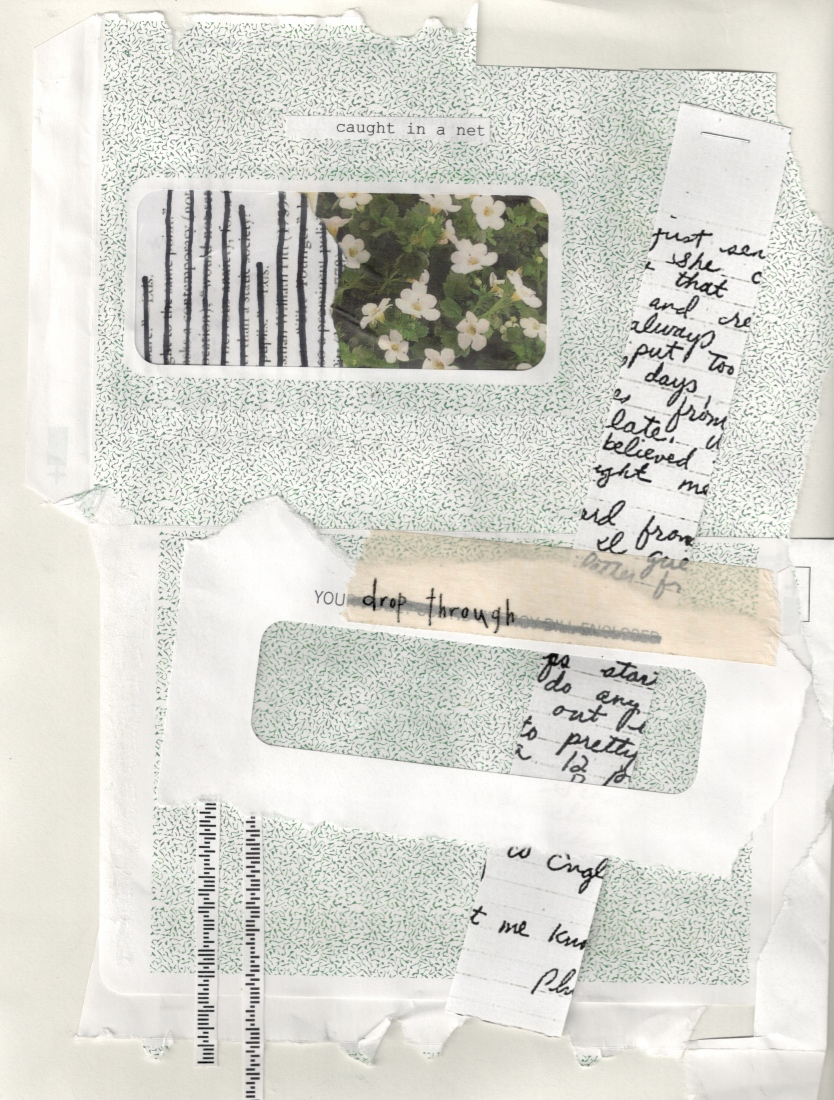
One interrogates the torn edge without making a fetish of the tear.

Ex 6 no 1


One abrades the boundary between beauty and ugly in a way only plastics and the postmodern can.

Ex 6 no 2


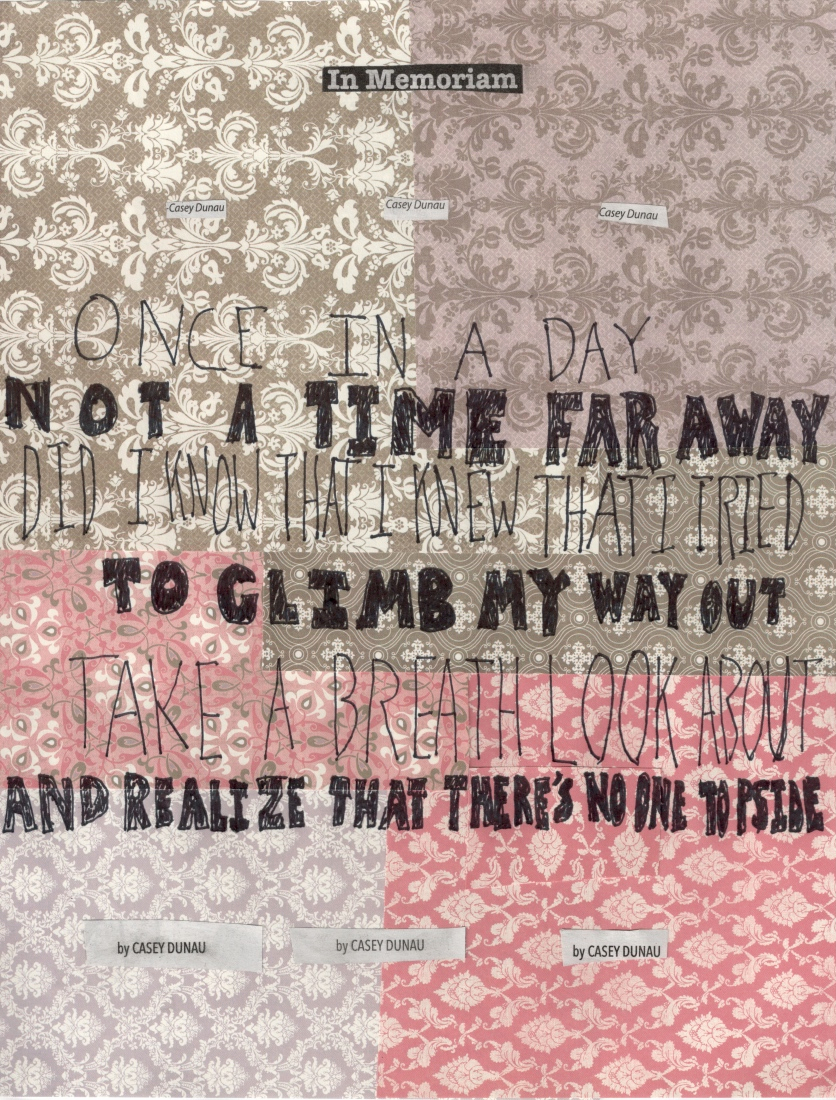
One applies a mathematic of the shell to arrange swatches cut it might be from a Louis Quatorze drawing room.

Ex 6 no 3


Click on this one to get some sense how it shone. Also it had a warm shaggy waft of tobacco which made me want to smoke which I’ve never (almost). It was, that is to say, multi-modal. Okay now I’m doing the nostalgia I got on Carson’s case for. O mimesis. O Plato.

Ex 6 no 4


Been on this student’s case to get his thinking into his fingertips. He broke through and big.

Ex 6 no 5


And this one, my goodness, click on it too, the layers! the textures! the heart! (all of them, the heart)

Ex 6 no 6

Elise Partridge – Launch of The Exiles’ Gallery

Oh late, oh night, and here are give or take some words I said at the Vancouver launch for Elise Partridge’s The Exiles’ Gallery, now out from House of Anansi Press, you can find one here.


So we’re here to celebrate a new book of poems by Elise Partridge. Elise can’t be here with us in a bodily form. After her struggle with cancer she has gone what some faith traditions like to call home. Not her tradition, as far as I know, or mine, but the word, “home,” gives me a comfort when it shares a sentence with her name. Too, it gets me thinking about her title. It’s an odd title. The Exiles’ Gallery. The sounds in it hardly touch each other. THE EXILES’ GALLERY. It’s as if our mouths were to be acrobats, temporarily. Or as if all the phonemes in there were jonesing to get the eff out of there. I hope that way of putting it wouldn’t, doesn’t, displease her.

You might even say the sounds are exiled from each other. And something like that’s true with all her book titles. FIELDER’S CHOICE. CHAMELEON HOURS. The phonemes are oddly at odds. I say “oddly” because she can sure as hell do euphony when she pleases to

 some small donations from these golden trees

 Now we welcome the widening water

The, not dissonance of her titles, their refusal to euphonize, she’s up to something.

Quick check, everyone raise their hand who’s not exiled in some way or other from something. Thought so. (Two guys raised their hands here. Really? Really?)

To be at home isn’t a given, and it isn’t that common, and maybe it isn’t even a right, to judge by how mostly we treat each other. It’s a lot more common for us to be in exile of one sort or another. Exile from your country or your spouse or your own sadness or the soil in your hands planting a flowerbed.

And there are so many things that a girl outside a country dance staring up at the planet Mars, and the parents who last danced grudgingly on their wedding day, and a homeless man under the Burrard Street Bridge living out of a shopping cart, and for that matter Rohingya refugees fleeing Myanmar in leaky fishing boats and wanted not anywhere, don’t have in common.

A thing they do have in common, and all us with them also, and her poems point us to it, their attention is a lighthouse on it, is such home as they do have, at a given moment, they’ve made it for themselves. For sure there are gifts, a look, a drink of water, no life without those. But home’s made through one’s own activity, dogged or desperate, out of what a moment offers, whether that’s ample, or it’s meagre, or it’s barely anything at all.

And that’s what I’ve been finding most lately in the poems. In their sounds, the extraordinary heterogeneity of them, which I’m embarrassed to be only now hearing. Sometimes the mixture heightens anxiety. Sometimes it darkens satire. Sometimes it’s pure praise for sheer mixed-up-ed-ness of this world.

             [W]e strode
back to our avenues,
jaunty, just nineteen,
to troll like rowdy gods.

My neighbour’s daughter claps
as they lurch right
again

Praise for the sweet various flowershot dungheap of our world. Only world, her poems say, we get. Read them.


Then some beautiful readers reading some beautiful poems in beauty. I can’t give you those so here instead my beautiful friend.

partridge


(I was the last reader and told this little story and read this poem.)

For around a decade Elise and Steve were regulars on the property I owned on Salt Spring Island. While I was away they would tend to a plumbing system Byzantine in its complexities—clean up nightly prezzies from my cat—and once endured a plague of tent caterpillars I have to admit I thought they were exaggerating to call Biblical, till I got back, and had confirmation from the locals.

They did good work there, despite the distractions, Steve on his articles, Elise her poems, and this is one such of hers, “Invitation.” I read the poem, as not a last poem, but a leave-taking poem, full to the brim and then some with the love of life I loved and love still in her.

INVITATION

The stag and doe
lift their heads
in the brush

ears raised
as if
attuned to our tears

The grass reaches through chairs
by the shed
as if to thatch cushions
for the pair of us

The gate that won’t quite shut
with its scruff of lichen
invites us into the orchard

to pick “till time and times are done”
our choice of the bursting plums.