Exercise: Zukofsky’s word-flowers

This one came in three parts — a reading assignment, a journal assignment, a writing assignment. The first two meant as robust prep for the third. And I was right they would find it a hard exercise! Maybe the hardest of the quarter. It did ask them to set aside things they’d spent years learning to do well, e.g., staying on topic, making proper sentences.

The exercise (with some of their work to follow) —

1. Reading

A few pages from Louis Zukofsky’s late word-flower sequence 80 Flowers. Like that one and this one:

STARGLOW

Starglow dwarf china rose shrubthorn
lantern fashion-fare airing car-tire crushed
young’s churning old rambler’s flown
to sky can cut back
a crown transplanted patient of
drought sun’s gold firerimmed branched
greeting thyme’s autumn sprig head
happier winter sculpt white rose

MOUNTAIN LAUREL

Known color grown mountain laurel
broadleaf of acid earth margin
entire green winter years hoarfrost
mooned pod honesty open unvoiced
May-grown acute 5-petal calicoflower cluster
10-slender rods spring seed sway
trefoil birds throat Not thyme’s
spur-flower calico clusters laurelled well


2. Journal exercise

Metonymy is calling one thing to mind by naming another that’s habitually associated with it. For instance, the phrase “red wheel barrow” calls to mind a barnyard, and perhaps a pile of dirt, or hay bales. Pick two individual words in 80 Flowers and describe the metonymic resonance of each — the things it calls to mind by habitual association. NOTE: Some metonymic associations are personal and idiosyncratic — associat­ing a red wheelbarrow with Indians, say, because there’s a mural with the poem on Indian Street. Try to steer away from those associations, and towards associations you can trust would be shared by a typical reader.

(In a class soon after we looked at how context, a word’s neighbour words, draw some metonymic associations into the foreground, and let others recede into the background.)


3. Writing exercise

Each of Zukofsky’s poems consists of eight five-word lines. Instead of coming together into sentences, the words make a sort of kaleidoscopic image of the flower — fragmentary, unparaphraseable. In fact, you might say that the relationship between any two adjacent words is not syntactic but metonymic, interested not in making a statement, but in drawing out habitual associations. Write a poem that uses the same form: eight five-word lines, compound words as you please, words next to each other not to make sentence sense, but to make richly textured juxtapositions.

teaching portfolio

Exercise: 101 word short story

Read the short short story “Frontiers” by John Daniel, and write a story that has exactly 101 words — including the title. The story:

Frontiers

I’ve never been this far from home. I’ve never stayed up this late. I’m out west.

We rode the train. I slept upstairs. You put your clothes in a hammock. They have Dixie cups.

The world has mountains on the edge, where the sun sets, big black things, and that’s where we’re going.

I’m in the front seat with my mother. I’m five. We’re going to a dude ranch. There will be cowboys.

There’s a soft green glow on the dash board. My mother wears perfume.

I’m traveling. I’ve never been this old.

“The stars are ablaze,” I tell my mother.

Exercise: Fall haiku

First . . .

Read the haiku by Bash­ō (here are some). Notice that

  • most have a seasonal reference — something that tells you what season it is;all are three lines, but most do not obey the Japanese formal stricture (5-7-5 syllable count) — haiku tend to work better in English if they’re shorter;
  • they rely on image rather than on statement — they’re vivid to the senses;
  • they often juxtapose two experiences or impressions — sort of the way Pound’s “In a Station of the Metro” does—though there need not be any metaphor;
  • they are completely simple.

. . . and next . . .

Write five fall haiku for next class. Your seasonal reference, a traditional part of the Japanese haiku, should be to fall. Be on guard for clichés!

Draw each haiku from the world you see (and hear, taste, touch, and smell) around you. Rely on image rather than statement. In other words, let the image speak for itself.

Don’t pile on effects. Be completely simple. In the spirit of which — no more than one adjective or one adverb in each.


. . .  and soon to come.

Some of their fall haiku, after a round of rounding them down.

In a Station of the Metro

The poem, as most all know –

IN A STATION OF THE METRO

The apparition of these faces in the crowd;
Petals on a wet, black bough.

I had two aims in our discussion of this too too famous poem. One, get a feel for how sound underwrites sense. Two, sharpen our feeling for the logos of the image. Logos, did I really say that. Bloody pretentious. But logic seemed too wee a word. Logos as in way, coherence, holdingtogether. PIE root, *leg-, “to gather.”


Sound underwriting sense. We’d done our rock and stone thang. The stop at the end of rock is a jagged sharpness. The nasal at the end of stone is a dying rounded fall. And those sounds underwrite the senses of their words.

How now with Pound. Asked them first what they saw with the first line. Eventual consensus – ghostly faces in a trainish station underground – misty, blur-edged, as in something Impressionist.

The second line? How did those petals get to hang on that bough? The bough (limb of tree not fore of ship) (why we had to clarify that goes to something important about teaching language and its poetry) is wet.

Wet how?

Most likely with rain.

And being wet means?

If wet, sticky, and petals that fall there, stick there.

Next comes, logos of the image, what kind of petals? Daisy? Rose?


One pictured the former. K so how did those petals come to be there? Someone brought a bouquet of daisies into the woods and when their beloved didn’t show threw the bouquet in a pique and it hit a pine tree and broke up and some petals stuck there?

Um yeah maybe?

It’s possible, sure, but other possibles?

Occam’s Razor comes to play here. The simplest account is often best. And so we came to – cherry blossoms, blown a bit about in a rainstorm, come loose, float around, land on the limb of the tree that bore them, to spend a little while adhered there.


“Too too.” Not that it not warrant its fame. But such fame keeps us from seeing it afresh. And freshness is its all – that much it shares with haiku, though it’s not one, no really, not really.


Penultimate Q, what’s the second line, cherry blossoms struck to presumably a cherry tree, got to do with the first, ghostly faces in an underground transit crowd?

Silence, a bit.

Anything cherry blossoms have in common with faces?

I picture an oval.

And right there’s what one called the metaphoric bridge. The likeness that draws two differences into relation. I’m not a big fan of metaphor, it’s a lie and makes things other than they is, but gotta admire this one, by this reading, its assertion of non-non-difference.


Coupla quals here. One, the faces, the shapes of them, help us to come to cherry petals, as much as the petals help us to see faces afresh. Two, the colours of the petals, pinkish-white, are part of the metaphoric bridge as well, and suggest a racially pretty homogenous Metro crowd. Maybe not inaccurate for Paris in 1912. But it does place and date the poem.


Final Q, how do the sounds of the lines support their senses? My whole purpose though the getting-there may have been more lovely than the gotten-to.

Apparition – except for the plosive p, softest among the stops, it’s all liquids and nasals. The blurred and softened sounds make the faces that much softer, blurrier, more deeply ghostly.

Wet, black bough – the first word ends in a stop, the second begins and ends with ones, the third begins with one. At the centre of the phrase is a sharply delineated core. Giving the cherry petals on the bough more clarity and definition than the faces they’re metaphors for.


In so far as the poem, its image and sounds, is about transience, the fleetingness of all this, it’s striking that the cherry petals are granted more clarity definition and permanence than the faces they’re figure for. If the poem may be called out for chinoiserie the ground of the cry is here.


LASTLY. Pound’s advice, that we compose in the sequence of the musical phrase, lives even in a thing so small as the comma after “wet.”

The stop, t, already punctuates it. Neither syntax nor articulation asks for more. But the comma makes one last refinement of the phasing – slowing just a little more the movement of breath and mind hand-in-hand through the line.

With that, wet comes a bit closer to the vegetal slowness of far longer syllables, blackbough – slows enough to join their company. The very words, wet, black, bough, become cherry petals, adhering to the poem a small while, then blown off.

teaching portfolio

On disjunction (II)

Disjunction often comes of suddenness—may be suddenness itself, given body, a form found.


Had my students working Tuesday on deep description. Pick one from this clump of grape leaves and describe it with sufficient devotion that another here, given this whole lot of leaves, hearing your account of yours, could pick that one out, unerringly.

They did and did and all good. The followup: Tune your antennae to beginning now and pick one phrase in your description that resonates beginningness. Write it at the top of a new page. Now tune to ending and pick one phrase that sings endingness. It goes at the bottom of that same page. Now, moving quickly, the first thought then the next first thought, write the paragraph that gets you from top to bottom. One restriction—can’t be about a leaf.


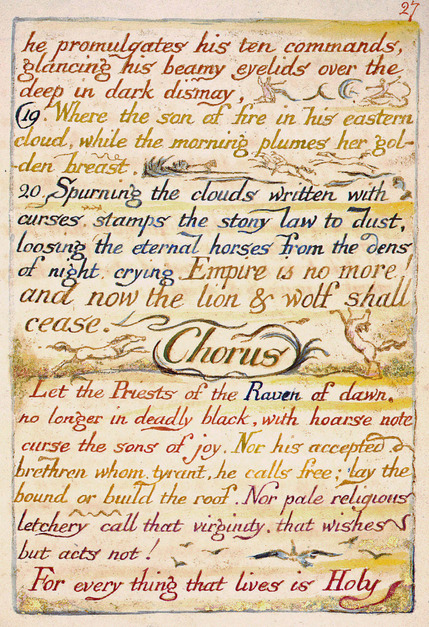
If each thing touches every thing (Indra’s Net) then disjunction is just in fun. No disruption except of our sense of disconnection. Blake’s Marriage of Heaven and Hell. Not everything but every thing. Means there’s all the space to move.

Blake - MHH plate 27


The way I put it in a poem that never found a public home.

The ease with each part touches each adjacent part.
Apples in a wood crate on a foldout cardtable.

Oh god he’s quoting himself make it stop.


Thought, as they worked away, too easy to sustain a through-line here, need to shake it up. OKAY I said STOP. On whatever word, or mid-word, stop. Draw a big dash. (Drew an em-dash on the board.) Put a period after it. (On the board.)


The way it came to me in mountains once when I was struck dumb by the perfect of each altogether and entirely open stone. You have all the space you’ve ever needed and have always had. You have all the closeness you’ve ever needed and have always had.

Snagged in a language of one who regathers himself after invasions and evasions as dimly as fiercely remembered. And, the insight didn’t keep me from being a somewhat total asshole to the woman I was there with and did stick with me through it, a year more, then she didn’t any longer, so.


A period after it and now pick up in a new place. Some other new subject, whatever, anything. Just don’t go on saying what you were. Day by day make it new. Day by day? Word by word.


To start, each word, anew. Meant to get to Tender Buttons. Sounds good, for another night than this, rain flying at my windows all.


POSTSCRIPT. After a dissipated start my afternoon class spent ten minutes talking about one line break and without repeating ourselves! The line:

Her

Kin in compost (II)

And another, found through Google, when I wanted to see if its searchy spiders had found this place, yet. What’s the odds of it? Another blog, begun in the spring of the very year, linking affections for compost and zen.

Click to embiggen to see lots of cool textural crap.

One diff, you might learn some from this one about actual composting, which here, you won’t, I don’t think so, no. The blog: zencompost.wordpress.com.

On disjunction (I)

A good, straight, clear, honest question this morning from one of our company. You keep praising, he said, approximately, work that’s weird, kooky, associative, fragmented, with no clear story or theme or argument to make. But what’s the difference between doing that and just spreading random garbage on the page?

And one came up after with another version of that question. You keep encouraging us, she said, to make big crazy associative leaps, but you wrote on my exercise, What’s the arc, where’s the through line? What gives with that? Which is it you want?

Just the questions I want to stir in them. I hope they know they’re doing great. Not sure how robust my answers in the moment were, so am thinking it through a bit more, here.

Will invite them to, and hope they feel moved to, read on.


A first thought. Three images, or words, or sentence fragments, say, can be at a great distance from each other and still make a pattern. In the same way that three stars, 10s or 1,000,000s of light years apart, can still belong to a constellation. In fact, they can’t not make a pattern—

*

*

*

—a triangle. In other words, even three bits of garbage, set out mindfully, make a shape. Could be slogan to the blog.

The triangle is from one vantage the perfect form. The number of points of contact by which a stool cannot not be steady.

And constellations are, besides, maps of human mind, not stars “in themselves.” Epsilon Pegasi has no sense of being part of a horsey.


An essay contrasting perfections of the circle (singular Platonic transcendental annihilatory) and the triangle (multiple immanent ecological). This from Creeley’s “Numbers,” in Pieces—

ONE

This time, this
place, this
one.

As of a stick,
stone, some-

thing so
fixed it has

a head, walks,
talks, leads

a life.

Alongside this—

THREE

Here forms have possibility.

The first
triangle, of form,
of people,

sounded a
lonely occasion I
think—the

circle begins
here, intangible—
yet a birth.

His priority always the forms the multiple takes. The circle as not singular perfection of the point but rather multiplication to infinitude of the triangle. Creeley as Pythagorean shaman.

But I digress.


Oh yes I do. Not much here yet of use to my students I fear. But must turn to work on a job letter. So, to be continued, and in the continuance, I hope, these.

First words of Tender Buttons. Disjunction as narrative fatigue. As provocation & alarm. As faith in essential wholeness. And probly, cuz I’m going on my nerve, lots I ain’t thought of, yet, now, here.

Creeley’s Pieces

Had a brief (5 min) but good (very) discussion in my afternoon section of this bit from Robert Creeley’s Pieces.

Cup.
Bowl.
Saucer.
Full.

We’d talked about integrity of the line, its wholeness, and I asked whether these lines, short as they are, felt complete. Do they offer an experience that satisfies and then releases you to the next experience. I expected great resistance but they so got it.

One saw a telegraphic narrative of breakfast (cereal and coffee). Another one of lunch (a cup or a bowl of soup). Another saw a formal patterning that reminded him of the buildup and falling off of a short story (three letters, four letters, six letters—over two syllables!—then down to four).

And all of the resonances metonymic. A poetry of everydayness.


I can’t hear pieces as not also peaces.

As in, the mind of pieces, is a mind of peaces.

Very different from our sense of “going to pieces,” falling apart, fragmenting, disintegrating. Here, rather, that any part, however wayward, however bereft or stranded, is its own whole.


My old teacher, Daido Roshi, said to us often, You’re perfect and complete, just as you are. He was no softy, he was a dragon, but he said that. I remember one sesshin (meditation intensive) when I was in a hard way, I went in for dokusan (face-to-face teaching) and blurted out, tearstreaky and snotfaced, Perfect and complete under all the conditioning (dumb learned damage we carry), or perfect and complete with all the conditioning? With he said and rang the bell. Creeley’s Pieces brings me back to that.


A beautiful thought of Thich Nhat Hanh. There is no way to peace, peace is the way. Do I harm it, and I hope not, by this variance, there’s no such as peace, there are only peaces.

Creeley had no patience for any zen bs or so I’ve heard. And yet the most dharmic poet I know. Here’s his take on Dogen’s “body and mind falling away”:

Here here
here. Here.

And here, the myriad ways of seeing water, Dogen says different modes of being have:

The bird
flies
out the
window. She
flies.

     .

The bird flies
out the
window. She
flies.
     .

The bird
flies. She
flies.

A variance, for sure, on Williams’s old woman, those plums.


A cup, a bowl, a saucer, all full, not in the sense of bearing up some matter, though they might that also, but in themselves, present, there.

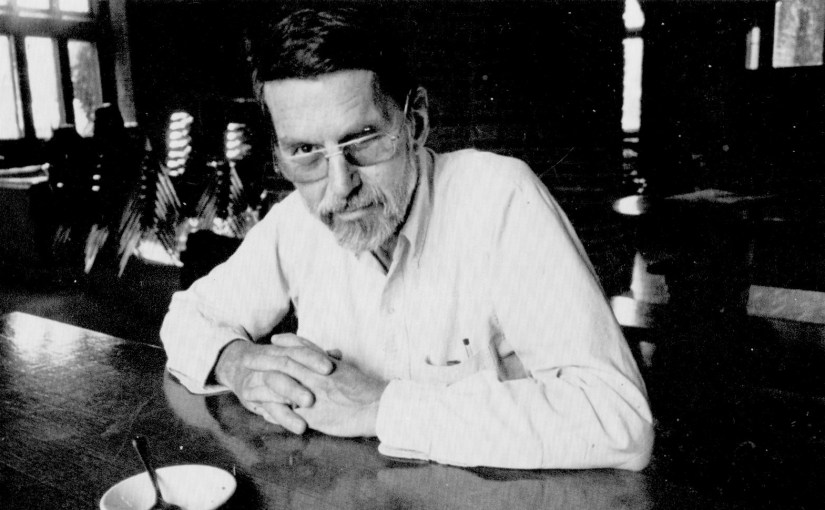
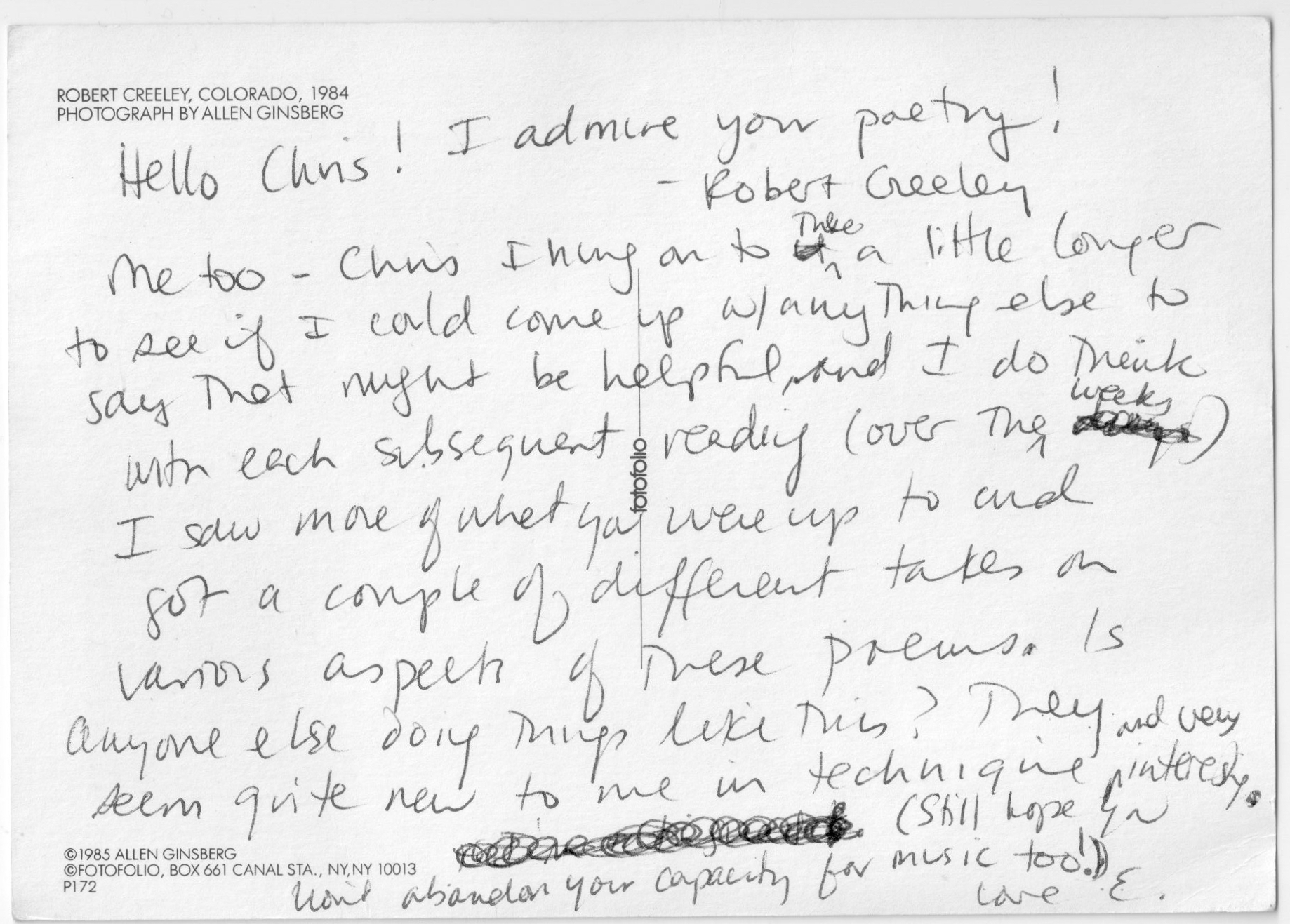
The image up top is a postcard of a photo taken by Allen Ginsberg sent to me by Elise Partridge after she’d turned her own clear quizzical eye to some poems of mine. In its entireties:

teaching portfolio