Exercise: Fall haiku

First . . .

Read the haiku by Bash­ō (here are some). Notice that

  • most have a seasonal reference — something that tells you what season it is;all are three lines, but most do not obey the Japanese formal stricture (5-7-5 syllable count) — haiku tend to work better in English if they’re shorter;
  • they rely on image rather than on statement — they’re vivid to the senses;
  • they often juxtapose two experiences or impressions — sort of the way Pound’s “In a Station of the Metro” does—though there need not be any metaphor;
  • they are completely simple.

. . . and next . . .

Write five fall haiku for next class. Your seasonal reference, a traditional part of the Japanese haiku, should be to fall. Be on guard for clichés!

Draw each haiku from the world you see (and hear, taste, touch, and smell) around you. Rely on image rather than statement. In other words, let the image speak for itself.

Don’t pile on effects. Be completely simple. In the spirit of which — no more than one adjective or one adverb in each.


. . .  and soon to come.

Some of their fall haiku, after a round of rounding them down.

In a Station of the Metro

The poem, as most all know –

IN A STATION OF THE METRO

The apparition of these faces in the crowd;
Petals on a wet, black bough.

I had two aims in our discussion of this too too famous poem. One, get a feel for how sound underwrites sense. Two, sharpen our feeling for the logos of the image. Logos, did I really say that. Bloody pretentious. But logic seemed too wee a word. Logos as in way, coherence, holdingtogether. PIE root, *leg-, “to gather.”


Sound underwriting sense. We’d done our rock and stone thang. The stop at the end of rock is a jagged sharpness. The nasal at the end of stone is a dying rounded fall. And those sounds underwrite the senses of their words.

How now with Pound. Asked them first what they saw with the first line. Eventual consensus – ghostly faces in a trainish station underground – misty, blur-edged, as in something Impressionist.

The second line? How did those petals get to hang on that bough? The bough (limb of tree not fore of ship) (why we had to clarify that goes to something important about teaching language and its poetry) is wet.

Wet how?

Most likely with rain.

And being wet means?

If wet, sticky, and petals that fall there, stick there.

Next comes, logos of the image, what kind of petals? Daisy? Rose?


One pictured the former. K so how did those petals come to be there? Someone brought a bouquet of daisies into the woods and when their beloved didn’t show threw the bouquet in a pique and it hit a pine tree and broke up and some petals stuck there?

Um yeah maybe?

It’s possible, sure, but other possibles?

Occam’s Razor comes to play here. The simplest account is often best. And so we came to – cherry blossoms, blown a bit about in a rainstorm, come loose, float around, land on the limb of the tree that bore them, to spend a little while adhered there.


“Too too.” Not that it not warrant its fame. But such fame keeps us from seeing it afresh. And freshness is its all – that much it shares with haiku, though it’s not one, no really, not really.


Penultimate Q, what’s the second line, cherry blossoms struck to presumably a cherry tree, got to do with the first, ghostly faces in an underground transit crowd?

Silence, a bit.

Anything cherry blossoms have in common with faces?

I picture an oval.

And right there’s what one called the metaphoric bridge. The likeness that draws two differences into relation. I’m not a big fan of metaphor, it’s a lie and makes things other than they is, but gotta admire this one, by this reading, its assertion of non-non-difference.


Coupla quals here. One, the faces, the shapes of them, help us to come to cherry petals, as much as the petals help us to see faces afresh. Two, the colours of the petals, pinkish-white, are part of the metaphoric bridge as well, and suggest a racially pretty homogenous Metro crowd. Maybe not inaccurate for Paris in 1912. But it does place and date the poem.


Final Q, how do the sounds of the lines support their senses? My whole purpose though the getting-there may have been more lovely than the gotten-to.

Apparition – except for the plosive p, softest among the stops, it’s all liquids and nasals. The blurred and softened sounds make the faces that much softer, blurrier, more deeply ghostly.

Wet, black bough – the first word ends in a stop, the second begins and ends with ones, the third begins with one. At the centre of the phrase is a sharply delineated core. Giving the cherry petals on the bough more clarity and definition than the faces they’re metaphors for.


In so far as the poem, its image and sounds, is about transience, the fleetingness of all this, it’s striking that the cherry petals are granted more clarity definition and permanence than the faces they’re figure for. If the poem may be called out for chinoiserie the ground of the cry is here.


LASTLY. Pound’s advice, that we compose in the sequence of the musical phrase, lives even in a thing so small as the comma after “wet.”

The stop, t, already punctuates it. Neither syntax nor articulation asks for more. But the comma makes one last refinement of the phasing – slowing just a little more the movement of breath and mind hand-in-hand through the line.

With that, wet comes a bit closer to the vegetal slowness of far longer syllables, blackbough – slows enough to join their company. The very words, wet, black, bough, become cherry petals, adhering to the poem a small while, then blown off.

teaching portfolio

On Sound (II)

Revisited sound today. This time, with a view to, how does sound do work the good work, bearing up thought and feeling?

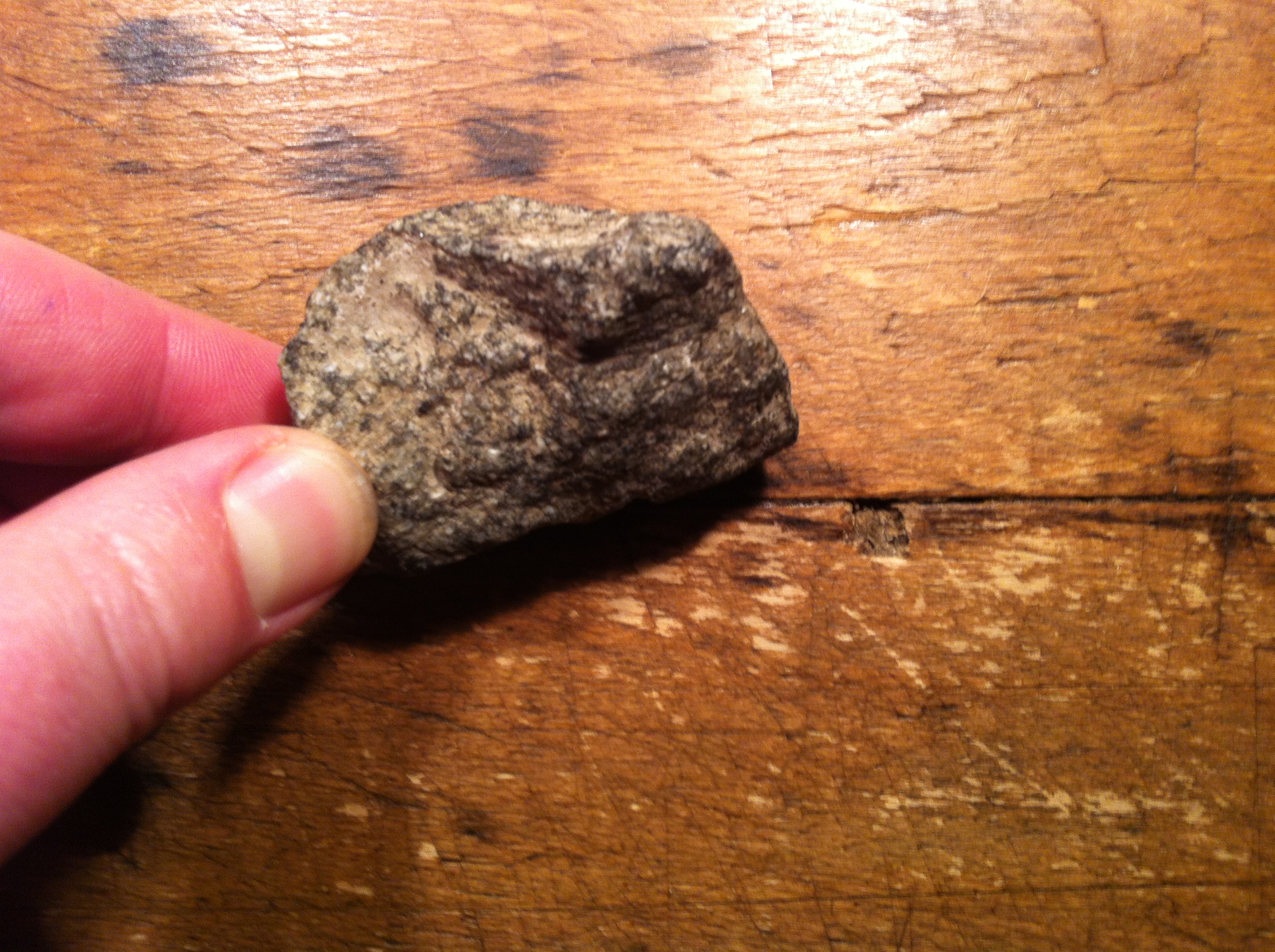
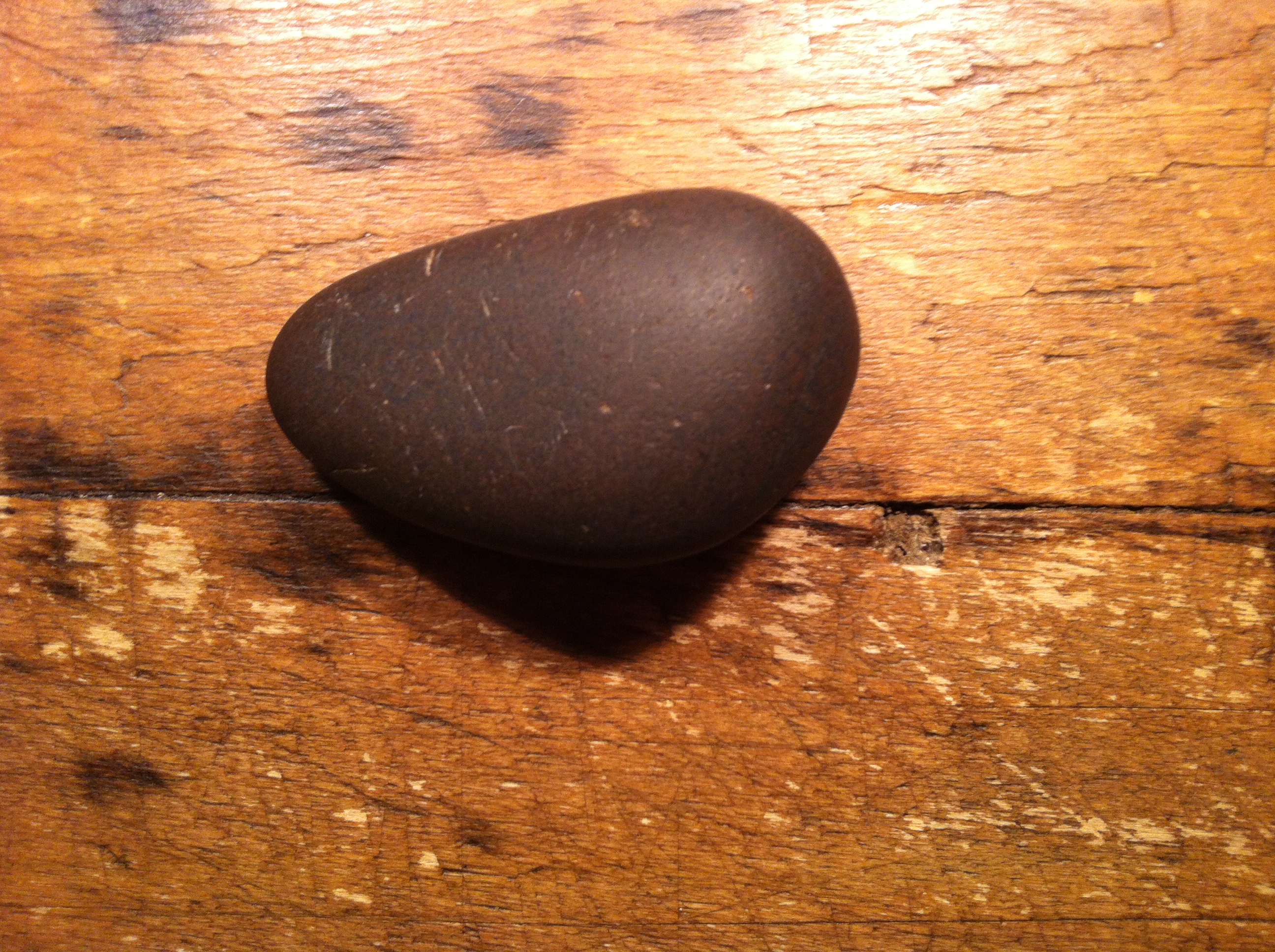
Had my students hold in hand, for their heft and texture, two petrous objects. You’ll see in a mo why the Greeky adj. One was sharp and jagged, rough-textured, a bit of railbed gravel. The other, smoothed and rounded, as out of a moving stream.

They passed those round. Took em back and said, One of these is a rock, and one is a stone. I’m going to hold one up in a second, and please write down, saying nothing, which it is, rock or stone.

Held up the jagged one. Write it down, guys, which is it, rock or stone. They wrote that down. Then shows of hands. Morning section, all but two said rock. Afternoon, all but none, said rock.

photo 1 (3)

But how do you know, I asked, pretend dumbfounded. “Rock” and “stone” mean the very same thing in the dick-shun-airy. So how do you know the one’s the one, the other the other?

And we found our ways, in not too long, to these. “Rock” ends in a stop, you have to stop saying it abruptly, and that has a sudden, even jagged, feel. “Stone” ends in a nasal and you can extend the sound for as long as you have breath. That has a softer and more rounded feel.

photo 2 (2)

The words have the same denotations (dictionary meanings) but very different connotations (aurae of association). “Rock” calls to mind rough sharp jagged thangs, “stone” water-smoothy river-beings. And that’s in part because of their sharp and edgy, or smooth and rounded, sounds.

Shout-out to Mary Oliver, a line in whose poetry handbook gave me the idea, years ago. And, next up, one way to bring the thought over to actual words (not “rock” nor “stone”) of actual poems. Teaser, it involves a station of the Paris metro. Yeah that ol’ chestnut.


POSTSCRIPT. This on a night Republicans are poised to take command of the Senate, setting to stay maybe long enough to f*** up the climate for as long, or as short, as we’re like to be here. Go figger. Yo, intelligent design people, don’t you think, if there WERE an intelligent design, the designer would be a little less STUPID than sweet haphazard evolution’s given us? Um, the appendix? Um, mothers who eat their children? Um, obscenely short-sighted self-interested climate-science denial? Saw this fun on FB, where I hardly ever hang, not sure I’m as atheist as it, but.

Be well, all, someone’s got to, and maybe it’ll start a thing.

teaching portfolio

On disjunction (II)

Disjunction often comes of suddenness—may be suddenness itself, given body, a form found.


Had my students working Tuesday on deep description. Pick one from this clump of grape leaves and describe it with sufficient devotion that another here, given this whole lot of leaves, hearing your account of yours, could pick that one out, unerringly.

They did and did and all good. The followup: Tune your antennae to beginning now and pick one phrase in your description that resonates beginningness. Write it at the top of a new page. Now tune to ending and pick one phrase that sings endingness. It goes at the bottom of that same page. Now, moving quickly, the first thought then the next first thought, write the paragraph that gets you from top to bottom. One restriction—can’t be about a leaf.


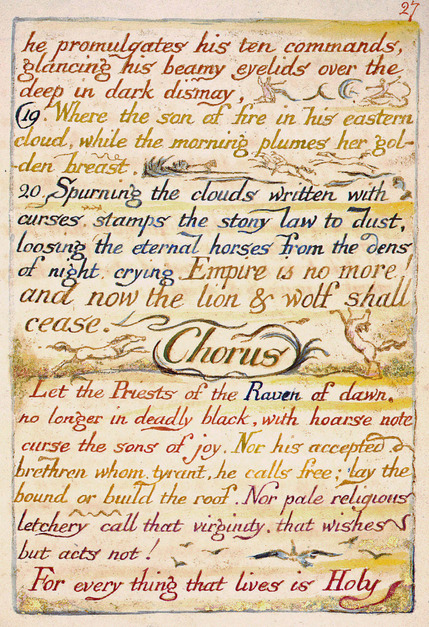
If each thing touches every thing (Indra’s Net) then disjunction is just in fun. No disruption except of our sense of disconnection. Blake’s Marriage of Heaven and Hell. Not everything but every thing. Means there’s all the space to move.

Blake - MHH plate 27


The way I put it in a poem that never found a public home.

The ease with each part touches each adjacent part.
Apples in a wood crate on a foldout cardtable.

Oh god he’s quoting himself make it stop.


Thought, as they worked away, too easy to sustain a through-line here, need to shake it up. OKAY I said STOP. On whatever word, or mid-word, stop. Draw a big dash. (Drew an em-dash on the board.) Put a period after it. (On the board.)


The way it came to me in mountains once when I was struck dumb by the perfect of each altogether and entirely open stone. You have all the space you’ve ever needed and have always had. You have all the closeness you’ve ever needed and have always had.

Snagged in a language of one who regathers himself after invasions and evasions as dimly as fiercely remembered. And, the insight didn’t keep me from being a somewhat total asshole to the woman I was there with and did stick with me through it, a year more, then she didn’t any longer, so.


A period after it and now pick up in a new place. Some other new subject, whatever, anything. Just don’t go on saying what you were. Day by day make it new. Day by day? Word by word.


To start, each word, anew. Meant to get to Tender Buttons. Sounds good, for another night than this, rain flying at my windows all.


POSTSCRIPT. After a dissipated start my afternoon class spent ten minutes talking about one line break and without repeating ourselves! The line:

Her

Teaching phil (expandated)

Go figure. Work on another teaching statement for another job app snagged my active engaged interest. Results here. Wary be, some loftiness ahead. And still enamoured of the pilcrow.


The more I write and teach the less I know. In my writing, most of a poem now is found in the moment at hand, in what senses, breath, and mind, each attuned to each, have to say. In that same spirit of unknowing, though, I am less prone than I was, as a young teacher, to think my process a template for my students. More and more they teach me how to teach them. I teach revision as re-vision, deep new seeing. Some students see newly by reworking one body of words: with each pass they come closer to what they meant, or might mean anew. For others, revision means turning the page; rework­ing one piece, they worry it to death. So I have students try it both ways and work with them as they come to a sense of their own practices. My workshops emphasize non-evaluative feedback. I find peer comments are more perceptive, and student authors more receptive to them, when praise and advice are set mostly aside. This ap­proach has a downside—the ego wants to be fed and may complain when it’s not—but I find most students come to prefer it before long. I emphasize the “writ­er’s antennae”—the capacity for close attention to the texture of your moment-to-moment experience of your own writing. I find faithful attention to those tingles of excitement, those pulses of boredom, guides composition and revision more reliably than any creative writing precept or external feedback. And I believe everyone has that capacity, though it’s often obscured by self-doubt or anxiety. A lot of teaching creative writing is showing how to wipe mud off a jewel. All the methods I use in the classroom—peer critique, small group work, class discussion, wacky writing prompts—are meant to foster that process of clarification. Many also ask students to work with differences of background and temperament they may have with their peers. For instance, I often put students in pairs to restore line breaks to a poem I’ve set as a para­graph. One is to make sure the line breaks are expressive, the other that the line itself has integrity. Each has to contact her felt sense of the poem’s language, and to feel through how new lineations will create new patterns of energy. And each has, as she articulates her perceptions, to accommodate the perhaps quite different values and priorities of her partner. In this way, the sort of difference a line break is, brushes against the sort of difference another person is. The values I’ve set out here, self-aware­ness, self-inquiry, empathy across differences, have meaning beyond the creative writing classroom. They are, to my mind, crucial to any humanistic education, and have something real to offer the business major, the nurse in training, the nascent physicist. And creative writing has ways of eliciting these values maybe not to be found elsewhere.  But far fewer of a given school’s students will take a creative writing workshop than take a general education course. So it’s important to me, in my general university courses, which at Western are capped at 60 or 75 students, to carry over all I can from my practice as a creative writing teacher. I rarely lecture for more than two or three minutes at a time. My mini-lectures are usually impromptu—offered as our conversation seems to warrant. I make a point of learning everyone’s names, and make getting a student’s name wrong a point of fun at my expense, to model that I’m learning, too. Really a pretty small expense. I use small group work so everyone can collaborate in their own education. And I give assignments that draw on both creative and analytical faculties—per­form­ance projects, formal debates, journal assignments that ask students to write a soliloquy in blank verse or a scene in the post-apocalyptic creole in which the novel we’re reading is narrated. My hope is that, through activities like these, students will draw their creative, intuitive, emotional, and analytic faculties closer together, and they will be more available to them in their other coursework, their careers, and their social and spiritual lives.

Student Work: 20 little poetry projects (II)

Some more fun bits from my students’ encounters with Jim Simmerman’s exercise.


The well-spoken gangster began to descend.
That gangsta-man was stepping onto the soil from flight, as he said.
“Carpe Diem” he said.
Even the wind howled back when he said this line.
The mountains didn’t soar as high as the gangster, the gangster who was I.

Usually these go better when they get off the topic, line by line, but here a disjointed narrative comes together (apart).


For the dead eye stars the struggle is real. Charlie Bradbury was absent from their event in Vancouver during which many a blue was tasted. We smelled what was right and what was wrong and we saw the reds that pretended to be the blues that were tasted.

Lovely parataxis here.


The trees decide to hug back,
Making the note-taking in fourth-grade science
Less of an assassination

Right at the end of the poem, that, a real surprise.


Arguments will be had but no points will be made
under a slimeball ceiling,
built by men who don’t create.
Papier pour moi, stylo pour vous?
Erasers eat lead.
Gummy belly-button on a pompous twenty-something.

One thing we noticed in class todays—abstractions can earn their place in a poem by sitting aslant each other—as in the phrase “the numbest kinds of pain” in Robert Hass’s prose poem “Museum.” Something similar goes on here in the first and third lines … abstract nouns and generic verbs become lively and specific through being at odds with their neighbours.


Some more on that poem by Hass to come. And haven’t forgotten my promise to follow through on disjunction. Just think though—the longer goes by, the more disjunctive the resumption. Word.

teaching portfolio

Student work: 20 little poetry projects

Some excerpts from my students’ work with Jim Simmerman’s exercise “Twenty Little Poetry Projects.” Good funs. Oh and I had them do a cutting-and-paring exercise on them … where those went especially well I’ll include the stuff cut.


Lemons are the sun.
Each yellow drop is a blinding, burning, ray in the green.
Wet tongue slides across teeth,
tasting squeezed citrus,
that sprayed lemon into my nose,
the slice of the knife in the skin is a whisper,
the yellow color tart and sweet.
My Nonna’s lemons turned to limoncello in the Italian sun.
Nonna died—those are my lemons.
The first time I lay on wet grass, I was barefoot.

Really effective cuts here opening up spaces that bring Tomas Tranströmer to mind. Only bit I might miss is “Nonna died …”.


I.

Yesterday
a little death. But
today. Rise. rise
get up
again.

II.

40 white teeth
a smiling hole
40 teeth each
Its mouth 
exploding
New Year’s Eve
Children smile
into the white
Everything knows
this white.

III.

Rancid milk steaming
In her eyes
one million orchids
opening
Irises white          blank
skin pressed against
night
with the last energy
turned to heat
all is
heat now
small crackles

Yeah good cuts here too. I admit I suggested some but the poet’s assent to them’s what matters. Again it’s about opening spaces. Here I hear tones of Stevens’s “Thirteen Ways of Looking at a Blackbird.” Just cuz of the roman numerals? Am I that susceptible?


Tom Waits for me, wishing he was in New Orleans.
Ain’t it a crying shame, he says just like that
except that isn’t the way it’s said at all—
after all, the only way to stay together
is to drive in opposite directions.

Echo here for me (that seems to be my track tonight) is Frank O’Hara. Specifically “A True Account of Talking to the Sun at Fire Island.” Specifically specifically the good cheer of the sun. It’s everywhere! How could it not be in a good mood! And that infects Frank and us. Poem as a high-pleasure construct.


A light crack on that little ankle bone on the inside that sticks out far, but the eleven floors otherwise treated her well in the last several seconds.
Zing was upset about the lag.
Effectively, they will no longer speak unless it is to reiterate the tension previously created, and this pact is now effective.

K that long line is just crazy. (Hard to set here. Read each sentence as its own line.) Whitman’s expansiveness, Ginsberg’s hypermania, Moore’s polysyllabism.

A few more …


This dismal abyss of cottage cheese Christmas
is just a fridge full of impulse.
Ms. Mary stole the cobweb from the shelf
Mama Tits has proof.

Where ballad meets blues meets Breton.


You are what you eat.
No purple antelopes here—
taste bitter roads and
hot rain, prickly on ends with
wafting scents of
mud puddles? Dark, but
cracked. Clicking nails
seeing Stairway to Heaven, la la
even Bill Nye believes in Jericho
where antelopes of purple hue
roam freely
from stars in galaxies afar
palooshing each other until
skidding off with fear.

A strange and sardonic turn on its opening truism. Most of the cuts sharpen the sense of line very nicely.


I cut off my arms and replace them with refrigerators.
And I taste my consciousness outside me
Excusez-moi, qui a pété?
I lift my hopes higher with my diamond-studded weasel arms.

Something of Lorca here …


Eu non podo deixar de chorar
I did not know I knew that.
Fate tips his hat and waves as he passes by.
The leaves fly out of my vision, whisked away by a stronger breeze, while I remain grounded.

No surprise, I guess, that a lot of these remind me of Spanish and American surrealists. Here, James Wright, the line at once taut and languid.


I fail horribly at taking a “selfie.”
Since my arms are short and my point of view is warped.
“I literally can’t even.”
The ridiculous clown and his pride ruined the atmosphere of the wake.
And your family was as accommodating as a state penitentiary.

Here I’m taken especially by the passages in quotation marks. As if the poem became aware briefly of its own language and raised a skeptical eyebrow.


He has the heart of a lion.
Does will do as does do.
Though he is not exactly what I would call courageous.
Okay, maybe he actually was.
Though he thrust his hands up in the air and shouted “YOLO!”

The cuts here have little lion hearts. Make bold to take out the connective tissue. The pun in line two liketh me much, acts, deers.

Some more to come later today. Thanks again to mes etudiants for allowing me to post ses leurs travailles.

teaching portfolio

Teaching phil

(Spillover from a job app. Why am I putting it here? Someone might be curious? And, I was having fun with the pilcrow.)


Teaching Statement

The more I write and teach the less I know. In my writing, most of a poem now is found in the moment at hand, in what senses, breath, and mind, each attuned to each, have to say. In that same spirit of unknowing, though, I am less prone than I was, as a young teach­er, to think my process a template for my students. More and more they teach me how to teach them. I teach revision as re-vision, deep new seeing. Some students see newly by reworking one body of words: with each pass they come closer to what they meant, or might mean anew. For others, revision means turning the page; rework­ing one piece, they worry it to death. So I have students try it both ways, and work with them in conference as they come to a sense of their own practices. My workshops emphasize non-evaluative feedback. I find that peer comments are more perceptive, and student authors more receptive to them, when praise and advice are set mostly aside. This ap­proach has a downside—the ego wants to be fed and may complain when it’s not—but I find most students come to prefer it before long. I emphasize the “writ­er’s antennae”—the capacity for close attention to the texture of your moment-to-moment experience of your own writing. I find that faithful attention to those tingles of excitement, those pulses of boredom, guides composition and revision more reliably than any creative writing precept or external feedback. And I believe everyone has that capacity, though it’s often obscured by self-doubt or anxiety. A lot of teaching creative writing is showing how to wipe mud off a jewel. All the methods I use in the classroom—peer critique, small group work, class discussion, wacky writing prompts—are meant to foster that process of clarification. Many also ask students to negotiate differences of background and temperament they might have with their peers. For instance, I often put students in pairs to restore line breaks to a poem I’ve set as a prose para­graph. One is to make sure that the line breaks are expressive, the other that the line itself has integrity. Each has to contact her felt sense of the poem’s language, and to feel through how new lineations will create new patterns of energy. And each has, as she articulates her perceptions, to accommodate the perhaps quite different values and priorities of her partner. In this way, the sort of difference a line break is, brushes on the sort of difference another person is.


POSTSCRIPT. Reading about the pilcrow in Keith Houston’s Shady Characters: The Secret Life of Punctuation, Symbols, and Other Typographical Marks. Good fun and some neat finds. But dreadful editing. Dangling modifiers so thick methinks I need a machete. Come on, Norton, you’re better than this.

Exercise: 20 Little Poetry Projects

(An exercise by Jim Simmerman, taken from The Practice of Poetry, Robin Behn and Chase Twitchell, eds. Will post some recent strangeness later.)

Give each project at least one line. You should open the poem with the first project, and close it with the last, but otherwise use the projects in whatever order you like. Do all twenty. Let different ones be in different voices. Don’t take things too seriously.

  1. Begin the poem with a metaphor.
  2. Say something specific but utterly preposterous.
  3. Use at least one image for each of the five senses, either in succession or scattered randomly throughout the poem.
  4. Use one example of synaesthesia (mixing the senses).
  5. Use the proper name of a person and the proper name of a place.
  6. Contradict something you said earlier in the poem.
  7. Change direction or digress from the last thing you said.
  8. Use a word (slang?) you’ve never seen in a poem.
  9. Use a piece of false cause-and-effect logic.
  10. Use a piece of “talk” you’ve actually heard (preferably in dialect and/or which you don’t understand).
  11. Create a metaphor using the following construction: “The (adjective) (concrete noun) of (abstract noun)…”
  12. Use an image in such a way as to reverse its usual associative qualities.
  13. Make the persona or character in the poem do something he/she could not do in “real life.”
  14. Refer to yourself by nickname and in the third person.
  15. Write in the future tense, such that part of the poem seems to be a prediction.
  16. Modify a noun with an unlikely adjective.
  17. Make a declarative assertion that sounds convincing but finally makes no sense.
  18. Use a phrase from a language other than English.
  19. Make a nonhuman object say or do something human (personification).
  20. Close the poem with a vivid image that makes no statement but that “echoes” an image from earlier in the poem.

The ones go best that let go, over and over, of whatever one thought to mean. Simmerman comments:

I created this exercise for my beginning poetry writing students who … seemed to me overly concerned with transparently logical structures, themes, and modes of development at the expense of free-for-all wackiness, inventive play, and the sheer oddities of language itself.

I created the exercise in about half an hour, simply listing, in no particular order, a lot of little sillinesses I had seen and liked, or had not seen but thought I would have liked, in poems here and there.

Here’s a poem by Simmerman that completes the twenty projects in order.

Moon Go Away, I Don’t Love You No More

  1. Morning comes on like a wink in the dark.
  2. It’s me it’s winking at.
  3. Mock light lolls in the boughs of the pines.
    Dead air numbs my hands.
    A bluejay jabbers like nobody’s business.
    Woodsmoke comes spelunking my nostrils
    and tastes like burned toast where it rests on my tongue.
  4. Morning tastes the way a rock felt
    kissing me on the eye:
  5. a kiss thrown by Randy Shellhourse
    on the Jacksonville, Arkansas, Little League field
    because we were that bored in 1965.
  6. We weren’t that bored in 1965.
  7. Dogs ran amuck in the yards of the poor,
    and music spilled out of every window
    though none of us could dance.
  8. None of us could do the Frug, the Dirty Dog
  9. because we were small and wore small hats.
  10. Moon go away, I don’t love you no more
  11. was the only song we knew by heart.
  12. The dull crayons of sex and meanness
    scribbled all over our thoughts.
  13. We were about as happy as headstones.
  14. We fell through the sidewalk
    and changed colour at night.
  15. Little Darry was there to scuff through it all,
  16. so that today, tomorrow, the day after that
    he will walk backward among the orphaned trees
  17. and toy rocks that lead him
    nowhere I could ever track
    till he’s so far away, so lost
  18. I’ll have to forget him to know where he’s gone.
  19. la grave poullet du soir est toujours avec moi
  20. even as the sky opens for business,
    even as shadows kick off their shoes,
    even as this torrent of clean morning light
    comes flooding down and over it all.

Examples from my students’ poems here and here.

teaching portfolio

On disjunction (I)

A good, straight, clear, honest question this morning from one of our company. You keep praising, he said, approximately, work that’s weird, kooky, associative, fragmented, with no clear story or theme or argument to make. But what’s the difference between doing that and just spreading random garbage on the page?

And one came up after with another version of that question. You keep encouraging us, she said, to make big crazy associative leaps, but you wrote on my exercise, What’s the arc, where’s the through line? What gives with that? Which is it you want?

Just the questions I want to stir in them. I hope they know they’re doing great. Not sure how robust my answers in the moment were, so am thinking it through a bit more, here.

Will invite them to, and hope they feel moved to, read on.


A first thought. Three images, or words, or sentence fragments, say, can be at a great distance from each other and still make a pattern. In the same way that three stars, 10s or 1,000,000s of light years apart, can still belong to a constellation. In fact, they can’t not make a pattern—

*

*

*

—a triangle. In other words, even three bits of garbage, set out mindfully, make a shape. Could be slogan to the blog.

The triangle is from one vantage the perfect form. The number of points of contact by which a stool cannot not be steady.

And constellations are, besides, maps of human mind, not stars “in themselves.” Epsilon Pegasi has no sense of being part of a horsey.


An essay contrasting perfections of the circle (singular Platonic transcendental annihilatory) and the triangle (multiple immanent ecological). This from Creeley’s “Numbers,” in Pieces—

ONE

This time, this
place, this
one.

As of a stick,
stone, some-

thing so
fixed it has

a head, walks,
talks, leads

a life.

Alongside this—

THREE

Here forms have possibility.

The first
triangle, of form,
of people,

sounded a
lonely occasion I
think—the

circle begins
here, intangible—
yet a birth.

His priority always the forms the multiple takes. The circle as not singular perfection of the point but rather multiplication to infinitude of the triangle. Creeley as Pythagorean shaman.

But I digress.


Oh yes I do. Not much here yet of use to my students I fear. But must turn to work on a job letter. So, to be continued, and in the continuance, I hope, these.

First words of Tender Buttons. Disjunction as narrative fatigue. As provocation & alarm. As faith in essential wholeness. And probly, cuz I’m going on my nerve, lots I ain’t thought of, yet, now, here.