Student work: Anagram poems

One more before this body heads to the gym. My students did great work with the anagram prompt. A few excerpts, posted with their permissions —

CHRYSANTHEMUM

musty men are her master
they see her as a chummy trashy muse


WANDERLUST

we learn as stars learn
sedated
wasted as a last sunset


PUGNACIOUS

pugs can coop up
in a soup can


GUNSHOT

shoot to sun
oh unhung sun
so soon


WEATHERS

Earth sews art,
water, seas

trees thrash
that were at rest

here we
are rare

we stare at stars,
aware


DREAMING

i dear am dreaming
in man-made greed


FINGERS

ginger grins
green ferns
fire rising

I see sense in freeing sin.


LUMINESCENT

sun: i see it set in mist
mice scuttle, still
insects teem in nite’s lull


ANXIETIES

I see sentient entities
six ants in tea


AUTHORIZED

I hear the tzar roar

I tour the tear
I hear the horror

teaching portfolio

Exercise: Anagram poem

Christian Bök describes his poem “Vowels” as an “anagrammatic text.” It builds itself out of permutations of the letters of the title. Write a poem according to the same principles. Your title should be a single word.

VOWELS

loveless vessels

we vow
solo love

we see
love solve loss

else we see
love sow woe

selves we woo
we lose

losses we levee
we owe

we sell
loose vows

so we love
less well

so low
so level

wolves evolve

teaching portfolio

On sound (I)

When semantic meaning is eclipsed all sorts of other meaning come out of hiding. In our first class I wanted to get students thinking with their ears about vocables — oral sounds — apart from the meanings we like to grant certain of the shapes they take (words). It’s hard to explain but easy to experience.

I started them off with scat singing (always defined in terms of “nonsense” vocables — slanderous) by Louis Armstrong —

and Ella Fitzgerald:

Only a brute would deny there’s meaning there. Not the sort of meaning we mean when we say “I understand what that means.” Much closer to the meaning we mean when we say “you mean a lot to me.” When someone reaches out to someone and makes contact — that’s a meaning.

We moved on to Christian Bok’s performance of Hugo Ball’s Karawane (a more gravelly doing than the one I played in class):

In some spots it’s a little referential and a lot mimetic — jolifanto calling to mind swaying circus elephants. But at the core it’s what the Russian Futurists called zaum or beyonsense — expression released from reference so its sensuous and esoteric possibilities can unfold. Sometimes comically, as here, and sometimes not.

Some meaning is had. Some meaning is been. And some meaning is done. Our focus here is sound, but I can’t resist a bit of vision, how Ball’s poem steps out to the eye:

Anyway, my students did great with this weird trio, pointing out connections to the proto-articulations of infants (which mean nothing communicable but everything to mom and dad) and the science in non-Western cultures of the spiritual efficacy of sound.

And, less esoteric, the noises we make to get something immediate, embodied, across. Ahhhhhhhh. Oh! Hmmmm.

teaching portfolio

First thoughts fall quarter

Okay, the move’s mostly made, still a bit of unpacking to do, but we’re up and running.

I’m teaching two sections of Intro to Creative Writing this fall. A course I’ve taught lots before but doing a thorough reno on it this go through. Less on core concepts and genre conventions. More on creative mischief and sideways mindleaps. The old version was good on fundamentals but kinda sobersided. And at Western this course isn’t a gateway for creative writing concentrators who need to learn all that good stuff. Rather it’s an elective taken by a lot of non-majors and future elementary and high school teachers. Who’re going to want some ways to get their students excited about the creative import of their own minds.

The first thing they learn about the course (after my office hours):

First premise. There is no one who is not creative. To make art—to sing, dance, shape sound, movement, language, or paint, any medium—is a birthright, as natural to us as our powers of speech and affection are. Second premise. We have not always been well served by our schooling. School may have, in fostering some of our capacities, estranged us from others. Most of us were probably better poets at six than at sixteen. Tentative conclusion. It is one task of a creative writing course—especially an introductory course—to rekindle the spark that connects, not A to B, but Q to oranges, mosses to stars. I don’t know exactly what this course will be—I see it as a work in progress and collaborative—but I hope you’ll feel more awake to being-alive-here-now for having taken it.

Heavy. Time for a foolish picture.

Cover image (4)

And so our itinerary is, one stop per week —

Sound
Word
Phrase
Line
Sentence
Image
Paragraph
Figure
Person
Shape

My posts will probably fall out likewise.

Final projects: Caitlyn

Caitlyn assembled a source text from found material and then performed an erasure on it to generate

EVE

          She thinks          this is
                      morning,         “I’ve got my

    things, I’m on the
verge.”

                    Guess
                    I  have
                        you

  breathing.

                      Finally, this

                                                two to one

static:

                        I swim across an
                    ocean
                from an         empty

                                                    room.

(Erased from a base text made of the first words of each song on the album Everything in Transit by Jack’s Mannequin.)

One thing I really like here: how the poem combines (composts) two time-honoured practices — the found poem and the erasure poem — in a way that feels seamless and self-assured.

Final projects: Megan

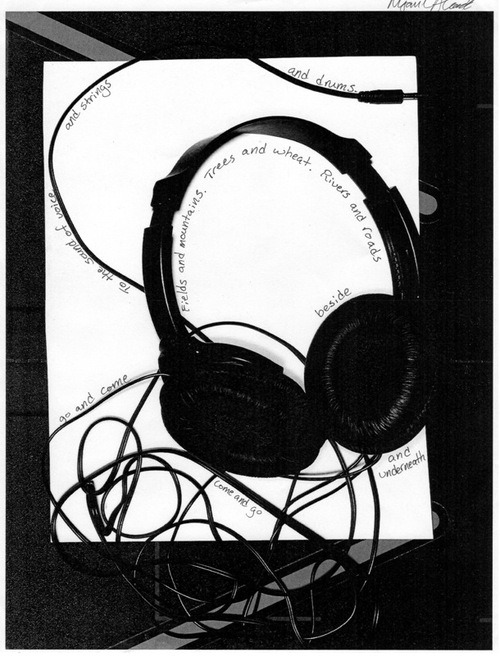
image

She writes:

Whenever my family and I go on roadtrips I listen to music for hours and watch the scenery pass. I placed the first part of the poem between the headphones to visually show scenery passing to music. The jumble of wire underneath the headphones creates visual and mental pauses. The last part of the poem (describing the music) is placed near the plug-in because that is the part that allows me to listen to my music.

One thing I really like here is how the loops and curls of the cord (especially at the bottom edge) pass on and off and onto again the sheet of paper. A feeling of freedom or unboundedness in it.

Final projects: Zoe

Zoe took the “worm in a compost bin” exercise and ran with it, burrowing through paragraphs of her own work and arriving at prose poems like this.

PM

I want to yearly remember your surviving and stay. I see you take your change, and with deeply you are in this small want. To hold each messy water-relapse and be daily when hard and heard. Parenting one or both of us is to stay. Edited puffy eyes, 7:33.

Spun to folds I can be.

One thing I really like here is the rhythm of her sentences — the prosody of her prose, as one of my colleagues would call it. Zoe and I talked a little about counting syllables or words in each phrase, clause, or sentence, and seeing what patterns emerge. Usually you’ll see trends of increase or diminution or equilibrium. Sometimes when a passage just won’t come right it’s because the rhythm is wrong for that place or that thought.

This piece feels masterly to me rhythmically. But let’s see. If we count syllables per phrase and phrases per sentence we get:

9   5|5   16   10   6|5

6

Yup, there’s a pattern. The number of syllables per sentence climbs from 9 to 10 to 16 and then drops back to 10. The last sentence in the main body stands out, for instead of continuing the diminution, it grows in size again. So the startle we get from the shift in diction (from high lyrical to compressed technical) is reinforced by a deviation from the expected rhythmic pattern.

Lots more we could say here — on the deferral of the expected short sentence to the following paragraph, on the difference between a 10 and a 5|5, on the primacy of five- and six-syllable units, on the counterpoint between syllables per phrase and words per phrase — but my day is done, time to ride to Joe’s Gardens for corn and blueberries. THANK YOU to all my students who’ve allowed me to post their really very striking work on this blog.

Final projects: Risa

Risa devised a really neat composting practice she’ll summarize below. But first one of the poems resultant:

MURDER

Water the piece I
visit. Such that I
could be alone. I
want to develop
the thought of you
before I start.

You were the same this
time. None of those
modifiers used
before. Each decade
they drive me to
murder.

One thing I really like here is how each sentence or fragment feels both a great distance from, and intimately bound up in, its neighbours. That a poem can be both fragmentary and whole (see, for instance, Creeley’s Pieces). And the fierce enjambments enact the same paradox line-by-line — each line both broken and intact. And the process by which the poem was generated is remarkably close to invisible.

Risa’s account of the process, with some abridgement:

Choose a word you’d like to end your poem or paragraph with. Google search the word (for example, “murder”). Scroll to the end of the first page of results and find the last substantive word in the last search result (for example, “decades”). Note that word down (so you now have a list with two words on it, in our example “murder” and “decades”). Repeat the process, using the second word as your search term, and adding your third word to the list (for example, “each”). Continue until you have around 15 words or get bored. Then compose a poem that uses each word, either in the order they were found in, or in the reverse order (as in our example).

The words Risa used to compose “Murder” are boldfaced above.

Exercise: Compost mural

From a 20 foot mural my class made today in 50 minutes (give or take). The prompt: using only the materials you have on hand, or can forage from the surrounding environment without breaking the law or hurting anyone’s feelings, express your understanding of “the art of compost” (course title). In other words, a crash course in targeted bricolage.