Exercise: Photocopier poem

Here’s their “writing” exercise for tomorrow:

After “reading” the examples, compose a poem by messing around on a photocopier. You should try out several kinds of manipulation (e.g., twisting, turning, shaking, fluttering) on several kinds of original (e.g., text, image, object) before deciding on a practice and a source to commit to. And then don’t be dismayed if it takes further trials to get to a poem you feel pleased enough with to hand in.

I played around on the department photocopier today (keeping a wary eye out for L. who had just cleaned the glass to a sparkle) with paperclips, paper towels, binder tabs. The paper towel rolls came out best & I’ll post them tonight.

Exercise: Punctuation poem

Next week we turn to the gorgeous Gorgeous Nothings, a collaboration across oceans and generations by Emily Dickinson, Jen Bervin, and Marta Werner. My students’ first exercise will be:

Compose a poem made entirely of punctuation. Then write a short paragraph describing what the poem “means.” Treat the paragraph as a creative extension of the piece — as playful creative nonfiction, not straight-faced literary analysis. Be ready to present both the poem and your explanation to the class.

The examples they’ll have “read” are retrieved from Rasula & McCaffery’s Imagining Language — up next.

Exercise: Chasing your tail in the word hoard

Write the editors of Imagining Language, from which the passage [they’ve just read] from Joyce’s Finnegans Wake is taken:

At the center of the episode is a hen scratching open a letter in a compost heap…. Any proto-narrative aspect of the Wake is subordinated to its manifestly epic ambition, which is the production of a polyglot interlingua, a massive reservoir from which all languages derive and into which they ultimately return.

In other words, well, in other words. Language itself as the mother of all compost heaps. As in all compost heaps, there are lines of affiliation, lines of ascent and descent. This exercise gets you working with that. It’s some hard work first, and then some free play.

1. Research

First you create a research document. Start by going to the Online Etymology Dictionary at www.etymonline.com. Type in the search window a word you like. I’ll use “compost” (what else). I get several entries, but the one with the most interesting material is

compost (n.) late 14c., compote, from Old French composte “mixture of leaves, manure, etc., for fertilizing land” (13c.), also  “condiment,” from Vulgar Latin *composita, noun use of fem. of Latin compositus, past participle of componere “to put together” (see composite). The fertilizer sense is attested in English from 1580s, and the French word in this sense is a 19th century borrowing from English.

I boil this down to the material I think I can use—

Compost. From OF composte, “mix of leaves and manure for fertilizing land.” Also “condiment,” from VL componere, “to put together” (see composite).

That goes in my research document. You do likewise. And do the same with five more words, choosing each new word from the entry you just made. For instance, from my entry on “compost,” I might choose “condiment,” for which etymonline.com gives me this:

condiment (n.) early 15c., from Old French condiment (13c.), from Latin condimentum “spice, seasoning, sauce,” from condire “to preserve, pickle, season,” variant of condere “to put away, store,” from com-  “together” (see com-) + -dere comb. form meaning “to put, place,” from dare “to give” (see date (n.1)).

 Boiled down, that becomes

Condiment. From L, “spice, seasoning, sauce,” from “to preserve, pickle, season,” variant of “to put away, store,” from com– “together” + dare “to give” (see date).

I move from “condiment” to “season,” from “season” to “timber,” from “timber” to “domestic,” and from “domestic” to “despot.” Boiled down I have:

Season (v.). “Improve the flavor of by adding spices,” from OF assaisoner, “to ripen, season,” “on the notion of fruit becoming more palatable as it ripens.” Applied to timber by 1540s. In 16c., also meant “to copulate with.”

Timber. From OE timber “building, structure,” later “building material, trees suitable for building,” and “trees or woods in general.” From PIE *deme-  “to build,” possibly from root *dem- “house, household” (source of Greek domos, Latin domus; see domestic (adj.)).

Domestic (adj.) From MF and L “belonging to the household,” from domus “house,” from PIE *dom-o- “house,” from root *dem- “house, household.” Cognates include Sanskrit “house”; Greek domos “house,” despotes “master, lord”; Latin dominus ”master of a household”; Lithuanian dimstis “enclosed court, property.”

Despot. From OF despot, from ML, from Greek “master of a household, lord, absolute ruler,” from PIE *dems-pota, “house-master,” pota cognate with L for “potent.” “Faintly pejorative in Greek, progressively more so as used in various languages for Roman emperors, Christian rulers of Ottoman provinces, and Louis XVI during the French Revolution.”

2. Mess around

Do whatever pleases you with this research base. Take the most surprising synonym (e.g., that “to season” once meant “to copulate with”) and write a paragraph in which you use the one to mean the other. Write a poem that gets you from the first word in your research document to the last word (how to get from “compost” to “despot”? is there something despotic about compost? something composty about a despot?). Make a paragraph out of nonsense sentences generated by homophonic translation (e.g., for “domestic,” “Be long in thee, how sold, from dumb us, house, from pie …”). Or make a 5×5 panel of words gleaned from your entries, such as

court          timber        pickle         season        manure

potent        emperor     …

Or turn your research into a family tree in which words are arranged as parents and children and cousins and stray animals. Or write a couple of sentences in imitation of Joyce — wringing every possible pun out of every syllable. Or something not thought of here or ever before.

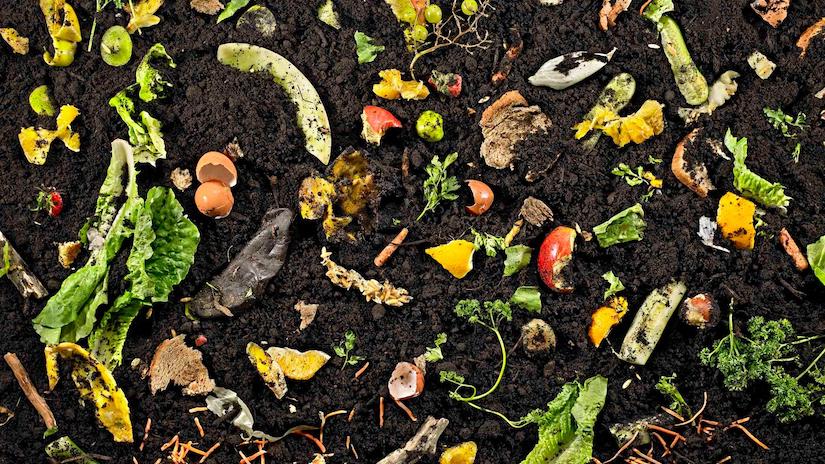
Exercise: Worm in the compost bin

We’ve talked [my students and I] about erasures that read horizontally and erasures that read vertically. The former preserve more of the gist of the source text. The latter create a more fully new thing, though some of the ground tone of the source, somehow, remains.

I’ve also proposed that composting, broadly construed, includes what we usually think of as “inspiration.” Because what is inspiration but suddenly, in a flash, connecting disparate elements of your own experience, and finding them transformed in each other’s company?

This exercise draws those two gists together: reading vertically, composting your own experience. First, find some of your own prose, between 75 and 150 words, and type it up as a column around three inches wide, give or take half an inch. You should sense a resonance in the prose, an electric charge, though it may fall here and there into cliché, overwriting, or banality.

Transcripts of dreams work well. So do journal entries that have a lot of concrete, specific detail. Here’s an example, a transcript of a dream:

A pathway, root-broken pavement, branches
hang down on both sides, willow branches in
new leaf with towering clusters of tiny white
aromatic flowers. I bring a branch to my face.
The scent is beautiful, pervasive, it floods me
and I begin to cry with a peace I suddenly
know has always been with me. I tell a doctor
on an island and he readies a needle over my
heart on a point called penetrating fragrance.

Kinda sentimenty, with that peace bit, but lots of concrete words to work with. Now, print your source text out, and burrow vertically for word sequences that please you, whether or not they make sense to you. (The pleasure they give is the sense they make.) You can select sequences by circling with a pen; I’ll approximate that in my example by greying the unselected text:

A pathway, root-broken pavement, branches
hang down on both sides, willow branches in 
new leaf with towering clusters of tiny white 
aromatic flowers. I bring a branch to my face. 
The scent is beautiful, pervasive, it floods me
and I begin to cry with a peace I suddenly
know has always been with me. I tell a doctor 
on an island and he readies a needle over my 
heart on a point called penetrating fragrance.

It took me several tries to get to that; print out a few copies, and go through as many times.

Once you have some vertically chosen text that pleases you, arrange it in lines, making what will look to an outsider like a poem received from the Muse, though you’ll know better. Finally, give it a title. In my example:

A PATH DOWN IT

A path down it
low beautiful cry ways
land to a point. Branches
branch tiny white branch to flood
sudden tell a fragrance

And there’s your poem. Composting? Inspiration? Who can say?

Class note

Great presentations by my students, yesterday and today, on composting in pop culture. Delighted how they’ve brought the mind of compost to J Dilla’s sampling technique, Karen Dalton’s bluesy borrowings, the distractive matrix of Twitter, the genre transmissions of Lindsey Stirling. I’ll hope to post some of their work here before we’re done together.

Struggle

Reading the post of someone kind enough to follow this blog. Someone struggling and I want to say, you’ll be okay, you’ll be okay, I know you will. Lean into anything and anyone that brings you ease. Not numbness — real true wakeful living ease. It’s there for you, it’s there, already in you.

And my students, one or another breaks my heart sometimes, how hurting they are sometimes. Want to hug them but can’t (not my place). Want to heal them but can’t (not mine to do).

Can’t do much but say, I’ve been there, or somewhere like there, consider me proof it can be got through, if that helps. Being a person is hard. That’s what I got for wisdom at 45 years. Being a person is just plain hard.

The line composts the sentence

Carson’s Sappho composts a dozen ways and more. One one student noted is, the enjambed and lightly punctuated line breaks a (propositional) thought into smaller (experiential) thoughts.

And in it cold water makes a clear sound through
apple branches and with roses the whole place
is shadowed and down from radiant-shaking leaves
sleep comes dropping.

The poet composes the line. The line composts the sentence. That’s general to poetry but more prominent here than often it is. “And in it cold water makes a clear sound through” is a whole phase and phrase and frame of feeling. Notwithstanding its unfinish as a sentence. The effect is to reorient thought — to reorient thinking — away from proposition and toward proprioception.

Sappho is a compost occasion

We found as a class three things compost does. One, there’s a breaking down of old forms, cauliflower leaves corn cobs egg shells radish greens, they begin to lose the walls that bound them as what they were. Two, there’s a blending and a merging, as the elements released in the breakdown start to wander in search of new figurations. (See mandibles in Empedokles, the clinamen of Lucretius, the fact that matter does wander, that’s its nature, that is nature.) Three, something’s nourished, as nutrients released by the breakdown and rearranged in the blending become the constituents of new forms, new ways of being life.

And found all three at work Carson’s translations of Sappho in If Not, Winter. Just one for now (all things in their times). The first line of the one poem of hers we have whole, called often her “Hymn to Aphrodite,” in the Greek is

Ποικίλοφρον ἀθανάτ Ἀφρόδιτα

Transliterated that is, I think, I have no Greek,

Poikilophron athanat’ Aphrodita

And translated word for word,

Spangle-minded deathless Aphrodite

One character is in question. Where Carson reads phi (φ), others read theta (θ), and that one difference, between a sphere crossed vertically and an ellipse crossed horizontally, is a difference between poikilophron, mind, and poikilothron, throne. Is it the mind of Aphrodite, or the chair she sits in, that’s glinting, variegated, subtle, ambiguous, changeful?

What makes this compost is that the two readings coexist. A word Sappho wrote, or had written, was made by time two words, jostling. We can never get rid of one of the other. Time’s co-author of the poem.

Deathless Aphrodite of the spangled mind