The revolution will not be tweets

Written for a teaching portfolio. I was asked to comment on a sample assignment, in a way that got across my teaching philosophy. I chose the DIY Rhizome Project that caps my advanced poetry workshop, and said this.


On the “DIY Rhizome” Project

English 453, Creative Writing Seminar: Poetry, is the highest-level poetry workshop undergraduates may take at Western. Most students are juniors and seniors majoring in English with a creative writing concentration. They’ll have taken an introductory poetry workshop already, probably also several other writing courses. That said, their prior experience in poetry can vary widely. So notwithstanding our esoteric arranging idea, some of our class time is given to basic matters of poetic composition: the line, concrete details, figurative language.

I call 453 “Poetics of the Rhizome.” Taken from Deleuze and Guattari, the rhizome is a way of seeing that emphasizes multiplicity, connectedness, interbeing. Diversity, robustly. Or Indra’s Net, with more contortions, because Western thought. Ranging among William Carlos Williams’s Spring and All, Aimé Césaire’s Discourse on Colonialism, Coral Bracho’s selected poems, and lots of others, students face several challenges: (1) Poetry and poetics texts from an outsider Western tradition (Black Mountain) and then from outside the Anglo-Amer­ican tradition. (2) An arranging idea that’s hard to wrap your head around. (3) A student-centred pedagogy that has evolved, as my Socratic teaching style has matured, into a collaborative form of co-teaching. (4) Creative exercises simple on the surface but hard to accomplish. “Write a poem that embodies spring.” “Write a poem that taps into myth consciousness.” “Write a poem of praise.”

These demands, if balanced right, and made with plenty of good cheer and encouragement, push students to new places. That’s happening this quarter right now and is lovely to see. Their final project, the DIY Rhizome project, is an invitation to each to define, provisionally, what that place is for them, its contours. It’s a portfolio, made rhizomatic, made to differ. Students are asked to imagine what forms a rhizome might take: a hypertext, a spoken word set uploaded to YouTube, a keepsake box of typewritten scraps. And it needs to build difference into its own body – by talking with, to, or about one of the poets we’ve read, and one of the poetics texts we’ve read, and also by having a non-textual aspect, something pictorial or tactile or auditory about it. Diversity, diverted to genre, medium, discourse. Because by now we’ve come, with the aid of Négritude, Sufism, the Haida Mythworld, Spanish Surrealism, Language Poetry, and Cage’s Black Mountain take on emptiness, as well as a cheerful scepticism about all these thought-boxes, to see the rhizome as what takes in difference without effacing its differentness.


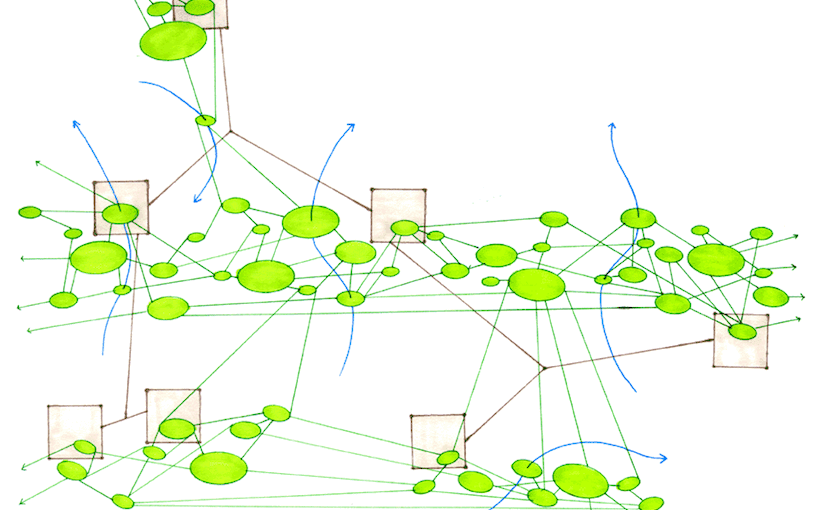
The drawing atop is from this site. Exquisite sequence!

Exercise: Mythtime, mythworld

Their writing exercise for this week, and it’s a tough one:

Write a poem that taps into myth consciousness. Pointers. Not literary myth consciousness, Hera, Zeus, Leda and the swan, that sentimental crap. The myth consciousness of Ghandl’s poems, all the world potentially sentient, stuffed with spirit beings. Awe, wonder, the sacred breaking down the door. To help that happen – no names of any gods or goddesses.

That would be Ghandl of the Qayahl Llaanas, classical Haida mythteller, in Robert Bringhurst’s translation.1 

Tough for students for whom Thor is a Marvel Superhero. I try to get across that the Greek and Norse gods of popular imagination are attenuated forms – you have to go back to Sappho at least, the Homeric hymns, to get a whiff of the sacred those forms were to their makers. Don’t know if I get my point across very well.

I say, when we talk about mythtime in Ghandl, that’s not only a distant past – it’s also just under the skin of this moment. Other cultures call it dreamtime. It’s what people take hallucinogenic drugs to get to. When you wake from a dream supercharged with with meaning – that’s myth consciousness.

Write a poem from that place.

How I put it in an e-mail to a student wanting to retell an Arthurian story:

The key to the assignment is to tap into myth consciousness. The state of mind that finds an enlarged significance in anything it pays close attention to. In Ghandl’s stories that enlarged significance is expressed as spirit beings and metamorphoses – how a bird skin can turn out to be weather, or a wife can be revealed as a cloud. In Greek myths, originally, that enlarged significance got expressed as “Zeus,” or “Aphrodite,” divine beings that embodied something awesome and terrifying – sacred – about being in the world.

But those myths have long since been attenuated, turned to literature, pretty stories. So I think have the Arthurian legends (which are legends, not myths, there’s a difference, though also some overlap). So it might be hard for you to tap into myth consciousness retelling one of those stories, whether or not you use the names.

I’m not going to tell you not to do it though; I’d sort of rather you didn’t retell anyone else’s story, but if you’re keen on this one, it’s not my business to stop you. Do apply this test to your poem though: Does it express wonderment? Not second-hand wonderment, coopted from the story you’re retelling, but your own, discovered in your encounter with the material.

The trick? The emoji on our iPhones, the Pokemon chars they spent a while chasing after, they too’s attenuated forms of that. We’re still after scraps of awe. Some of them are called metaphors.

A sorry nostalgic chase, I say, when leaves, wind, rain, sun, deer 953.

photo-23


1. Around which controversy skirled awhile. Whether Bringhurst had the right to. Whether those who said he didn’t spoke for the whole Haida people or no. I feel tender, tentative, around it all, but from what I can tell, Ghandl knew what he were up to, when he sold and told his stories to John Swanton, an anthropologist committed (unlike most – astonishing) to transcribing the stories he heard word for word. Was Ghandl coerced just the same? His culture was in grave peril. He could have had his stories die with him – perhaps let many to. He also, for reasons we can’t ask him, chose to sow this killing culture with seeds that flourish even today. Though the book‘s out of print.

A course for winter

One of the two courses I’m teaching winter quarter.


English 214: Introduction to Shakespeare: Page and Stage

To study Shakespeare is to study ourselves. Our language is full of his turns of phrase. His drama informs our drama, our cinema, and our TV shows, from South Park to Game of Thrones to Westworld. We’re going to explore just how current Shakespeare is by putting his plays into action – sometimes from the page (in ear and mind), sometimes on the stage (for eye and ear). Which brings us to the fine print. And it’s important enough to start with some big print. PLEASE TAKE NOTE. This is not your usual GUR. There will be no lectures. There will be no midterm exam. There will be no final exam. There will be a whole lot of discussion; writing, memorization, and recitation assignments; blocking projects; scansion quizzes; and a group performance project worth a big fat chunk of your grade. You’ll be asked to memorize a part and to perform, in character, in front of your peers, although acting ability is not a prerequisite. Do not sign up for this course if you’re not ready to attend every class and to participate actively in all aspects of our work together. If you are so ready, we should have a lot of fun. Our plays: A Midsummer Night’s Dream, Twelfth Night, Othello, The Tempest.


The image up top, Djimon Hounsou’s Caliban, in Julie Taymor’s 2010 film of The Tempest. A performance of real dignity and power – Caliban enslaved, not a slave. And it can’t not touch on (press damned hard on, actually) the subjugation of the black body, African, American, by such as Prospero are.

By such as prosper. My hope’s to talk with them about that some.


The class went well last time round. Went great, actually. By the end the group was an organic form, a living animal, thriving under its own power, and mostly I could just attend.

My favourite comment in the evals, Shakespearean in its wit: This class was lit. 

Heather for president

I find this paragraph beautiful:

Whenever Heather entered a patient’s home for the first time, she knew that she was walking into a long, long, complicated story that she understood nothing about, a story that was just then reaching its final crisis. She was extra alert on those first visits, extra careful, trying to figure out what was going on – the conflicts and rivalries between members of the family, tension over who wasn’t doing enough, who was doing too much, unresolved bitterness, and nearly always grief and anxiety and fretting about how to take care of the patient and what to do.

–Larissa MacFarquhar, “The Threshold”

It’s about being a hospice nurse, but dial down the stakes some, and it’s what it feels like to enter a classroom, not knowing what the nexus of needs is, but knowing there is one, feeling the strands of the web of it stretch against you, each step you take. Binding you into it and yielding to you its intelligences.

Broaden the scope of it some, and it’s just the alertness evidently massively lacking at the helm of a certain rightish party, even more than uge.

See these two beautiful women –

New Yorker - MacFarquhar
Heather Meyerend examining Mary, 92, at her home in Brooklyn, Sept. 2015. The article.

I’m afraid of dying alone. Oh yes I am. Has nothing to do with this, except a presidential candidate unable to self-inquire? has no right to ask the time of us.

Maybe I’m a sucker for charisma. But I’d vote for Heather Meyerend over any of the fools who’ve been on parade this dismal season, yes Sanderistas even yours, on the basis of what I’ve read about her so far, and seen in her eyes. Which I can’t see, but her body’s eyes, Avalokitesvara’s.


On Socratic method

Just quick, it’s late, and I’ve a torrent to watch. Witch.

I was made sad beyond all reasonable bound by a student’s complaint. “He has a great sense of humour but he doesn’t teach.” Someone I admired and respected so was open to feeling hurt by.

I guess in a sense she was right. You know that guy Obama? Whom I aspire to be when I grow up? And who got mocked for saying something about leading from behind? I sort of teach like that. Want you to be your own teacher, and poke you till you find it.

Times I want to say, some students, smart and shallow, young and coddled, they aren’t up for being poked. Entitled brats.

Times I want to say, it’s me fucked up, poked when I had no okay to, missed the cues, all my bad. (I’m leaving out all the lovely times it went bitchin’ fine.)

Seems to me, as of this now, it’s neither this nor that.

There’s no telling how the combos, one person and another, or 20, are going to work it out. We like to think our sciences can say, but no.

All there is, is, I do my most honourable best, you do your most honourable best. And if we fail to meet – no harm, no foul, okay?

I like to think, when I’m feeling sympathique to Plato, that that’s a premise to all his dialogues (just as all his dialogues are together a premise to all our universities). If we fail to meet, no harm, no foul, okay?

It happens to the best of stars, too. They fly on.


The bit I’ve put in my syllabus newly, with that student’s, and another’s, negations in mind.

I work by Socratic method. I ask questions meant to sharpen distinctions, shed light on unexamined premises, and enhance a student’s own capacity for inquiry. It’s a messy, improvisational process that sometimes falls flat and makes everyone (me included) feel awkward. Sometimes it looks sort of inefficient. And yet it’s the oldest teaching method we have (older than the university, as an institution, itself) and has survived this long for a reason. It makes the student her own teacher.

If it causes discomfort sometimes that’s why. Or I think so anyway. Being asked to be your own teacher is not easy or comfortable.

They’re growing more tender by the year. What’s the bearing we need to meet them rightly and kindly? I want not to do harm – want also, not to let up.

Occam’s Razor 2016

Celebrated the launch of Occam’s Razor with its faithful dedicated brilliant editorial staff this evening. Wow they done good. So proud of them.

I’m faculty advisor, which in some situations might mean doing lots, but here’s mostly meant saying, “you, go be you; oh and keep a style sheet.”

Soon, a link to the online issue, in all its glory. For now, a TOC to titillate or intimidate you – maybe both – and brief remarks I made at a podium.


Check these Western moves out.

  • The Beneficence of Gayface
  • Domestic Violence Lethality Assessment Screening
  • The Historical Biogeography of Phototropic Consortium
  • Perspectivalism and Blaming
  • Nonalcoholic Fatty Liver Disease: Cause to Treatment
  • Deterministic Chaos: Applications in Cardiac Electrophysiology

And what I thought to say, or close to it.

Ockham’s Razor. Called a razor because it shaves away the excess, the unnecessary. Named for William of Ockham, a medieval Scholastic theologian whose shapeliness of mind may still be of help to us.

An early form of his razor goes like this. “Plurality must never be posited without necessity.” Got that?

Or – other things being equal, the simpler explanation is the better one.

Or – don’t add entities to your story of what happened you don’t have to.

For instance, when your iPhone stops working for no reason you know, you could blame leprechauns for it, but you don’t, because that would be extra.

In other words – cut through bullshit, your own or another’s, as best you can, in every way you can.

The world is complex enough; don’t add needless complications.

The more complications you cut through, the more the magnificent complexity of the life we share here together steps out.

And these guys get that. Their work shines forth their understanding of it. Look at this cover, at the edge of this cloudbank here. It’s complex. Puffs and crannies. And you know that if you zoomed up to it, it would be just as complex, six inches from your face. Wisps and droplets.

The only way that works – the only way complexity can resound like that – is when everything unnecessary has been let fall away. Look at this design. Clouds and empty space and a pebble moon. Complexity meets simplicity, and right at that edge, there’s life, and light.

Anyway, heeding Ockham’s principle, I’m going to be brief.

Does this journal matter? Is it more than just a needless complication?

I think it is. I think it does. Students at Western are doing some phenomenal work in their classes, their research, their independent projects. And all too often it gets handed in, graded, filed away, forgotten. No one in their class sees it – let alone other students in their department, other departments, other colleges.

I think of Occam’s Razor as the geekiest coffee shop on earth. It’s the place where the papers and projects that otherwise might not meet come together, share the same space, relax a little, caffeinate a little, share their intelligence with each other. Calculus chills with social science methodology. Cultural studies flirts with chaos theory.

Geeky coffee shop, or, the university, remembering why it came to be. There are no grades in these pages, no student learning outcomes, no bureaucracy of any sort. This is inquiry not institution. Curious, restless, meticulous.

I’m honoured and grateful to have been a small part of it.

Mother’s Day, a hard day

Mother’s Day’s a hard day for me. My mother and I have been estranged for some years. We’ve started talking a bit by e-mail recently, and that’s good, but this day’s still tough, even with all my humanistic skepticism re: the greeting card–industrial complex.

So I did what I usually do when something tough comes up. In no particular order. Meditated. Neglected the dishes. Wrote in my journal. Cut myself some slack. Stared into space thinking/feeling. Neglected a pile of grading. Pulled some weeds. Chitchatted with neighbours passing.

The journal writing (nothing very new vis-a-vis my mother) (inner mother and outer mother) (a distinction for another post) (one maybe never to be writ) (curious? buy my poetry!) after photocopy mojo looks like this.

Mother's Day
Click on me for some up close face time.

Veiled, I know. Do I want you to put the work into decipherment? Ish. Confession, I swing madly between nutshell-to-others and severe overshare. Seriously – I mean no glib appropriation here – I’m close to the spectrum on this one. Can’t figure out the norms, read the signals, can only see the shudder or shoulder-turn when I’ve overstepped.

With that proviso – maybe proof of the point it makes – I’ll for once give the source text of the aasemic text above.

8 May.

Mother’s Day. Not ever an easy day. With the chime of an email arriving came in quick succession—dread of an email from my mother tearing into me for not writing sooner or in a better way—shame, at that feeling—and, a thought, the connection is broken for good isn’t it. As to that shame: thought later: wherefore? The feeling (dread) verifies itself. I mean I would not feel it if I had never had reason to feel it. So—I thought later working at weeding—instead of shame, maybe, sadness. That I think is what comes in when the shame steps aside a little—sadness, for me, for her too, in the grip of she knew not what———.


I want to affirm three friends, all mothers, who’ve borne me up today.

One, Beth Thomas, an old friend from New York, who told the truth for her about Mother’s Day today on FB and made me feel bold to do likewise.

Another, S., even longer a friend, who wrote to me today

And thinking of you because it’s that day again – how is it that day again so quickly? – and I know it’s a hard one for you. As always, I hope you not just know but believe and feel that you’re loved.

Brings tears cuz I guess I don’t always.

Third, came to me a memory of a student in our program, she’s a mother, maybe a month ago we were both at a reading, her son was with her. And seeing, late in the evening, how heavily and easily her son draped in her arms sleeping – how quietly and carefully she packed up her bag, his toys etc., so as not to wake him – how fixed even so, all the while, her attention was on the reader reading, taking the words in.

Is it strange of me? Do you find it ordinary? It was so moving to me, her undividedness, her totally being nourished by what she was there for – the poetry – and being totally there as what her son needed her to be.

I need, as we all do, to be mother to myself, and lack, as many do, a good interior image of that. And so I savage me.

A lot of my inner life is trying to find relief from that.

Some relief comes from inner resources. Some more comes from chosen works – teaching, say, though I should be grading right now. And some comes from blessings like rain – friendships like these three.


She’s also, that third one, one of the most kickass poets I’ve worked with.

We ask a lot of mothers (fathers also) (children also).

Who are we that we think we get to ask so much.

Donald Drumpf. That’s your koan. Pass it and I’ll vote for you.

Good luck w/ that.


Addendum May 9.

Not Mother’s Day. Mothers’ Day.

Or just Mother Day.

Be a mother to what needs you to.

Something, someone, in here, out there, do.

Have I tucked this where none will see it?

I do that.

The Making of a Book

In the spirit of reuse – the description for my summer course.


ENG 459: Editing and Publishing: The Making of a Book

Making a book takes work—and it’s not done when the writing’s done. Still to come, the queries, the subs, the pitches, the proposals. The rejection slips. The acceptance letter! Revisions. Cover art, layout, permissions. Galleys, copyediting, proofs and proofreading. Marketing. ARCs. The launch party. The book tour. Would you believe it’s actually kind of fun? (It’s your book.) (Whether you’re author or editor or designer or marketing intern—it’s yours.) (Also at key points there are wine and cheese.)

This course is designed with two sorts of student in mind. One, those who’d like, when the time is right, to see their own work in book form—knowing that books can take a gazillion forms, from mass market paperbacks to e-books to small–press run poetry volumes to one-of-a-kind artist’s books writ in oxblood on paper made of pond algae. (Wondering why the hyphen between “small” and “press” looks too long? It’s an en-dash. Wonder why it’s there? Take this course, you’ll find out.) Other, students interested in careers in the publishing industry. And here, while the book will be our focus, it won’t be our bound; knowledge you gain, skills you develop (e.g., copyediting, proofreading), will be useful in careers across the publishing industry.

Expect lots of hands-on exercises; in-class work on your peers’ drafts; student presentations on how books come to be; student-designed lessons on grammar and punctuation; and a final research project in which you explore a possible path for yourself, as author, editor, agent, designer, or TK, in editing and publishing. Likely texts: Suzanne Gilad, Copyediting and Proofreading for Dummies. Sarah Parsons Zackheim and Adrian Zackheim, Getting Your Book Published for Dummies.


Now I’ve got to design the damn thing.

DIY rhizome

Planted asparagus crowns today – kraken jellyfish sprawls – and guess what, they’re rhizomes. In which honour, instead of the grading I meant to, am posting the project I spent the afternoon hatching for my poetry students.


For your final project, instead of a plain old boring ordinary portfolio, you’re going to construct a rhizome of your ownsome. I’ll set some parameters, and then we can work out together, one-on-one, the form each of your rhizomes takes. Please enter this project in the spirit of cheerful exploration you’ve been cultivating (lovely to see) all quarter.

As we discussed, your rhizome needs (1) to do self-reflection; (2) to include finished poetry of your own; (3) to engage with at least one of the poetry texts and one of the poetics texts we’ve read; and (4) to have a non-textual dimension. My hope’s that these parameters will foster rhizome values of heterogeneity, interconnection, polyphony. And I invite but won’t require you (5) to engage with Deleuze and Guattari’s essay “Introduction: Rhizome” itself.


(1) Self-reflection

You’ve read others on their poetics – what about your poetics? Hey what are your poetics? How have your poetics changed over the last ten weeks? What aspects of the course, other courses, your daily round, have affected your poetics? (Williams learns his poetics from an old man with a watch chain; Levertov from a vase of tulips; Cage from street noise and the endlessness of Kansas.) Is there a given word, image, line or line break in one of your poems where your poetics come clear to you? Write about it, talk about it, blog about it, make a sound poem à la Taggart out of it. You’re doing self-reflection if you’re thinking explicitly and incisively about your own work and practice.

(2) Finished poetry

This is the only component of the rhizome I can realistically quantify. There should be five to eight finished poems. (Towards the lower end if other requirements are met outside the poems. Towards the higher end if they’re met within.) Don’t include drafts unless drafts are part of your rhizome-vision (a process-study rhizome…?). Do consider all the feedback you’ve received, everything you’ve learned about poetic inspiration and poetic craft, and your own writerly intuitions, as you revise your work, a little or a lot.

(3) Engagement with poetry and poetics texts

Your rhizome needs to meet one of the poetry texts we’ve read, head-on, and one of the poetics texts, head on. (Spring and All can count as either, but you need to grapple with a second text as well.) Your meeting can be analytical or creative or both. Endless possibilities! Analytical: Say your rhizome’s a blog. You could write a post about your changing understanding of Williams’s line and how it has changed your own line. Creative: Say your rhizome’s a series of manipulations of found texts. You could do an asemic translation of Cage’s “Lecture on Nothing” following an algorithm derived from the square root sequence he uses to structure it.[1]

Whether your work here is creative or analytical, it should be thoughtful and substantive, emerging, in a way that’s clear to an outside reader (me), from a sustained engagement with the text at hand. Quote, converse, argue; analyze, imitate, parody; cut up, write through, collage.

(4) A non-textual dimension

Your rhizome should have a significant non-textual aspect, component, or dimension. It could be one part of the rhizome – a visual poem, in among other textual poems. Or it could be an aspect of the whole – your rhizome presents as hypertext, say, or a mobile for above the crib of your unborn child, or a set of performance poems, or nested boxes you’ve glued up out of grocery store bags and inscribed with your poems in fake blood from the dollar store. Why? Because rhizome.

(5) “Introduction: Rhizome”

Finally, and optionally, I encourage you to make contact with Deleuze and Guattari’s essay, source of this nuttiness. It’s posted on Canvas, along with key excerpts, some of which we’ve discussed. Seems to me even snippets, little phrases, could turn, open, frame, or maybe defenestrate a poem of yours. Take one and build it into a poem it has nothing to do with – see if it opens up things. A love poem with “Don’t bring out the General in you!” as epigraph? An elegy with “Don’t sow, grow offshoots!” as last line? Or, just put your finger down on a page at random, and whatever phrase you land on, write a poem with that as the title. Or, if you’re truly brave, read the essay for real, see if any of it sheds light on the work you’ve done, are doing, have yet to do.


How it comes together

There’s a safe way to do this. A poetry portfolio that includes a visual poem and a self-assess­ment in which you situate your work in relation to the poet who’s had the most effect on you this quarter, and the poetics essay you’ve found most provocative, illuminating, or unsettling.

I hope though you’ll bring out the rhizome in you more so. Consider the interconnecting divergent heterogeneous multimedia genre-bending border-crashing ways you might do this thing. A few we came up with last week: A chapbook. A conspiracy board. A video mashup. A blog. A purse. A potted plant. Do others come to mind?

And consider as you work: what makes the art object whole? We’re well beyond the well-wrought urn here, the neat and tidy closure of the sonnet. Think about all the accounts of wholeness we’ve encountered: the seeming sprawl of Spring and All; the forest network of Ghandl’s stories; Cage’s tightly structured yet breezy improvisatory lecture; Olson’s and Hejinian’s divergent senses of open field and open form.

And no, not one of them means just any old mess passes muster, sorry. (A stake in the heart of Reader Response Theory! Die! It’s not that you’re not right, but you stunt the young minds!) What, for Ghandl, Lorca, Cage, Valentine, Taggart, is the difference between whole and not whole? What is the difference for you? Hey, sounds like a question of poetics … maybe one to reflect on …


Finally, practicalities

Our last workshop round will be a rhizome workshop. Bring, for it, whatever will be most helpful to you to discuss – a poem to be part of your rhizome, or a paragraph describing your rhizome scheme, or a link to a blog post or video essay. If the object’s unique and irreproducible – a paper mâché elephant assembled of discarded drafts – bring pictures to pass round, and on the day you’re to be discussed, the object itself, if you can.

Please take note of your date in the schedule. We’re slightly behind, but please, just the same, bring your work on the day your work is due. Allows us max flex. As said, we’ll take care of the backlog at a supplemental meeting, Monday March 14, 5pm at Rudy’s Pizza. Because mushroom.

[1] WTF? See Beaulieu, Flatland. This, BTW, is what Bedient is talking about.

teaching portfolio