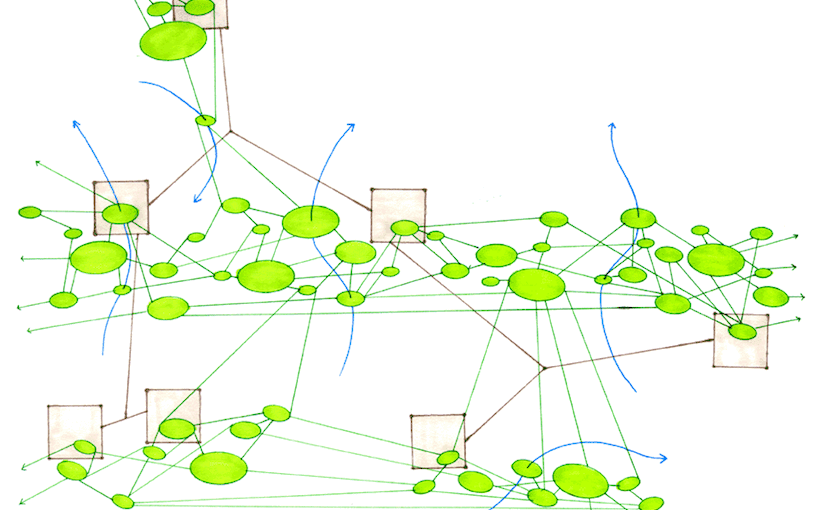
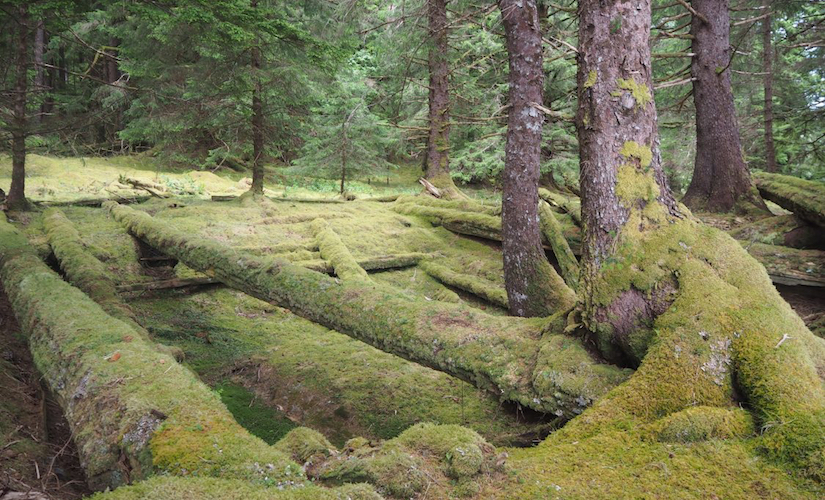
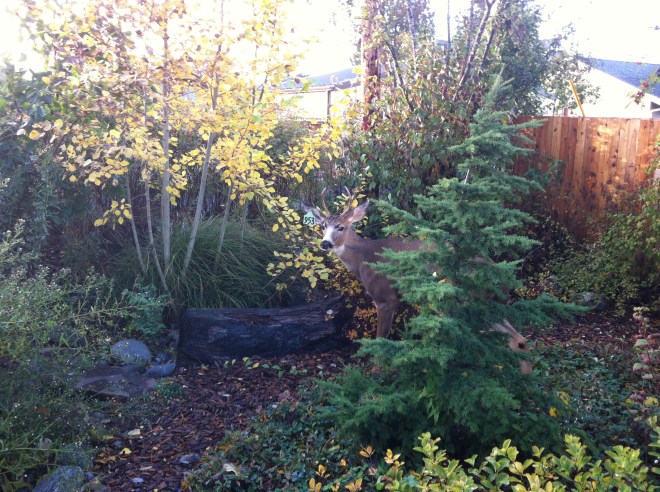
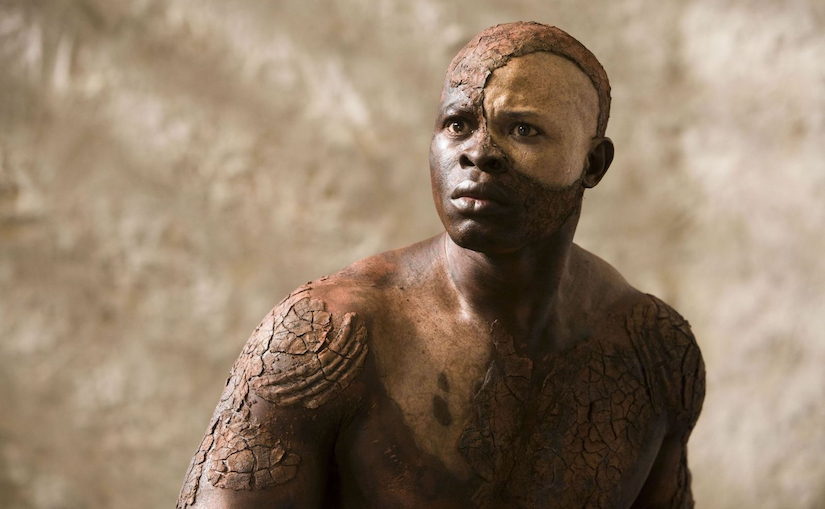
Planted asparagus crowns today – kraken jellyfish sprawls – and guess what, they’re rhizomes. In which honour, instead of the grading I meant to, am posting the project I spent the afternoon hatching for my poetry students.
For your final project, instead of a plain old boring ordinary portfolio, you’re going to construct a rhizome of your ownsome. I’ll set some parameters, and then we can work out together, one-on-one, the form each of your rhizomes takes. Please enter this project in the spirit of cheerful exploration you’ve been cultivating (lovely to see) all quarter.
As we discussed, your rhizome needs (1) to do self-reflection; (2) to include finished poetry of your own; (3) to engage with at least one of the poetry texts and one of the poetics texts we’ve read; and (4) to have a non-textual dimension. My hope’s that these parameters will foster rhizome values of heterogeneity, interconnection, polyphony. And I invite but won’t require you (5) to engage with Deleuze and Guattari’s essay “Introduction: Rhizome” itself.
(1) Self-reflection
You’ve read others on their poetics – what about your poetics? Hey what are your poetics? How have your poetics changed over the last ten weeks? What aspects of the course, other courses, your daily round, have affected your poetics? (Williams learns his poetics from an old man with a watch chain; Levertov from a vase of tulips; Cage from street noise and the endlessness of Kansas.) Is there a given word, image, line or line break in one of your poems where your poetics come clear to you? Write about it, talk about it, blog about it, make a sound poem à la Taggart out of it. You’re doing self-reflection if you’re thinking explicitly and incisively about your own work and practice.
(2) Finished poetry
This is the only component of the rhizome I can realistically quantify. There should be five to eight finished poems. (Towards the lower end if other requirements are met outside the poems. Towards the higher end if they’re met within.) Don’t include drafts unless drafts are part of your rhizome-vision (a process-study rhizome…?). Do consider all the feedback you’ve received, everything you’ve learned about poetic inspiration and poetic craft, and your own writerly intuitions, as you revise your work, a little or a lot.
(3) Engagement with poetry and poetics texts
Your rhizome needs to meet one of the poetry texts we’ve read, head-on, and one of the poetics texts, head on. (Spring and All can count as either, but you need to grapple with a second text as well.) Your meeting can be analytical or creative or both. Endless possibilities! Analytical: Say your rhizome’s a blog. You could write a post about your changing understanding of Williams’s line and how it has changed your own line. Creative: Say your rhizome’s a series of manipulations of found texts. You could do an asemic translation of Cage’s “Lecture on Nothing” following an algorithm derived from the square root sequence he uses to structure it.[1]
Whether your work here is creative or analytical, it should be thoughtful and substantive, emerging, in a way that’s clear to an outside reader (me), from a sustained engagement with the text at hand. Quote, converse, argue; analyze, imitate, parody; cut up, write through, collage.
(4) A non-textual dimension
Your rhizome should have a significant non-textual aspect, component, or dimension. It could be one part of the rhizome – a visual poem, in among other textual poems. Or it could be an aspect of the whole – your rhizome presents as hypertext, say, or a mobile for above the crib of your unborn child, or a set of performance poems, or nested boxes you’ve glued up out of grocery store bags and inscribed with your poems in fake blood from the dollar store. Why? Because rhizome.
(5) “Introduction: Rhizome”
Finally, and optionally, I encourage you to make contact with Deleuze and Guattari’s essay, source of this nuttiness. It’s posted on Canvas, along with key excerpts, some of which we’ve discussed. Seems to me even snippets, little phrases, could turn, open, frame, or maybe defenestrate a poem of yours. Take one and build it into a poem it has nothing to do with – see if it opens up things. A love poem with “Don’t bring out the General in you!” as epigraph? An elegy with “Don’t sow, grow offshoots!” as last line? Or, just put your finger down on a page at random, and whatever phrase you land on, write a poem with that as the title. Or, if you’re truly brave, read the essay for real, see if any of it sheds light on the work you’ve done, are doing, have yet to do.
How it comes together
There’s a safe way to do this. A poetry portfolio that includes a visual poem and a self-assessment in which you situate your work in relation to the poet who’s had the most effect on you this quarter, and the poetics essay you’ve found most provocative, illuminating, or unsettling.
I hope though you’ll bring out the rhizome in you more so. Consider the interconnecting divergent heterogeneous multimedia genre-bending border-crashing ways you might do this thing. A few we came up with last week: A chapbook. A conspiracy board. A video mashup. A blog. A purse. A potted plant. Do others come to mind?
And consider as you work: what makes the art object whole? We’re well beyond the well-wrought urn here, the neat and tidy closure of the sonnet. Think about all the accounts of wholeness we’ve encountered: the seeming sprawl of Spring and All; the forest network of Ghandl’s stories; Cage’s tightly structured yet breezy improvisatory lecture; Olson’s and Hejinian’s divergent senses of open field and open form.
And no, not one of them means just any old mess passes muster, sorry. (A stake in the heart of Reader Response Theory! Die! It’s not that you’re not right, but you stunt the young minds!) What, for Ghandl, Lorca, Cage, Valentine, Taggart, is the difference between whole and not whole? What is the difference for you? Hey, sounds like a question of poetics … maybe one to reflect on …
Finally, practicalities
Our last workshop round will be a rhizome workshop. Bring, for it, whatever will be most helpful to you to discuss – a poem to be part of your rhizome, or a paragraph describing your rhizome scheme, or a link to a blog post or video essay. If the object’s unique and irreproducible – a paper mâché elephant assembled of discarded drafts – bring pictures to pass round, and on the day you’re to be discussed, the object itself, if you can.
Please take note of your date in the schedule. We’re slightly behind, but please, just the same, bring your work on the day your work is due. Allows us max flex. As said, we’ll take care of the backlog at a supplemental meeting, Monday March 14, 5pm at Rudy’s Pizza. Because mushroom.
[1] WTF? See Beaulieu, Flatland. This, BTW, is what Bedient is talking about.
☚ teaching portfolio