A taste of rhizome mind

From Poetics of the Rhizome. A course set to start soon.


Before the World Wide Web, there was a worldwide web. Human beings are recent guests in that web, guests often rude and destructive, but sometimes stunned with awe, or love.

[T]he Great Subculture which runs underground through all history … [a] tradition that runs without break from Paleo-Siberian Shamanism and Magdalenian cave-painting; through megaliths and Mysteries, astronomers, ritualists, alchemists and Albigensians; gnostics and vagantes, right down to Golden Gate Park.
                – Gary Snyder, “Why Tribe”

Rats are rhizomes. Burrows are too, in all of their functions of shelter, supply, movement, evasion, and breakout. The rhizome itself assumes very diverse forms, from ramified surface extension in all directions to concretion into bulbs and tubers. When rats swarm over each other. The rhizome includes the best and the worst: potato and couch­grass, or the weed.… The wisdom of the plants: even when they have roots, there is always an outside where they form a rhizome with something else – with the wind, an ani­mal, human beings…. “Drunkenness as a triumphant irruption of the plant in us.”
                – Gilles Deleuze and Felix Guattari, A Thousand Plateaus

I would describe poetry as ecology in the community of words.
                – Jed Rasula, This Compost

[T]he separate perspectives of my two eyes converge upon the raven and convene there into a single focus. My senses connect up with each other in the things I perceive … each perceived thing gathers my senses together in a coherent way, and it is this that enables me to experience the thing itself as a center of forces.
                – David Abram, The Spell of the Sensuous

This old plum tree is boundless. All at once its blossoms open and of itself the fruit is born. It forms spring; it forms winter. It arouses wind and wild rain…. Its whirling, miraculous transformation has no limit. Furthermore, the treeness of the great earth, high sky, bright sun, and clear moon derives from the treeness of the old plum tree.
                – Eihei Dōgen, “Plum Blossoms”

Most of each thing
is whole but contingent
on something about
the nearest one to it
                – Fanny Howe, “The Splinter”

Common threads here are multiplicity and interdependence. There’s no one way to be human. There’s no one way to be a poem. There’s no one way to be at all! And no one way to say so.
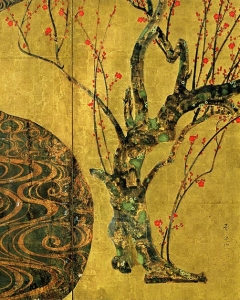

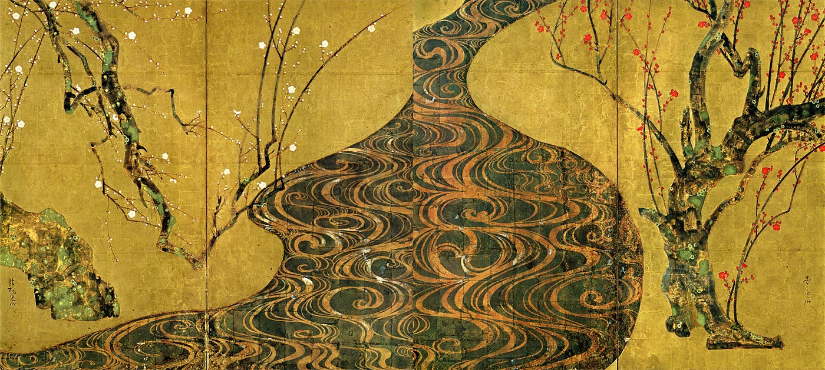
Plum Blossoms - detailMy students are you reading. Winter is coming. You’re gonna be asked, early on, to write spring. The image atop is Red and White Plum Blossoms by Ogata Kôrin. You can read a nice treatment of it here.

Here’s what Dōgen Zenji, my teacher’s teacher’s teacher, and on, has to say about painting spring:

When you paint spring, do not paint willows, plums, peaches, or apricots – just paint spring. To paint willows, plums, peaches, or apricots is to paint willows, plums, peaches, or apricots. It is not yet painting spring.

It is not that spring cannot be painted. My late master, old buddha, he alone was a sharp-pointed brush that painted spring.

So be the sharp-pointed brush painting spring. Or whatever.

teaching portfolio

Syrians to Canada

I’m proud of my country today. The first 163 of 25,000 expected Syrian refugees arrived last night – Lebanon to Toronto, by air.

Have I ever said that before, “I’m proud of my country today,” of either of those that half-claim me? Maybe not. But today, yes. From the NYT:

The arrival of the first flight was highly anticipated in Canada. To avoid a crush that might overwhelm the exhausted refugees, the government asked the public not to go the airport to see the flight arrive. Those who ignored the request were not able to get close to the refugees in any case: the military plane taxied to a terminal building deep in the airport grounds with no public access; it is normally used only for visiting foreign dignitaries.

The building has been converted into a special processing center, where arriving refugees will not only go through the usual customs, immigration and health screenings, but will also be given all of the other paperwork necessary for their new lives, including public health insurance cards. They will also be given winter clothing, and children will receive toys.

Visiting foreign dignitaries. Damn straight. And what do you give visiting foreign dignitaries? Toys. Someone’s getting it right for once somehow.

The whole article here (you may hit a paywall).

Honestly? I’m so heartachy, after Charleston, Roseburg, Paris, San Bernardino, hardly an exhaustive list, and too a racist convulsion here at Western I haven’t found the clarity yet to write about, and too all I learn from reading or listening about my students’ struggles with assault, trauma, depression, poverty, addiction, violence, and dysfunction – when I read “children will receive toys” it takes something not to start crying.

I look forward to whitened old age when I can weep quietly at the slightest provocation and no one will take it amiss. Oh, that’s just how Grandpa is, he weeps when you swat a fly …

Student blogs: Breadhead, The Unbook

Couple more student blogs for ya. They’re having some trouble, truth be told, not all but many are, sustaining their blogs as a steady discipline, without any deadlines from me. I was clear when I concocted this project, that’d be part of the challenge, the drive and momentum would need to come all from them. It’s a 400-level course. They’re to go out in the world soon. The work here is maturation and self-direction.

Now, I get it, I do. They’ve got accumulating loans, part- (or, incredibly, full-) time jobs, crazy heavy course loads, personal crises, roommates melting down. Too they’ve grown up in a multifactoral technological surround that makes concentration well nigh impossible. But, counterargument, to stay in distraction’s a choice, you can turn off the iPod, walk away from the roomie.

There ends my highminded plaint, of the “kids these days” variety.


Want also to say, the group’s gelled really nicely, even if I’m a bit pissy on the state of the blogs. Some of them have been having a hard time; I too have been having a hard time. It seems to have made us good to, appreciative of, each other. How nice is that.


So here are a couple of blogs I think have found their natures well.

One takes bread, the making and breaking and sharing of bread, as its metaphor for what happens in poetry, communion in words. It also has a lot of fun finding faces in toast.

Jacob has a lively quirky slantwise imagination – he may be a distant cousin of M. Dada – and his cutups and breakdowns are very worth checking out. If I have a hope for this blog, it’s that heel (sorry!) find something verbal to do with or near the toastposts … they’re fun and pleasing in themselves, but I feel like there’s some mischievous potential here, not yet tapped into.


If the one blog points back to anciency, our oldest communion, this other points into futurity, asking what the book might be, once fully undone by digitality. Donald’s proposal, and think he’s right, is that we haven’t thought the question very far through.

E-books are not the future. E-books are just the past put on touch screens, it’s still black on white, left to right, top to bottom. And that’s not bad. But I think we can do better….

Why must books be linear? Why do they have to be the same every time? Why does reading have to be a solitary endeavor?  At one point they stop being books and become something else. Something untapped, unrestricted and undone. Untapped, because there is more to books than books. Unrestricted, because they are given freedom from the restrictions of physicality. Undone, so they can be redone.

I give you, then, the concept of the UnBook. A book unleashed by technology.

Thinking on the question is going on, though. UbuWeb doesn’t have a dedicated section on digital texts but possibilities are scattered all through. And my own English Department’s Bellingham Review has an online issue in the works, due out fall 2016, on “The Kinetic Page.” So stay tuned all y’all.


Student blogs: Addendum

Thought I’d share too, since I think here out loud about pedagogy, the note I just sent my compost class.

I’m hoping, so you know, to do a few things by sharing your blogs publicly, and advising you of it. One is to let you know, the work you do matters, beyond our little campus. Another is, to say a few words, in the language I use as a writer outside the classroom, about how your work impinges on me. And a third is, to keep you in touch with each other’s work, so your blogs can be models for each other, inspiration, goad.

The theme here is: seamlessness. Which is compost, but less messy.

I’m struck by a couple of differences in how I teach poetry and how blogging.

One is, I would never proclaim one student’s poem over another. But here I have, implicitly, their blogs. I do mean to praise and publicize every student blog to the world before the class is done. Still, though, I’ve picked one, and another, to go first.

The fact is, some students have nailed it, right off, and I want the others to learn from them. And by saying, these guys have nailed it, I make that more possible. And by making my praise public – worldwide, technically, if very sparsely – I raise the stakes.

I have two motives in teaching, in some tension, and the tension’s laid bare here. One – do no harm. Two – push them as hard as I can get away with.

A poem is a tender creation. Has inmostness. A blog is probably less so. Has, more likely, a thick skin. So, no guarantee, but I’m less likely to do harm by offering or withholding praise. Am willing to risk stinging just a bit, even, if it will, like a nettle, nourish.


The other diff. This blog here. I don’t want my poetry students reading my poems! But I’m fine if my blog students read my blog. What up with that?

Maybe it’s that I know well how to teach the craft of poetry through other poets’ poems. Blogging, I want to teach best practices quick, by showing five or six good ones, and if mine’s in their fields of awareness that’s just fine. Then they can get down to the content, the good stuff.

Maybe it’s that bad examples of blog form are so much more available than bad examples of poetic form.

No. It’s that form and content aren’t intimate in a blog the way they are in a poem. They’re involved but not intimate. And so I’m teaching the form as a technique, an efficiency, and the content as an art. Get done with the one, so we can focus on the other.

It’s ok, blog world, you’re only 10 years or so old. Check in when you’re 10,000.

Newspaper_rock
Newspaper Rock, Canyonlands, UT

Student blog: The clothes we wear

Another student blog for you, come into its own, right here, on the threshold where the inmost being we are, touches the public sphere we move about in. Clothes, hair, eyes, lips, limbs, and how we make up and dress down, pierce and dye, stain or tear, tattoo or don’t. For, as Evan rightly says, not to is every bit as much a choice, as to.

I say this as one uncomfortable caring at all about how I look. So much more important to me how one sees. And yet it do matter don’t it. We are moving at all moments through a web of codes.

Merleau-Ponty noted, I think it was he, I’m taking this from my memory of David Abram‘s Spell of the Sensuous, that the eye can’t see without also being seen – can’t do vision without entering the visual. To see is to be seen. More, to see is to be seen seeing. A phenomenology of flirting might begin here. (Maybe also one of voyeurism, which maybe feels dirty because it breaks out of that reciprocity.) That, anyway, is our social being, to see and to be seen and to be seen seeing.

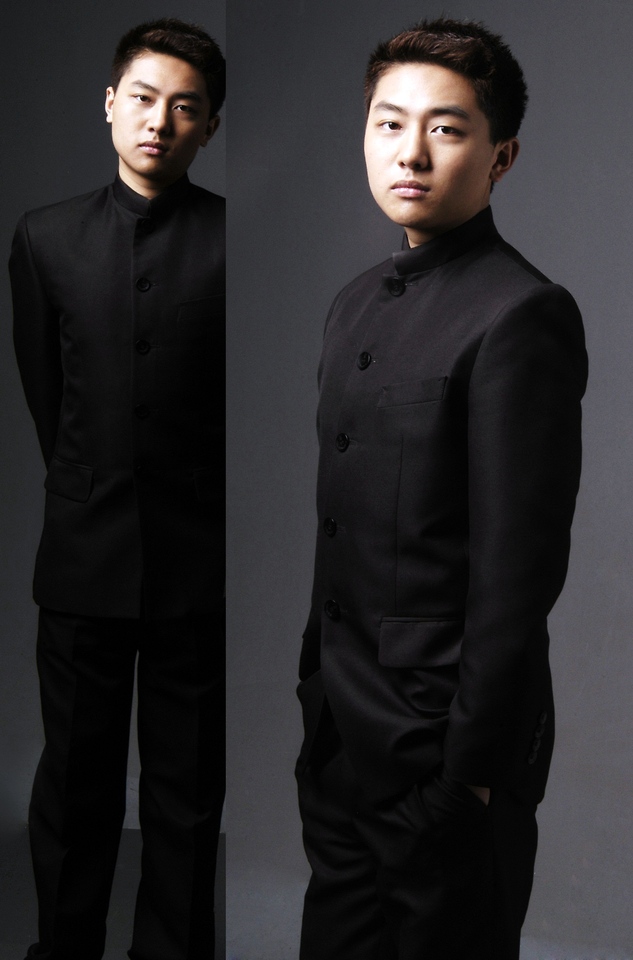
Is why we do not all wear Mao suits. Or, if we do, we want to look this good.

mao suit

Evan’s got a fine and punchy style going, a good model of, one, how to do blog prose, and, two, how to marry personal and social awarenesses. Light touch, nothing didactic. I mean it feels seamless to me, how her awakeness to her own life, and her wondering how the world goes, meet. Check it out.

Student blog: Postmod

My Art of Compost students are hard at work on their blogs and I mean to post links to them as they come to life. Here’s a first. A lively deft insightful blog on postmodern art and culture, with an emphasis on pop art, and theory consonant with same. Andy Warhol, Jean Baudrillard, french yé-yé pop, The Cure. I hope Benjamin and Barthes to come. Scared yet? Good. But for real, it’s an excellent resource, Michelle’s really done, doing, her homework, and giving it away to all.

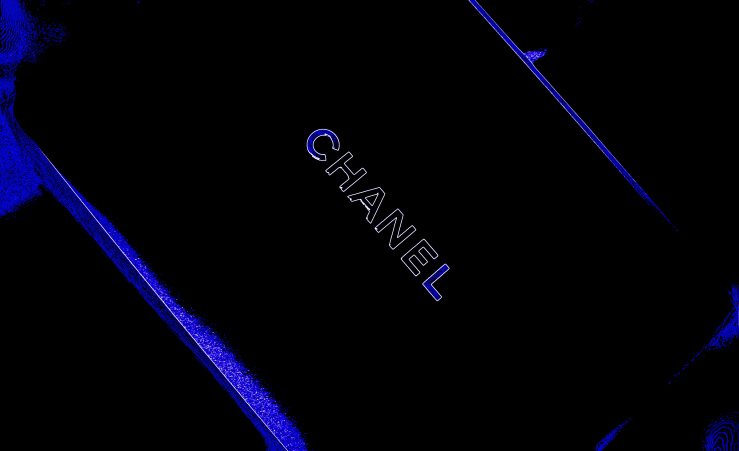
Most excitingly, to me, she’s bringing her own creative work into the mix. She’s a wonderful photographer, and the more she manipulates the images, the more she “problematizes” their “authenticity,” the more they belong.

chanel

Here’s one I stole from there to draw you on. Meant all four scare quotes yes.

Poetics of the Rhizome

Been a while. Here, a post that takes composting (repurposing) (ok cutting and pasting) to heart – coarse description for my winter poetry workshop. And, cuz the Puritan in me says LAZY BOY for plopping this down, I’ll put in some links, rhizome-style, to what I hope’ll be pleasing surprising ties.

By the way? Rhizome, from Deleuze and Guattari’s “Introduction: Rhizome” from A Thousand Plateaus, which, as I said today to my colleague Oliver, I’d never make an undergrad actually read, though in fact it’s durn pretty cool.

By the way also? Rhizome’s a complicated way of saying Indra’s Net.


English 453: Creative Writing Seminar: Poetry: “Poetics of the Rhizome”

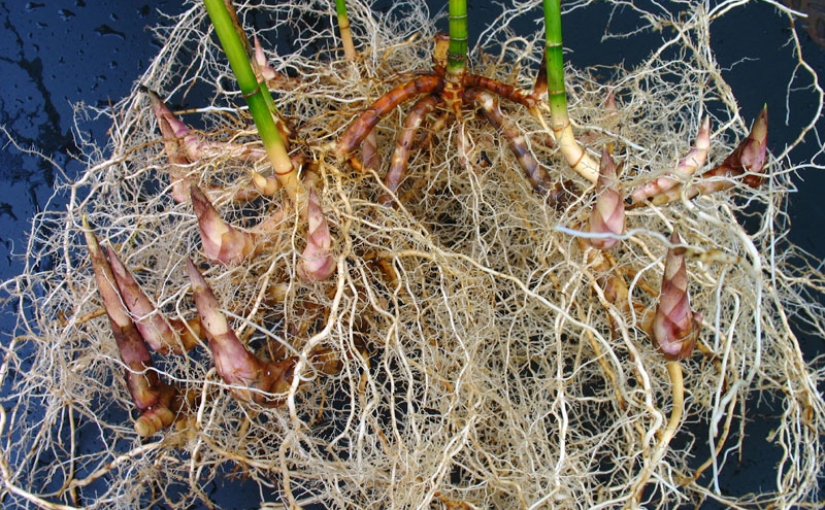
A plant that grows by rhizomes spreads laterally underground, sprouting new plants where chance prompts it or opportunity allows. A rhizomatic plant lets go of where it came from. It extends indefinitely. Sprawls and breaks the rules. Makes its own rules and it don’t look back. Diverse and plural, not a voice but voices, it connects and connects some more. Think aspen, orchid, ginger, bamboo. Think poison oak, horsetails, bunch grass. We’re past good and evil here, beautiful and ugly, the rhizome’s where shit gets real.

In this class, we’ll meet the poem, poetry, as rhizome – a conversation without edges – messy sprawling webs of language that circle the globe, link human prehistory to the present moment, and embed human speech and action in a more-than-human world. Our focus will be student work, but we’ll touch in with ways of thinking-about-poetry, feeling-through-poetry, sympathetic with rhizomatic mind. The post-colonial turn from Anglophone canons to literatures of cultures at the muzzle end of empire. The work of ethnopoetics, fruitful but troubling, to recover pre-techno­logical ways of being and seeing. And the work of ecopoetics to divine, through the dowsing wand of poetry, a human place in the green and toothy world.


Full disclosure, with whine. Do I have time to check out all the links mischief has me propose? Are you kidding? With my working life? You know I make about minimum wage, right, when minimum wage is actually a living wage, as it is in, say, SeaTac? And here I am at 9:50pm eating Coop lasagna from the microwave and drinking a cheap but really not bad Grenache and spending entirely too long on a blog post … well, point is, I’ve given the links a quick scan, they seem fun, but be your own judges. Century of Scatter.


The intent here’s intimately practical. How to widen our notion of the possible in poetry? So count on lots of provocative reading, frequent writing exercises, and thoughtful responses to your work and that of your peers. Too, be ready for conceptions of the poem you hadn’t thought before: poem as prayer, incantation, manifesto, compost pile, neural net. Grades will be based on assigned exercises, writing journal, final portfolio, active and generous participation. Poetry by W.C. Williams, Robert Creeley, John Taggart, Ghandl of the Qayahl Llaanas, Will Alexander, Adonis, Jean Valentine, Coral Bracho. Poetics essays by Williams, Charles Olson, Denise Levertov, John Cage, Charles Bernstein, Lyn Hejinian, Adonis, Adrienne Rich.


More of the promised links to come, friends, but I gotta call it a night. Rhizome mind is hard work. As all ferns and their fronds know.

teaching portfolio

Marlise’s portfolio

Friends. (Oppen said something like, the poem that ends as it should, “ok,” the poem of the world. Tonight for me, it’s the post that begins as it should, “friends.”) I’ve meant to share with you a portfolio by one of my vis po students from this spring. She rides a badass wheelchair and her work is images of and round and beyond her condition, Friedreich’s Ataxia, a truly shitty degenerative neuro-muscular disorder.

I don’t mean to be sentimental here. That’s cheap to those who live with a disability. From here it seems, there are some who live with such visible cruelties, I’m using Marlise’s so apt word here, and others who bear cruelties invisible to all until they flame out horrible, and some who have the bad luck to be lucky till they’re not, and then they know not what the fuck to do.

Even all that considered though. This young woman has moved me no small measure with her guts and her mischievous gleam. So, here are, with her permission and a bit of anonymizing, some words and images of hers.


“One of my passions, my goals, and perhaps my purposes, is to help arts by and/or about the physically-disabled population to gain at least culturally standard recognition. This course has made me see visual poetry as a wonderful and effective forum to achieve this.

Portfolio-3“In creating my pieces, I was most inspired by our course text Nox, by Anne Carson. She delivers poignant messages about grief through photocopies of memorabilia about or featuring her late brother, while still leaving the concepts of familial love and loss open-ended and undefined.

Portfolio-5“Being physically disabled myself, I often think of myself and my as audience members, just insignificant observers of my disease’s progression, effects, and affects. This ‘outsider’ perspective is what I interpret as Carson’s purpose and message behind Nox, and it’s what I have striven to elicit for disability in this project.
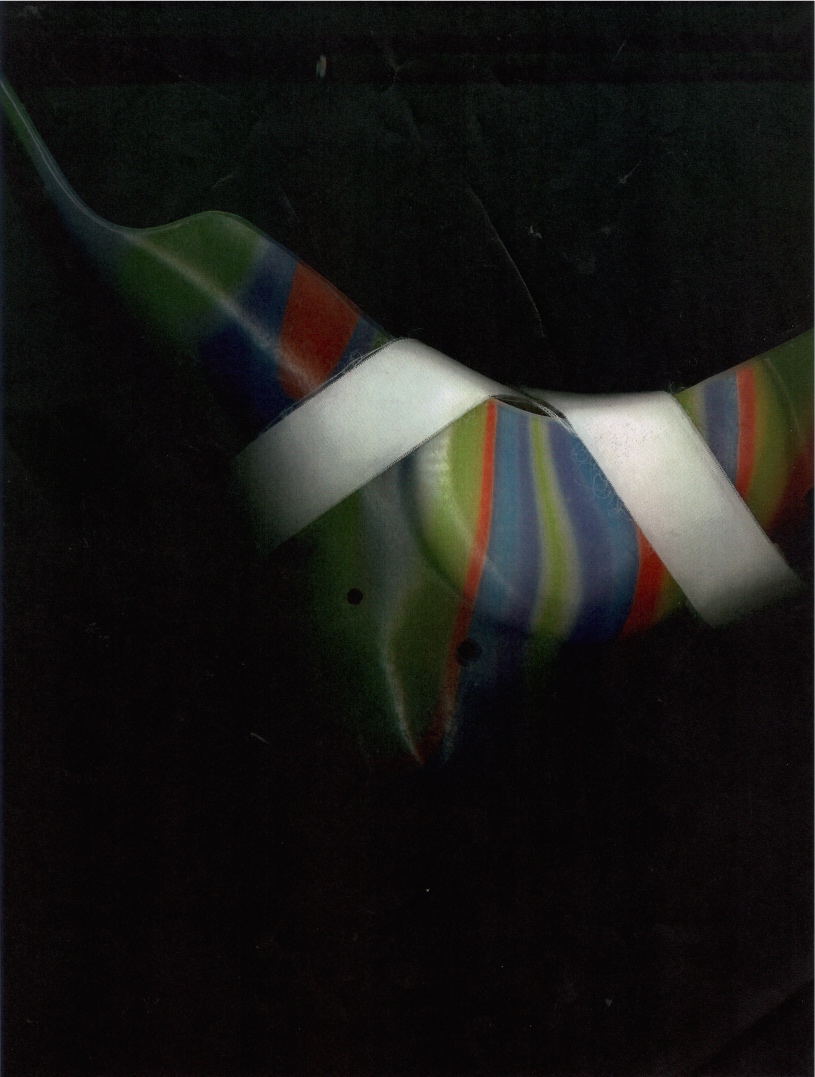
Portfolio-2“I’ve explored the photocopy technique, implementing forms of handwritten pieces and material objects. Attempting to play with my method of choice in new ways, I photocopied in the ‘negative’ setting a couple of times to convey the stark labels put in visibly-disabled people, Another way I twisted the work via the photocopier was selection of reflective objects to photocopy.

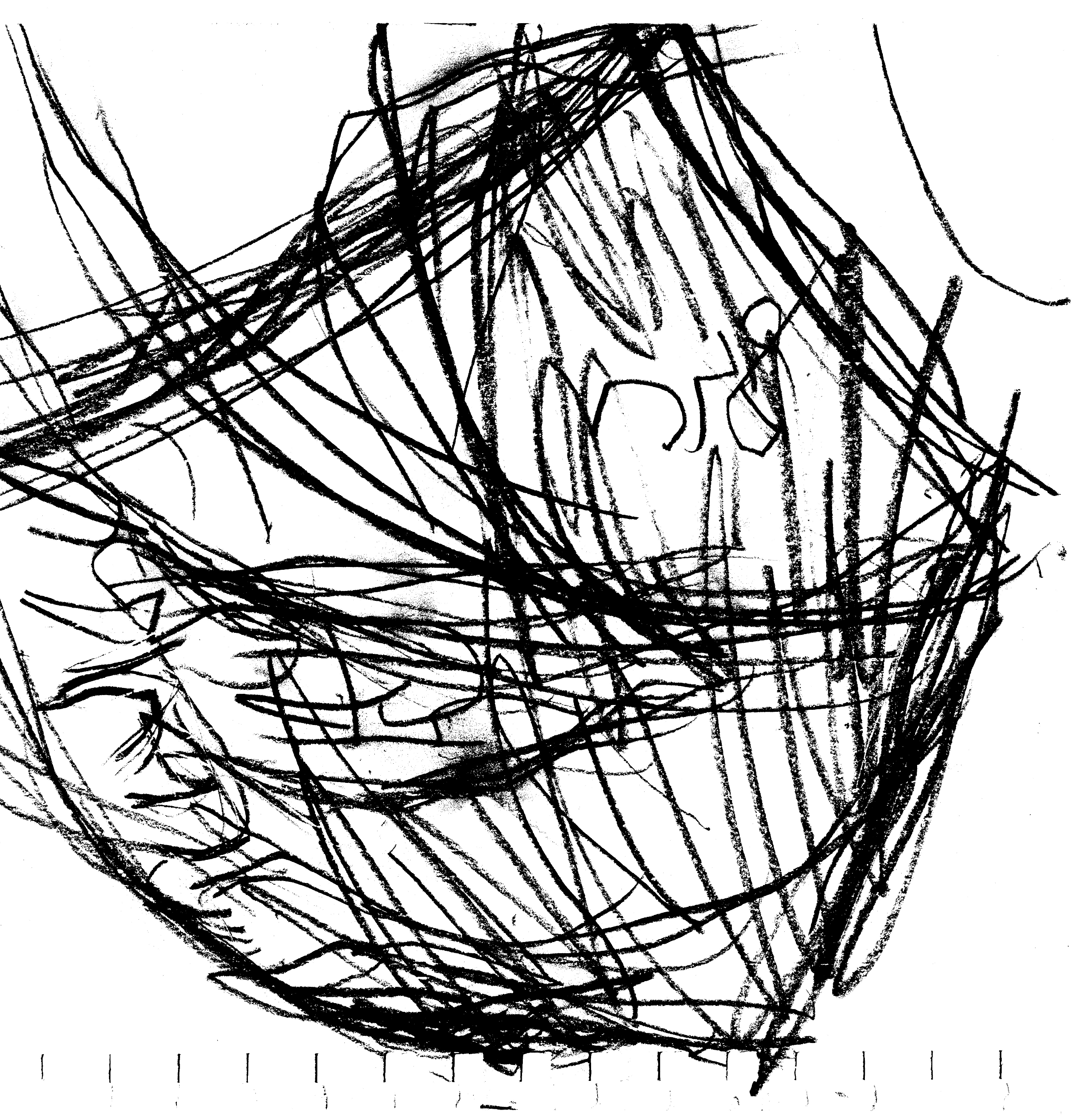
“The first artifact displays the title of my disorder, Friedreich’s Ataxia (FA), through a bag that has one transparent side and one opaque, turquoise side. I chose this to hold the piece because I knew the photocopier because I knew the photocopier would reflect off the bag, and the resulting glare I wanted to evoke the unapologetic cruelty of my handicap.

Portfolio-1“Also, I thought the bright turquoise backing worked as representation of the crippling sadness or unashamed joy underlying nearly every part of disabled life. The writing is done in charcoal, and then smudged, translated to be the destruction of effort. Where I placed the artifact in the photocopier cut off the top fails-at-drawing-a-straight-line of th F, leaving a single, straggling line reminiscent of lives cut short by means of physical disability, including mine. Finally, I inserted the page into its sleeve upside-down to distance and simultaneously inconvenience the viewer, like disability effects everyone involved in the victim’s life.

Portfolio-4“As a visual element, I will steer the viewer’s attention to the cover art. There I have my prescription-medication bottles, showcasing the nameplate-labels. Not only do I associate paid-for treatment with disability, but I see this photocopy of personal and yet widely recognizable objects as the prime subject to introduce this portfolio, too. It compartmentalizes disability, and also starts the project’s accessible journey of disabled interpretation.”

Portfolio-0


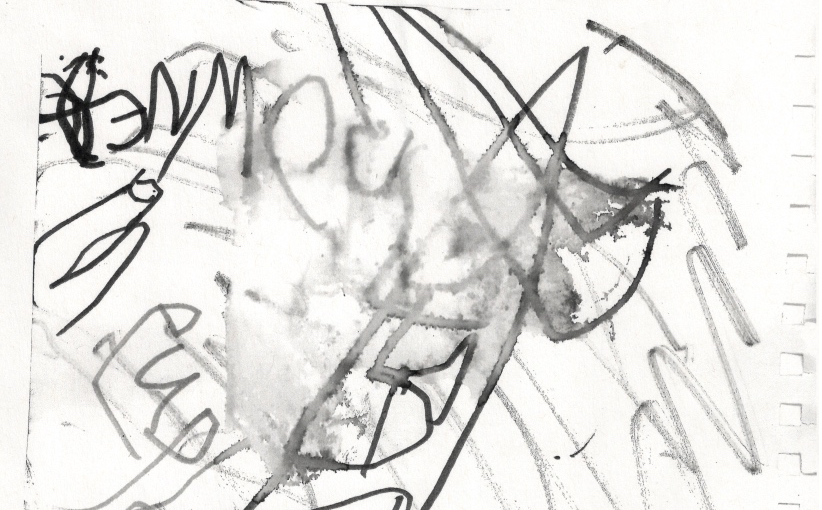
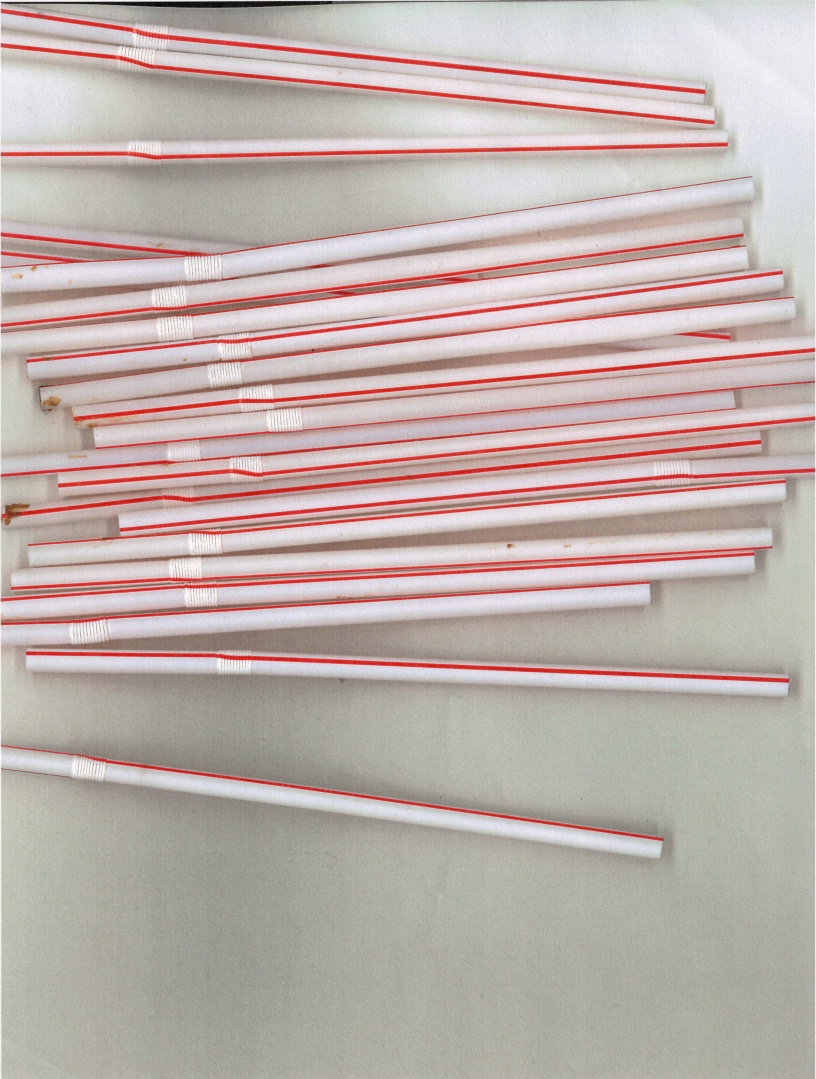
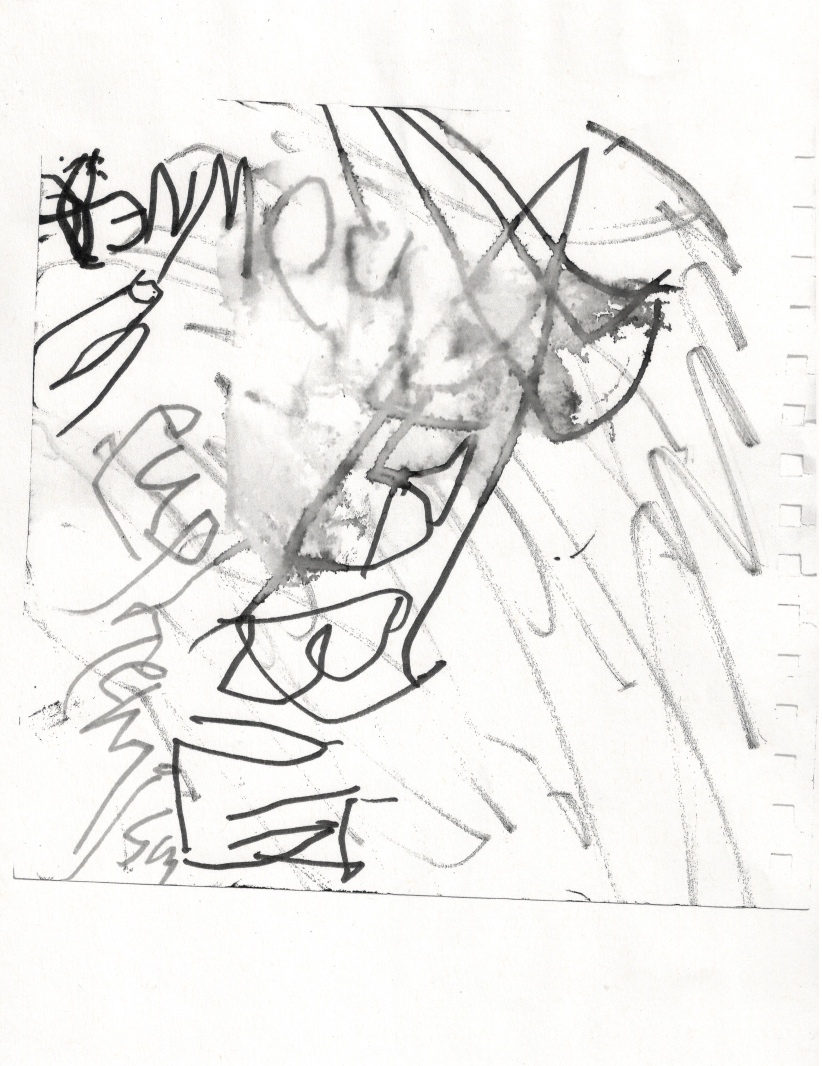
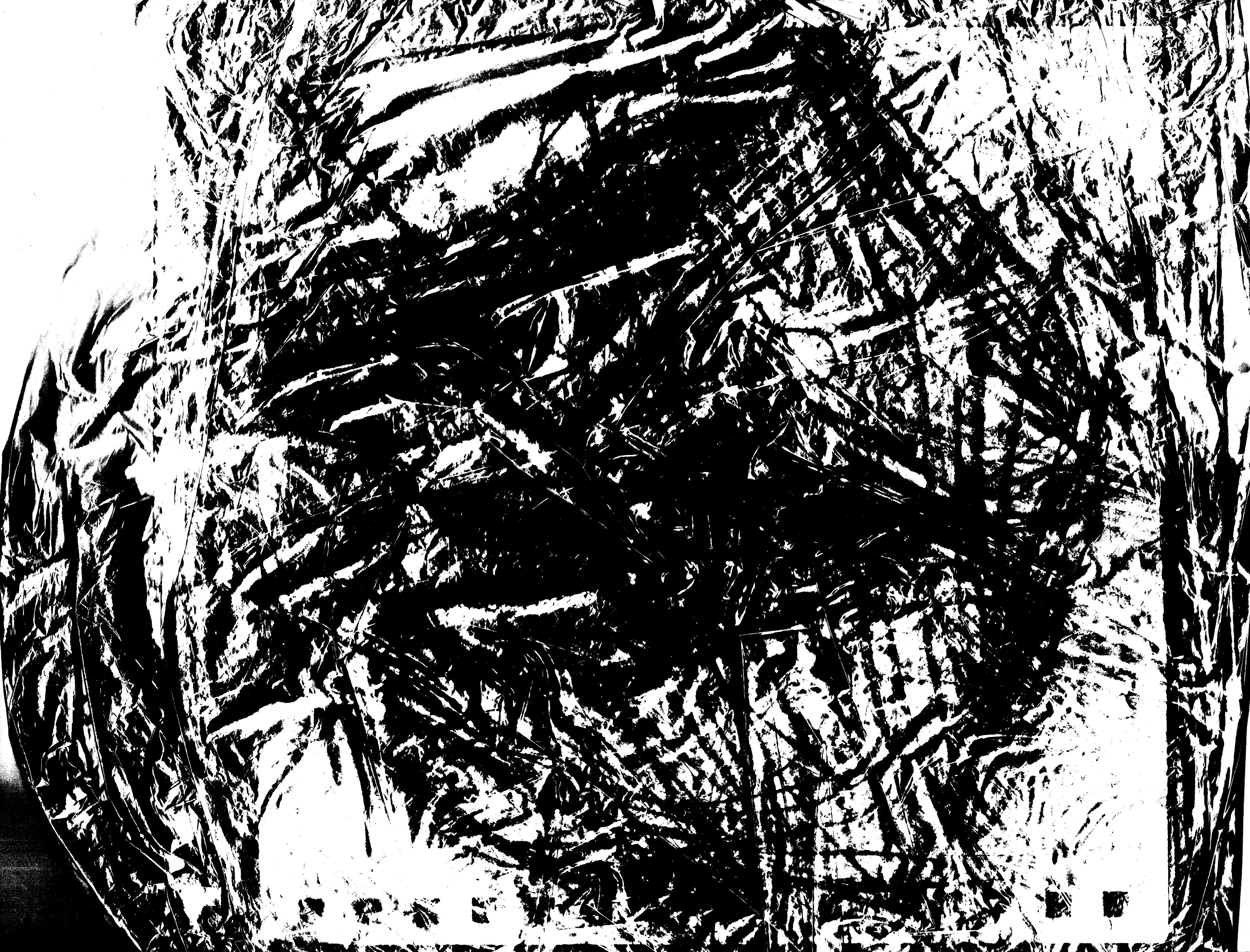
POSTSCRIPT. The cellophane technique I’ve been playing with BTW is thanks to Marlise, who on a handwritten poem assignment took my encouragement to view her handwriting as differently beautiful and handed this in –

Handwriting 3a

– but because the charcoal was bleary handed it in, considerately, in a plastic bag, which gave me an idea, so when I scanned it I scanned it in said plastic, with all those unanticipable opacities –

Handwriting 3b

Whoever says teaching creative writing sucks from their creative work needs to check what they’re teaching.

Tea-Time

And, one last one for ya. A blog dedicated to coffee makes a somewhat chill detour into tea world. Where lives, wait for it, one badass Tea Rex.

lenadonovan's avatarMind, Drips

One of the many reasons I love tea… Cute strainers

My introduction to warm, caffeinated beverages that go well with rainy days and books wasn’t coffee—I was an avid tea drinker long before I found myself nourishing essays at 2 a.m. with coffee as the only thing tethering me to the waking world. So, this post is an ode to the launching point of my caffeine addiction.

Interesting myth about coffee: lighter roasts have a higher caffeine content. Interesting fact about tea: lighter tea has a lower caffeine content.

I won’t go into the nitty-gritty about the process of oxidation that tea undergoes, but generally the longer the oxidation (which leads to darker teas), the more caffeinated the tea will be when brewed.


From lowest to highest caffeine content, there are five over-arching categories of tea.

herbal, white, green, oolong, and black.

All of these teas (except herbal, see below) come…

View original post 161 more words

Privacy? What privacy?

Hey folks, coupla more student blog posts for ya, and here’s one. Angles on through round and under, as in cutting, patriarchy, by sound image erasure and general largeheartedness.

(The posted videos aren’t coming through, so go to the blog itself, here, do.)

thefeministlens's avatarThe Personal is Political

Gloria- Patti Smith

We live in an age where, for women, everything is public. As a woman I live in a society where I am a subordinate class. Men hold a majority of the power, and as women we can either except that, or say: “Oh, hell no!”

Bury Our Friends- ‪Sleater-Kinney

This is an erasure pome from a history book. I feel like it goes with this idea, but I’m not entirely sure exactly how yet. What do you think?

Public

The first was statues.

________

For every piece

of public art, at one point,

has predicted a Plaza of Memories.

________

The Plaza’s final attraction

was donated by

a publishers editorial fury.

________

It was a title against

those who thwarted.

________

It was necessary

as a “real estate man.”

________

The aura of power

decides what’s best.

________

One by one, all these

breaks came though,

tottering…

View original post 3 more words