A clutter of starlings

Another riddle for yehs. Birds? Or maybe it’s unsolvable & that’s the solution.


Clutter of Starlings

Đeos lyft byreð          lytle wihte
ofer beorghleoþa,          þā sind blace° swīþe,
swearte, salopāde.          Sanges rōpe,°
hēapum fēraþ,          hlūde cirmað. ⬩°
Tredað bearonæssas,          hwīlum burgsalo
niþþa bearna°          nemnað hȳ sylfe.° :⁊

Clutter of Starlings

Nightair carries little creatures over
the hillside, they are black, very black,
their coats are dark. Singing profusely
they spread out in bands, call out loudly –
treading wooded headlands, sometimes
in halls of men they name themselves.

Commentary

Though the birds are full of articulate noise, and cross at the end the verge of human dwelling, the poem is not in their voice, but that of a human riddler. Their flight habits seem those of starlings, which travel in great clouds, following the contour of the countryside, sometimes at twilight. Muir, however, sees swallows, which have dark backs and pale underparts; if you read blace (2) with a long vowel, blāce, it goes from “black” to “bright,” and you can get to a sort of swallowy look:

Little creatures ride the air
over the hillside, flashing brightly
black, dark-coated. Singing profusely
they go in flocks

Also, swallows are more likely than most to swoop into a human dwelling. But a group of them is not quite a hēap (4) “band, multitude,” and no way can they be said to tredað (5) “tread” the earth; while starlings come in crowds and are conspicuous walkers.

More birds than these two have been proposed; it’s one of the Exeter riddles more resistant of answer. Niles likes the crow, crāwe, as the bird most likely to name itself with an onomatopoeic call. Crows do gather in flocks, and they tread the earth, but they’re even less songful than starlings, and not so little neither. Other birds posited: swifts, jackdaws, house martins. Some readers go onward to bees, hailstones, raindrops, storm clouds, musical notes, damned souls, demons – but a bird does seem most likely, even if the thought of musical notes tromping the countryside in black coats is awfully surreally lovely.

In The Riddle Ages, a smart multi-authored blog devoted to the riddle poems, Michael Warren notes that all birds in the Exeter riddles elude naming to some degree. Transecting earth and heaven, betimes kissing-distance from human beings, betimes flyspeck-far in the sky, they are liminal to us, coming as they go, going as they come. So many of them, in such variety, and they flew off so fast, how could language catch them?

[S]cholars across the medieval period stress that what is most birdy about birds is their transformative abilities. Or to put it another way, what most defines birds is their habit of avoiding definition – they’re intrinsically unknowable in some respects, escapologists.

Medieval encyclopaedists like Bartholomew the Englishman and Saint Isidore of Seville found in birds, Warren adds, a locus for some of their more general anxieties about naming. Words are themselves birdy, keeping escaping us, and these bird riddles, with their soundplay and wordplay and the pressure they put on acts of naming, delight in linguistic mischief. Fugitive moments roost in them, small and large, chirping, singing, flitting, shitting – puns, innuendoes, ambiguities, runes, misfires. They like the unlikenesses.

In this one, the clues point akimbo, like jayfeathers after their bird fell into a bath and scrambled out. With the change of a vowel value black turns to bright. They may be named either to or in human halls. The crowning ambiguity’s in the last verse, nemnað hy sylfe, which can be read as either an imperative, “name them yourselves,” or a declarative, “they name themselves.” Read it one way, we’re told what to do, but we can’t, with the clues pointing this way and that. Read it the other way, we maybe get another clue – is their call onomatopoeic? – but it taunts us with the birds’ apartness: they call themselves a name we’re not told.

Reading this aporia, Warren suggests the riddle may be unanswerable, or even that its answer may be unanswerableness. We hold an object that’s also a subject, it remains nameless or polyonymous; empty, many-natured. The birds invite us, as Warren puts it, to

inhabit a space somewhere between knowledge and ignorance, just as the birds themselves sometimes dwell with niþþa bearna “the sons of men” and sometimes move beyond our boundaries to the bearonæssas “woody headlands.”

Or, if we must know, be holy fools in what we know. Isidore in his Etymologies writes of birds: “They are called birds (avis) because they do not have set paths (via), but travel by means of pathless (avia) ways.” Let this riddle and that sentence put to rest any thought that wordplay of the sort seen in Perec’s La Disparition or Alan Davies’s a an av es is new in the world. We’ve been switching letters to make new meanings for as long as we’ve been swapping nucleotides in codons under our rubric as sapiens, the wise ones, the percipient.

Notes

2     blace. Usually read with a short vowel, as “black,” so that the sequence blace swiþe, / swearte, salopāde translates as “very black, black, dark-coated.” The redundancy is its own little puzzle.

3     Sanges rōpe. “Bountiful of song.” The phrase, which somewhat inhibits a reading of “starlings” or “crows,” doesn’t especially point towards “swallows” either.

4     The punctum puts the poem’s turn here. If it’s taken seriously, then tredað bearonæssas “tread wooded headlands” belongs to the closing verses and the final sentence, and the birds’ walking is kin to the human activity of these lines, hall building, meadjoys. It is almost as if they become human visitants.

5–6   hwīlum burgsalo / niþþa bearna. It is either to or in the burgsalo “city-dwellings” of niþþa bearna the “sons of men” the birds are named. Whether or not they set wing in a hall, a call penetrates, makes present.

6     nemnað hȳ sylfe. Either “name them yourselves” or “they name themselves.” Traditionally editors have preferred the former – it’s often seen at the end of riddles – but according to Warren the latter has recently gained favour.


P.S. [after checking out images of starling clouds] Maybe their song is synaesthetic – goes to eye not ear – astonishing chord of their synchronic flight. See Pound’s Canto LXXV.

starling cloud

A Bookworm

The final poem of Unlikeness Is Us. Undereating the whole thing.


A Bookworm

A moth ate words. Which seems
splendid to me. Think of the wonder
that worm consumed, riddles we wrote,
a thief in darkness of our deep musings;
the stiff parchment too – and the thief not
a whit wiser for the words it swallowed.

A Bookworm

Moððe word frǣt.°          Mē þæt þūhte
wrǣtlicu wyrd,          þā ic þæt wundor° gefrægn,
þæt se wyrm° forswealg          wera gied° sumes,
þēof in þȳstro          þrymfæstne cwide
ond þæs strangan staþol.          Stælgiest ne wæs                         (5)
wihte þȳ glēawra          þe hē þām wordum swealg. ⬩

Commentary

This one’s based on an ænigma (no. 16, “Tinea”) by Symphosius:

Littera me pauit, nec quid sit littera noui.
In libris uixi, nec sum studiosior inde.
Exedi Musas, nec adhuc tamen ipsa profeci.
                    (Glorie 637)

Letters fed me, but I do not know what letters are.
I lived in books, but am no more studious for that.
I devoured the Muses, but still have not myself progressed.
                    (Cavell trans., n.p.)

Not a translation but a transmutation of a Latin precursor. It has digested a prior poem, one by Symphosius, to arise remade in a new language, and a new rendering. So the poem about a bookworm is a bookworm. Intertextuality is the modern word for this ancient preoccupation. It’s as old as writing is – older, in fact, as old as spoken stories are, which change as they change hands and minds, recombining each time they’re told. That interchange is pretty ordinary in an oral tradition and doesn’t warrant a lot of special attention. When writing fixes speech, though, tries to make it a thing durable, its ongoing decay on all sides becomes something to talk about.

One challenge in this riddle is to figure out whether the words eaten are oral or written (Cavell n.p.). The word gied (3) “song” suggests the former. How do you eat a spoken or sung word – by hearing it? Two lines later, strangan staþol (5) “strong foundation” points towards a thing that’s read, parchment, binding. You could eat that by reading it, but it’s clear this consumer’s no reader. How to reconcile one gesture towards voice and one towards written form and frame? John Niles (121–22) suggests we go with written song – specifically the canonical psalms of King David. The Song of Solomon, with its secret visits in the night, akin to thievery, also comes to mind. Whatever you take the text consumed to be, the consumer is usually thought a bookworm: that’s how to eat writing without getting it. Its work isn’t profitless though. Worm becomes moth, matter’s made energy, parchment flight. Not a whit wiser, but a marvel; and the worm knows what readers forget, that the text is a thing in the world, storehouse of energy.

Just as “bookworm” is metaphor for a certain sort of reader, though, some readers of that sort, scholars, will burrow into the bookworm for a meaning more hidden. I’m drawing from Megan Cavell’s post on The Riddle Ages and her thoughts on the Latin ruminatio, which worked dually, just as our word “rumination” does. It’s how a cow chews and chews, also how one mulls an idea, pre-digesting it. If the poem’s written with this sort of slow absorption in mind, it’s possible it does, in addition to its lateral metonymic work of turning parchment to worm to moth, also some vertical metaphoric work. Who else in its world chewed dumbly awaiting metamorphosis? The moth is cast across a region of unlikeness towards, perhaps, some poor monk or student with bad teeth, breath, acne. And the likeness that carries us with it across the lie? Moth and student are both larval forms, in waiting. (Isidore of Seville would enjoy it that in our English only one letter separates pupal from pupil.) A creature chewed uncomprehendingly on words, and now, having gone off, witless and winged, it’s gained some sort of mastery. A professor?

Notes

1     Moððe word frǣt. Williamson: “the initial half-line contains a double disguise: moððe for wyrm and word for bec” (285). The worm presents as its future as a moth, the book as the words it contains. Projective, metonymic.

2     wundor. In the OE, it’s the fact of consumption that’s a marvel, not a wonder that’s consumed. More faithful to the letter would be: “What a wonder! That the worm consumed words someone wrote.”

3     wyrm. Note the play among near-homophones, word, wyrd, wyrm. Word, fate, and worm bound together in orþoncbendum, skillful contrivance. ¶ gied. Usually “song.” Cavell (n.p.) translates this verse “a certain man’s song.” However, gied can also mean “riddle,” and to an uncomprehending worm, the whole library would be insoluble, if digestible.


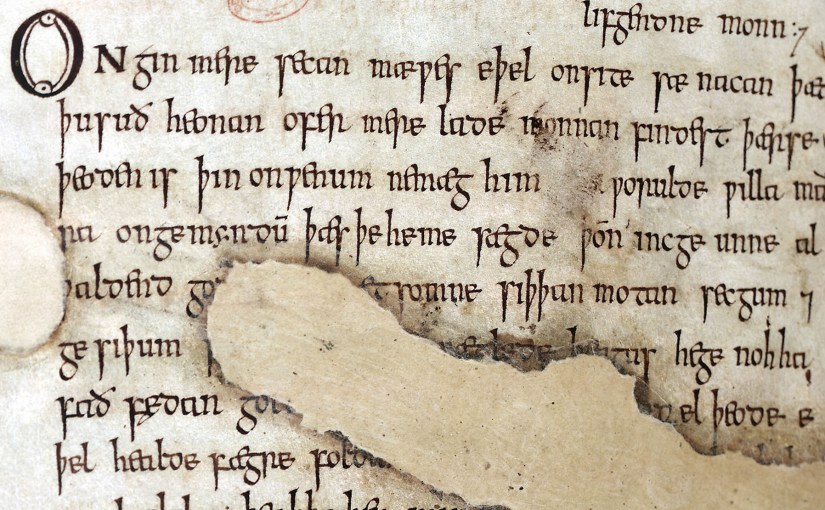
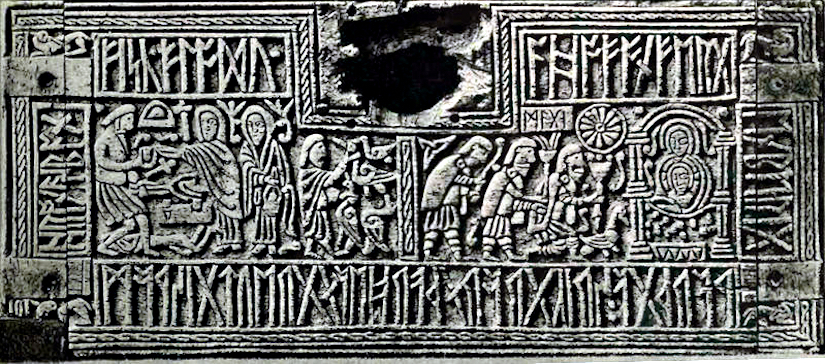
The image atop is the front panel of the Franks Casket – riddled with holes, graven with a runic alphabet whose import as a whole’s up for grabs. Consider the opening paragraph of the online article that accompanies the image

One of the more vexing problems facing scholars of Anglo-Saxon art is the simple fact that we often do not know precisely what it is that we are dealing with. I am speaking not so much of the questions of dating and localization that hamper the study of medieval art. Rather, it is that we cannot even say for certain what many of our most famous objects even are, or were intended to be. The Franks Casket, for example, has been identified as a treasure chest or a book shrine, and was used in the later Middle Ages as a reliquary, but all we can say with any certainty is that it is a box that likely originally had a latch.

Riddle me this. This here worm, had he the time, would read it all. But bed.

The Swan

From Unlikeness Is Us. With thoughts on the Anglo-Saxon riddle as a threshold genre, and how can the more-than-human speak in our rather human poems.


The Swan

My dress silent when I walk on land,
or house myself, or stir up the water.
Sometimes my clothing and the air
lift me above the human dwellings,
and for that all the powers of cloud
bear me on – my white vestments
sound loudly and resound sweetly,
sing clearly, when I rest on neither
earth nor water, wandering spirit.

The Swan

Hrægl mīn swīgað°          þonne ic hrūsan trede,
oþþe þā wīc būge,          oþþe wado drēfe.
Hwīlum mec āhebbað          ofer hæleþa byht
hyrste mīne          ond þēos hēa lyft,
ond mec þonne wīde          wolcna strengu°                         (5)
ofer folc byreð.          Frætwe° mīne
swōgað hlūde          ond swinsiað,
torhte singað,          þonne ic getenge ne bēom ⬩°
flōde ond foldan,          fērende gǣst°. ⬩   :⁊

Commentary

There are ninety-five riddle poems in the Exeter Book. Give or take – a few short poems, whether or not they’re riddles is an open question. A few haven’t been solved for sure; some effectively announce the answer in the first line. In some the thing speaks for itself; in others it’s described by a curious or bemused third party. Most are marked by compact wordplay, many by playful, occasionally salacious banter. Some end with a challenge – name what this is.

“The Swan,” like many of them, offers speech to a thing we would have thought speechless (a kind of prosopopoeia). What to make of that depends on how hard you look. Pressed lightly, the poem is a happy game of make-believe. “Imagine a swan could speak!” And it’s nice to find a ludic impulse in a body of work often thought wholly gloomy in its celebration of heroes done in by wyrd. Read at this pressure, the riddle poems show a debt to a post-Classical genre that dates back at least to Symphosius (ca. 4th–5th C.), whose three-line, apparently extempore Ænigmata inspired translations and imitations by Aldhelm (639–709), bishop of Sherborne, and Tatwine (ca. 670–734), archbishop of Canterbury, among others. The influence of these precursors, all in Latin, can be felt in the Exeter riddles, but the latter aren’t for the most part translations or imitations; they tend to be longer, more detailed, and more playful stylistically than their forebears (Marsden 310).

Look harder, the ludic becomes lucid, as the brute world is found to be sentient. A swan speaks; later in these poems, a cuckoo does; elsewhere among the riddles, mead, a tree, a mail coat, a reed pen. The poems recall for us an old human premise we’ve forgotten or grown unconscious to – the sensuous surround of stones and trees and birds and bugs is awake, articulate. Maybe in these poems the notion was just taken down from a shelf in the mind for use in a verbal parlour game; maybe it also touched on grave true belief. Compare an earlier instance, both playful and earnest, an Archaic Greek cup on which the words are inscribed, “I am Raven’s wine cup.” Robert Bringhurst writes of it:

[What] the Lindos cup asserts, apart from its owner’s name, is its own articulate vitality: “I am.” This is an animate, vocal drinking vessel, likely to cry for help if you should put it in your pocket and walk off. (175)

That cup, this poem, belong to an animist inheritance, the final human universal.[1] The first-person riddle poems take it as a given that our minds engage in a larger network of minds endowed with sense and speech and reciprocal responsibility. In this they rebut the Seafarer and the Earthwalker, who in their ascetic commitments aim to leave earthly being behind; for them the meaning that matters is not in matter – is, as for Augustine, immaterial and indefinitely deferred. But even they, lonely and cold, can’t help but take birdcalls for human chatter, the birds themselves as human comrades. They can’t escape their own imaginations, any more than they can be not an animal, or evade having been born.

All objects potentially subjects. The notion sits near the heart of the objectivist mode. You see it especially in the Objectivist poets after whom the mode is named. When George Oppen avows the life of objects in “Of Being Numerous”

So spoke of the existence of things,
An unmanageable pantheon

Absolute, but they say
Arid.
           (“Of Being Numerous”)

or Lorine Niedecker lays for that pantheon a sensate material ground

“We have a lovely
          finite parentage
                    mineral

vegetable
          animal”
                    Nearby dark wood –
                               (“Wintergreen Ridge”)

they’re stepping into a way of thinking the riddle poets walked before them. The habit of mind went underground, not away.

That’s one side of it – the object is hallowed.

The other is, it’s hollowed out – appropriated, made to speak with a human tongue, of human things. The swan has not feathers but hrægl “garments,” which are later seen as frætwe “ornaments” – as if a bird had clothes and vanity and the social energy for all that. As it rises from the world we know, flood and field, it calls itself fērende gǣst “wandering spirit,” or else fērende gæst “wayfaring guest” – terms that connote the soul, a guest on earth, fleeting in flesh before it ascends to Heaven. The living creature is made to do a job in a Christian sign system, and in this respect, it’s made a tool. The swan is here to shed light on the human world, its social and ecclesiastic arrangements. This is the mind of resource extraction, alert to use-value. That that value is cultural, then production of meanings, rather than grossly material, the production of food or drink, tractors, iPhones, matters not so much. The swan belongs to us, it has been baptized, domesticated. [2]

And, yet, some of its swanness hangs about it still. Made a tool, it’s not reduced to tool. Put in human terms, it’s marked by its distance from human realms: not on land, not on water, far above our dwellings. The sky it flies across calls to mind Heaven but stays a material sky. And the swan is only crossing, notheaded upward, as the soul we might  want it to stand for would be. As it leaves our sight and the poem, if we feel the affirmation of a Christian construct, we feel as much a visit from outside our constructions. And even as it is made to speak human (how else could the poem make it understood?) its words make the sounds its wings would in flight: swīgað, swōgað, swinsiað – sounds that also point, as Lockhart notes, to its name, the riddle’s answer, OE swan. In the sign-realm the swan is put to work, as said, doing our heavy lifting; in the sound-realm it sends, by onomatopoeia, a coded message, one true to its name in human speech, but also to the swish of its wings. Is it ours, then, or not ours, an it or a thou?

The poem’s a cross-section through a dialectic unfolding on a threshold. The human realm commodifies a non-human mode of being for tool-use, even as that more-than-human being brushes us with meanings not our own. Abiding on that threshold is how the poem appears to tremble. The riddle poems draw their other into the borderlands of human use, where the mystery of what it was before contact with human hand or mind (a tree, a seed, honey, the inside of an egg) still hangs about it as aura, and the mind of utility, seeing a tool (rune stick) or food (onion) or drink (mead) or sign (cuckoo) possible, works to harvest the mystery.

The poem is a look at that work, right at the moment of naming, when the name is a shining new thing, as for Adam.


I wanted to go somewhere with unclosedness: that language, though inescapably human, in its indeterminacy leaves gaps the non-human comes streaming in thru – thinking especially of that gǣst/gæst play at the end, how it multiplies meanings and leaves something unresolved, uncompletable. Because rhizome. But it’ll have to wait for another day. Got a heap of other poems to comment on & a tight deadline.


Notes

1     swīgað. Marsden notes a play between this word, “be silent,” and swōgað (l. 7) “make sound.”

5     wolcna strengu. “Power of clouds (or skies).” A kenning for wind.

6     Frætwe. Literally, “ornaments.” In other contexts, fields that cover the earth and armour that covers a warrior’s body are described as frætwe. Here the word refers to the bird’s plumage.

8     The punctum, appearing mid-sentence, emphasizes the speaker’s absence, ne bēom. In an MS without line breaks, it also, with the punctum that follows, sets off the last line as a compositional unit:

flode ond foldan ferende gæst

9     gǣst. Vowel length is unmarked in the manuscript, so this word may be read as gǣst “soul, spirit,” as gæst “guest,” or as both.


[1] An exercise I used to give: “Take a pencil and paper and make a quick sketch of a friend. Include whatever makes them them to you – how their hair curls, their unfashionable glasses. Now take your pencil and stab the eyes out. Stop. No need to do it. Instead just notice what happened in you the moment I asked you to.” We’re all still animists. I don’t think there’s any art without it. I stopped giving students the exercise because it made the point too well, disturbed all of us.

[2] What men want to learn from nature is how to use it in order to wholly dominate it and other men. That is the only aim. There is to be no mystery. And this disenchantment of the world is the extirpation of animism. In time the multiplicity of forms is reduced to position and arrangement, history to fact, things to matter. —Theodor W. Adorno and Max Horkheimer, Dialectic of Enlightenment (5–7 passim)

Small incidental find

The Anglo-Saxons got ear wax out same as the rest of us (sans Qtip)

Screen Shot 2017-06-26 at 9.26.26 PM

Warms my heart, the thought of it. Some warrior, in his downtime back in the ranks, helmet off, little finger reaming his ear out.

Don’t need Game of Thrones to make the medieval real. Just need Bosworth & Toller. (Though when the first of the new season airs I’m there.) Next is look up nosepicking. I mean, they must have, right? a word for it?


The Wolf

What I been working on. With a deadline pushing. Speaks tonight to my condition too, a bit lone a bit ferocious. So a bite from Unlikeness Is Us, fourteen carried o’er from the Old English, to come from Gaspereau fall 2017 2018!


THE WOLF

As if one had made the people an offering.
They will receive him if he comes in violence.
      Unlikeness is us.
The wolf is on an island. I am on another.
Mine is secured and surrounded by marsh.
The men on that island are glad at war—
they’ll receive him if he comes in violence.
      Unlikeness is us.
I have borne a wolf on thought’s pathways.
Then it was rainy weather and I sat crying.
When the war-swift one took me in arms,
the joy he gave me, it was that much pain.
Wolf—my Wolf—thoughts of you
sicken me. How seldom you come
makes me anxious, not my hunger.
Listen, overseer, to our miserable whelp
     wolf bears to woods.
Easy to make two what was never one;
     our song together.


THE WOLF

Lē­odum is mīnum          swylce him mon lāc° gife.
Willað hȳ hine āþecgan°          gif hē on þrēat cymeð.
      Ungelīc is ūs.°
Wulf is on īege,          ic on ōþerre.
Faest is þæt ēglond,          fenne biworpen.                                   (5)
Sindon wælrēowe          weras þǣr on ige;
willað hȳ hine āþecgan           gif hē on þrēat cymeð.
      Ungelīce is us.
Wulfes ic mīnes wīdlāstum          w­ēnum dogode°.
Þonne hit wæs rēnig weder          ond ic reotugu sæt.              (10)
Þonne mec se beaducāfa          bōgum bilegde,
wæs mē wyn tō þon,           wæs mē hwæþre ēac lāð.
Wulf, min Wulf,           wēna mē þīne
sēoce gedydon,           þīne seldcymas,
murnende mōd,           nāles metelīste.                                          (15)
Gehyrest þu, ead wacer°,           uncerne earmne hwelp
      bireð wulf tō wuda.°
Þæt mon ēaþe tōslīteð          þætte nǣfre gesomnad wæs,°
      uncer° giedd geador.


COMMENTARY

More commonly “Wulf and Eadwacer.” A woman speaks. She’s pregnant and her people are hostile to the father of the child. Not much else is settled about the poem. Wulf may be a raider from another clan; is their encounter a rape, as has often been thought? That makes her longing for him awfully hard to account for. Something more mutual then. Still though the poem is riven with her ambivalence – she wants him to come, and wants him not to come, and the doubleness in her thought sickens her.

Her ambivalence streaks the poem with ambiguities. A refrain, Ungelīc is ūs, as odd in composition and placement as Stein’s “The difference is spreading.” A female speaker whose relation to the masculine warrior ethos is intimate but aslant and has, for us, only a few interpretive helpmates in the Anglo-Saxon corpus (primarily “Her Case”). Verbs that appear nowhere else in the literature and must be defined in a context as nearly unprecedented as they are. A scribal practice of leaving names uncapitalized that makes it difficult to discern person from epithet from animal. When is wulf a wolf and when is it her Wulf? An oral tradition, not long left behind, in which the utterance “wulf” could function without trouble as both. The scribe, following his lowercase practice, could preserve this ambiguity, but a modern editor has to decide.

I take ead wacer as an epithet, not a name, which plucks out the third party usually thought to be involved – a husband cuckolded by the raider Wulf. That’s extra, a late entry throwing off a poem exquisitely balanced dramatically. Her people and her own mind are opponent enough. Other readers have doubted this third party too: one has, for instance, read the compound as an epithet for Wulf himself, “joy guardian.”

In this translation, which is literally anachronistic, ead wacer is the one who gehyreþ the spoken poem, the wacer of the written poem, the listener, the reader. Not that we’re her imprisoner exactly – but if we weren’t here, she wouldn’t be, either. She’s been hurt into a consciousness so sharp it tears the fabric that gives it voice. Tears the air or page that binds her to, as it divides her from, her first and last interlocutor, us.


NOTES

  1. lāc. Offering or gift, especially in a ritual sense. A sacrifice; in some contexts a message.
  1. āþecgan. The verb appears to mean “receive” in the sense of food, with a suggestion of killing, destruction, consumption.
  1. ungelīc is ūs. Literally, “(it) is different (with) us” or “(it) is different (between) us.” Disagreement whether the difference is between the speaker and Wulf, or between speaker-and-Wulf and the speaker’s people, or both.
  1. dogode. Possibly the past tense of an otherwise unrecorded dogian, meaning something like “to suffer” or “to follow,” maybe here in imagination (Marsden). Some amend to hogode, past tense of hogian, “to consider, to dwell upon” (Muir). My translation draws from both senses.
  1. ead wacer. Most take this as proper name, that of the speaker’s husband. Ead, “riches, prosperity, joy, property.” Wacher, “watcher.” A possessive spouse and enemy to Wulf. However, because the scribe does not use capital letters to distinguish names, the compound can also be taken as an epithet; one reader reads the compound as an epithet for Wulf himself: “joy guardian” (Marsden). I’ve translated something I hear near the core of the phrase, a sense of being thronged by eyes all round. Note that she calls on the watcher not to see but to hear. She will rip him if she can out of his crowning sense function.
  1. bireð wulf tō wuda. The verb, “bears,” may be in either the present or the future tense. Is she crying wolf here or naming her Wolf? Which is it carries, or will, her newborn whelp to the woods and to what end?
  1. Þæt mon ēaþe tōslīteð | þætte nǣfre gesomnad wæs. Literally, “The man easily tears apart what was never joined.” The line doesn’t alliterate. Muir: “[It] has the ring of a gnomic utterance, and may well be an Anglo-Saxon rendering of the biblical ‘Quod ergo Deus coniunxit, homo non separet’ [Therefore what God has joined together, let no one separate] (Matt. 19:6), which might account for its not following an accepted alliterative pattern.”
  1. uncer. First-person dual genitive – “of us two.” Ours as in yours and mine.

Image atop, a belt buckle recovered from Sutton Hoo burial site. Shining instance of orþoncbendum, inborn shaping, cunning clasping, what I am more and the more finding in these poems. Sneaky snakework of this mind.

Messages across seas

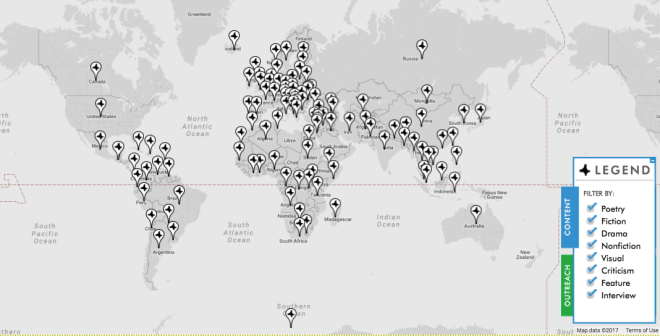
Delighted to share with you a translation just now out in the journal Asymptote. I love this journal, its global intention attention & compass. Check out this map of their scope & multiplicity.

Screen Shot 2017-04-18 at 7.07.20 PM
Click for a live version

My little poem is a pre-modern throwback in an issue otherwise on translation’s front edge. (Okay, there’s some Tzara, too, but he’s still.) Grateful they thought to find room for it. Thematically it does I guess fit an issue called “People from the In-between.” It’s got people at a loss, unbridgeable textual gaps, & runes – runes how to make meaning from which is all dispute.

Well see what you think it’s here. Poem I’ve called His Message and usually goes by The Husband’s Message. With floating footnotes, & the Old English, & me reading said Old English badly, should you wish to go there.

Whole issue’s rad. Especially worth your time and heart, the special feature on “literature from banned countries,” i.e. those 7 or 6 singled out by the present US administration’s unconscionable incoherent & never mind that they’re unconstitutional travel bans. I’m having trouble finding the section as a cluster, but go to the headline piece, then you can just wander over borders, as surely mostly we should be.

Wander or sojourn or flee as our luck has it. I avoid the word “privilege” as calcified but I am luck-filled. Many on the map above are not. Many pressed against borders are getting fucked by the stick of the world. May you come to places of rest. You should have, & it’s in the UN Declaration of Human Rights, Trumpwad, so you’re a signatory, you should have a place to live that’s safe for you to love & work & love more & live & die meaningful lives and deaths.

Reading this article in The New Yorker has shocked the living shit out of me.

These women girls & men are moving up Africa along the old slave-trading routes. What they endure on the journey & when they arrive, if they do arrive, seems, to this far away safely sheltered reader, no less than what the slaves did in olden days, when they were fuelling the economic growth of the Americas.

More to say here. Such as, bringing it to my nonfiction workshop’s notice, putting it beside Ta-Nehisi Coates’s Between the World and Me, his effort to broaden a indictment of systemic American racism into a critique of global inequality, including climate change. That’s for another post. God & damn it’s all connected. Where to snip the thread? Thank you friend. May I call you friend? If you’ve read this far.

Found poem (w/ rune painting)

A near perfect haiku came from my love by text earlier this eve.

Im making my moms
moms cake for dessert , it
is called “my cake”

I get pissy about 5-7-5 for haiku in English. Wordy. Haiku’s genre for us not form, moment of unanticipated in-seeing. Count your blesses! not your sylls!

Also the search has been on since at least Kerouac for authentic American haiku. Now and then one’s found, and this looks to me like one.

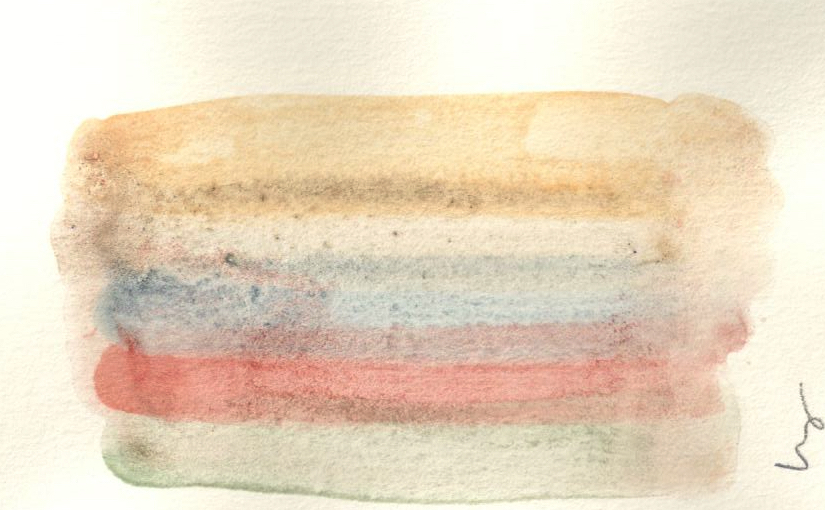
Serendipitous also, her rune tanka, 5-7-5-7-7, pigments made of ochres from the whole planet. No fool I haven’t counted the sylls. It’s a five-realm rainbow.

Heidi - runes 2

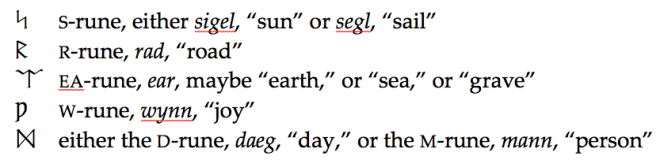
H. painted it in quick accord with these runes in the OE poem “His Message.” The which no one knows how for sure to read

Screen Shot 2017-03-29 at 9.25.16 PM

Have a trans. of it coming out soon in Asymptote, will post a link of it when up.

Aasemic writing

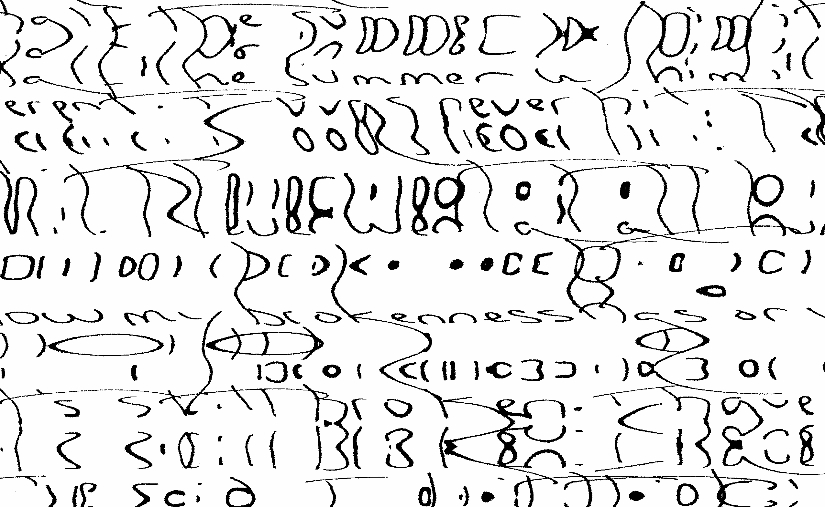
Asemic writing is writing you can’t read. Semic writing is writing you can. (A back formation, there’s no such word.) I am at play, finessing the difference, with aasemic writing.

A joy of asemic writing is that it draws all the promise of meaning-making, all the whole multifoliate interpretive apparatus, into activity, w/o resolution or conclusion. It’s Steinian indeterminacy, in not the syntax but the graphemes. It’s the made mark as blastocyst, as stem cell, as potential to become. Is it a Deleuzian plateau? Maybe, still sweating that concept out.

So the aasemic script I’ve been playing with is neither indeterminate nor determinate. (GOD you can take this non-dualist thing too far, mm? how’s this not just centrist squish?) It starts with a journal page transcribed in a projective hand – descender a plunge, cross-stroke a jailbreak. Then I wave or shiver it over the photocopier light bar as it slides under, gathering data in.

All this is lead in to say, The New Post-Literate has posted a few, and that makes me happy, cuz they’re the first bits of Overject to be published, other than here, which don’t count. Here’s the link.

And here are a few other recent offerings there I think especially cool.

The home page of The New Post-Literate where it’s all to be found.


A lot of my trouble w/ academic parlance comes from trying to translate Buddhist vocabulary and values to a non-Buddhist circumstance. Most of the rest of it comes from being a lazy and a lousy Buddhist. (The latter’s 90%.)


Feste to Viola, Twelfth Night, “I am [a] corrupter of words.” After they’ve just rung their changes on live, stand, lie. I compared the move on lie to a triple-axle – Viola to Feste, “yo watch this move” – and one of my students found a sextuple axle in it, bam. Post-structuralism, its insights, e.g., words’re banana peels, dates back at least to Shakespeare, if not to Jesus? “On this rock I build my church,” that’s a pun, Jesus is making a funny, I told them, explaining the finger joints of a dactyl, by way pterodactyl. Petros (Peter), petra (rock). Long live the rhizome. Weed shoot that cracks the rock.

Hwæt (the movie)

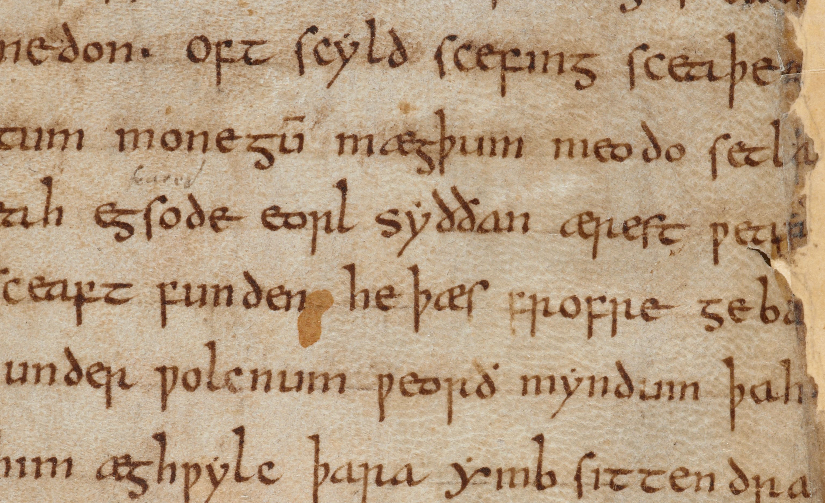
Last week I had the pleasure of reading in the epic recital of Beowulf at Bellingham’s local meadery, Honey Moon, þæt wæs good fun. The opening lines wouldn’t quit me after so I kept messing with them. Here’s the result.

https://youtu.be/zBGbtU8QK14

My first movie. Crude stuff, okay, but what I’m keen on? Putting images I’ve made by hand in motion and putting sound and voice to them. Doubt I’m done exploring that.

Check out, while I’m channeling the pre-mod, Benjamin Bagby’s astonishing recreation of these same lines. My Old English is too crappy for me to know for sure, but I think he’s probably the Olivier, the Brannagh, of the scop set.

https://youtu.be/PzmmPRG4smU

On a question of genre

A hard spell. More than a bit PTSDy after my surgery – anxiety waves, wanting to cry lots, panic in the grocery store. Halloween freaked me the fuck out, roving packs in darkened streets and shouts and bangs at all sides.

The trauma’s been here many years, but hasn’t surfaced like this in a while … all the work I’ve done, it’s done some good. But maybe no surprise a minor surgery (hernia repair) brought it back? A knife’s an insult the body knows of, unconsciousness or no, and frozen there, can do nothing about. And this knife in especial was working not very far, in Mitchell’s translation of Rilke’s of Apollo’s of original fire, from that dark centre where procreation flared.

A line from ago I never used and suddenly remember: “Shouts in the street were pieces of me in the mouths of dogs.”

Rousseau had it, I’m sure of it.

[A] word to speak, the least trifle to perform, appear an intolerable labor; everything alarms and terrifies me; the very buzzing of a fly makes me tremble. (Confessions)


This morning I went to the Farmers’ Market and saw Rich and Kendall, also Sean, a former student, and chatting was nice, good. I was looking for herbs to plant in my newly landscaped (or still landscaping) front yard but found instead some apple cider and a chocolate croissant. This afternoon I went to the grocery store and got a flu shot and an anxiety pulse. Tomorrow I’ll drive out to Cloud Mountain Farm and look again for herbs, also fruit trees, apple, plum, frost peach.


My workouts have become meditation by other means – access to inward, when I’m otherwise too distracted or resistant to tune in. So it’s good to be back on the treadmill. Not running, yet, but walking hard up a steep pitch, hard enough for a heartmind opening.

Today it was this. (And tears came in a jag. Which no one can see, nor will anyone, even, if a sob comes loose. Workout a perfected disguise.) There’s a core wound. You can hold it as what’s given to you to hold. Or you can keep living out of it and creating craziness.


This post is actually about a question of genre. Because I can write about this stuff, directly, apparently, in a blog post. And it’s not impermissible either in nonfiction, in memoir. A bit edgy, maybe, but hardly forbidden. But in poetry … no, you can’t do that in poetry, put it in an image, please.

Don’t want it in an image. Want the banal exposed awkward inarticulacy with which it came to me. Because that’s my subject. So fuck peach blossoms and fuck the objective correlative. Here’s what I wrote in my journal when I got home –

journal scrap 3

– and here’s the notecard I did, yes, transpose it to:

notecard
The notecards, yes, are simulacra.

I look about in vain for precedents. Loads of treacly banal sentiment dumps in verse, sure. But I mean legit artistic practices drawing straight from how you speak to yourself about your own feelings and what you do with them and they with you. George Oppen makes concrete poetic objects out of carefully configured abstract surfaces set at colluding angles –

The sad marvels;

Of this was told
A tale of our wickedness.
It is not our wickedness.

– but his concerns are moral and ontological not psychological (“The self is no mystery …”). In many of Frank Bidart’s poems the speaker wrestles semi-articulately with a tormented inner life –

An adult’s forgiveness of his parents
born out of increasing age and empathy

which really forgives nothing,—
but is loathing, rage, revenge,

yet forgiveness as well—;

– but the poem gets its charge from the distance cut open by a persona.

Is what I want, direct speech of and from an emotional life without resort to irony or persona, just inadmissible in poetry? Why permissible in memoir, but not in poetry, when in so many other respects, they’re known to overlap? And where lives the voice, anyway, that says impermissible?


I wonder how I’ll feel about my little notecard when a few days have passed.

I can say this. It belongs, in intent, to Overject as a whole, which means to translate every feature it can of its source text, a minor didactic Old English poem, into the current moment. For that poem is, I have come to feel sure, a trauma document, full to brim with opacities, deferrals, fractures, hapless power moves, inadvertent tender disclosures.

This too I’ll say, writing it has mattered, as writing about it has mattered.

Before you decide my little notecard belongs in the dustbin of banalities, read it for the thoughts and feelings between its phrases and clauses. Those are the ones I took the most care to articulate.