“Constructions of Whiteness”

Next week I’m moderating a reading and discussion called “Constructions of Whiteness” with the brilliant and talented poets Stephanie Bolster and Barbara Nickel at the Canadian Writers Summit in Toronto. What little I mean to say by way of introduction, follows.


Hello, and welcome to our reading and discussion, “Constructions of Whiteness.” Before we say more we should say that we are meeting on traditional indigenous territory of the Mississaugas of the New Credit. Land also with a deep history of use and care by the Haudenosaunee and the Huron-Wendat nations. We are grateful to be able to gather here.

I’m not going to say much by way of introduction. Just that we have taken as our starting point, as invitation and provocation, a passage from Ta-Nehisi Coates’s Between the World and Me.

[R]ace is the child of racism, not the father…. Difference in hue and hair is old. But the belief in the preeminence of hue and hair, the notion that these factors can correctly organize a society and that they signify deeper attributes, which are indelible—this is the new idea at the heart of these new people who have been brought up hopelessly, tragically, deceitfully, to believe that they are white.

These new people are, like us, a modern invention. But unlike us, their new name has no real meaning divorced from the machinery of criminal power. The new people were something else before they were white—Catholic, Corsican, Welsh, Mennonite, Jewish—and if all our national hopes have any fulfillment, then they will have to be something else again.

But for now, it must be said that the process of washing the disparate tribes white, the elevation of the belief in being white, was not achieved through wine tastings and ice cream socials, but rather through the pillaging of life, liberty, labor, and land; through the flaying of backs; the chaining of limbs; the strangling of dissidents; the destruction of families; the rape of mothers; the sale of children; and various other acts meant, first and foremost, to deny you and me the right to secure and govern our own bodies.

—Ta-Nehisi Coates, Between the World and Me (2015)

He’s talking about his son’s body and his own there, and the African-American body more generally, and the American body politic, including American whiteness, and we’re here in Canada, and our national experience is different. But maybe not altogether different. We each, the three of us, Stephanie Bolster, Barbara Nickel, and myself, Christopher Patton, want to share with you projects that examine the invention of whiteness, its construction, and some of its attendant destructions, examine them in ways we hope are morally alert, if fallible.

I’ll read first, followed by Barb, then Steph, with some time for discussion after. Each reader will introduce the next one, though since I’m going first, I’ll introduce myself, even if it feels a bit weird.


Curious to hear more? If you’re attending the CWS, join us in Toronto!

Saturday, June 16
2:00–3:15
Loft 1, Harbourfront Centre
Repeal the Second Amendment

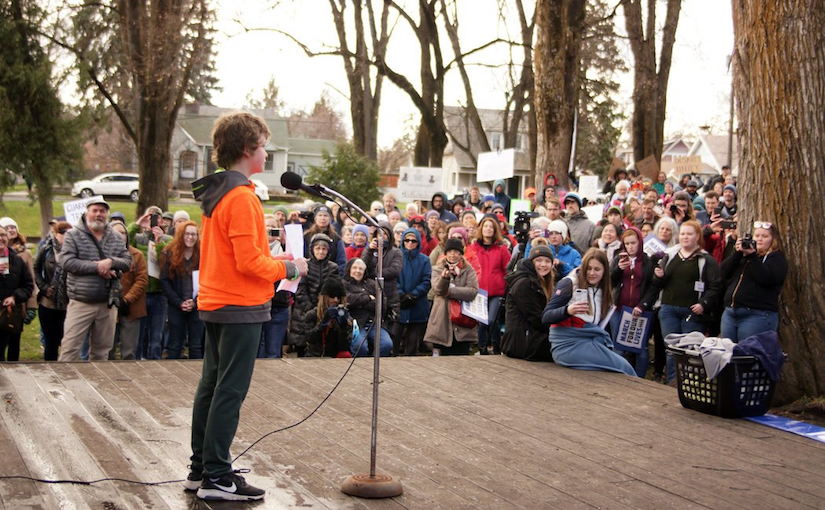
I am a kombucha-swilling poet smoking his weed as he listens to Fleetwood Mac on Spotify. So you might not take me serious on this point. You might not take the kids serious though you sure as shit should. Maybe you will take a retired Supreme Court Justice serious though when he says

REPEAL THE SECOND AMENDMENT

Questions? Refer them to the dead.

And yeah, so it’s undoable. Start now, wait till doable catches up, if it takes 50 years, 100, all the more reason to have gotten started today.

Take the guns

So the answer to a bad guy with a gun is a good guy with a gun, they say.

The more bad guys with guns, the more we need good guys with guns, and the more guns we need. Sounds like a child-slaughtering racket to me.

Just take the guns away already. All of them. The cost would be small. What we save would be so much. And “common sense” would cease to be the obscenity it’s become in the mealy mouths of politicians when they speak of gun control.

Till then. Have the gunsmiths and bulletmakers apologize in person, on their knees, to the mothers and fathers of every child their handiwork kills. I’m as starry-headed an optimist as I am appalled to contemplate this latest, has it become routine yet, schoolyard mass murder, and have to think the weaponmakers would not, if they knew with their own eyes and ears what what they made had done, would still make the things that they do make.

Constructions of Whiteness

A panel proposal put together by the best triangle I’ve ever been a corner to. (Side note, do you know how hard it is to persuade a room of undergrads that a three-legged stool can’t wobble? I do know now. I mean, you get it, or you don’t, how to explain it?) For next summer’s CCWWP convention (that mouthful’s the Canadian Creative Writers and Writing Programs) in Toronto. Has a thematic focus whose statement starts like this

As we live this moment of intensifying racial and gendered violence, discourses and policies of intolerance, and environmental crises, we are also bearing witness to and participating in a broad surge of resistance, resilience and reclamation as evident in movements like Idle No More and Black Lives Matter. Literature has always had a role in responding, intervening and shaping the historical and cultural present. We believe literature is a way to interrogate anew what it means to be human and living in shared humanity on this land and in this time. Literature creates opportunity for the difficult conversations between us that might address our historical present, how we are haunted and how we can proceed.

and can be read whole here. We wanted to speak to the theme without presuming to speak from anywhere other than where we were. And so this.


In Between the World and Me, Ta-Nehisi Coates calls out the people “who have been brought up hopelessly, tragically, deceitfully, to believe that they are white.” He suggests that race is a shared fiction, one that served and serves the powers that wrote it, slavers, imperialists, eugenicists, white supremacists. Our ongoing shared belief in the fiction makes it real and lethal to Black kids on American city streets, Indigenous women of Canadian cities and prairies, countless others. This panel consists of three poets who, being white, can’t help but take part in the construction of whiteness. They’ll read from works-in-progress that ask whether whiteness might also be witness – how construction might also be re- or de-construction – and then open the room to questions and discussion.

Last summer, as Christopher Patton wrote the critical introduction to his book of translations from Old English, white nationalists were marching in Charlottesville, VA, and the air in Bellingham, WA, where he lives, was white with cross-border forest-fire smoke. His thinking sharpened some about ties between those thousand-year-old poems and white supremacy and climate change. Race wasn’t a thing when the poems were composed – tribe and ethnicity, yes, foreignness yes, but not race as we live in it now. And yet what were their warrior ethos and fear of the other, their love of gold and roiling suppressed anxieties, but raw material for the later construction of whiteness? Add profit motive and oceangoing ships and stir. Can a translator put such values back out in the world without validating them? What help is it, that other values run countercurrent in the poems, self-inquiry, dialogue, empathy for the outsider?

In the weeks and months after Hurricane Katrina, Robert Polidori entered hundreds of ruined homes alone, with his camera. Stephanie Bolster resisted writing about these haunting, voyeuristic images for years, before accepting that the only way out was through; her project, Long Exposure, began in the interrogative mode, with her own voyeurism-once-removed. Evolving politics intensified the questioning and made her see her witnessing as white. In the New Orleans thread of her manuscript, she writes from empathy with the (mostly poor, mostly Black) former residents of these homes, but her recognition of her own subject position means she knows others may see that empathy as trespassing – or, worse, slumming. Can good art arise from, even overcome, guilt? How to strive for aesthetic authenticity amidst this complexity? How to write while wondering what one has the right to see, to say, to feel? Yet how much worse to be silent.

Barbara Nickel witnesses daily the loss of a body of water; she lives on lake-bottom land. The former Sumas Lake in the Upper Fraser Valley of British Columbia was drained in the 1920’s to create farmland. Named “reclamation,” the drainage was an act of irrevocable violence against the land and the Stó:lo people whose lives had depended on the lake. When Barbara discovered that Mennonite settlers from the prairies were some of the first to farm the newly drained land, the tension of her own witness was increased to include the complicity of her own people. Her response is made from vestiges – poems found in historical and contemporary voices, texts and other more visible remains – sandpiper in a museum drawer. As she writes over/in/of the lake’s ghost, she questions her right to do so, asks which roles are authentically hers – inquirer, trespasser, artist, friend?


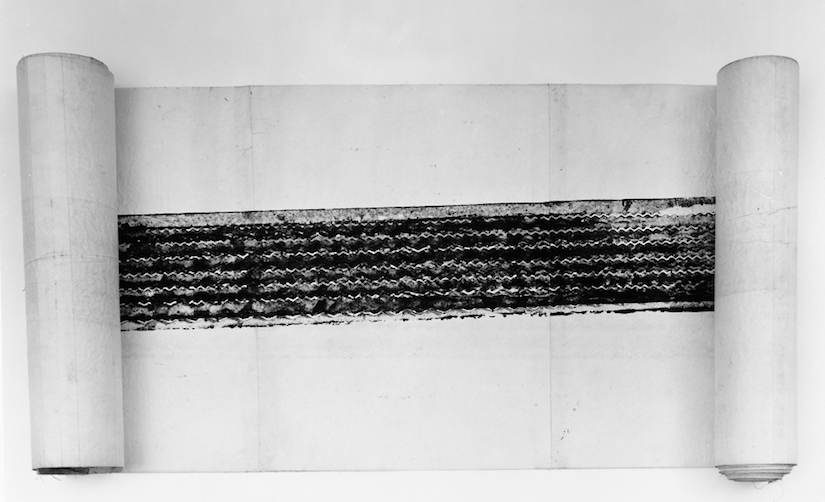
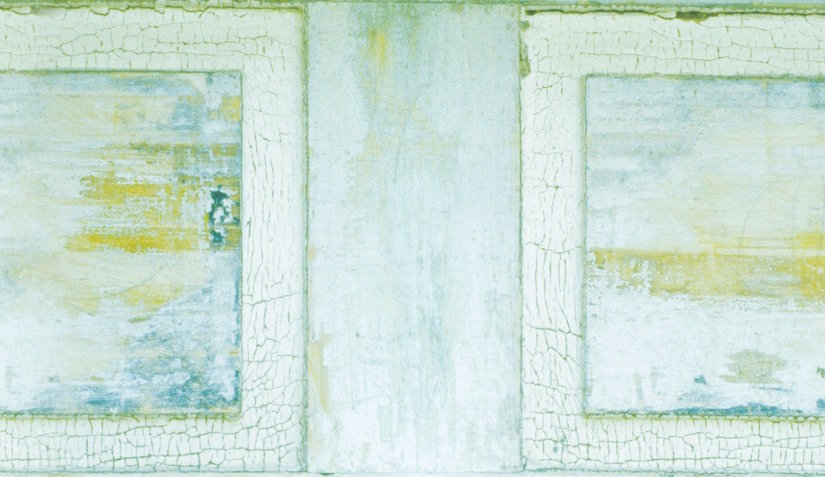
I was browsing Robert Rauschenberg’s white paintings, hoping for something with enough texture visible to work in that upper heaven, top of the post, and came to this. Am caught by how all context is. Context of Black Lives Matter, the image is wake-up appalling. Context of Black Mountain, it’s American mid-century innocence enterprising. Phaidon‘s text on its generation, the painter collaborating with John Cage composer:

Rauschenberg said that Cage was the only driver in Manhattan willing to collaborate on such an unusual scheme. Perhaps this is a suitably flip comment to accompany so brisk a work. When asked if the work is a little like a musical stave, the artist demurred, preferring to compare it to a Tibetan prayer scroll. Yet, Cage drove over Rauschenberg’s scroll in the very same Model A Ford that he had carried him to Black Mountain College in a few years earlier; and doesn’t this single track bring to mind a little something of Cage’s featureless score for 4’33” – the silent work that’s never quite rid of the world’s noise?

A few closeups from it:

Road music. Rowed music. Rode music.

That innocence, it’s not gone, it ne’er was.

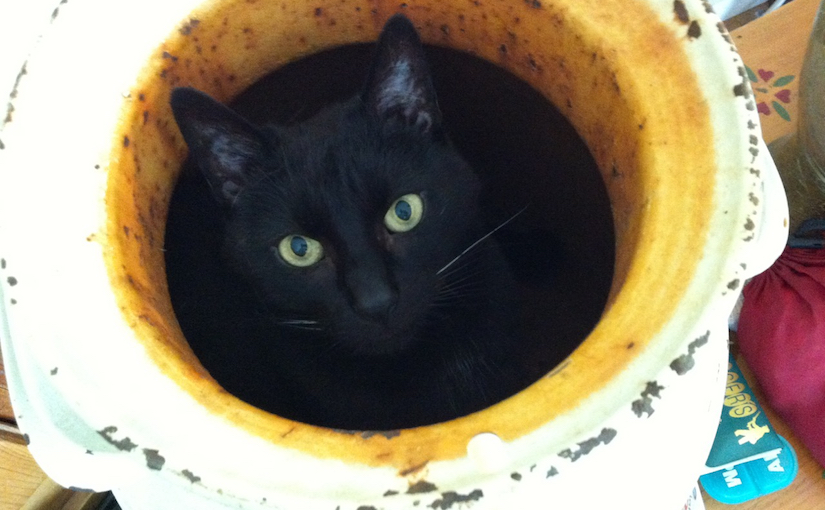
Stray thought on a cat

Sitting last night with my cat, who is dying of cancer, in my lap. Wondered, Am I doing this right? A voice came to say, There is no doing this right. Was such a relief.

Does that make sense? Do other people have the same overseer in them I do?

Am I being present in the right way? am I letting these last moments with her in fully? am I not clinging to her? All this stuff, just below the threshold of awareness, about living up to some ideal I’ve got, where it came from who knows. Saw it for the load of crap it was.

Wasabi, my dying scrappy streetfighter, is a good teacher. She’s not worried about dying right, she’s just dying. Slowing down, drawing inward.

There’s no doing it right, there’s just doing it.

Found her outside a sushi restaurant in a blizzard the day after Christmas, year of 2000 in Philadelphia. She’s been with me to Salt Spring Island, Salt Lake City, Bellingham WA. A whole lot of mice met their maker in her. She’s been companion comfort irritant playmate and source of many forearm scratches. When I have to let her go I’m going to bawl like a little baby.

Say a prayer – whatever that means to you – that her last weeks are easy for her?


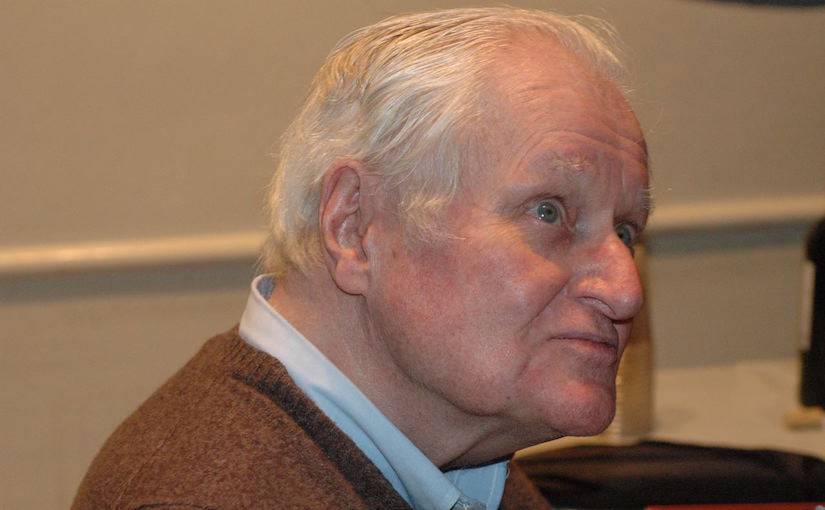
John Ashbery, 1927–2017

A great one gone from us today. Ashbery dead at 90.

His extraordinary proposition: that a poem is a poem.

So many years before I got that. When I did I saw in hindsight he had helped me to. (Haven’t yet managed to write one, but now I know what one looks like.)

No time for the post I want to write. So just this sweet bit from the NYT obit

Asked once about a poet’s proper relationship with his audience, Mr. Ashbery rejected the idea of deliberately “shocking” the reader, a tactic he compared to wearing deliberately outlandish clothing and which he dismissed as “merely aggressive.”

“At the same time,” he said, “I try to dress in a way that is just slightly off, so the spectator, if he notices, will feel slightly bemused but not excluded, remembering his own imperfect mode of dress.”

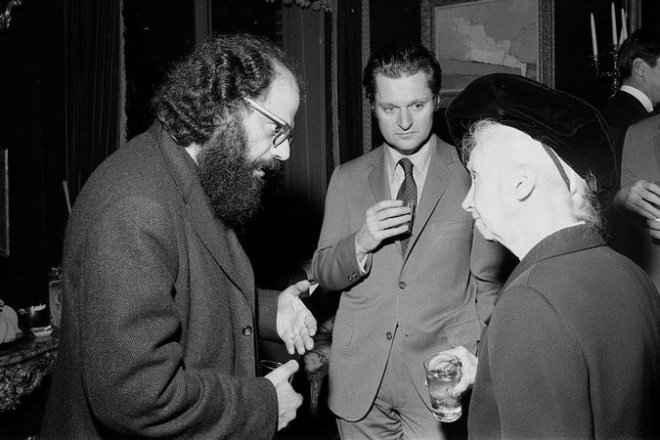
And this photo from same. Imagine the conversation they’d have had! or not!

04ashberyobit-party-master675
Allen Ginsberg, John Ashbery, Marianne Moore. At a party in 1967. Photo by Jill Krementz.

Take care of each other. We don’t get a lot of time.

Intermission, gardenal

Took the day half off from Unlikeness. Slept in a bit, read a bit. Wrote a bit too. Then attended to a garden prolific in my negligence of it. Today’s harvest

august produce

And this evening’s meal (11:03 and it’s still simmering the liquid down)

tom and zucch

Got some Italian sausage to pop in there before I’m done. This post has unofficially been not about politics nor about writing neither. Good night.

P.S. But here’s a image to feed the spirit

counter-protest

You know what it is right? what we need & hope for, goodness overwhelming.

Augustine, whiteness, alienation

From an early draft of my intro to the OE translation book. On the trope of exile and how it enacts Augustine’s “region of unlikeness.” But madness in Charlottesville and moral turpitude in Washington took it over. Wanted and still want to think through how the poems, composed by white men before “whiteness” was a thing, still inform this thing we know now as “whiteness.” The poems hold some of the raw materials – patriarchal culture of violence and valour and stoicism; will to dominance; constraint of women and suppression of what’s thought feminine; default stance of fear and suspicion towards the unknown; I could go on. Add ships and maps and a thirst for wealth and stir.

Also in them I find – mindfulness and curiosity, a tolerance for ambiguity, values of restraint and moderation, a love of beauty, playfulness, the thought that much in the sense world could be animate, with its own ways of thinking-and-feeling-through.

Caught between wanting to diagnose a sickness, and celebrate an innocence.

From Unlikeness Is Us: Vagrant Inquiry

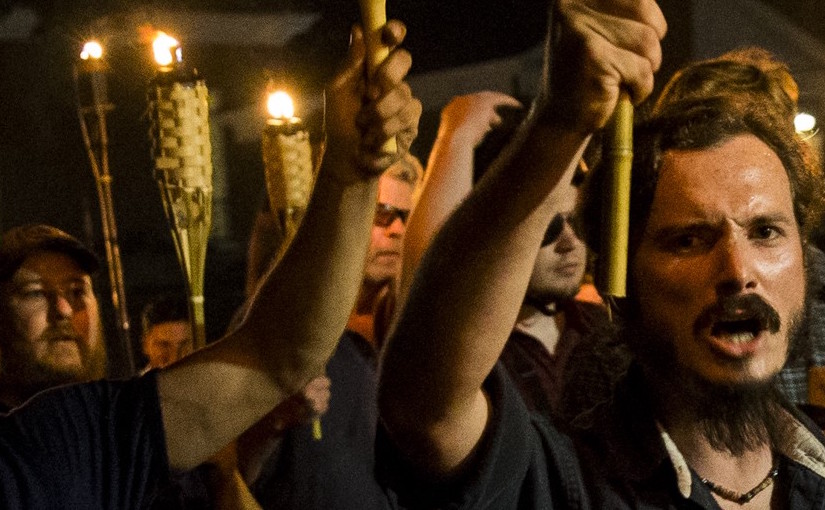
Unlikeness not aware of itself is alienation. On the other edge of the country I call mine for now a node of alienated whiteness drove through a crowd yesterday and killed someone. His idiot crew had flags on pointy sticks and torches, pointy sticks.[1] These poems may be ancestors to those supremacist pricks. They’re not on the hook for them, I insist that, but they may provide clues to them. The loneliness in the Anglo heart, the character Western restlessness later takes in it, bold and practical, industrious, venal, unscrupulous, when the age of exploration and colonization starts, and how that goes for the others met – there are clues to that in these poems. Maybe also seeds of the grotesque absurdities of Anglo-Nordic pride as it beetles from the fringes of American life pretty much as I type into the White House bedroom. But that’s later. The poems are wakeful. They take Augustine to heart, they believe in his unlikeness. They take unlikeness in, estrangement from the astonishing felt tissue of the present, their own blooming singing bodies and the shining rampant sense world about. That may be tragic error. It might be the tragic subject all these poems have in common. But they hold a wakeful engagement with their condition as it’s given them. They don’t shut down. They stay brave, eyes open, looking out, looking in. They’re at the root of one of the world’s great traditions of interiority.


[1]. “When questioned about the rationale for Trump’s evenhandedness, the White House clarified that both the protesters and the counter-protesters had resorted to violence. This is notable in that the United States was once a country that did not see Nazis and those willing to fight them as morally equivalent. Aside from that, however, there were no images of anti-fascist protesters mowing down reactionaries with their cars.” – Jelani Cobb in The New Yorker.


P.S.? I hate hate hate having that photo there. Like the smell of fresh shit in a kitchen drawer. To lessen it I’ll note that the douchebags are using for their grand display tiki torches of the sort used to repel mosquitos at family BBQs. Ride, warrior, ride. (Noted by Vinson Cunningham, also in The New Yorker.)

P.P.S.? Not that there’s anything wrong with mosquitos, shit, or a douche, in their places.

Writing Exercise: Erasure, Interference, Noise, Distraction

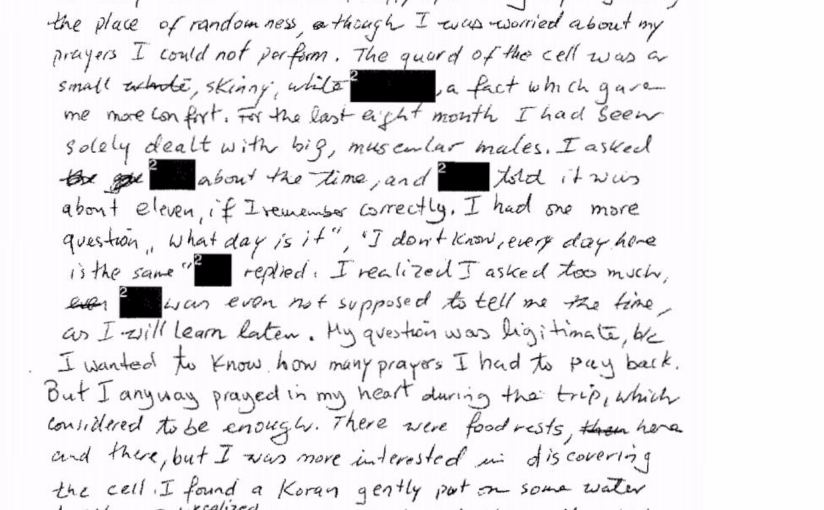
Last exercise for my advanced creative non-fiction workshop. We’ve been reading Mohamedou Ould Slahi’s Guantánamo Diary – riddled with redaction marks a government that couldn’t find him guilty of a damn thing, yet could not for 14 years see him to be innocent, saw fit to strike his voice through w/.

An ex on the eloquence of silence; on wrenching eloquence out of silencing.


First, to remind you of the assignment for your fourth and final essay, it’s

a text that incorporates erasure, interference, noise, or distraction. You can put a text of your own (it must be written for this course) under erasure like this or like this: ████. You can take another’s text and put it under erasure to elicit new meanings from it. You can do an audio essay and overlay a second track that makes your voice difficult or impossible to hear at key junctures. You can compose a hypertext that instead of offering a linear reading becomes a garden of forking paths. The possibilities are myriad. Crucial though is that your essay draw erasure, distortion, noise, or distraction into its formal body. In this way it becomes a study of how we make meaning at all.

For this exercise, make a first experiment towards that essay. No more than one page – if it’s on paper at all. I can’t imagine all the possibilities for you here. I can only say, I’m looking for language, written or spoken, that gets interfered with somehow, visually or aurally, in a way that sheds light on how we go about making meaning. (The redaction marks in Slahi’s book, included the way they are, do that, yes? How does Slahi insist on what he means, his humanity, when he’s shut up – imprisoned, silenced? He cracks jokes. He answers absurdity with absurdity. He writes, and gets his writing out there, replete with the redaction bars that speak his silencing.)

Learn too from examples posted – Johnson, Phillips, Bervin, Foer, Strickland, Wave Books. Ask yourself too, what’s missing from these examples that I wish were here? What could you add to this assemblage of interferences?

You could go entirely paperly, erase and/or illuminate a text, your own or another’s. If you erase someone else’s text, be sure to credit the source, and sure your work upon it’s transformative. You need not confine yourself to negation; consider illumination, á là Phillips; hands-on cutting or tearing, á là Foer; other ways of turning gap and omission into a sort of presence.

You need not pin yourself to paper either. I’m open to audio essays, hypertext essays, multimedia enterprises. Interference, noise, distraction can take the form – as we said today – of static, crowd noise, a robotic voice intoning “redacted,” many many things. (The MTA’s “mind the gap” comes to mind.) Our roundtables next week will be a chance to think through options.

I’d like to take these in Thursday, but if you are working off the page, and would like till next Tuesday to make that happen, I can give you till then.


I’m curious what they’ll come up with. It’s been a curious class, invented one week, enacted the next. Improvisatory. Creating a world one step ahead of what you see. I don’t mean I am, we are.

An answer to a killing

Writ by my dear friend Barbara Nickel:

Sometimes I have loved the peacefulness of an ordinary Sunday. It is like standing in a newly planted garden after a warm rain. You can feel the silent and invisible life. All it needs from you is that you take care not to trample it.  

That’s John Ames, Congregationalist minister, narrator of Marilynne Robinson’s novel Gilead.

I love John Ames as I’ve never loved a fictional character; I sat at his feet and listened to his gentle voice. Not one to push himself to the front of a crowd and trumpet his views, John Ames; approaching death, he wants his sermons burned. (“The deacons could arrange it. There are enough to make a good fire. I’m thinking here of hot dogs and marshmallows, something to celebrate the first snow.”) I wish his voice haunting the ear of the gunman in Quebec before he fired at the praying men. You take care not to trample. The silent and invisible life of prayer, care not to trample, the three-year-old with his father at prayer.

Care is not to trample. Her whole post here.