Metamorphosis (bbeepp)

Long teaching day, could go on, won’t. Here’s a description of an upcoming course, hope it makes you laugh.


ENG 334: Texts of North America and Europe: Metamorphosis

Change happens. Now, there’s a vulgar way to say that, begins in S and ends in T and says “hello” in the middle. And that about sums it up. Change happens, and we don’t always like it, and so we call it after a process that humiliates us, even as change meets us anyway with an ahem-eating grin.

All that’s to say, Euro-American culture has felt sort of averse, much of the time, to the facts of metamorphosis, and has proposed various stays against it. Platonic Forms. An Eternal Immutable Deity. Your Immortal Soul. Important Things In Capital Letters. But an equally complex literary tradition, the indigenous American one that predates the Euro-American on this soil and now lives uneasily intertwined with it, offers responses to transience, loss, mortality, that at least feel different, and may mean differently, too.

Instead of the hero Aeneas, the trickster Raven. Instead of immortal gods, spirit beings learning to spit mussels from a longhouse roof. Instead of a Heaven incalculably distant, a mythworld alive in your own speech, your own dreaming.

Ah but these binaries are too easy. The West, too, has always been embracing change, the mercurial, even in the middle of texts honouring a changeless God or King or State or whatever. We’re going to read us some of those. Meanwhile the texts of indigenous America express a wish (elegiac) that some changes not ever have happened, and an intention (political) that changes to come go one way not another. And we’re going to read us some of those, too.

Texts of Europe: Cave paintings of Lascaux, Chauvet. Fragments of Herakleitos, Parmenides, Empedokles. Plato’s cave parable. Ovid, from Metamorphoses. Dante, from Inferno. The Bible, Revelation. Shakespeare, The Tempest. bpNichol, from The Martyrology.

Texts of North America: Newspaper Rock. Ghandl, Nine Visits to the Mythworld. Rothenberg, from Technicians of the Sacred. okpik, Corpse Whale. Drunken Boat 15, “Native American Women Poets.” Abel, The Place of Scraps.

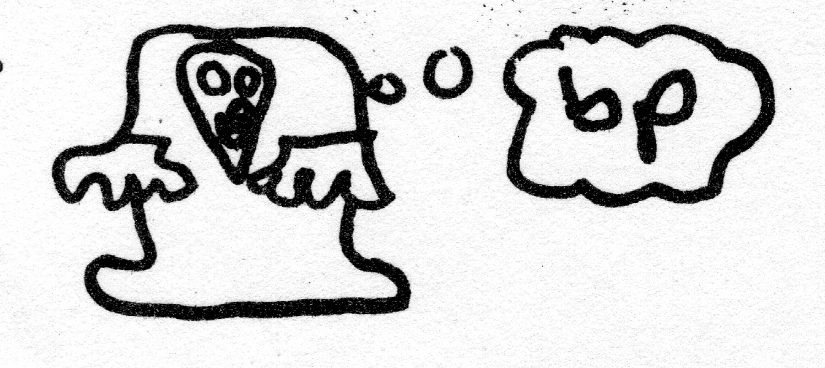
bpNichol liked to alter words like this. Storm becomes St. Orm. Strap, St. Rap. Stranglehold, St. Ranglehold. What happens to permanence, and hell to sainthood, when a period can change meaning underfoot, like that?
 

Syrians to Canada (II)

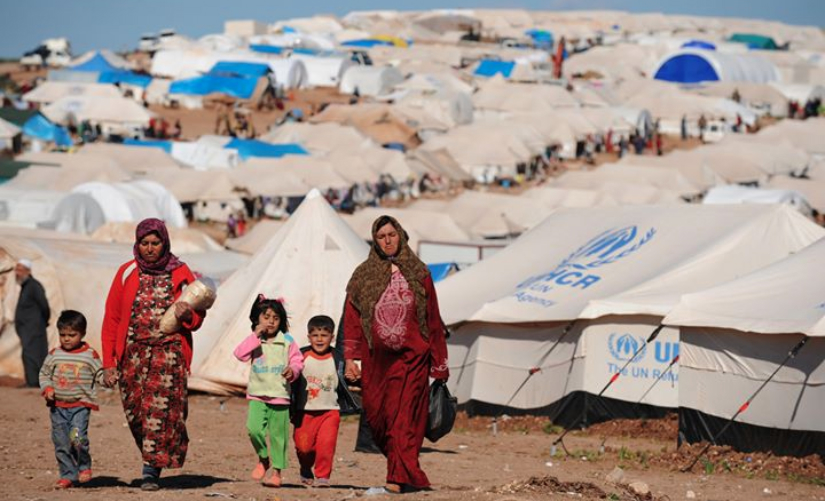
Some friends on Salt Spring Island are raising money so they can invite two, maybe three Syrian families to come live there with them there. Maybe they will make new lives, new starts, there. Maybe they will go from faces in the news to friends you run into in the grocery store. How nice is that?

It strikes me as the most, a sliver of the only, important thing.

If you want to send them a few bucks you can here.

It’s hard to feel loss even when it’s right in your face. My dad, he’s in decline, I don’t want to see it. Three hours after we’d had lunch together he was asking if I’d had lunch with them. He’s going. Next time I see him he’ll be a little more gone. Don’t want to see or feel any of it. And yet I don’t want not to more.

And when it’s not your family, and not your people, and not your problem …

And yet it is, and it is, and it is – and you know it, yo?

Nina Simone Breaks Fourth Wall, Makes Blogger Cry

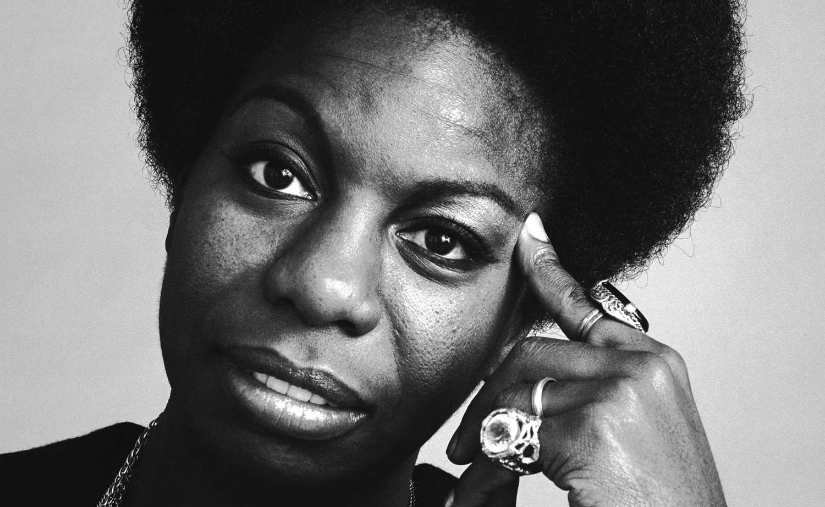
Still don’t have a damn idea how to write about race, freedom, trauma. But this came along last evening and got all the way in. I had a hell of a time cracking protects to get it to you, file formats are pretty hard to navigate too, but I claim fair use. And well goddamn but hear the smarts in her voice. I mean here.

My father always promised me
That we would live in France,
(You know you don’t believe that)
We’d go boating on the Seine
And I would learn to dance.

We lived in Ohio then
And he worked in the mines—

I don’t want to sing this song. It’s not for me. My father always promised me that we would be free, but he did not promise me that we would live in France. (Most beautiful laughter.) (Words I can’t make out.)

—How ’bout Brooklyn?

No, my father knew nothing about New York. At all. He promised me that we would live in—peace. And that maybe I can still get. Okay. We have to skip that one.

Really though, hear her. The transcript’s nothing. Don’t know how to put words to my sense of the fullness of life I hear in her voice as it bodies forth.

https://youtu.be/86JvVZeVMAs


Addendum a day later. She’s a dharma teacher. That is the liveness I perk to in her words from the wholeness I hear in her person. I don’t mean to diminish the particularity of the fight she was part of – a civil rights struggle I empathize and identify with but cannot have felt as an existential claim on my being as she did. And yet, the clarity of her no, this is not for me, a gift to me in my witless powerlessness.

Syrians to Canada

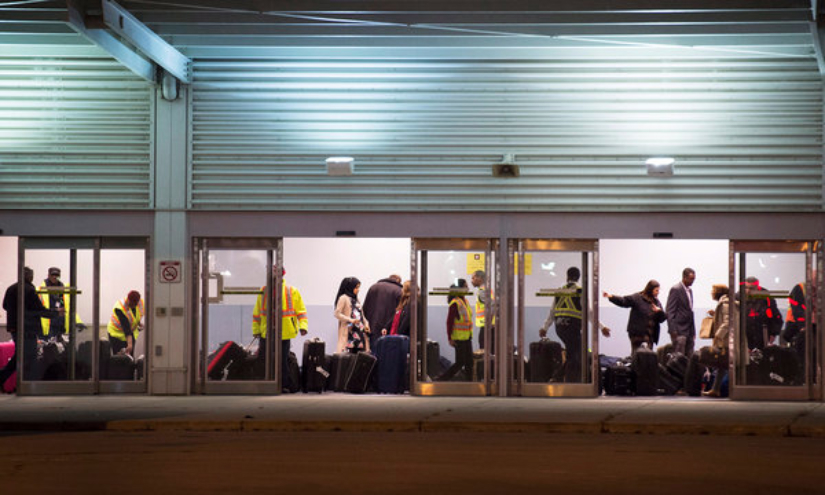
I’m proud of my country today. The first 163 of 25,000 expected Syrian refugees arrived last night – Lebanon to Toronto, by air.

Have I ever said that before, “I’m proud of my country today,” of either of those that half-claim me? Maybe not. But today, yes. From the NYT:

The arrival of the first flight was highly anticipated in Canada. To avoid a crush that might overwhelm the exhausted refugees, the government asked the public not to go the airport to see the flight arrive. Those who ignored the request were not able to get close to the refugees in any case: the military plane taxied to a terminal building deep in the airport grounds with no public access; it is normally used only for visiting foreign dignitaries.

The building has been converted into a special processing center, where arriving refugees will not only go through the usual customs, immigration and health screenings, but will also be given all of the other paperwork necessary for their new lives, including public health insurance cards. They will also be given winter clothing, and children will receive toys.

Visiting foreign dignitaries. Damn straight. And what do you give visiting foreign dignitaries? Toys. Someone’s getting it right for once somehow.

The whole article here (you may hit a paywall).

Honestly? I’m so heartachy, after Charleston, Roseburg, Paris, San Bernardino, hardly an exhaustive list, and too a racist convulsion here at Western I haven’t found the clarity yet to write about, and too all I learn from reading or listening about my students’ struggles with assault, trauma, depression, poverty, addiction, violence, and dysfunction – when I read “children will receive toys” it takes something not to start crying.

I look forward to whitened old age when I can weep quietly at the slightest provocation and no one will take it amiss. Oh, that’s just how Grandpa is, he weeps when you swat a fly …

On trauma, karma, genre

I’ve felt ashamed, in the face of Paris, Homs, Beirut, drowning seas off Turkey and Lesbos, murdered and maimed Frenchwomen and men, Syrian migrants around whom walls of the mind have now reached further skyward, to have been vexed by my little troubles – though for whatever reason, surgery, readiness, the fall’s brought them forward for my study.

But harm is harm. Sometimes we confuse the perspectives of justice and mindfulness. From the perspective of justice (redress) one harm does weigh against another, more, less. From that of compassion, though, there’s maybe just whatever’s in you, filling the cup. To weigh a present this against a remembered that is it-consciousness (Buber). And it-consciousness is the original harm.

What is sin? Distance from God. Don’t believe in God yet I believe that.


I don’t get to separate. That’s the meaning, as I take it, of the precepts my teacher gave me. (He told me the meaning of my name, endless spring, and asked Do you understand. I have the pine needles he brushed my forehead with on my altar.) It means the assholes gunning down concertgoers in a club in Paris are me. The lost boy in Roseburg executing his schoolmates in coldness is me.

I don’t mean I know what it’s like to be them, that would presume. I mean what they’re burning in, I’m burning in.

Shit, I’m going all Christian sounding, or Eliot or something, because I don’t know how to express something I feel as dimly as I do strongly. I just feel it matters how I take care of my undone karma, the busted-up places, even if to a calculative eye, my trials are small to nil.

I don’t get to separate from any of it. All I get is to choose whether or not to create craziness. I’m not ever, as this body, going to pick up a gun. I doubt I’m ever, as this body, going to even punch anyone. But I already have, as the gunner, goddamn him, as the suicide bomber, goddamn him and him and him, and him and him and him – God I want to cut their throats – given up to my craziness and slaughtered scores.

Of course I’m ashamed, of course I’m stricken.


So I’ve been wondering, is there any art, a possibility of art, in my dim stumbling efforts to take charge of my own karma. Harms I’ve received and want not to make more harm of (than I surely already have).

Not an art found by sifting and refining records of those efforts. Rather, could those records, taken whole in all their roughness, with minimal alteration, move. Could there be beauty, insight, transport, in the very awkward transparent mostly untransformed material mess of them.

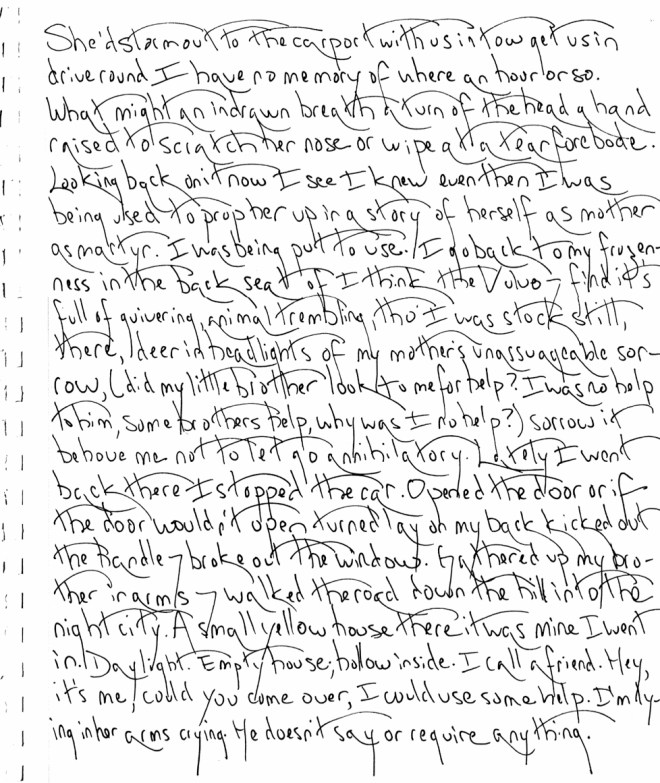
Here’s one such, a journal entry, lightly edited. It begins as a memory that became an episode of lucid dreaming – the transition is around where “I” kick out the handle of the car door.

Journal page 2

I mean it as a visual poem. It has to be handwritten – doesn’t work typed. Every cross-stroke is a jailbreak, the force of the kick breaking the boy free.

For context, since I’m disclosing bravely here, this was a little bit of solo EMDR work. EMDR’s a protocol for working with traumatic memories that instead of describing in detail I’ll just link to here. I picked a memory that was charged, but not too charged, because I’m still learning how to handle this practice, and can easily get overwhelmed by it.

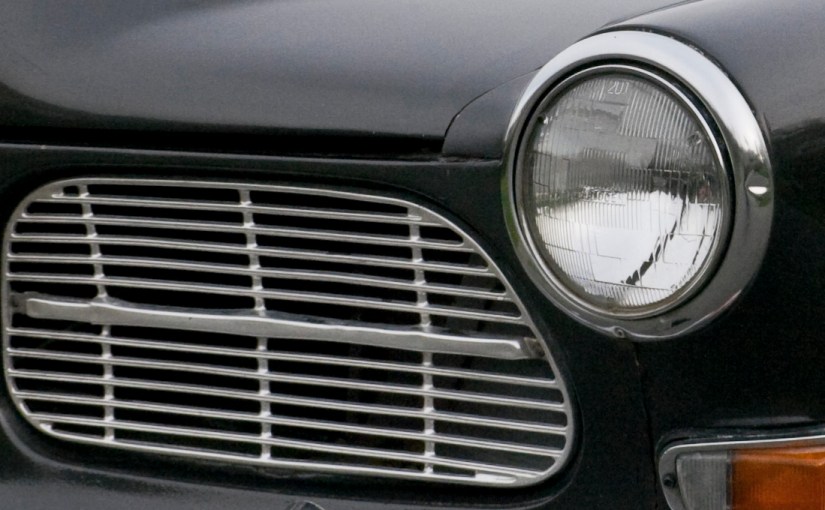
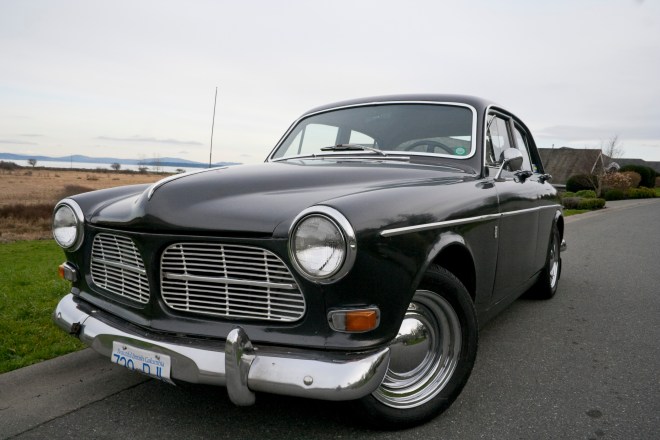
I’m so curious the friend morphs gender. The friend’s my mother and father, I think so, as I knew they could also be. Not as I would get them to be if I were good enough – fuck that, done with that. But as they are now, somehow, in me. volvo-122-1966-6

To end, an image I found online, eerily like the very car. Right navy/eggplant colour. BC license plate though the landscape looks more Delta/Surrey than West Van where the memory lives …


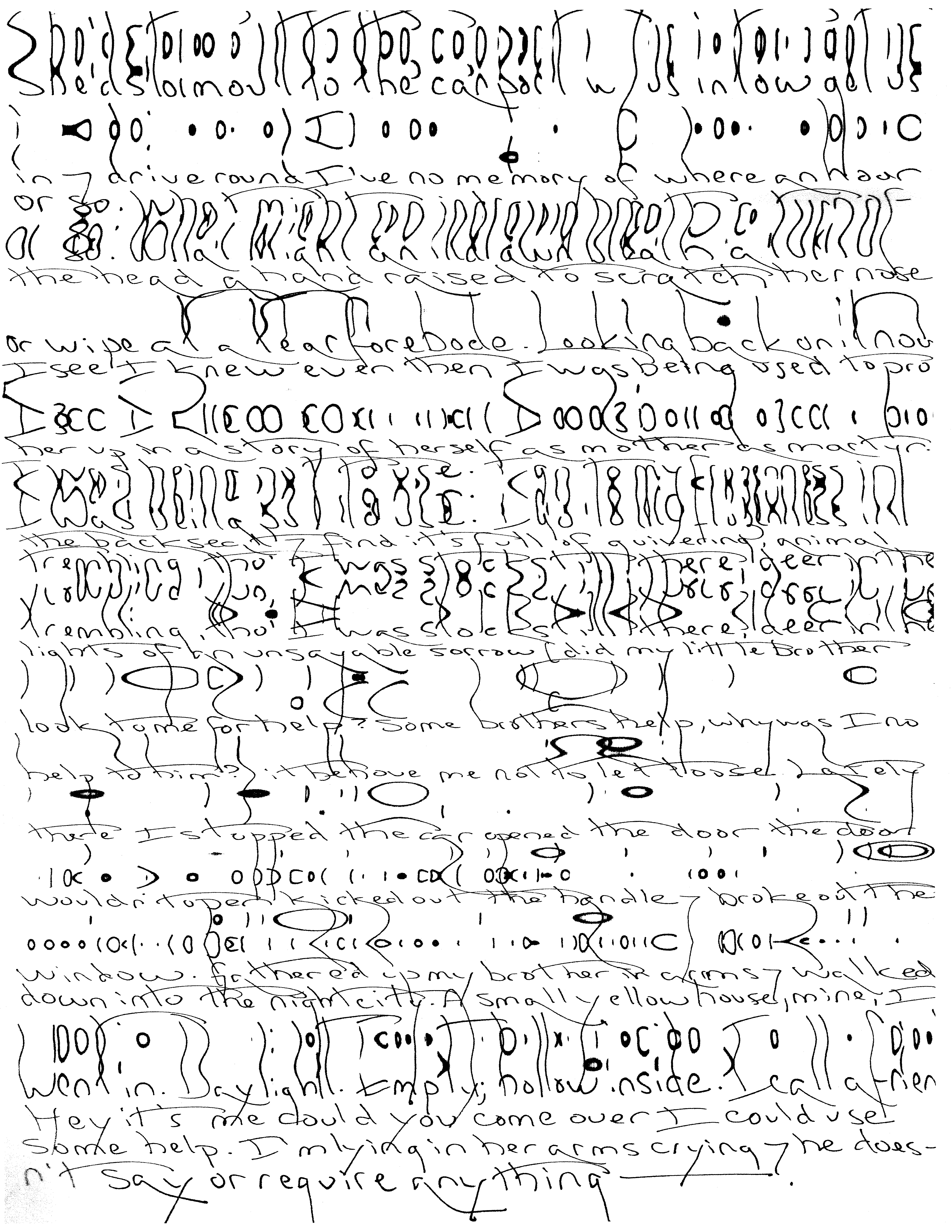
ADDENDUM. Came to feel, in the setting of Overject, the text needed more alterity – to be more other to itself. Started playing with moving it on the photocopier glass as the blue light bar moved along under the glass gathering in the image. And found, this was nice, that when I induced the movement that the text, its content, and yes my students I do still care about content, that the text induced in me, waving or trembling or rocking or whatever – that was the image that felt most true.

In the case of the page above (reinscribed) that was this.

She'd storm - warped (new)
Getting my HTML on. Click to enlarge and then some.

Not asemic writing, properly, because it has legibility (versus “is legible”). Aasemic writing?

Note to blog self

There are nouns one might hear as verbs rather. Living processes we make things of. Reify. Not that there’s anything wrong with things. Some of my best friends are things. But things are just actions sitting still a moment.

Life as a verb. Okay.

Death as a verb. Oh shit.

Self as a verb. Oh my.

Peace as a verb. “There is no way to peace, peace is the way.”

Blog as a verb. Oh get over it.


Ernest Fenollosa, in The Chinese Written Character as a Medium for Poetry:

A true noun, an isolated thing, does not exist in nature. Things are only the terminal points, or rather the meeting points of actions, cross-sections cut through actions, snap-shots. Neither can a pure verb, an abstract motion, be possible in nature.

Is nature a noun or a verb. Yes.

But we of the West weight the noun. BEING, eternal forms, ειδοσ, Plato, that crapola, so to recover the living act, transmutation, you and me in flux, Heraclitean, who knows what comes in the next instant – terrifying, marvellous, necessary –


Let’s get it edgier. Benjamin Lee Whorf, in Language, Thought, and Reality, with some composting.

[A member of the Hopi nation] has no general notion or intuition of TIME as a smooth flowing continuum in which everything in the universe proceeds at an equal rate, out of a future, through a present, into a past. At the same time, the Hopi language is capable of accounting for and describing correctly all observable phenomena of the universe.

The Hopi metaphysics has its cosmic forms comparable to those of the West, past, present, and future, in scale and scope. It imposes on the universe two grand cosmic forms, which we may call MANIFESTED and MANIFESTING (or, UNMANIFEST) or, again, OBJECTIVE and SUBJECTIVE.

The objective or manifested comprises all that is or has been accessible to the senses, the historical physical universe, in fact, with no attempt to distinguish between present and past, but excluding everything that we call future. The subjective or manifesting comprises all that we call future, BUT NOT MERELY THIS; it includes equally and indistinguishably all that we call mental – everything that appears or exists in the mind, or, as the Hopi would prefer to say, in the HEART, no only the heart of man, but the heart of animals, plants, and things, and behind and within all the forms and appearances of nature in the heart of nature.

Don’t know how good this is as anthropology. Could be Whorf’s wet dream of an escape from Plato’s noun. Or a projection of Heidegger onto decimated tribes. But there is at least dimly an intuition of alterity in it, salutary.

On a question of genre

A hard spell. More than a bit PTSDy after my surgery – anxiety waves, wanting to cry lots, panic in the grocery store. Halloween freaked me the fuck out, roving packs in darkened streets and shouts and bangs at all sides.

The trauma’s been here many years, but hasn’t surfaced like this in a while … all the work I’ve done, it’s done some good. But maybe no surprise a minor surgery (hernia repair) brought it back? A knife’s an insult the body knows of, unconsciousness or no, and frozen there, can do nothing about. And this knife in especial was working not very far, in Mitchell’s translation of Rilke’s of Apollo’s of original fire, from that dark centre where procreation flared.

A line from ago I never used and suddenly remember: “Shouts in the street were pieces of me in the mouths of dogs.”

Rousseau had it, I’m sure of it.

[A] word to speak, the least trifle to perform, appear an intolerable labor; everything alarms and terrifies me; the very buzzing of a fly makes me tremble. (Confessions)


This morning I went to the Farmers’ Market and saw Rich and Kendall, also Sean, a former student, and chatting was nice, good. I was looking for herbs to plant in my newly landscaped (or still landscaping) front yard but found instead some apple cider and a chocolate croissant. This afternoon I went to the grocery store and got a flu shot and an anxiety pulse. Tomorrow I’ll drive out to Cloud Mountain Farm and look again for herbs, also fruit trees, apple, plum, frost peach.


My workouts have become meditation by other means – access to inward, when I’m otherwise too distracted or resistant to tune in. So it’s good to be back on the treadmill. Not running, yet, but walking hard up a steep pitch, hard enough for a heartmind opening.

Today it was this. (And tears came in a jag. Which no one can see, nor will anyone, even, if a sob comes loose. Workout a perfected disguise.) There’s a core wound. You can hold it as what’s given to you to hold. Or you can keep living out of it and creating craziness.


This post is actually about a question of genre. Because I can write about this stuff, directly, apparently, in a blog post. And it’s not impermissible either in nonfiction, in memoir. A bit edgy, maybe, but hardly forbidden. But in poetry … no, you can’t do that in poetry, put it in an image, please.

Don’t want it in an image. Want the banal exposed awkward inarticulacy with which it came to me. Because that’s my subject. So fuck peach blossoms and fuck the objective correlative. Here’s what I wrote in my journal when I got home –

journal scrap 3

– and here’s the notecard I did, yes, transpose it to:

notecard
The notecards, yes, are simulacra.

I look about in vain for precedents. Loads of treacly banal sentiment dumps in verse, sure. But I mean legit artistic practices drawing straight from how you speak to yourself about your own feelings and what you do with them and they with you. George Oppen makes concrete poetic objects out of carefully configured abstract surfaces set at colluding angles –

The sad marvels;

Of this was told
A tale of our wickedness.
It is not our wickedness.

– but his concerns are moral and ontological not psychological (“The self is no mystery …”). In many of Frank Bidart’s poems the speaker wrestles semi-articulately with a tormented inner life –

An adult’s forgiveness of his parents
born out of increasing age and empathy

which really forgives nothing,—
but is loathing, rage, revenge,

yet forgiveness as well—;

– but the poem gets its charge from the distance cut open by a persona.

Is what I want, direct speech of and from an emotional life without resort to irony or persona, just inadmissible in poetry? Why permissible in memoir, but not in poetry, when in so many other respects, they’re known to overlap? And where lives the voice, anyway, that says impermissible?


I wonder how I’ll feel about my little notecard when a few days have passed.

I can say this. It belongs, in intent, to Overject as a whole, which means to translate every feature it can of its source text, a minor didactic Old English poem, into the current moment. For that poem is, I have come to feel sure, a trauma document, full to brim with opacities, deferrals, fractures, hapless power moves, inadvertent tender disclosures.

This too I’ll say, writing it has mattered, as writing about it has mattered.

Before you decide my little notecard belongs in the dustbin of banalities, read it for the thoughts and feelings between its phrases and clauses. Those are the ones I took the most care to articulate.

Confessions of a random researcher

Another guest post on the place of chance in poetic practice, this by Stephanie Bolster, another longtime coconspirator. And need I even say dear friend.


Being a guilt-prone perfectionist (she writes) may make for a strong work ethic, but it rarely makes for strong poetry. It’s when I give up – stare out the window, leaf through a book, check e-mail, scroll through Facebook for five minutes before starting my writing commitment – that I find the living stuff. Someone mentions a poem by George Oppen which, when Googled and read, opens up a universe and suddenly I’m writing and remembering a lake I can’t remember if I swam in with a friend to whom I haven’t spoken in years, but who will call my parents just days after I’ve written her into the poem. Or, more prosaically, a truck rattles past, laden with construction equipment destined for the new development at the end of the street, where a forest was, and the rebuilding of New Orleans post-Katrina, about which I’ve been writing for the past few years, is a little more tangible. Coincidence is my gold star.

Disappointment, too. Knowing a little kindles the imagination more than knowing a lot. What scholars didn’t find when seeking evidence that the site of Vermeer’s “The Little Street” actually existed gave me a found poem. Although I’ve described my research methodology convincingly enough to get a research-creation grant for a trip through old zoos in Western Europe, what I found was rarely what I said I sought. W.G. Sebald’s Austerlitz led me to the Nocturama in the Antwerp Zoo, but wasn’t the fact that it was closed for renovations more Sebaldian than a glimpse of some eyes in darkness? In Jersey, they were an aye-aye’s eyes that met mine in the five panicked minutes when I thought I’d been locked into that nocturnal hut for the night. That zoo I went to because the writer Gerald Durrell built it humanely exists in a poem as that moment only.

When the Wikipedia article on the Chernobyl disaster’s remark – “This page may be too long to read and navigate comfortably. Please consider splitting content into sub-articles and/or condensing it.” – becomes advice for the poem about Chernobyl and Katrina and Robert Polidori’s photographs of both places I might not be writing about had an exhibition of his work not happened when and where it did, I’m on the right track.


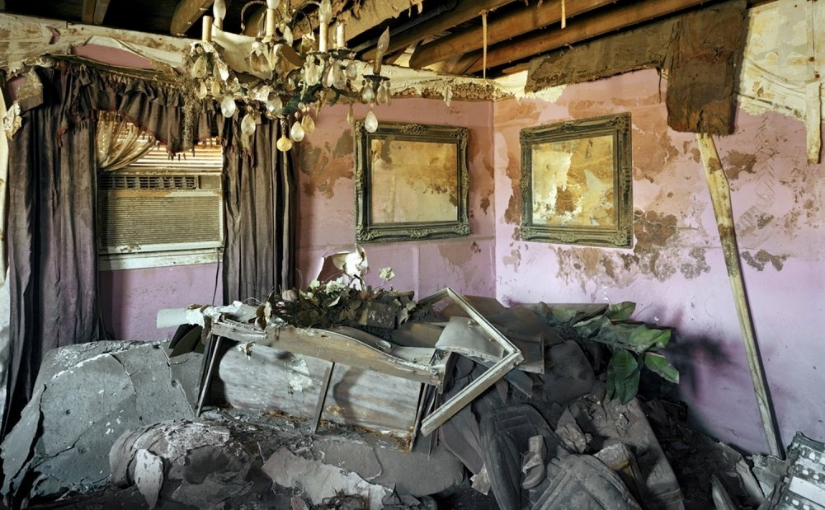
Aside, Steph mentioned, in an email this morning, she’d got a Google alert of this Polidori photograph up for auction. And remarked, though she’s not going to bid, how “the language used to describe the painting is problematic in ways I want to write about.” Dude, check that language out. Graced. Captured. Romanticizing (unironically). Hell, in that writeup, dwell is problematic. Artworld assholes. Not, Steph, to pluck your thunder.


I’ll discuss (Steph again), with readings from recent work, how following the contingencies of live and virtual research has formed my poems. What happens when a poem’s image of a bare field and going-nowhere driveway in New Orleans – seen onscreen a year or two earlier after Googling the address of one of Polidori’s ruined rooms – gets displaced on Google Street View by a street of fresh houses? The poem as process takes on a new life, its own, not mine. Is following accident, distraction, disappointment, always the poem’s true course?


Stephanie Bolster is the author of four books of poetry, the first of which, White Stone: The Alice Poems, won the Governor General’s and the Gerald Lampert Awards in 1998. Her latest book, A Page from the Wonders of Life on Earth, was a finalist for the Pat Lowther Award. Editor of The Best Canadian Poetry in English 2008 and co-editor of Penned: Zoo Poems, she was born in Vancouver and teaches creative writing at Concordia University in Montréal, where she also coordinates the writing program.

Divination: Every poem a hundred small contingencies

A few days hunkered at home. Having been scissed and stitched inside am recuperant. But’ve had it in me to assemble a panel on chance operations in contemporary poetic practice. Here’s a propose and very fine, as guest post, from Barbara Nickel. (I’ll pepper in some links rhizome-style.) (Why when I say that do I think of Psy.)


I’ll present on projects from Consider the Ear, my poetry manuscript-in-progress being written in the village of Yarrow, British Columbia. My presentation will consist of a collage of mini-talks and readings, each led off with a guiding central image. I’ve listed below a series of points and paths that will circle or lead to or away from each image. I’ll select – possibly randomly (e.g., strips of paper from an envelope) – these points for each image and expand upon them at lengths to be determined by the presentation’s time limit.


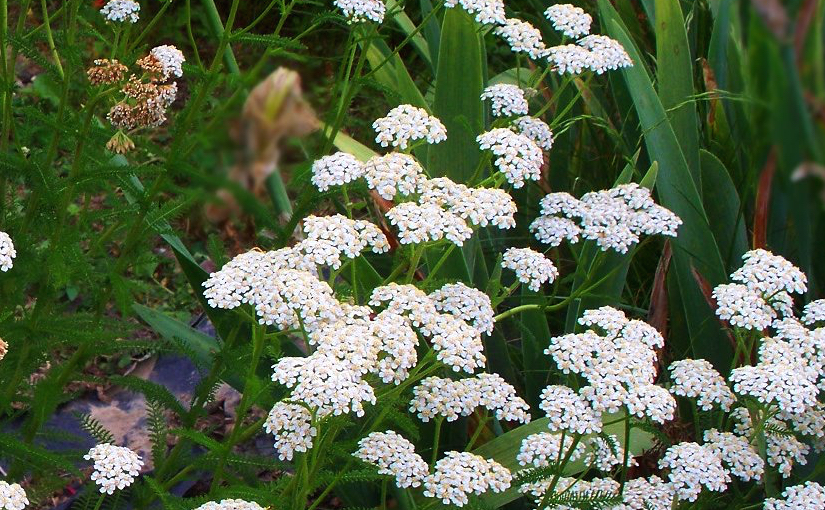
Yarrow

The story of my choosing to live in Yarrow by meeting Lois in her garden.

Yarrow, Achillea millefolium, its stalks used for centuries in I Ching divination practices (involving numbers of changing or unchanging lines), its profuse growth along the dyke by my house and Lois’s in a village named after it.

Dykes, places of growth for yarrow, built by my Mennonite ancestors in the Vistula Delta and coincidentally also in Yarrow.


Torn page

Old books on Mennonite theology written by Mennonite men are taken from a pastor’s library after his death to a thrift shop where Lois is employed.

A random meeting of the three poets of this panel in a graduate poetry workshop at UBC in 1992, how one of them years later begins a blog, “The Art of Compost,” in which he describes a poetry exercise called “Torn Page.”

My “Torn Page (‘(old men)no books’)” project as “divinations twice over” (Patton), written in a room of Lois’s house.


Witch hazel

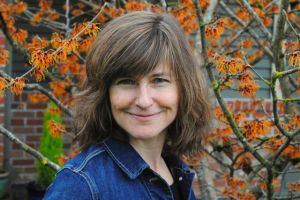
A witch hazel treeHamamelis, planted by the former owners, growing right outside my home in Yarrow, blooming every January.

Witch hazel twigs commonly used as divining rods (for ground water, buried metal, gemstones, oil, gravesites), the conflict in naming between the Latin Virgula Divina (divine rod) and the German Glück rüt (luck rod).

[Can I just say? About that last link? Bad form, to speak to a link? I just got me some fat insight as to where my students’ bad writing comes from. Portentous dialogue & crappy plotting.] [That was CP not Barb.]

Heaney’s description of water diviner as “figure who represents pure technique” in poetry in his essay “Feeling into Words” (Finders Keepers), mentioned in an e-mail by Stephanie, another of this panel’s three poets, also met at UBC in 1992.


A death in January

The story of “Witch Hazel” sonnet, where its path intersects above paths.


Abandoned house

A random decision on a road trip to take an old, forgotten highway instead of the usual route.

A random glance back at an abandoned house not seen previously anywhere or time.

The curious story of a sonnet, “Saskatoon to Coaldale, July, Highway,” written in Lois’s house.


Ear

The ear (in rhyme and metre and “verbal texture” (Heaney)) as divining rod in the projects chosen for discussion.


Questions that grow from the mini-talks, to be explored in the presentation:

What tension grows from the roots of “divining rod” – in Latin, “divine,” in German “luck”?

In other words, in each of the poems and the paths and intersections of paths leading up to them, what is the balance of miracle and luck, divination and design?


Next to come [CP here again] the random differently undertaken by Stephanie Bolster.


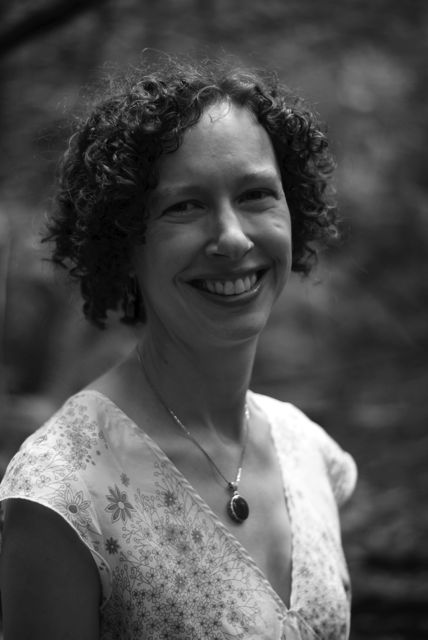
BarbNickel3Barbara Nickel is the author of two books of poetry, The Gladys Elegies and Domain, and the recently published A Boy Asked the Wind, illustrated by Gillian Newland. She has received numerous awards, including the Pat Lowther Award, and her poems have appeared in such publications as The Walrus and Poetry Ireland Review. Visit her website at barbaranickel.ca. Also check out that witch hazel.