Junk mail bricolage II

On the far side of an intense burst of poem making. For a few weeks there I could do no wrong. Now though most of what I do is a strained imitation of what came full-throatedly before. If I were one of my students I’d tell me not to worry – time to lie fallow a bit is all. Since I’m me though I say time for some bloggery.


Here’s a fancy word I learned recently. Pareidolia. The tendency to see Christ in burnt toast, the Virgin Mary in soot stains on a wall, a man or a rabbit in the seas (the “seas”) of the moon.

We’re all pareidoliasts. My proof:

O       O

______

If you don’t see a face there you can stop reading – we have nothing in common.

From the Greek, para, beside, near, from, against, contrary to, + eidolon, appearance, image, ultimately from eidos, form, shape – the word Plato uses for his damnable forms. To make art out of such para-forms, and that’s where I’m headed, is give the philosopher an itch he shan’t ever manage to scratch.


Pareidolia coheres most around the human face – we’re made to make it out, and early, so early. Infant to mother, eyes to eyes, our survival in spirit depends on it, as much as our survival as bodies depends on the sustenance of touch those eyes signify.

But it seems to me there are other forms we are prone to see with hardly any prompting – trees, say.

Terror of tall trees

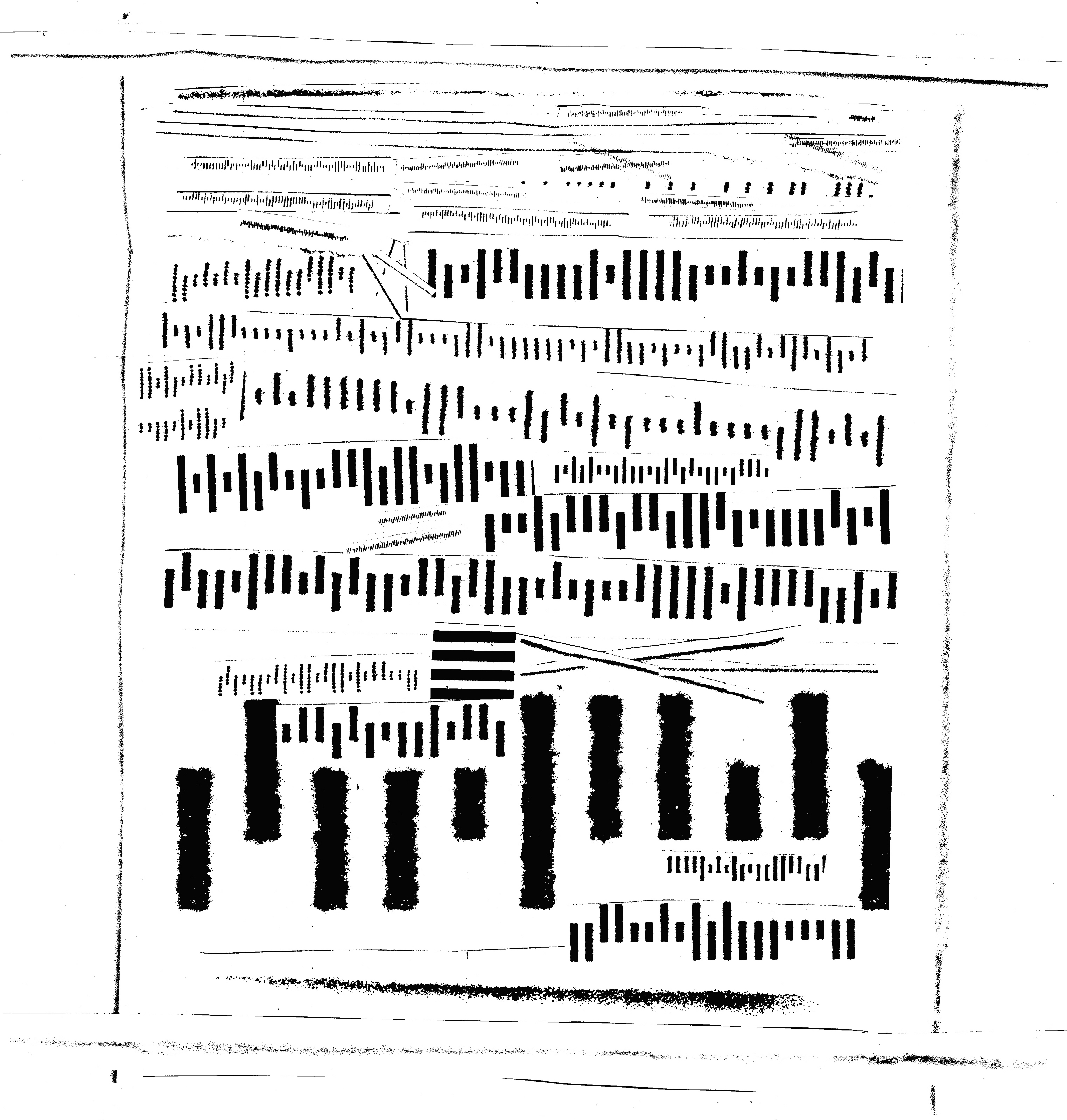
Fig. 1 Terror of the Tall Trees

This image is built out of junk mail bar codes (and the visual noise left behind by the strips of paper the codes are on when xeroxed). It’s the first one to show up in Dumuzi and is meant to sit right on the edge between “burnt toast” and “the ghost of Christ in burnt toast.”

The allusion is to Dumuzi’s dream, which he recounts to his sister, and the signs aren’t good.

Out of Sumer

A bit more about the handwriting sometime later. Working on a pretty/ugly hand that looks a bit like hurried wedged impressions in clay and a bit like clumsy medieval calligraphy and a bit like where my head was at when I make the strokes up to down and left to right.

K so fire

And run he does. Not that it gets he anywhere but deeper to wit

Terror of tall trees – detail

Fig. 2 Terror of the Tall Trees (detail)

And that’s what I got of an evening. Tell me what you think if you have thoughts. All this is new to and for and from and of me. C.

Junk mail bricolage (I)

A few weeks ago I took Dumuzi – a manuscript I had thought pretty much done – back into the shop for an overhaul. Started incorporating handwritten bits, pages of journal writing, fragments of the myth stroked out on scraps torn from junk mail envelopes, and’ve been pretty pumped about where it seems to be headed.

And my feelings in the wake of Elise’s passing, which have surprised me in their intensity, though why should they really, I loved her as a true friend, far from derailing the work seem to have thrown themselves into it for fuel. (I showed her one of them, not posted here today, and true to generous form, she flared, though it was far outside her taste, gladness on my behalf.)

Here’s one. I should say, this is the part of the book that tells the story of Dumuzi’s consort’s, Inanna’s, journey to the underworld, i.e., death and metamorphosis. As she readies for her journey (as if anyone chose such a journey) she gathers her me, her powers, which are all the powers of culture, our being as civilized beings.

her-me-1-3.jpg

And the other.

her-me-2-3.jpg

You’ll see some anger in it. Okay so yeah I’m pissed. Some of it’s, I’m pissed at the world, it took my friend. Even, let’s say it, pissed at my friend, she got took. And, some of it’s anger at, well, junk mail, and a life among and as commodity, even as it’s also an effort to subvert commodification. Sounding like a lit prof now shutting up.


What am I doing here. I don’t know. Something about an elegy in motion. If blog (I first typed glob) as form lets me do something my private journal nor a public statement won’t, too, it’s to do with catching the gist of the feel of the thought on the fly.

Terraces the colour of stars

Dear Don,

“Memory supplants history in the humbled mind,” you wrote. To which we might add that epic fallen to fragments becomes lyric, and those lyric scraps of myth and history may become well nigh indistinguishable from personal memory.

So that the Pisan Cantos, held at a certain angle, in a certain light, read as if all of Europe were sifting through the fragments washed up in and of its ruin, trying to comprehend its downfall.

And to separate what it might still love from the dross of its vanity, gazing eastward for equivalences that might be insights, Kuanyin ≒ Aphrodite, rain as Tao ≒ Heraclitean flow, apricot blossoms on the wind as gallows at the camp’s edge terribly clarify the mind.


At a certain angle, in a certain light. The poems are a tsunami in their mass energy valences. Any effort to summarize encapsulate or contain them seems further folly. So I will just tell you the way I am floating along with them this morning.


It starts with defiance and venom. Mussolini as a “dead bullock” eaten at by maggots. Lenders as “loan lice.” The mind is at work on the scale of history, the “enormous trag­edy of the dream” now lost of the ideal city “whose terraces are the colour of stars.”

Pound heaps scorn and contempt upon those he calls guilty, FDR, Churchill, banks, rich Jews. This noise goes on for some time. But even at the outset, turning words are at work in the mind:

The suave eyes, quiet, not scornful,
                              rain also is of the process.

Those same eyes appear some hundred pages later — “there came new subtlety of eyes into my tent” —Kuanyin? Aphrodite? — to release the hymn of self-abnegation, in which love and right action are got free at last of resentment and vanity.


One side of it is letting the world enter, really enter, the tent. To admit that “rain also is of the process” is not idle or abstract in a roofless cage. The other side is, get humble, erase yourself, let the world enter, that is the way through:

ОЎ ΤΙΣ, ОЎ ΤΙΣ? Odysseus
                             the name of my family.

Things flow. So let them. The Pisan Cantos are (this morning) (for this reader) about the thorny ecstatic work of getting out of the way. To be Odysseus is to be skilled in many things, polumetis, a man of twists and turns, and one such turn is to be no man at all.


The poem flows. So let it. ОЎ ΤΙΣ, “no man,” recalls here and everywhere “’Tis. ’Tis. Ytis!” in Canto IV, the cry of Philomela become nightingale. Which connects in turn to the orchestrated birdsong of Canto LXXV. Which connects to the birds composing themselves on wires in Pound’s tent-straitened view. Who sing in Canto LXXXII this song

                             f           f
                                             d
                                                    g

which I hear as the drawn-out first syllable, and then descending scale, of “Terreus! Terreus!” — Philomela given the power to name he who raped her and cut out her tongue to foster silence.


This would be a way to write about the Cantos: choose one node, trace all that it echoes or actuates, how they foster speech when speech is due, rich silences otherwise.

For so many noticings don’t fit the arc I’ve staked out for myself.

A key that shows up in the first moments: periplum, circumnaviga­tion, as in “the great periplum brings in the stars to our shore.” Not sure what to make of this. Feels like a concession that the world is whole, and epic strivings unnecessary, but that may be my effort, once more, to turn Pound into a dharma holder.


The poem is one left parenthesis and another. So I can hardly say it makes a clean transit from benightedness to insight. That would be too happy an ending — that would be an ending. To the last Pound is hailing Il Duce, his lieutenants, various collaborators whom history has since found, and I’ve no reason to question the verdict, cowards and villains.

There is though a gradual shift in the relative weights given to vitriol (accusation, explanation, calumny) and humility (surrender, sympathy, wakeful attention) — to being right and being alive. A few of the energies at work in that shift:

Hey Snag wots in the bibl’?
wot are the books ov the bible?
Name ’em, don’t bullshit ME.
                                                ОЎ ΤΙΣ
a man on whom the sun has gone down

As Odysseus, become No Man, is connected to Elpenor, a man remembered only for the company he kept, so Pound, as No Man, is connected to the prisoners and guards of the DTC, anonymous but for the place he gives them in his poem. (His giving goes hand in hand with sympathy.) (His humbling is an enlarging.)


As Pound settles into the ascetic attention forced on him by his confinement, mist and clouds, stray camp animals, vagrant insects become charged with meaning:

that the ants seem to wobble
as the morning sun catches their shadows

Sometimes that meaning takes on the dimension of myth, not in the way of epic sweep and portent, but of lyric intensity, the moment eternal: the butterfly, Aphrodite or Psyche, at the smoke hole. Identity with the insects makes humility absolute —

As a lone ant from a broken ant-hill
from the wreckage of Europe, ego scriptor.

— out of humility comes a new allegiance —

nothing matters but the quality
of the affection —
in the end — that has carved the trace in the mind
dove sta memoria

— a descent into memory with consolation from Confucius —

“How is it far, if you think of it?”

— peppered with eruptions of the old rage —

                    interest on all it creates out of nothing
the buggering bank has;                   pure iniquity
                    and to change the value of money, of the unit of
money
                              METATHEMENON
                     we are not out of that chapter

(as if the deep disappointment of the world could be laid at the feet of the banking industry — we are not out of that habit) and in time a reaffirmation—

Amo ego sum, and in just that proportion

To be as one loves.


Such luminous details fall like seeds into a welter of sensation, memory, argument, and myth. And after a near endless swirling gestation they break up through the soil and the world greens with a new sort of understanding:

What thou lovest well remains,
                                             the rest is dross,
What thou lov’st well shall not be reft from thee
What thou lov’st well is thy true heritage

Humbled, the sun gone down on him, made no man, Pound overwinters, all that long summer, to green in autumn with hard insight:

Pull down thy vanity, it is not man
Made courage, or made order, or made grace,
             Pull down thy vanity, I say pull down.
Learn of the green world what can be thy place
In scaled invention or true artistry,
Pull down thy vanity


I am of Pound’s company in this if in no other thing: “Learn of,” not “Learn from,” because of how long “from” would take to say. The music matters. Music is the matter.


The hate that went out turns inward as ruthless self-excoriation —

Thou art a beaten dog beneath the hail,
A swollen magpie in a fitful sun,
Half black half white
Nor knowst’ou wing from tail
Pull down they vanity
                         How mean thy hates
Fostered in falsity
                         Pull down thy vanity,
Rathe to destroy, niggard in charity

— that also is of the process, the Tao of prison, the way of awful reflection. Allowed to flow, it flows, then is gone. What one has loved — that one has loved — remains:

                         To have gathered from the air a live tradition
or from a fine old eye the unconquered flame
This is not vanity.


Well I have tried to work here with a light hand but still feel I have striven to reduce the irreducible. So let me say as I wrap up that these poems are teaching me a different sort of attention. They are not vessels, nor is there any vessel to hold them, they’re mind in motion, world in motion, soul in process, one meets them as a rainstorm or a storm surge. I mean the only way to read them is surrender. One could spend a lifetime in them and not find the depth of them, and that — fascistic rantings notwithstanding — is a great beautiful good.

teaching portfolio

Thin glitter of water

Another letter to Donald Revell on Ezra Pound. (Queuing up a few in the lull between writing camp and Christmas).


Dear Don,

I’ve been thinking about the “lyrical principle” as Kenner frames it. “That words or names, being ordered in time, are bound together and recalled into each other’s presence by recurrent sounds.” As Pound’s practice develops, seems to me, the elements that recur grow larger and larger, until in the Cantos, as he manages recurrence on varying scales, from phoneme to homeomorph, he makes lyric a mode of logic. A logic that loses not one eyelash of particular existence, because it doesn’t abstract or deduct, but exemplifies and counterpoints.


In his early Provençal translations the recurring element is the phoneme. The effect is loyal to the troubadour and his rhymes and clanky maybe in a modern English ear:

“Up! Thou rascal, Rise,
        I see the white
        Light
        And the night
                Flies.”

No less dense, but more subtly modulated, is a later (1951) rendering of Montanari:

A swallow for shuttle, back,
Forth, forth, back
        from shack to
marsh track:
        to the far
sky-line that’s fading now

The consonantal music is so finely tuned that one might miss the quieter more drawn-out play of the vowels: swallow – forth – now. Not to mention the aural pleasure of the switch to long i and a sounds in the last line, enacting the swallow’s sudden shot off into the distance.


A long time before, in Cathay, Pound had brought the work and play of recurrence and departure to whole words — the refrain-words I spoke of before in “Song of the Bowmen of Shu” and “The River-Merchant’s Wife.” And in “The Beautiful Toilet” he mixes, as Kenner shows, the word-repetitions of the original Chinese (blue … blue) with lighter aural ligatures (willows – overfilled) that convey the spirit of the Chinese original’s musical patterning and avoid the clunky literalisms of Waley’s rendering.


In the Cantos the repeated elements grow larger — words, phrases, motifs — but the arrangement, and the intelligence it calls into play, remain musical. In Canto IV Diana bathes in a forest pool. The air is “alight with the goddess” herself, her limbs loading and endowing matter with divinity —

Ivory dipping in silver,
        Shadow’d, o’ershadow’d
Ivory dipping in silver,

Hidden by a forest canopy impenetrable to sunlight, the goddess lives in an eternal present, a light at once flowing and still.

What that image does in the eye (light made liquid) the music of recurrence (a word lightly varied nestled in a phrase exactly doubled) does in the ear. So that time circles round, flows but stands in place, in us also.


Then Actaeon, poor boy, blunders in:

The dogs leap on Actaeon,
        ‘Hither, hither, Actaeon,’
Spotted stag of the wood;
Gold, gold, a sheaf of hair,
        Thick like a wheat swath,
Blaze, blaze in the sun,
        The dogs leap on Actaeon.

The paradisal now of the goddess meets historical (tragic) human time. The word spoken twice aloud, hither, hither, urges haste, propels time body matter forward, while those repeated silently, gold, gold blaze, blaze, fix attention, intensify the sensory moment, hush and slow the mind. Meanwhile, on a larger scale, the phrase that bookends the scene, “The dogs leap on Actaeon,” fixes the unfolding action in place, so Actaeon enters mythic time.

Not, it has to be said, on the same terms as a god would enter.


With Actaeon’s entry the sun blazes into the scene. And this penetration of myth by history, of a divine now by historical time, releases light into the world. “Thus the light rains, thus pours, o lo soleils plovil.

Carroll finds in this line “the important canto motif of the light-water-stone progression which finally ends in crystal, i.e., the transmutation of the fluid transparency of subjective experience into the objective solidity of stone through poetry.”

If this is right, and if the light is that of a goddess, too, set loose in the world, and also the light of the Paradiso, which it must be, then the goddess can be nothing but an instance (purified, rarefied) of consciousness.

And if that’s right, there’s no divine eternal now after all, just human time, mostly fallen into history, but at certain points — points at which, for which, gods stand — fleetingly redeemed.


Getting too lofty and well ahead of me. No time here, or space now, for the homeomorphic rhymes, Cadmus and Odysseus, venturing they know not where, Itys and Cabestan, their hearts served up on plates, Actaeon and Vidal, gotten in their own trouble. But to note as I sign off a point or two where the poem wells up with an image of its own activity.

The liquid and rushing crystal

and

Ply over ply, thin glitter of water;
Brook film bearing white petals.

and

Adige, thin film of images,

 and

And Tian … with his hand on the strings of his lute
The low sounds continuing
        after his hand left the strings,
And the sound went up like smoke, under the leaves,

teaching portfolio

Out of Sumer,

I tell my students to trust their boredom, it’s good guidance, better than any outside feedback or creative writing precept can be, when attended to rightly. When I found I was, at a recent reading I was part of, bored by parts of what I read, I practiced what I preached. And so, a new preface to Dumuzi.


Out of Sumer,

Dumuzi, god of the new, the new green, to be drawn down broken. Flees gazelle to his sis & she reads his dream. Bro she says don’t tell me that dream. Okay so well fire gone out in yr hearth’s desolation of yr green fields she says. The rushes thick round you galla says. The tall firs in terror round you galla says. Run says.

Sent by Inanna the demon galla hover an inch over the earth bright drought angels pursuant. Justice an in-law turns Dumuzi snake & hands & feet the hands & feet of snakes he runs.

Galla working undercover offer sis a water gift a grain gift a corner office gas & groceries for life to give him up nope. They strip her rape her pour in orifices hot pitch nope. When has a sister ever given up a brother they giggle little to large.

A friend upgives Dumuzi & galla fat & thin harvest him. Scale the perimeter barricades & throw down & perforate that face with nails & smush with shepherd crooks that skull. Shit, you’re not even sleeping, nuff faking say. Get the sweet bloody fuck up they say. Hands bound & iron round his neck with aspect of a warrior caught pressed in clay & proud downed head & spade beard okay says show the way.

Some later find his body in a roadside ditch outside the city. An holy fly tells them where. Son my son mother says as mothers must in wars of sons the face is yours the spirit’s gone from. Deal is, fly gets to hear any quarrel any bar diner bedroom anywhere. Come spring, comes Dumuzi, arrogant, wist­ful. Your broad hand lover Inanna says is manna & your sweet little wee toe’s nectar. I stroll with him sings among the standing trees & stand with him sings among the fallen trees.

& their life is orchard. & he wants to want nothing but take joy in her joy. & he’s to be milled packaged traded shipped bought & sold soiled broiled roasted baked & eaten.

At the king’s lap stands the rising cedar.
Plants grow high by their side.
Grains grow high by their side.

When they tire of riding the holy hard-on Inanna gathers her me together for an excursion. The me are powers won from her drunken father Sweetwater back in the day. Dagger & sword & descent to the kur & measuring rod and line & dark bright dress & unbinding her hair & cocksucking assfucking lovemaking weeping & consolement terror dismay & passing judgement conferring power animal husbandry plundering cities & running away & ascent from the kur & spear arrow quiver bow knife AK47 RPG ICBM crows eating eyes on village greens town squares redbrick college plazas faceless high glass offices & lamentation purification bare attention compassion smack acid crank & scribe & stylus & cylinder seal ironwork carpentry leatherwork star of morning star of evening sacred mountain caduceus rosette a fistful of river & bull sheep scorpion apple tree kindling fire extinguishing fire gathering family dispersing seed voice of the whirlwind broken to voices & crown of the grasslands & a black seducing eye-paint & a friend taken too with her partway.

She takes a road no one turns on to the kur underearth where names go to die & her way crosses his every moment at right angles. What says is this as the guard strips her down. Shut it dirt bitch says our ways are perfect immaculate metamorphosis. Shorn of her me. Crown of the grasslands. Double strand of small beads. Wedding gold. Lapis measuring rod & line.

Naked to throneroom where Queen Thing Mind kicks & slaps punches & cuts & hangs her dear sis up on a wall. Slab of rotting meat hung on a hook.

That sad friend calls 911 gets the dad-man on the line & not too sauced for once he flicks dirt from under his nails & beings of his fashioning, kurgarra (moth), galatur (bee), descend from on high to sprinkle pharmaceuticals on the corpse.

Inanna ascends behung with galla. Comes in turn on her faithful friend her grieving son her other grieving son. I shan’t give up who serviced me well says & with her galla walks on. In Uruk comes upon Dumuzi sitting under an old apple tree. Lost in a thought. Enthroned & he don’t bow. Anagram, enthorned. Take this one says. Whatevs he says & flees &c.

Ineluctably ariseth. Anagram, hastier, raiseth. I’m shaking why.


This all got broken up & put through 7 transforms.

Six Hungry Ghost Abatement Protocols (II)

A lot of the Hungry Ghost poems have been coming lately with royal or tyrannic classical riders. Lear, Oedipus, Romulus.

Partly accident—a lot of verbs, look, take, sneak, poke, cough up kings when pressed to participle. But in a project like this, which is harnessed accident, I still get to take responsibility.

Something here of hunger for a lost father, a father whose power to shelter shatters. It’s funny, the sorts of ways I used to write, I got or had to go through the whole emotional travail, the past and its unprocessed sadnesses, to get the poem through.

I felt on the far side I’d come through a narrow sharp defile with a few verbal berries at hand and my ongoing breathing.

The plus of that. Authenticity. The minus of it. Harrowing.

High ∙ beat up ∙ on a couch ∙ beside me paper
hands and a spine of lace ∙ so here’s a split
a poem led me back to ∙ Dad getting the door
riffed on the many large thin guarded anthills
and how sound collapsed their city ∙ nobody
knows how he agonized ∙ then and there ∙ no
one more out there or into it than he ∙ lead is
dropping into a neighbouring city ∙ we just ta-
ble it though and go where to be seen is to be
housed to be housed known ∙ the king of lack
woke to a fist of bees some kids tossed at him

This erasure and treatment process, I seem to bypass much of that, the harrowing. The poem comes through semiautomatic processes I watch happen in amaze. On the far side, less of the deeply grateful, I said what it was or is like for me, and plenty of a differently glad, this is a potent made thing-being here.

The one, I’m writing myself through language, other, language writes a poem through me. Viz. Spicer’s Martians.

THINK DEW

We fed who knows,
sd th King of Thebes, how
many more than the
city dared.

We than that had no body more.

No, nobody lead, we just—

a sound out there
splits the thought.

One more boring show and how.
Guard the heir.

That’s one I redid this morning. The other is

A POEM HANDS HIGH

Dad’s getting so thin.
Mos’ def.
Dies.

Goes out a sand door.
So where now do we go to be?

And that’s how Rome
woke to a regal glare.

—A heathen deal.
—Yes and some of it lethal.

Dad’s getting so thin.
Go go death gadget.
How snow.

“Go go gadget” a phrase that stood out in a student’s poem last year (thank you Reilly) and somehow got stuck in my mind and forgotten there and returned to view when some of “Dad getting” anagrammed to “gadget.” Had, of course, to look up the ref, cuz my geekiest student is hipper than I.


Speaking of which. Many bonus points to anyone who can for me explicate the directive, “shred the sauce.” Urban Dictionary lets me down here. Written on a student eval last year and I might like to try but no idea how.


Last thought. To give a reading (maybe this upcoming one at Western) wholly of poems initiated or inflected by my work with students. A thread blogwork attunes me to is the continousness of teaching writing reading thinking moving being.


Last last thought. Mistype Western and you get Wetern, as in, “wetter’n,” as in “ahm wetter’n a flounder at the bottom of the sea in this rain.” Sorry, that’s the country music at Liz Station, on now, and maybe Cormac McCarthy doing their work in me.

Student Work: 20 little poetry projects (II)

Some more fun bits from my students’ encounters with Jim Simmerman’s exercise.


The well-spoken gangster began to descend.
That gangsta-man was stepping onto the soil from flight, as he said.
“Carpe Diem” he said.
Even the wind howled back when he said this line.
The mountains didn’t soar as high as the gangster, the gangster who was I.

Usually these go better when they get off the topic, line by line, but here a disjointed narrative comes together (apart).


For the dead eye stars the struggle is real. Charlie Bradbury was absent from their event in Vancouver during which many a blue was tasted. We smelled what was right and what was wrong and we saw the reds that pretended to be the blues that were tasted.

Lovely parataxis here.


The trees decide to hug back,
Making the note-taking in fourth-grade science
Less of an assassination

Right at the end of the poem, that, a real surprise.


Arguments will be had but no points will be made
under a slimeball ceiling,
built by men who don’t create.
Papier pour moi, stylo pour vous?
Erasers eat lead.
Gummy belly-button on a pompous twenty-something.

One thing we noticed in class todays—abstractions can earn their place in a poem by sitting aslant each other—as in the phrase “the numbest kinds of pain” in Robert Hass’s prose poem “Museum.” Something similar goes on here in the first and third lines … abstract nouns and generic verbs become lively and specific through being at odds with their neighbours.


Some more on that poem by Hass to come. And haven’t forgotten my promise to follow through on disjunction. Just think though—the longer goes by, the more disjunctive the resumption. Word.

teaching portfolio

Exercise: 20 Little Poetry Projects

(An exercise by Jim Simmerman, taken from The Practice of Poetry, Robin Behn and Chase Twitchell, eds. Will post some recent strangeness later.)

Give each project at least one line. You should open the poem with the first project, and close it with the last, but otherwise use the projects in whatever order you like. Do all twenty. Let different ones be in different voices. Don’t take things too seriously.

  1. Begin the poem with a metaphor.
  2. Say something specific but utterly preposterous.
  3. Use at least one image for each of the five senses, either in succession or scattered randomly throughout the poem.
  4. Use one example of synaesthesia (mixing the senses).
  5. Use the proper name of a person and the proper name of a place.
  6. Contradict something you said earlier in the poem.
  7. Change direction or digress from the last thing you said.
  8. Use a word (slang?) you’ve never seen in a poem.
  9. Use a piece of false cause-and-effect logic.
  10. Use a piece of “talk” you’ve actually heard (preferably in dialect and/or which you don’t understand).
  11. Create a metaphor using the following construction: “The (adjective) (concrete noun) of (abstract noun)…”
  12. Use an image in such a way as to reverse its usual associative qualities.
  13. Make the persona or character in the poem do something he/she could not do in “real life.”
  14. Refer to yourself by nickname and in the third person.
  15. Write in the future tense, such that part of the poem seems to be a prediction.
  16. Modify a noun with an unlikely adjective.
  17. Make a declarative assertion that sounds convincing but finally makes no sense.
  18. Use a phrase from a language other than English.
  19. Make a nonhuman object say or do something human (personification).
  20. Close the poem with a vivid image that makes no statement but that “echoes” an image from earlier in the poem.

The ones go best that let go, over and over, of whatever one thought to mean. Simmerman comments:

I created this exercise for my beginning poetry writing students who … seemed to me overly concerned with transparently logical structures, themes, and modes of development at the expense of free-for-all wackiness, inventive play, and the sheer oddities of language itself.

I created the exercise in about half an hour, simply listing, in no particular order, a lot of little sillinesses I had seen and liked, or had not seen but thought I would have liked, in poems here and there.

Here’s a poem by Simmerman that completes the twenty projects in order.

Moon Go Away, I Don’t Love You No More

  1. Morning comes on like a wink in the dark.
  2. It’s me it’s winking at.
  3. Mock light lolls in the boughs of the pines.
    Dead air numbs my hands.
    A bluejay jabbers like nobody’s business.
    Woodsmoke comes spelunking my nostrils
    and tastes like burned toast where it rests on my tongue.
  4. Morning tastes the way a rock felt
    kissing me on the eye:
  5. a kiss thrown by Randy Shellhourse
    on the Jacksonville, Arkansas, Little League field
    because we were that bored in 1965.
  6. We weren’t that bored in 1965.
  7. Dogs ran amuck in the yards of the poor,
    and music spilled out of every window
    though none of us could dance.
  8. None of us could do the Frug, the Dirty Dog
  9. because we were small and wore small hats.
  10. Moon go away, I don’t love you no more
  11. was the only song we knew by heart.
  12. The dull crayons of sex and meanness
    scribbled all over our thoughts.
  13. We were about as happy as headstones.
  14. We fell through the sidewalk
    and changed colour at night.
  15. Little Darry was there to scuff through it all,
  16. so that today, tomorrow, the day after that
    he will walk backward among the orphaned trees
  17. and toy rocks that lead him
    nowhere I could ever track
    till he’s so far away, so lost
  18. I’ll have to forget him to know where he’s gone.
  19. la grave poullet du soir est toujours avec moi
  20. even as the sky opens for business,
    even as shadows kick off their shoes,
    even as this torrent of clean morning light
    comes flooding down and over it all.

Examples from my students’ poems here and here.

teaching portfolio

Six Hungry Ghost Abatement Protocols

Wrote this up for a job app and thought I’d post it here—after revising blogwise. Medium is so message.

Been working about a year on a manuscript called Six Hungry Ghost Abatement Protocols. It’s a study of creative process done at a crossroads of word and image. In which crash prose passages go through a series of verbal and visual metamorphoses—extraction, precipitation, illumination, inspiration.

My thought here is that even well tamed verbal structures possess a wildness inherent in language. In that wildering I feel less that I am writing and drawing poems than that the poems are drawing me out and writing me down.

Themewise the book takes on the Buddhist figure of the hungry ghost, a being of insatiable hunger, unassuageable suffering, to trace some connections among desire, attachment, loss, release. Process and content are very interwoven here: renunciations asked of the poems in their proceeding, as each gives way to a successor, are kin to renunciations they wrestle with in mind.

The transformations in their turns.


Extraction

I begin with a passage from my journal, streamlined and depunctuated, for instance this dream transcript.

I’m with R. on roads in the mountains ∙ at the
base of a ski hill we are looking at trail maps ∙ a
web or net of red lines thrown down over a
volcanic core ∙ a whole series of them side by
side ∙ each to the left steps back a bit further ∙
takes more in ∙ the gradations so fine I have to
take more steps across to get to the map that
has what I want to show than I thought to ∙ at it
I point to the road or trail on a southwestern
shoulder of a mountain ∙ One branch goes west­-
ward ∙ that’s somewhere we’ve been ∙ one goes
rightward across the valley of the Stehekin
though we’re in Colorado ∙ that’s the trip I’m
talking about ∙ somewhere else I am saying how
full the colours were up there ∙ Even in winter ∙
a lake in the mountains ∙ sunlight on it and me
through firs on the far side ∙ bleached wood of
fallen snags half-submerged in the water ∙ in
the foreground tall as I am so I must be crouch-
ing ∙ brilliant red blueberry leaves ∙ a few in a
bare bush ∙ the colours give life to the sun and
to me ∙ then in a car with R. driving in and
away from the mountains ∙ he says he doesn’t
use trails when hiking ∙ he just pulls over to the
side of the road and starts bushwhacking up ∙
because of how his mother taught him hillwalk-
ing ∙ she was crazy or maybe just very intense ∙
I laugh too loud ∙ say ∙ But that was in Scotland
where they cut down the forests centuries ago ∙
do you really want to bushwhack through fir
thickets ∙ I wake picturing different sorts of fir
woods ∙ an impassable thicket of small dead
densely interwoven branches ∙ a stand of ma-
ture trees ∙ spacious and cool ∙ a floor of moss

Next I mine this source material for word clusters that bear poetic charge. Here’s the same prose with the mined bits prominent.

I’m with R. on roads in the mountains ∙ at the
base of a ski hill we are looking at trail maps ∙ a
web or net of red lines thrown down over a
volcanic core ∙ a whole series of them side by
side ∙ each to the left steps back a bit further ∙
takes more in ∙ the gradations so fine I have to
take more steps across to get to the map that
has what I want to show than I thought to ∙ at it
I point to the road or trail on a southwestern
shoulder of a mountain ∙ One branch goes west­-
ward ∙ that’s somewhere we’ve been ∙ one goes
rightward across the valley of the Stehekin
though we’re in Colorado ∙ that’s the trip I’m
talking about ∙ somewhere else I am saying how
full the colours were up there ∙ Even in winter ∙
a lake in the mountains ∙ sunlight on it and me
through firs on the far side ∙ bleached wood of
fallen snags half-submerged in the water ∙ in
the foreground tall as I am so I must be crouch
ing ∙ brilliant red blueberry leaves ∙ a few in a
bare bush ∙ the colours give life to the sun and
to me ∙ then in a car with R. driving in and
away from the mountains ∙ he says he doesn’t
use trails when hiking ∙ he just pulls over to the
side of the road and starts bushwhacking up ∙
because of how his mother taught him hillwalk-
ing ∙ she was crazy or maybe just very intense ∙
I laugh too loud ∙ say ∙ But that was in Scotland
where they cut down the forests centuries ago ∙
do you really want to bushwhack through fir
thickets ∙ I wake picturing different sorts of fir
woods ∙ an impassable thicket of small dead
densely interwoven branches ∙ a stand of ma
ture trees ∙ spacious and cool ∙ a floor of moss

I compile my extractions to make a shorter stranger paragraph.

The roads in are look thrown down over a side
of them a bit further ∙ so fine I have to map that
too ∙ each step I want more a mountain road to
where the valley of what else I am even in win-
ter sunlight on it and me bleached wood in the
water in a crouch ∙ a lake fallen through firs in
the foreground ∙ brilliant bare red bush ∙ then in
a car with the mountains hiking us ∙ art a moth
taught us ∙ Just be at rest as you hack through a
rent sort of small dead ∙ the trees here really do
wake an interwoven densely spacious impasse

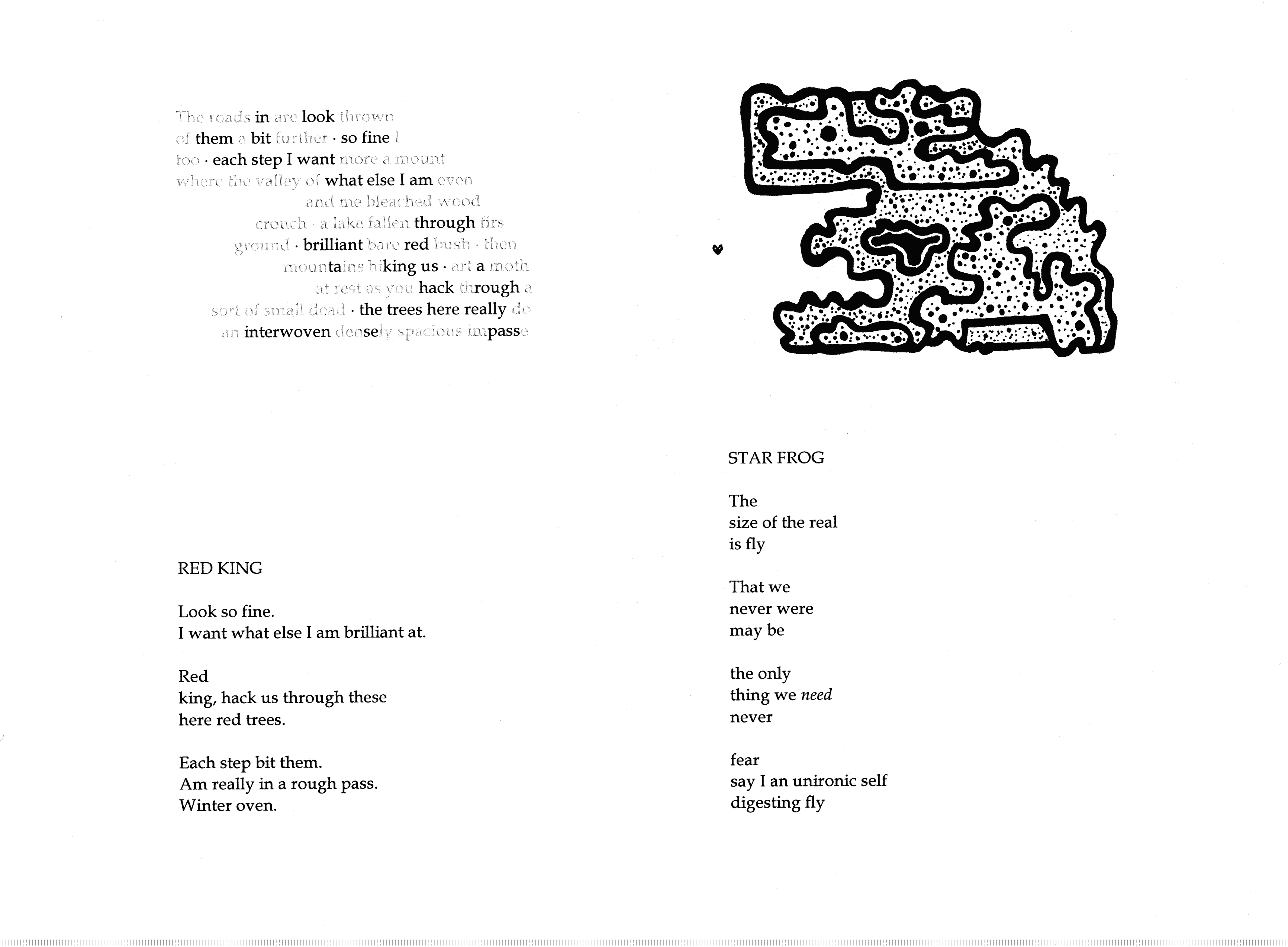
And perform the same extraction operation on this paragraph. This time my record of the process becomes a visual poem in its own right at hang on a threshold between signal and noise.

The roads in are look thrown down over a side
of them a bit further ∙ so fine I have to map that
too ∙ each step I want more a mountain road to
where the valley of what else I am even in win-
ter sunlight on it and me bleached wood in the
water in a crouch ∙ a lake fallen through firs in
the foreground ∙ brilliant bare red bush ∙ then in
a car with the mountains hiking us ∙ art a moth
taught us ∙ Just be at rest as you hack through a
rent sort of small dead ∙ the trees here really do
wake an interwoven densely spacious impasse

Extracted text stays black, a corona of greyscale text persists about it, the rest of it’s let fade to the colour of the page.


Precipitation

The second round of extraction yields a material enough enriched for the next transformation—precipitation of a verse poem. In this process material drawn from the prose paragraph descends and settles into verbal strata.

RED KING

Look so fine.
I want what else I am brilliant at.

Red
king, hack us through these
here red trees.

Each step bit them.
Am really in a rough pass.
Winter oven.

I count myself free, making this one, to arrange words and lines as I wish. But only get to use words I can plausibly find in the source paragraph. I interpret “plausibly” often quite and sometimes really very generously.


Illumination

A book made just of these poems seemed a cold prospect, too procedural, not human enough, so I started to think and feel my way towards companion poems—poems born of those already made, but freely, with no constraint or set procedure.

At first nothing came. One morning, though, staring at an extraction record in frustration, I started drawing lines around the black text, then round the grey. I thickened lines and emphasized the faces and forms I began to think I saw. The result was a monstrous assemblage of eyes and mouths, horns and spikes and tusks. Faces predominated, mostly in profile, and I found them both frightening and endearing. They seemed spirits caught up in all sorts of longing and yet capable of illumination.

I decided to trust the weirdness and began to do the same with other extraction records. Sometimes the process yielded a compost of half-formed faces. Other times, I came to a single form, as here, where illumination got me a frog.

Image - Frog Star

The extraction process may be familiar from Ronald Johnson’s Radi Os and Jen Bervin’s Nets, the precipitation process from Srikanth Reddy’s Voyager. Likewise these illuminations owe a debt to the work of Tom Phillips in A Humument. But as far as I know these methods haven’t been combined in this way or directed to quite these ends. Quite possibly for good reason.


Inspiration

The ghosts showed me the way to the fourth poem, the companion poem, which I hear as the voice of their suffering as it grows aware of itself. No constraints now except that the poem share a page with its illuminated precursor.

STAR FROG

The
size of the real
is fly

That we
never were
may be

the only
thing we need
never

fear
say I an unironic self
digesting fly.

The term “inspiration” may want scare quotes. One point here is to challenge our still persistent notion of the poet as a solitary figure fashioning her art ex nihilo. But still I feel that something in these poems draws a deep breath.


All Together Now

The four poems together make a two-page spread.

Upper left: prose scarred by an extraction process
Lower left: verse precipitated from the extracted ore
Upper right: illumination of the extraction scars
Lower right: verse inspired by the longing of the image

Click on me!
Click on me!