On “The Seafarer”

My commentary on The Seafarer for Unlikeness. Long cause I went to Pound. Here’s his Seafarer for you. At the bottom of the post, a special mp3 treat.


For literary translators of OE – for scholars not so much – Ezra Pound’s version of this poem is a watershed moment. His Seafarer in fact is a bearing point for any poet who translates into English; along with the Zukofskys’ Catullus and a couple of other seminal modern works of translation, Pound’s version, first published in Ripostes in 1912, makes later adventurous aberrant projects like Jerome Rothenberg’s “total translations” of Frank Mitchell and David Melnick’s Men in Aida conceivable. This book is nothing like those, but a brief look at Pound’s venture seems fitting, for any translation that comes after must contend with his garrulous and maddening astonishingly rightly-wrong one.

Pound spoke of three ways to freight words with poetic meaning: melopoeia, handling sounds; phanopoeia, throwing an image to the mind’s eye; and logopoeia, setting a word in a special relation to its usage.[1] Three worksites, ear, eye, mind. The trick with Pound’s Seafarer is that he translates faithfully for sound, opportunistically for image, and licentiously with thought. In setting these at the time somewhat scandalous priorities, Pound composed a translation of The Seafarer more objectivist than any heretofore, or probably since, though there have been sorry mimicries many.

As a patterned arrangement of sounds, Pound’s Seafarer is fidelity itself:
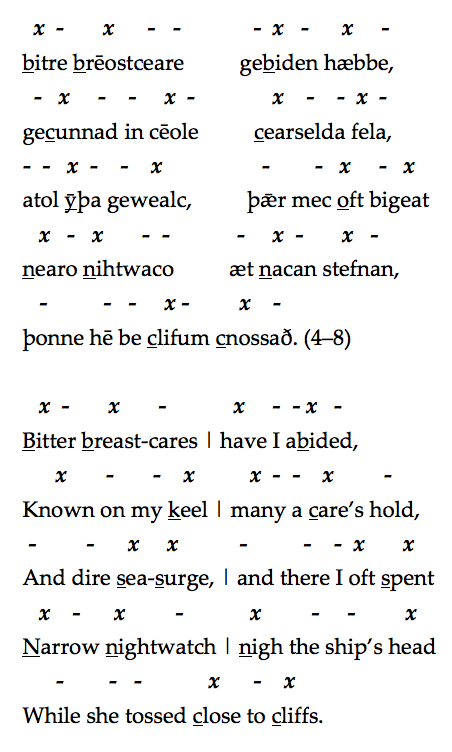
Screen Shot 2018-10-13 at 8.31.21 PM(x = primary stress)

He does far more than catch the feel of the AS cadence – often he keeps the rhythmic form specific to the verse. Where a verse in the source front-loads its stresses, as in bitre brēostceare, Pound’s verse does too, “Bitter breast-cares.” When the source spreads the stresses evenly across the verse, as in gecunnad in cēole, Pound does likewise, “Known on my keel.” When the OE verse reserves the stresses for the end, as in atol ȳþa gewealc, Pound’s verse does that too, “And dire sea-surge.” In this way he captures distinctive effects of the original, as in how the run of lightly stressed syllables before clifum mimes the rush of water towards the cliff. With alliteration, again, not only is the pattern preserved; in most lines the specific sound in the OE poem is kept. Pound translates the internal structure, what Hugh Kenner calls the “patterned integrity” (145), of the AS line; in that given pattern, all its variances, a specific intelligence is to be found, by which articulations of value not otherwise possible, are. Later he’ll speak of the rose magnetic forces shape in steel dust. That insight’s outside our purview, except that the AS poet, his line and his Seafarer’s exile, were clerestory to it.

Phanopoeia – an image thrown to the mind’s eye – means immediacy. In its speed of arrival is the image’s power. In The Seafarer Pound saw an accretive syntax that threw one image then another with minimal interruption:

Stormas þǣr stænclifu bēotan,          þǣr him stearn oncwæð,
īsigfeþera;          ful oft þæt earn bigeal
ūrigfeþra. (23–25)

Storms, on the stone-cliffs beaten, fell on the stern
In icy feathers; full oft the eagle screamed
With spray on his pinion.

An image is cast on the mind’s eye, another succeeds it, and in their likeness contrast and interpenetration, a new perception arises. Storms beat on the stone cliffs – they fall on the stern – as the former image presses through the latter, the force bearing down on the cliff-face becomes focused on the fragile hull of the boat. Then “In icy feathers” lays, over the brute force of the storm, a sense of something animate, almost delicate; then the feathers of spray, overlaid by an eagle’s cry, become eagle feathers, dimly heard;and then the storm throws its icy-feathered spray on the eagle’s wing, a sort of completion, storm-wing meets eagle-wing, as the sequence comes to rest.

He’s doing Vorticism, a short-lived movement in which he readied himself for The Cantos, in part by conceiving his ideogrammic method, which assayed in words the sort of montage Sergei Eisenstein accomplished in pictures. Both were incited by Ernest Fenollosa’s misapprehensions of the Chinese written character, but like Kenner I think Pound got some of his first stirrings from the Seafarer poet. Either way, it’s a gorgeous montage, one of many in his version, and it arrived as a new possibility for poetry in English. It came though at the cost of turning a bird (stearn “tern”) into the butt of a ship (“stern”).

Later, again using the AS poet’s accretive syntax to cast images in quick succession, Pound shrinks byrig “cities” into berries.

Bearwas blōstmum nimað,          byrig fægriað,
wongas wlitigað,          woruld ōnetteð (48-49)

Bosque taketh blossom, cometh beauty of berries,
Fields to fairness, land fares brisker

Faithful as a pup to sound, brilliant opportunist with image, Pound looks kind of slobby with what the words “actually mean.” And though in the abstract we may agree a poem’s meaning lies mostly outside its words’ denotations, we’re like to cry foul when dictionary sense is just forgot.

“reckon” (1) from wrecan, “recite”
“shelter” (61) for scēatas, “surfaces” or “corners”
“on loan” (66) from læne, “fleeting”
“twain” (69) for twēon, “doubt”
“English” (78) for englum, “angels”

One or two are felicitous; more look like gaffes; did he really just write in the ModE word the OE word reminded him of? We can maybe find justification for any given departure. This one was made to preserve the rhythmic or the alliterative fabric; that one refuses the connec­tive tissue that would set images in logical or causal arrangements; angels are demoted for the same reason the devil is erased later, to draw the poem back to what Pound thought were its pre-Christian origins. But the glary errors, taken together, suggest Pound didn’t care so much for the semantic values of the poem’s words – not as he cared for the sound matrix they were in, or for the image cascades they composed.

He sacrificed sense to hold a sonic form, or to sharpen an image sequence. He valued those most so he translated them foremost. Or, is it that word, image, sense were on an equal footing, another unwobbling stool, but loss of sense stands out most to us because symbolist reading habits make us meaning junkies? We may be as eager for a semantic meaning as the Seafarer is for a transcendent one, as ready to travel off in mōd from our embodiment, ear’s wonder, eye’s honey, to an abstract immaterial construction elsewhere. That was the temptation Pound spent his long cracked terrible beauty of a poetic life arguing tangibly against.[2]

The poem calls its abstract immaterial construction “Heaven.” The moment the poem commits to it fully, it also happens to turn a page – and Pound stops right here. Cuts the last 23 lines of the poem. He was sure they were the work of some later pious other. And he wasn’t alone in wanting to save an ostensibly pagan original from a later Christian overlay. His and others’ evidence: Right where folio 82v ends, the sentence ends too, and also the larger thought. Start of the next folio, hypermetric lines set in; pious commonplaces start to pile up; arguably, poetic invention falls off. And so more than Pound only have concluded The Seafarer is cut off by the loss of one or more folios, and what picks up on what’s now 83r is the middle some other, less interesting poem.

But the sudden shift to an earnestly Christian homiletic register would not have jarred an AS audience the way it does a modern reader. A lot of the impetus to break the poem in two came in the late 19th C. from scholars who wanted to recover a heroic pagan Germanic literature in its “pure” condition. While that drive has long since thankfully died, the case that the poem is interrupted, a chimera, has not yet quite. Pope and Fulk:

[T]he shift at this place from the specifics of a retainer’s sad condition – the approach of decrepitude, the loss of a lord, the futility of burying gold with the dead – to a passage of mostly devotional generalities, in conjunction with a sudden change to hypermetric form, raises the possibility that The Seafarer is not one poem but fragments of two. It is not necessary to read the text this way … but unity of design is by no means assured. (102)

They like the question for displaying a sort of indeterminacy special, they say, to OE studies, with its single copies of poems handwritten by error-prone scribes in frangible manuscripts. And I’m not one not to cheer twice for indeterminacy. Still, I see a single poem, a single author. The shift to hypermetric (six-stress) lines doesn’t last long, and such lines come and go in a number of the Exeter poems. The switch to a homiletic register fits the dramatic, emotional, and spiritual arcs of the poem, and is consonant with other poems of its ilk. And the closing lines do have poetic force, something in places quite majestic. Yes, the last few lines are sententious, but other OE poems of the first order have like passages; and as I note below, the scribe does quietly set them a bit apart. I see nothing out of fit here, just ordinary variousness.

The seam at the end of the folio (l. 103) is just one of the aporiae that have thrown the poem’s unity into doubt. Another is that its sea voyage seems literal at the outset, full of material details that resist the calculus of allegory mind—an ice-clotted beard, a mew gull’s cries; and yet misfires in the Seafarer’s discourse around the voyage start to invite figurative reading and to load the journey with allegorical freight; and yet, as one ventures into allegory, the voyage itself disappears from view, not to be seen again. How to reconcile these signals and keep the poem one poem? Whitelock has argued (Pope and Fulk 100) that the journey is literal from start to end; religious self-exile and pilgrimage were actual AS cultural practices, and this is a composite account of such a journey. Conversely, for Marsden, the journey stands from the start for the Augustinian pilgrim’s passage from the earthly to the heavenly city; the Seafarer’s exile is not from the towns of men, but from Heaven, whence he also is bound (221). I take a middle position, feeling the poem morphs from literal to allegorical: the journey begins as an actual journey, full of resistant earthly textures, and gradually, thanks in no small part to the misfires around forþon crying there’s more here than meets the eye, metamorphoses into journey as allegory. The journey journeys. It’s subtle, there being no one point where we can say the journey has changed its nature, from literal to figurative. The transformation is as mysterious, imperceptible, and I think maybe undeniable as the metamorphosis the pilgrim aspires to.

A third aporia is the speaker’s ambivalence towards sea voyaging. He hates it, loves it, loves to hate it. At sea he longs for the delights of human company. Among men and women he thirsts for his cold hard life at sea. His ambivalence, and especially the pressure he puts on the word forþon “therefore” – which seems sometimes to mean just that, and sometimes about the opposite, “even so” or “just the same” – have vexed readers who want a unitary speaker, leading some to treat the poem as a dialogue. Frankly, as a poet who makes his living off mixed feelings, I have trouble seeing the problem. Keats, Negative Capability, solved. More interesting is that it’s been an interpretive problem in the first place. Belonging to print and internet cultures, we’re attuned to certain ways of rendering mixed feelings – synchronic ways, mostly, particularly irony, where one attitude is layered over another, with gaps for the underlayer to show through. Think George Eliot, Jordan Abel, a well-crafted tweet. In The Seafarer oral storytelling conventions persist, and oral traditions don’t, to my knowledge, use irony to create interiority. Some, though, convey mixed feelings diachronically. In The Odyssey, the consummate seafaring story as it happens, when Telemachus expresses two conflicting feelings adjacently, it’s not a contradiction or a change of heart, but a two-step account of an inner conflict: the poet describes one feeling, then the other, and his audience knows they cohabit in the young man’s mind. Some of what seems like self-contradiction in The Seafarer may be the work of unfamiliar narrative conventions. And some of it is the AS poet’s use of logopoeia in putting forþon in a torqued relation to its ordinary usage.

There are two capital letters in the MS, both near the end of the poem, and I’ve broken the OE transcription into verse paragraphs accordingly. I don’t posit a new speaker for the final lines, let alone for the closing “Amen,” but rather the same speaker putting on the new voice he has aspired to the whole poem.


Phew. Thanks for hanging in there. Just the first lines of mine …

THE SEAFARER

I can from myself call forth the song,
speak truth of travels, of how, toiling
in hardship, hauling a freight of care,
I have found at sea a hold of trouble
awful rolling waves have, too often,
through long anxious nightwatches
at the prow, thrown me to the cliffs.
My feet, ice-shackled, cold-fettered,
froze, even as cares swirled hot about
my heart and inner hungers tore at
my sea-weary spirit. You can’t know
to whom on land all comes with ease
how I, sorrow-wracked on an icy sea
wandered all winter the way of exile,
far from kinsmen, my hair and beard
hung with ice, as hail fell in showers.
I heard nothing there but sea-surge
and icy surf, swan song sometimes,
took the gannet’s cry and the voices
of curlews for human laughter, made
the call of a mew gull my honeymead;
storms beat at stone cliffs, icy-feathered
the tern answers, a dew-winged eagle
screeches; no sheltering kinsman here
who might console a desolate spirit.

And, special treat! Ezra Pound reading his translation (with drums).


[1]. You can still charge words with meaning mainly in three ways, phanopoeia, melopoiea, logopoeia. You use a word to throw a visual image on to the reader’s imagination, or you charge it by sound, or you use groups of words to do this. Thirdly, you take the greater risk of using the word in some special relation to “usage,” that is, to the kind of context in which the reader expects, or is accustomed, to find it. – ABC of Reading (37)

[2]. I have tried to write Paradise // Do not move / Let the wind speak / that is paradise. – The Cantos (822)

teaching portfolio

A clutter of starlings

Another riddle for yehs. Birds? Or maybe it’s unsolvable & that’s the solution.


Clutter of Starlings

Đeos lyft byreð          lytle wihte
ofer beorghleoþa,          þā sind blace° swīþe,
swearte, salopāde.          Sanges rōpe,°
hēapum fēraþ,          hlūde cirmað. ⬩°
Tredað bearonæssas,          hwīlum burgsalo
niþþa bearna°          nemnað hȳ sylfe.° :⁊

Clutter of Starlings

Nightair carries little creatures over
the hillside, they are black, very black,
their coats are dark. Singing profusely
they spread out in bands, call out loudly –
treading wooded headlands, sometimes
in halls of men they name themselves.

Commentary

Though the birds are full of articulate noise, and cross at the end the verge of human dwelling, the poem is not in their voice, but that of a human riddler. Their flight habits seem those of starlings, which travel in great clouds, following the contour of the countryside, sometimes at twilight. Muir, however, sees swallows, which have dark backs and pale underparts; if you read blace (2) with a long vowel, blāce, it goes from “black” to “bright,” and you can get to a sort of swallowy look:

Little creatures ride the air
over the hillside, flashing brightly
black, dark-coated. Singing profusely
they go in flocks

Also, swallows are more likely than most to swoop into a human dwelling. But a group of them is not quite a hēap (4) “band, multitude,” and no way can they be said to tredað (5) “tread” the earth; while starlings come in crowds and are conspicuous walkers.

More birds than these two have been proposed; it’s one of the Exeter riddles more resistant of answer. Niles likes the crow, crāwe, as the bird most likely to name itself with an onomatopoeic call. Crows do gather in flocks, and they tread the earth, but they’re even less songful than starlings, and not so little neither. Other birds posited: swifts, jackdaws, house martins. Some readers go onward to bees, hailstones, raindrops, storm clouds, musical notes, damned souls, demons – but a bird does seem most likely, even if the thought of musical notes tromping the countryside in black coats is awfully surreally lovely.

In The Riddle Ages, a smart multi-authored blog devoted to the riddle poems, Michael Warren notes that all birds in the Exeter riddles elude naming to some degree. Transecting earth and heaven, betimes kissing-distance from human beings, betimes flyspeck-far in the sky, they are liminal to us, coming as they go, going as they come. So many of them, in such variety, and they flew off so fast, how could language catch them?

[S]cholars across the medieval period stress that what is most birdy about birds is their transformative abilities. Or to put it another way, what most defines birds is their habit of avoiding definition – they’re intrinsically unknowable in some respects, escapologists.

Medieval encyclopaedists like Bartholomew the Englishman and Saint Isidore of Seville found in birds, Warren adds, a locus for some of their more general anxieties about naming. Words are themselves birdy, keeping escaping us, and these bird riddles, with their soundplay and wordplay and the pressure they put on acts of naming, delight in linguistic mischief. Fugitive moments roost in them, small and large, chirping, singing, flitting, shitting – puns, innuendoes, ambiguities, runes, misfires. They like the unlikenesses.

In this one, the clues point akimbo, like jayfeathers after their bird fell into a bath and scrambled out. With the change of a vowel value black turns to bright. They may be named either to or in human halls. The crowning ambiguity’s in the last verse, nemnað hy sylfe, which can be read as either an imperative, “name them yourselves,” or a declarative, “they name themselves.” Read it one way, we’re told what to do, but we can’t, with the clues pointing this way and that. Read it the other way, we maybe get another clue – is their call onomatopoeic? – but it taunts us with the birds’ apartness: they call themselves a name we’re not told.

Reading this aporia, Warren suggests the riddle may be unanswerable, or even that its answer may be unanswerableness. We hold an object that’s also a subject, it remains nameless or polyonymous; empty, many-natured. The birds invite us, as Warren puts it, to

inhabit a space somewhere between knowledge and ignorance, just as the birds themselves sometimes dwell with niþþa bearna “the sons of men” and sometimes move beyond our boundaries to the bearonæssas “woody headlands.”

Or, if we must know, be holy fools in what we know. Isidore in his Etymologies writes of birds: “They are called birds (avis) because they do not have set paths (via), but travel by means of pathless (avia) ways.” Let this riddle and that sentence put to rest any thought that wordplay of the sort seen in Perec’s La Disparition or Alan Davies’s a an av es is new in the world. We’ve been switching letters to make new meanings for as long as we’ve been swapping nucleotides in codons under our rubric as sapiens, the wise ones, the percipient.

Notes

2     blace. Usually read with a short vowel, as “black,” so that the sequence blace swiþe, / swearte, salopāde translates as “very black, black, dark-coated.” The redundancy is its own little puzzle.

3     Sanges rōpe. “Bountiful of song.” The phrase, which somewhat inhibits a reading of “starlings” or “crows,” doesn’t especially point towards “swallows” either.

4     The punctum puts the poem’s turn here. If it’s taken seriously, then tredað bearonæssas “tread wooded headlands” belongs to the closing verses and the final sentence, and the birds’ walking is kin to the human activity of these lines, hall building, meadjoys. It is almost as if they become human visitants.

5–6   hwīlum burgsalo / niþþa bearna. It is either to or in the burgsalo “city-dwellings” of niþþa bearna the “sons of men” the birds are named. Whether or not they set wing in a hall, a call penetrates, makes present.

6     nemnað hȳ sylfe. Either “name them yourselves” or “they name themselves.” Traditionally editors have preferred the former – it’s often seen at the end of riddles – but according to Warren the latter has recently gained favour.


P.S. [after checking out images of starling clouds] Maybe their song is synaesthetic – goes to eye not ear – astonishing chord of their synchronic flight. See Pound’s Canto LXXV.

starling cloud

A Bookworm

The final poem of Unlikeness Is Us. Undereating the whole thing.


A Bookworm

A moth ate words. Which seems
splendid to me. Think of the wonder
that worm consumed, riddles we wrote,
a thief in darkness of our deep musings;
the stiff parchment too – and the thief not
a whit wiser for the words it swallowed.

A Bookworm

Moððe word frǣt.°          Mē þæt þūhte
wrǣtlicu wyrd,          þā ic þæt wundor° gefrægn,
þæt se wyrm° forswealg          wera gied° sumes,
þēof in þȳstro          þrymfæstne cwide
ond þæs strangan staþol.          Stælgiest ne wæs                         (5)
wihte þȳ glēawra          þe hē þām wordum swealg. ⬩

Commentary

This one’s based on an ænigma (no. 16, “Tinea”) by Symphosius:

Littera me pauit, nec quid sit littera noui.
In libris uixi, nec sum studiosior inde.
Exedi Musas, nec adhuc tamen ipsa profeci.
                    (Glorie 637)

Letters fed me, but I do not know what letters are.
I lived in books, but am no more studious for that.
I devoured the Muses, but still have not myself progressed.
                    (Cavell trans., n.p.)

Not a translation but a transmutation of a Latin precursor. It has digested a prior poem, one by Symphosius, to arise remade in a new language, and a new rendering. So the poem about a bookworm is a bookworm. Intertextuality is the modern word for this ancient preoccupation. It’s as old as writing is – older, in fact, as old as spoken stories are, which change as they change hands and minds, recombining each time they’re told. That interchange is pretty ordinary in an oral tradition and doesn’t warrant a lot of special attention. When writing fixes speech, though, tries to make it a thing durable, its ongoing decay on all sides becomes something to talk about.

One challenge in this riddle is to figure out whether the words eaten are oral or written (Cavell n.p.). The word gied (3) “song” suggests the former. How do you eat a spoken or sung word – by hearing it? Two lines later, strangan staþol (5) “strong foundation” points towards a thing that’s read, parchment, binding. You could eat that by reading it, but it’s clear this consumer’s no reader. How to reconcile one gesture towards voice and one towards written form and frame? John Niles (121–22) suggests we go with written song – specifically the canonical psalms of King David. The Song of Solomon, with its secret visits in the night, akin to thievery, also comes to mind. Whatever you take the text consumed to be, the consumer is usually thought a bookworm: that’s how to eat writing without getting it. Its work isn’t profitless though. Worm becomes moth, matter’s made energy, parchment flight. Not a whit wiser, but a marvel; and the worm knows what readers forget, that the text is a thing in the world, storehouse of energy.

Just as “bookworm” is metaphor for a certain sort of reader, though, some readers of that sort, scholars, will burrow into the bookworm for a meaning more hidden. I’m drawing from Megan Cavell’s post on The Riddle Ages and her thoughts on the Latin ruminatio, which worked dually, just as our word “rumination” does. It’s how a cow chews and chews, also how one mulls an idea, pre-digesting it. If the poem’s written with this sort of slow absorption in mind, it’s possible it does, in addition to its lateral metonymic work of turning parchment to worm to moth, also some vertical metaphoric work. Who else in its world chewed dumbly awaiting metamorphosis? The moth is cast across a region of unlikeness towards, perhaps, some poor monk or student with bad teeth, breath, acne. And the likeness that carries us with it across the lie? Moth and student are both larval forms, in waiting. (Isidore of Seville would enjoy it that in our English only one letter separates pupal from pupil.) A creature chewed uncomprehendingly on words, and now, having gone off, witless and winged, it’s gained some sort of mastery. A professor?

Notes

1     Moððe word frǣt. Williamson: “the initial half-line contains a double disguise: moððe for wyrm and word for bec” (285). The worm presents as its future as a moth, the book as the words it contains. Projective, metonymic.

2     wundor. In the OE, it’s the fact of consumption that’s a marvel, not a wonder that’s consumed. More faithful to the letter would be: “What a wonder! That the worm consumed words someone wrote.”

3     wyrm. Note the play among near-homophones, word, wyrd, wyrm. Word, fate, and worm bound together in orþoncbendum, skillful contrivance. ¶ gied. Usually “song.” Cavell (n.p.) translates this verse “a certain man’s song.” However, gied can also mean “riddle,” and to an uncomprehending worm, the whole library would be insoluble, if digestible.


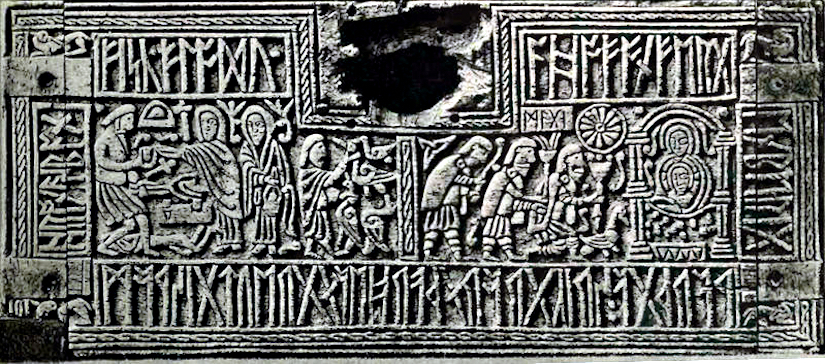
The image atop is the front panel of the Franks Casket – riddled with holes, graven with a runic alphabet whose import as a whole’s up for grabs. Consider the opening paragraph of the online article that accompanies the image

One of the more vexing problems facing scholars of Anglo-Saxon art is the simple fact that we often do not know precisely what it is that we are dealing with. I am speaking not so much of the questions of dating and localization that hamper the study of medieval art. Rather, it is that we cannot even say for certain what many of our most famous objects even are, or were intended to be. The Franks Casket, for example, has been identified as a treasure chest or a book shrine, and was used in the later Middle Ages as a reliquary, but all we can say with any certainty is that it is a box that likely originally had a latch.

Riddle me this. This here worm, had he the time, would read it all. But bed.

The Swan

From Unlikeness Is Us. With thoughts on the Anglo-Saxon riddle as a threshold genre, and how can the more-than-human speak in our rather human poems.


The Swan

My dress silent when I walk on land,
or house myself, or stir up the water.
Sometimes my clothing and the air
lift me above the human dwellings,
and for that all the powers of cloud
bear me on – my white vestments
sound loudly and resound sweetly,
sing clearly, when I rest on neither
earth nor water, wandering spirit.

The Swan

Hrægl mīn swīgað°          þonne ic hrūsan trede,
oþþe þā wīc būge,          oþþe wado drēfe.
Hwīlum mec āhebbað          ofer hæleþa byht
hyrste mīne          ond þēos hēa lyft,
ond mec þonne wīde          wolcna strengu°                         (5)
ofer folc byreð.          Frætwe° mīne
swōgað hlūde          ond swinsiað,
torhte singað,          þonne ic getenge ne bēom ⬩°
flōde ond foldan,          fērende gǣst°. ⬩   :⁊

Commentary

There are ninety-five riddle poems in the Exeter Book. Give or take – a few short poems, whether or not they’re riddles is an open question. A few haven’t been solved for sure; some effectively announce the answer in the first line. In some the thing speaks for itself; in others it’s described by a curious or bemused third party. Most are marked by compact wordplay, many by playful, occasionally salacious banter. Some end with a challenge – name what this is.

“The Swan,” like many of them, offers speech to a thing we would have thought speechless (a kind of prosopopoeia). What to make of that depends on how hard you look. Pressed lightly, the poem is a happy game of make-believe. “Imagine a swan could speak!” And it’s nice to find a ludic impulse in a body of work often thought wholly gloomy in its celebration of heroes done in by wyrd. Read at this pressure, the riddle poems show a debt to a post-Classical genre that dates back at least to Symphosius (ca. 4th–5th C.), whose three-line, apparently extempore Ænigmata inspired translations and imitations by Aldhelm (639–709), bishop of Sherborne, and Tatwine (ca. 670–734), archbishop of Canterbury, among others. The influence of these precursors, all in Latin, can be felt in the Exeter riddles, but the latter aren’t for the most part translations or imitations; they tend to be longer, more detailed, and more playful stylistically than their forebears (Marsden 310).

Look harder, the ludic becomes lucid, as the brute world is found to be sentient. A swan speaks; later in these poems, a cuckoo does; elsewhere among the riddles, mead, a tree, a mail coat, a reed pen. The poems recall for us an old human premise we’ve forgotten or grown unconscious to – the sensuous surround of stones and trees and birds and bugs is awake, articulate. Maybe in these poems the notion was just taken down from a shelf in the mind for use in a verbal parlour game; maybe it also touched on grave true belief. Compare an earlier instance, both playful and earnest, an Archaic Greek cup on which the words are inscribed, “I am Raven’s wine cup.” Robert Bringhurst writes of it:

[What] the Lindos cup asserts, apart from its owner’s name, is its own articulate vitality: “I am.” This is an animate, vocal drinking vessel, likely to cry for help if you should put it in your pocket and walk off. (175)

That cup, this poem, belong to an animist inheritance, the final human universal.[1] The first-person riddle poems take it as a given that our minds engage in a larger network of minds endowed with sense and speech and reciprocal responsibility. In this they rebut the Seafarer and the Earthwalker, who in their ascetic commitments aim to leave earthly being behind; for them the meaning that matters is not in matter – is, as for Augustine, immaterial and indefinitely deferred. But even they, lonely and cold, can’t help but take birdcalls for human chatter, the birds themselves as human comrades. They can’t escape their own imaginations, any more than they can be not an animal, or evade having been born.

All objects potentially subjects. The notion sits near the heart of the objectivist mode. You see it especially in the Objectivist poets after whom the mode is named. When George Oppen avows the life of objects in “Of Being Numerous”

So spoke of the existence of things,
An unmanageable pantheon

Absolute, but they say
Arid.
           (“Of Being Numerous”)

or Lorine Niedecker lays for that pantheon a sensate material ground

“We have a lovely
          finite parentage
                    mineral

vegetable
          animal”
                    Nearby dark wood –
                               (“Wintergreen Ridge”)

they’re stepping into a way of thinking the riddle poets walked before them. The habit of mind went underground, not away.

That’s one side of it – the object is hallowed.

The other is, it’s hollowed out – appropriated, made to speak with a human tongue, of human things. The swan has not feathers but hrægl “garments,” which are later seen as frætwe “ornaments” – as if a bird had clothes and vanity and the social energy for all that. As it rises from the world we know, flood and field, it calls itself fērende gǣst “wandering spirit,” or else fērende gæst “wayfaring guest” – terms that connote the soul, a guest on earth, fleeting in flesh before it ascends to Heaven. The living creature is made to do a job in a Christian sign system, and in this respect, it’s made a tool. The swan is here to shed light on the human world, its social and ecclesiastic arrangements. This is the mind of resource extraction, alert to use-value. That that value is cultural, then production of meanings, rather than grossly material, the production of food or drink, tractors, iPhones, matters not so much. The swan belongs to us, it has been baptized, domesticated. [2]

And, yet, some of its swanness hangs about it still. Made a tool, it’s not reduced to tool. Put in human terms, it’s marked by its distance from human realms: not on land, not on water, far above our dwellings. The sky it flies across calls to mind Heaven but stays a material sky. And the swan is only crossing, notheaded upward, as the soul we might  want it to stand for would be. As it leaves our sight and the poem, if we feel the affirmation of a Christian construct, we feel as much a visit from outside our constructions. And even as it is made to speak human (how else could the poem make it understood?) its words make the sounds its wings would in flight: swīgað, swōgað, swinsiað – sounds that also point, as Lockhart notes, to its name, the riddle’s answer, OE swan. In the sign-realm the swan is put to work, as said, doing our heavy lifting; in the sound-realm it sends, by onomatopoeia, a coded message, one true to its name in human speech, but also to the swish of its wings. Is it ours, then, or not ours, an it or a thou?

The poem’s a cross-section through a dialectic unfolding on a threshold. The human realm commodifies a non-human mode of being for tool-use, even as that more-than-human being brushes us with meanings not our own. Abiding on that threshold is how the poem appears to tremble. The riddle poems draw their other into the borderlands of human use, where the mystery of what it was before contact with human hand or mind (a tree, a seed, honey, the inside of an egg) still hangs about it as aura, and the mind of utility, seeing a tool (rune stick) or food (onion) or drink (mead) or sign (cuckoo) possible, works to harvest the mystery.

The poem is a look at that work, right at the moment of naming, when the name is a shining new thing, as for Adam.


I wanted to go somewhere with unclosedness: that language, though inescapably human, in its indeterminacy leaves gaps the non-human comes streaming in thru – thinking especially of that gǣst/gæst play at the end, how it multiplies meanings and leaves something unresolved, uncompletable. Because rhizome. But it’ll have to wait for another day. Got a heap of other poems to comment on & a tight deadline.


Notes

1     swīgað. Marsden notes a play between this word, “be silent,” and swōgað (l. 7) “make sound.”

5     wolcna strengu. “Power of clouds (or skies).” A kenning for wind.

6     Frætwe. Literally, “ornaments.” In other contexts, fields that cover the earth and armour that covers a warrior’s body are described as frætwe. Here the word refers to the bird’s plumage.

8     The punctum, appearing mid-sentence, emphasizes the speaker’s absence, ne bēom. In an MS without line breaks, it also, with the punctum that follows, sets off the last line as a compositional unit:

flode ond foldan ferende gæst

9     gǣst. Vowel length is unmarked in the manuscript, so this word may be read as gǣst “soul, spirit,” as gæst “guest,” or as both.


[1] An exercise I used to give: “Take a pencil and paper and make a quick sketch of a friend. Include whatever makes them them to you – how their hair curls, their unfashionable glasses. Now take your pencil and stab the eyes out. Stop. No need to do it. Instead just notice what happened in you the moment I asked you to.” We’re all still animists. I don’t think there’s any art without it. I stopped giving students the exercise because it made the point too well, disturbed all of us.

[2] What men want to learn from nature is how to use it in order to wholly dominate it and other men. That is the only aim. There is to be no mystery. And this disenchantment of the world is the extirpation of animism. In time the multiplicity of forms is reduced to position and arrangement, history to fact, things to matter. —Theodor W. Adorno and Max Horkheimer, Dialectic of Enlightenment (5–7 passim)

The Wolf

What I been working on. With a deadline pushing. Speaks tonight to my condition too, a bit lone a bit ferocious. So a bite from Unlikeness Is Us, fourteen carried o’er from the Old English, to come from Gaspereau fall 2017 2018!


THE WOLF

As if one had made the people an offering.
They will receive him if he comes in violence.
      Unlikeness is us.
The wolf is on an island. I am on another.
Mine is secured and surrounded by marsh.
The men on that island are glad at war—
they’ll receive him if he comes in violence.
      Unlikeness is us.
I have borne a wolf on thought’s pathways.
Then it was rainy weather and I sat crying.
When the war-swift one took me in arms,
the joy he gave me, it was that much pain.
Wolf—my Wolf—thoughts of you
sicken me. How seldom you come
makes me anxious, not my hunger.
Listen, overseer, to our miserable whelp
     wolf bears to woods.
Easy to make two what was never one;
     our song together.


THE WOLF

Lē­odum is mīnum          swylce him mon lāc° gife.
Willað hȳ hine āþecgan°          gif hē on þrēat cymeð.
      Ungelīc is ūs.°
Wulf is on īege,          ic on ōþerre.
Faest is þæt ēglond,          fenne biworpen.                                   (5)
Sindon wælrēowe          weras þǣr on ige;
willað hȳ hine āþecgan           gif hē on þrēat cymeð.
      Ungelīce is us.
Wulfes ic mīnes wīdlāstum          w­ēnum dogode°.
Þonne hit wæs rēnig weder          ond ic reotugu sæt.              (10)
Þonne mec se beaducāfa          bōgum bilegde,
wæs mē wyn tō þon,           wæs mē hwæþre ēac lāð.
Wulf, min Wulf,           wēna mē þīne
sēoce gedydon,           þīne seldcymas,
murnende mōd,           nāles metelīste.                                          (15)
Gehyrest þu, ead wacer°,           uncerne earmne hwelp
      bireð wulf tō wuda.°
Þæt mon ēaþe tōslīteð          þætte nǣfre gesomnad wæs,°
      uncer° giedd geador.


COMMENTARY

More commonly “Wulf and Eadwacer.” A woman speaks. She’s pregnant and her people are hostile to the father of the child. Not much else is settled about the poem. Wulf may be a raider from another clan; is their encounter a rape, as has often been thought? That makes her longing for him awfully hard to account for. Something more mutual then. Still though the poem is riven with her ambivalence – she wants him to come, and wants him not to come, and the doubleness in her thought sickens her.

Her ambivalence streaks the poem with ambiguities. A refrain, Ungelīc is ūs, as odd in composition and placement as Stein’s “The difference is spreading.” A female speaker whose relation to the masculine warrior ethos is intimate but aslant and has, for us, only a few interpretive helpmates in the Anglo-Saxon corpus (primarily “Her Case”). Verbs that appear nowhere else in the literature and must be defined in a context as nearly unprecedented as they are. A scribal practice of leaving names uncapitalized that makes it difficult to discern person from epithet from animal. When is wulf a wolf and when is it her Wulf? An oral tradition, not long left behind, in which the utterance “wulf” could function without trouble as both. The scribe, following his lowercase practice, could preserve this ambiguity, but a modern editor has to decide.

I take ead wacer as an epithet, not a name, which plucks out the third party usually thought to be involved – a husband cuckolded by the raider Wulf. That’s extra, a late entry throwing off a poem exquisitely balanced dramatically. Her people and her own mind are opponent enough. Other readers have doubted this third party too: one has, for instance, read the compound as an epithet for Wulf himself, “joy guardian.”

In this translation, which is literally anachronistic, ead wacer is the one who gehyreþ the spoken poem, the wacer of the written poem, the listener, the reader. Not that we’re her imprisoner exactly – but if we weren’t here, she wouldn’t be, either. She’s been hurt into a consciousness so sharp it tears the fabric that gives it voice. Tears the air or page that binds her to, as it divides her from, her first and last interlocutor, us.


NOTES

  1. lāc. Offering or gift, especially in a ritual sense. A sacrifice; in some contexts a message.
  1. āþecgan. The verb appears to mean “receive” in the sense of food, with a suggestion of killing, destruction, consumption.
  1. ungelīc is ūs. Literally, “(it) is different (with) us” or “(it) is different (between) us.” Disagreement whether the difference is between the speaker and Wulf, or between speaker-and-Wulf and the speaker’s people, or both.
  1. dogode. Possibly the past tense of an otherwise unrecorded dogian, meaning something like “to suffer” or “to follow,” maybe here in imagination (Marsden). Some amend to hogode, past tense of hogian, “to consider, to dwell upon” (Muir). My translation draws from both senses.
  1. ead wacer. Most take this as proper name, that of the speaker’s husband. Ead, “riches, prosperity, joy, property.” Wacher, “watcher.” A possessive spouse and enemy to Wulf. However, because the scribe does not use capital letters to distinguish names, the compound can also be taken as an epithet; one reader reads the compound as an epithet for Wulf himself: “joy guardian” (Marsden). I’ve translated something I hear near the core of the phrase, a sense of being thronged by eyes all round. Note that she calls on the watcher not to see but to hear. She will rip him if she can out of his crowning sense function.
  1. bireð wulf tō wuda. The verb, “bears,” may be in either the present or the future tense. Is she crying wolf here or naming her Wolf? Which is it carries, or will, her newborn whelp to the woods and to what end?
  1. Þæt mon ēaþe tōslīteð | þætte nǣfre gesomnad wæs. Literally, “The man easily tears apart what was never joined.” The line doesn’t alliterate. Muir: “[It] has the ring of a gnomic utterance, and may well be an Anglo-Saxon rendering of the biblical ‘Quod ergo Deus coniunxit, homo non separet’ [Therefore what God has joined together, let no one separate] (Matt. 19:6), which might account for its not following an accepted alliterative pattern.”
  1. uncer. First-person dual genitive – “of us two.” Ours as in yours and mine.

Image atop, a belt buckle recovered from Sutton Hoo burial site. Shining instance of orþoncbendum, inborn shaping, cunning clasping, what I am more and the more finding in these poems. Sneaky snakework of this mind.

“How will this project contribute to your artistic development? advance artistic practice?”

From, ho hum, another grant application.


I’m certainly entering new terrain as an artist with SCRO. In earlier projects I’ve experimented with visual poetry and with handwriting, and worked on the threshold of legibility, but I’ve always been bound to the page, 8.5 x 11, and to the still image. The only sound I’ve brought to bear has been my own reading voice occasionally. In SCRO, projecting images on a surface, I work with the relation between embodiment (the movements that make the writing and the rocking that creates the distortion) and disembodiment (so many photons on a wall). Putting those images in motion, I have a whole new language in which to think and feel through time and change. Conjoining images with sounds, scriptural marks with audio tracks of household noise, I can create juxtapositions that are not narrative or expository but lyrical, syncretic, and happenstance. The relation of image to sound is a bit like the relation between the singing voice and the played instrument that was once the mainstay of lyric poetry: complementary and complicating. Except here the singing voice is visual, and maybe a bit ’pataphysical, a nonce botanic script.

SCRO is for me a lyric poem. If it advances artistic practice, it does so by testing the range of what’s possible or admissible in the lyric. It goes to the edge of illegibility, then pulls back a step, so its words get to mean by fits and starts – what, it asks, is the feeling tone of that? It takes chance operations, grown cold in the hands of some conceptual poets, and brings them to bear on emotionally hot material – family trauma, the degradations of old age. Can it be a conceptual poem even if (pace Goldsmith) it demands to be read? Can it be a lyric poem even when there’s really no “reading” it? The poem has no coherent “I” to hold it together; he dissolved early in the process of distorting the memoir. Can the 16:9 frame in which nameless shapes come and go do the work of an “I” – be attention, be sentience? If so, is that the acme of lyric experience, or its abolition? I don’t have answers to these questions, just instincts and biases, but faithful attention to SCRO might raise them in some viewers.

On abandonment


Been my work to report from the inside of what Winnicott calls “unthinkable anxieties” or “primitive agonies.” Others have said “annihilation terror.” The feeling I’m about to be snuffed out, next instant, makes no sense I’m going on being at all. Whole universe withdrawing from me in the mode of female rejection. Times I’ve wanted to help the process along, step in front of a truck. No, not now, not for a long time – I’m okay. This is a field report not a plea.

All the childs feel them. Belongs to being human, animal part stone part star. Most of us probably have echoes in us, form of nightmares, neuroses, phobias, premonitions. And some us saints been left with ’em more wholesale.

A rupture with my lover (screwy and I hope brief) and another with my mother (my choice and I fear for good) have me in a rough pinch right now. Add an intrusive procedure this AM to look at my bladder by the only route on offer – I fucking wept, not with pain, it hurt bad but was the intrusion got my sorrow on – and I really am in a way this evening.

A life’s work, wow, yeah. Tracing and reporting on it. How I hollow out inside. Or how the whole world, every perceptible instant, birdsong say, recedes from me, becomes alien, taunting, hostile.

Those who got stuck at this juncture with me will know it already. Those who made it through may not remember it. The forgetting is salutary, why should I ask you to remember. I have no good answer to that, right now.

But also, points of exit, relief. This terror, when I’m in it, is my ground – I’m looking to speak my ground. But also to find the ground under my ground and to soar from it.

Well. I’m sitting at Menace Brewing, trying to work on my Old English ms, due sooner than I fear I can manage, but this blog post called. I want to write about Winnicott, kindest of the psychoanalysts, but if I start I won’t stop, and I’m away from my books anyway. His interfusions with the buddhadharma are many. I have a feeling he underwrites, already, my Dura Mater.

And sorrows of these women I don’t understand, and have had a hand in, and feel held to account for. Sorry I’m mysterious there. The only life I get to strip mine here is my own.

I’m a man nearing 50 with a squalling inconsolable babe in me.

This grabbed (later) from Maggie Nelson’s Argonauts:

As concepts such as “good enough” mothering suggest, Winnicott is a fairly sanguine soul. But he also takes pains to remind us what a baby will experience should the holding environment not be good enough:

The primitive agonies

Falling for ever
All kinds of disintegration
Things that disunite the psyche and the body

The fruits of privation

going to pieces
falling for ever
dying and dying and dying
losing all vestige of the hope of the renewal of contacts

Mothers they got it tough. I don’t know how any of them do it. And its going wrong, well, Winnicott thought some of the world’s hurt could be explained there.

I say to me, you got to mother yourself, no one else will, you got to father yourself, no one else will. Everything that is here is here with you. What’s the practice of that though.

A lifetime looking, and I’ll be honest, not not finding.

Hard to remember when the fear sweeps through you as nebula.


Dear Canada Council, love, C.

A grant application I done sent.


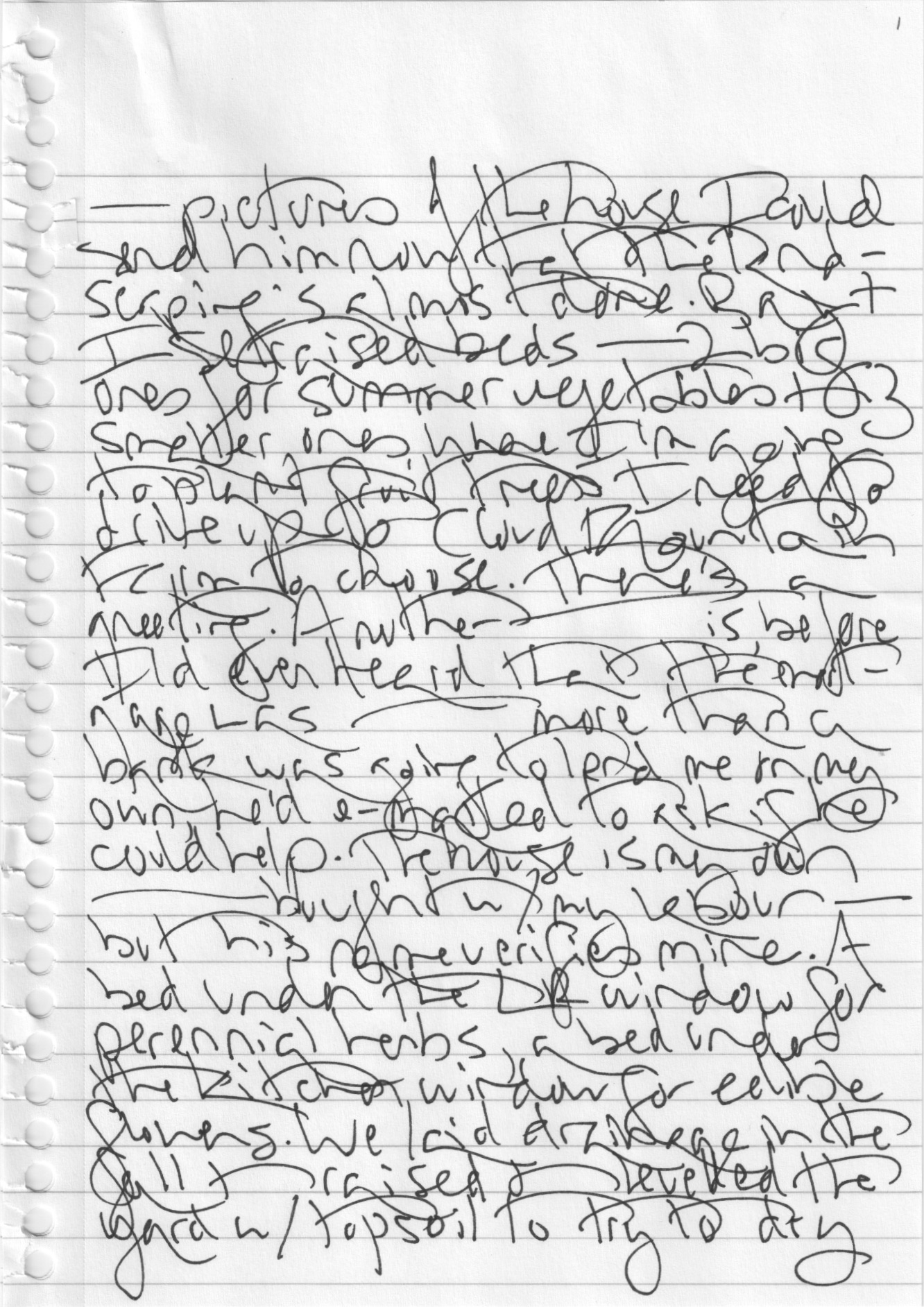
Page 1 base textSCRO began after a visit to my father, 84 years old, in California. I wrote many pages in my journal, worries and fears about his health and state of mind, thoughts on our relationship, childhood memories of him. In time I arrived at a base text of 24 handwritten pages, one page for each hour of the day. To the right is the first. Wandering in time and space, thought and feeling, the text comes home time and again to my little house, which my father, co-signing a loan, made me able to buy. “SCRO,” a truncated form of escrow. Also of scroll – one form the poem will take. And the title can’t fail to call to mind scrotum. The poem’s a study of father and son, and whatever manhood is, and continuity and rupture. Scroll and escrow both derive from a Germanic root meaning “shred.”


p 1 600 cropped
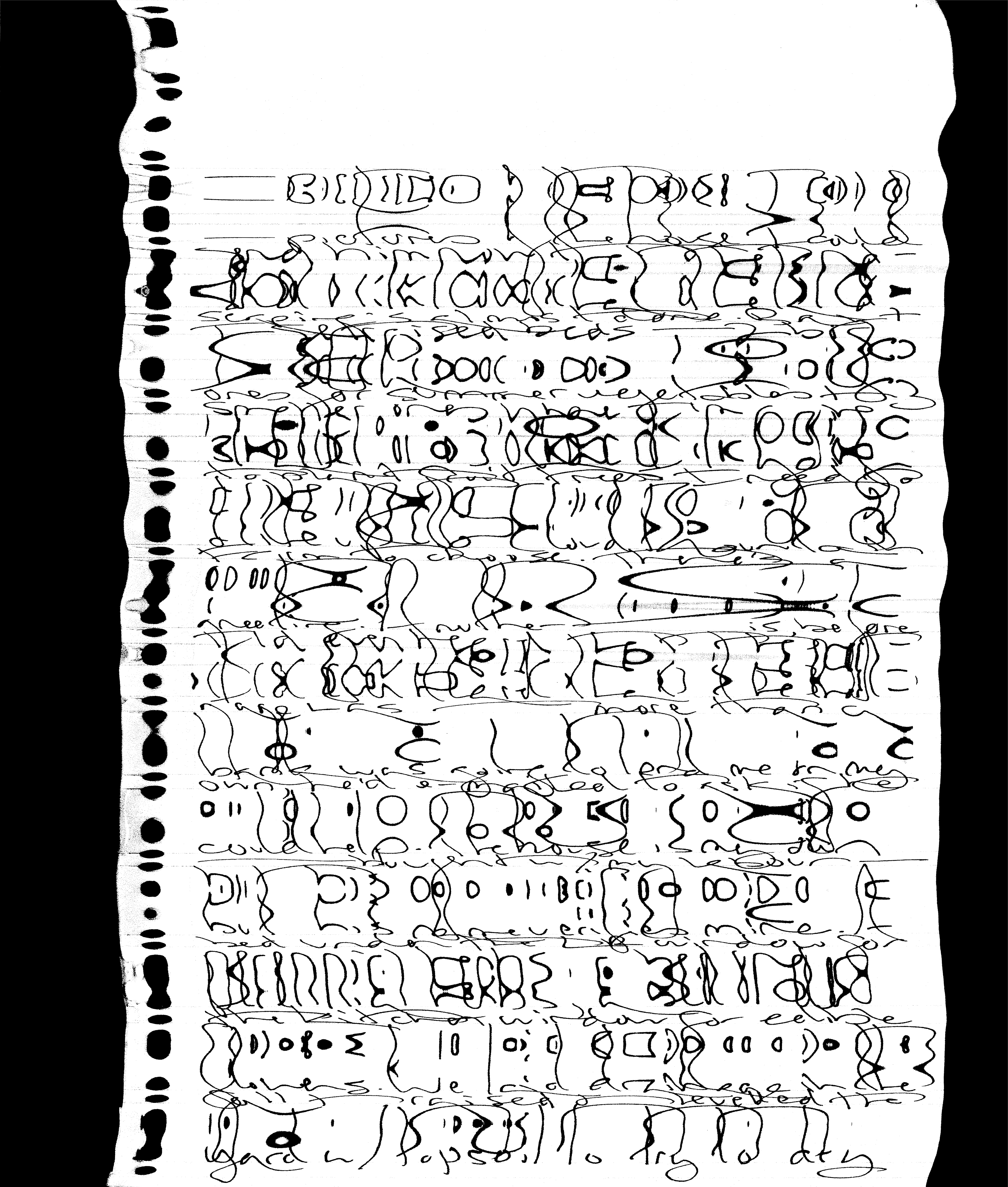
Next I distort the handwriting on the photocopier, rocking it up and down as the scan bar moves underneath, gathering in data, losing information, abandoning and reforming context. Poet Tim Gaze coined the term asemic, one a, for unreadable writing that calls your sense-making apparatus into play without letting it resolve on any given meaning. Steinian indeterminacy on the level of the grapheme. I’ve in turn coined the term aasemic, two a’s, the negative negated, for writing you neither can nor cannot read. I want for these texts to hang on the threshold between signal and noise. Why threshold. Because I’m afraid my father’s going to where he’ll be unreachable; unreadable. Because of how hard it is to know each other at the best of times. Because how of hard it is to read yourself, what you even feel, at same. Most of a given moment’s unintelligible. And, something happens when the mind somehow eases anyway into that state of things, just not getting it. These are experiments toward such ease.

SCRO will have two lives, at least. One, a scroll built of 24 aasemic panels like the one above, flown seamlessly together. That will take some time; the base text is written, but the asemic pages need to be re-generated, most or all of them. Then I need to build a mock-up scroll before I begin to approach publishers.

The other is a series of 24 one-minute video-poems. I start with close-up stills from the aasemic panels described above.

While the panels, as wholes, are to be flown into a scroll, the close-up stills drawn from them are enlisted in brief, meditative animations. Chance operations dictate the length of each clip. Why chance. Because letting in the accidents – patterns not of my choosing; patterns I inherit, my father’s kar­ma, my father’s genes – not my choosing or his. And so, given 60 seconds to fill, I take the factors of 60, excepting 1 and 60, which are 2, 3, 4, 5, 6, 10, 12, 15, 20, and 30, and choose at random from that sequence how long each still will last. If a given choice pushes my total over 60 seconds, I throw that choice out and I select again. For instance, the stills for 6:00 am are 2, 3, 15, 3, 6, 6, 2, 2, 15, 2, and 4 seconds long. Made this way, each one-minute video gets to a rhythm I’d not have on my own. The world is rhythmic I find if I let it.

I use two freeware programs, GIMP and Audacity, for image and audio editing, and iMovie to compose the video. The last is limited but its limits guide me the way her rhyme scheme does a poet prone to sonnets. The audio track is quiet but integral: ambient sound, household or neighbourly, recorded the hour of the day the asemic page was made.

How will these video poems find a public. Easy to shove them around online of course. But I want to throw them big and severally on gallery walls, let them be embodied again, with persons in their bodies moving among, stopping between a projector and a receiving wall to interrupt my images, occlude my words, to intercede – for what, for whom? From whatever I thought to mean. To join in the play on the edge between real and ideal, material and im.

I picture a large or warrened gallery space, each of the videos set separate, a big one here, small one there. Each cast on its bit of wall, far enough from others for its companion sound to adhere to it. As you move round the space the sounds mix up. Soundtracks spare enough for the mix not to muddy.  The effect would be like that on the mind in meditation – relaxing into the hereness of a shape, sound, texture, mixture thereof you have no name for as it passes.

Coupla updates

Friends. Just updated a couple parts of this blog, thought I’d let you know.

New words about my two current projects, Overject and SCROhere.

A portfolio of my adventures in visual poetry here.

The latter turned into a narrative essay of sorts. Writing it, I learned a few things about what I think I’m up to. Cool when that happens. Please enjoy –

C.


SCRO (II)

Right so where were we. SCRO will have a life as ink on paper, another as light in the air. That’s what I imagine right now anyway. Both start from a shaken aasemic journal page like this.

Page 3 600
Click to zoom in and wander about.

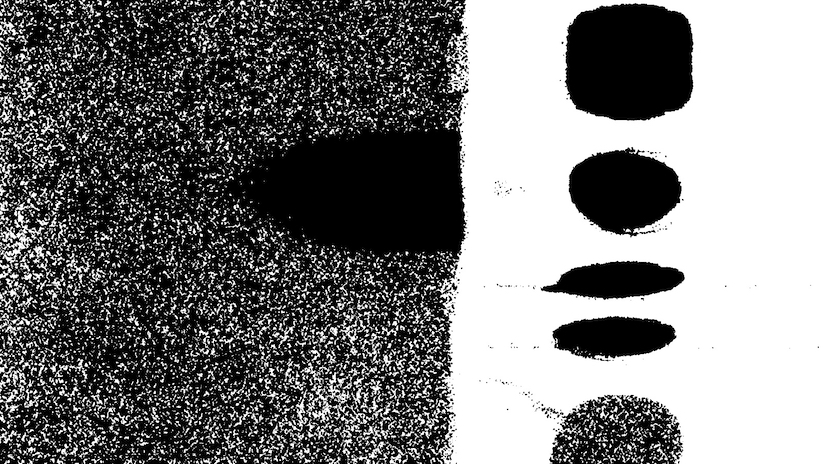
The black wavy areas are my fingers (to the left) and wrists (to the right) where they press the paper to the glass. (“Are”?) This one came out unusually white on the left because of how afternoon sunlight had soaked my study just then. The checker pattern on the right’s what my scanner does with a grey that hovers, to its this-or-that B&W mind, discomfitingly between.

The first one to come out white like this was a shock. Shitty shit, I thought, I just got this toner cartridge, I hate going to Office Depot. Then I waited for a cloud, tried again, the scan came out black, I thought aha, oho.

I’d already planned 24 pages, for dailiness, the quotidian, now I saw I needed to do the pages one an hour over the course of a single day. When a learned a week or two later about the Poetry Marathon, I knew what day it would be.


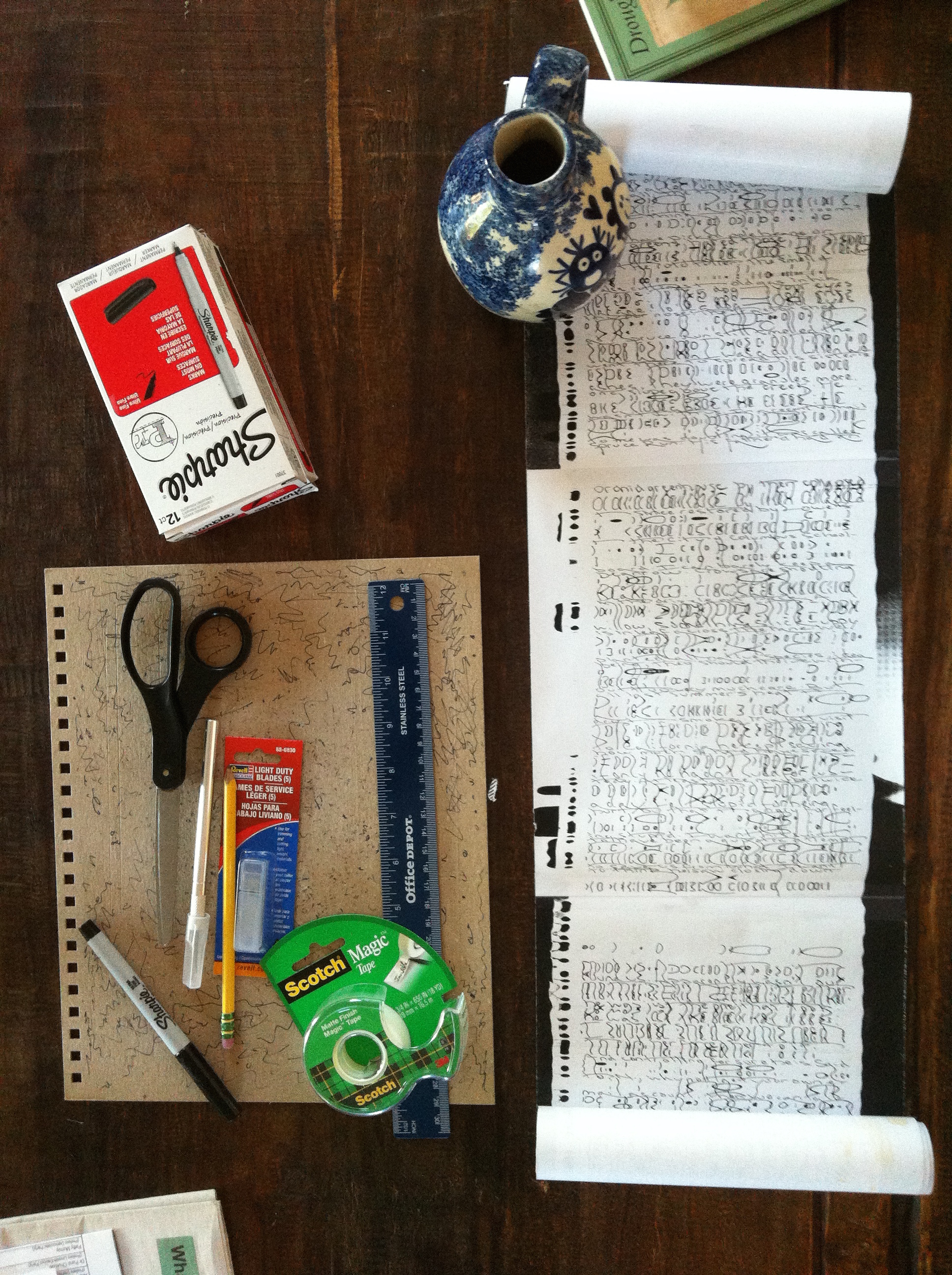
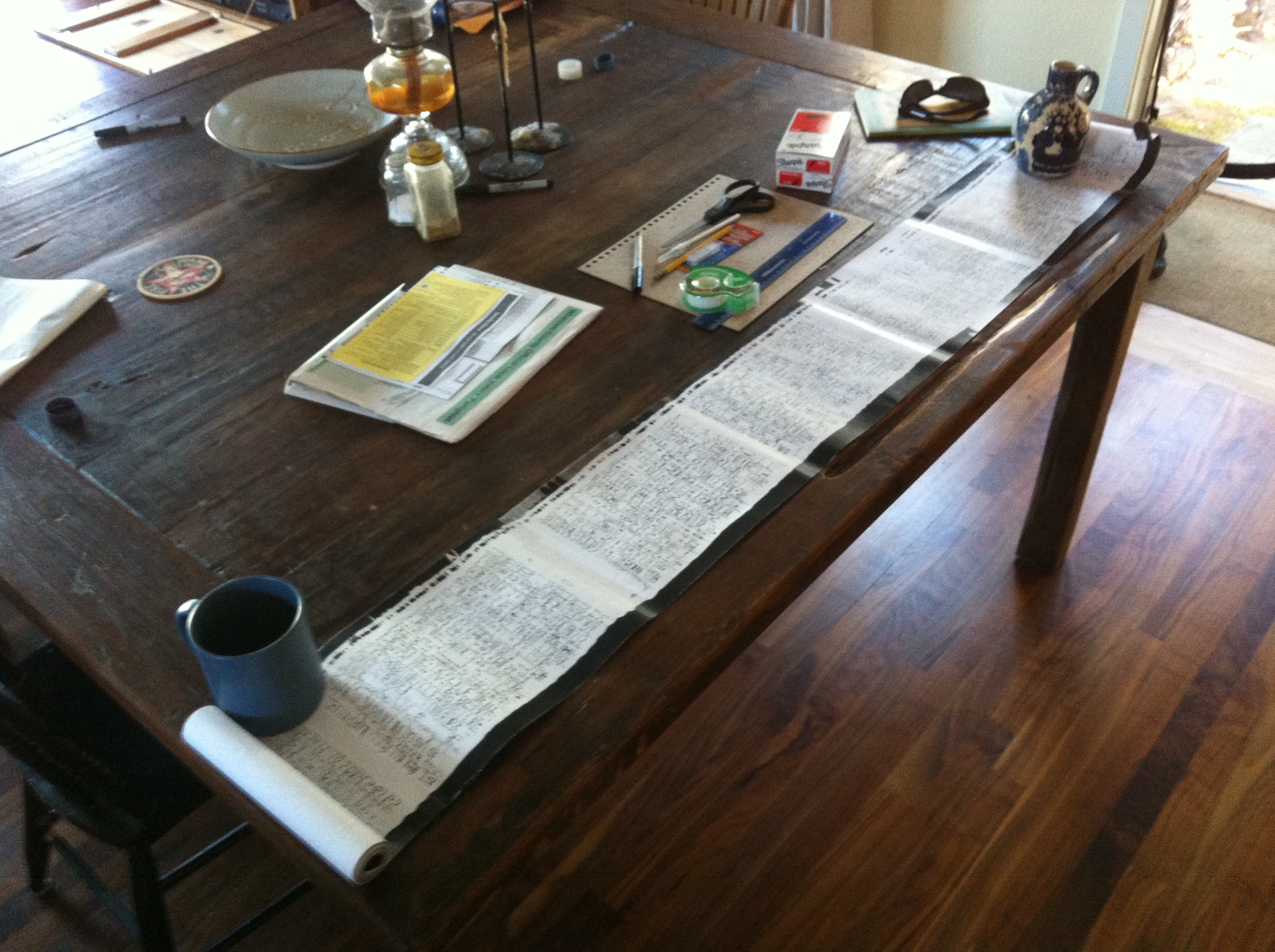
The printed form, if I can find a chapbook publisher willing and able to take this on, will be a continuous scroll of these pages, looking something like this.

photo 1 (4)
The page above, in situ.

photo 2 (3)
And a bit more in situ.

Just a mockup, assembled by X-acto knife and scotch tape …

I’ll be starting at 6 am, around sunrise. If the day’s sunny, I should get the brightest backings in mid-afternoon, when my south and west windows take in the sun. From there it will go, as the poet said, into the dark.


The other life I imagine for this – patterns of dark and light cast on a wall.

I opened up iMovie, thinking I’d mess around there for a bit, then learn some real video editing software. But as I hit the program’s limitations, I started to feel they were a help to me – limits I could make constraints on the poem. Plus, holding myself to ordinary means (Sharpie, home-office photocopier, iPhone voice-notes app) suits this project, which is all about nothing special.

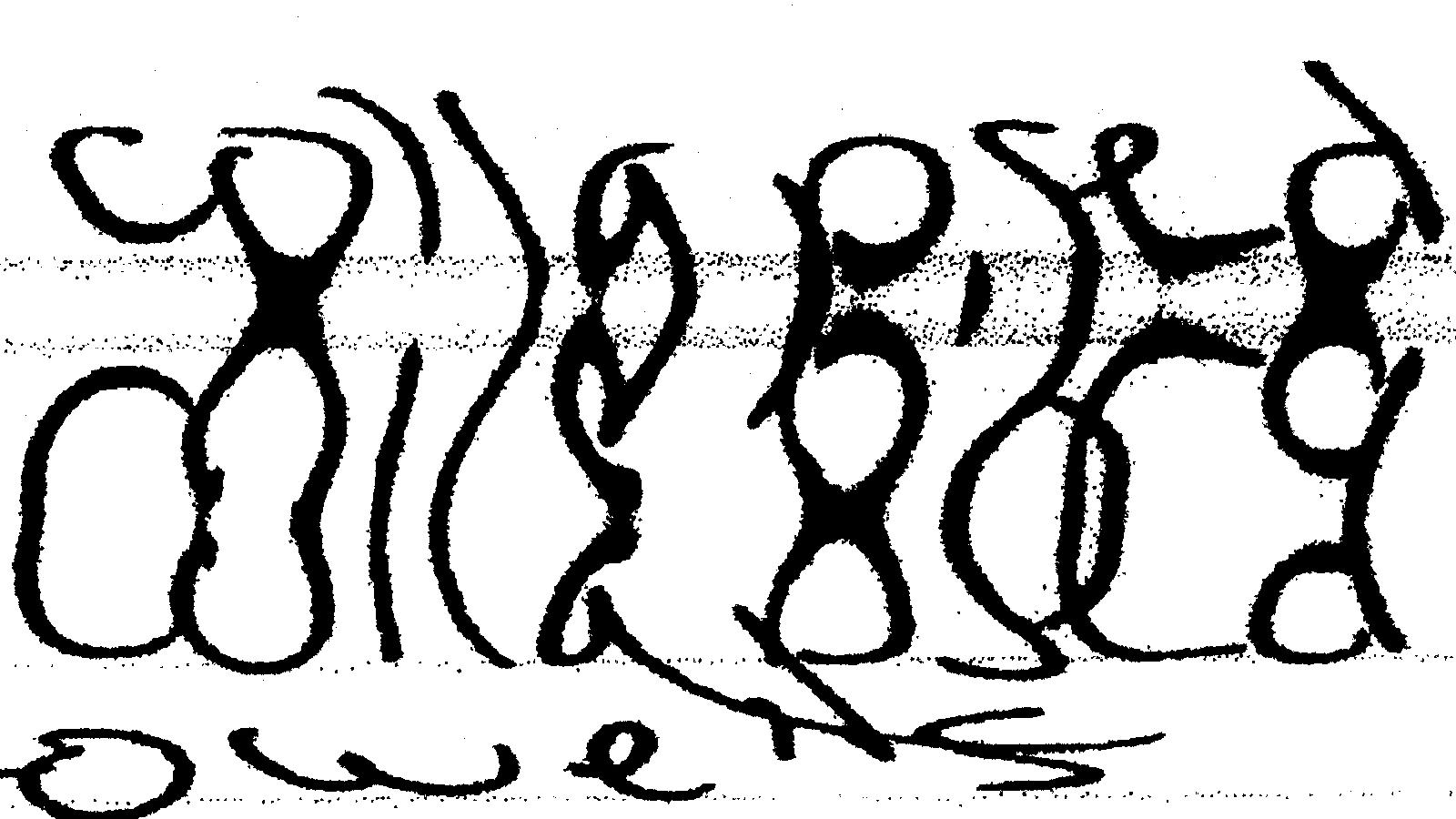
Working quickly, not deliberating much, I cropped some 16:9 stills from the page I’d scanned. (At 1200 dpi, the highest res I can. Some kinds of data loss I love. Not pixellation. And if I want these images on the big screen one day.) Here are a few.

Some grabbed me because their language did what it meant.Page 3 detail 1


Here I love Mr. Moustachio. The back-and-forth between him and “angry” feels equally weighted. And the horizontal distortion bar pleases me.

Page 3 detail 4


This might be my favourite. A leaf beetle bearing or born of the word “leaf.”

Page 3 detail 15


This one’s mostly abstract – I’m keen on the way markings call our language faculty into play without allowing it to resolve in a determinate meaning – but “city” resonated well with the audio clip I had by this point found.

Page 3 detail 17


Cuz I’d also begun grabbing clips of ambient sound with my iPhone’s voice-notes app. At first thought I was just practicing for when I could borrow real recording gear. But after a few test clips I found the homemadeness of the sound suited me just fine. Also the sounds of me recording or abiding – shifting in my seat, clinking my coffee cup on the tile coaster.

The audio for the clip I posted yesterday – chainsaw crew next door taking out my neighbour’s lilac, in preparation for raising a new fence – me closing my study window – clink of said coffee cup.


How to put it together? It’s about letting the accidents in – patterns not of my choosing. Including patterns I inherit, my father’s karma, my father’s genes. (Not my choosing or his.) Each page of the scroll takes about a minute to read aloud and I know I might want, in some iterations, to read the poem aloud in company of the moving images.

First decision, each of 24 passages gets a minute each.

So I’m in the realm of number, 24 passages, 60 seconds each. If each still is Phoenician, in a wildering course that never travels wholly out of view of phonetic charactery, for their sequencing in time I’ll go to Babylon, where our minutes and seconds, our degrees and zodiacal houses come from.

I did some reading about 60. It’s a cool number. A unitary perfect number, one of only five known, being the sum of its unitary divisors. A highly composite number, having more factors than any smaller number. An abundant number, the sum of its divisors greater than itself.

Count the joints on the fingers of one hand, once through, thumb doing the counting, you get 12 – that’s a day. Do it with both hands – that’s 24, a day and a night. Do it five times, you get 60. So much for the inevitability of base 10 systems.

Sixty also has a sweet number of factors: 1, 2, 3, 4, 5, 6, 10, 12, 15, 20, 30, 60.

Decided, each clip will be x seconds long, where x is one of the first ten divisors of 60, randomly generated.

If x yields a sum longer than 60 seconds, discard and generate a new x (as in darts when you’re playing to 300). So clips will tend to accelerate at the end. Whoosh.


The results for x in this clip

were 5, 20, 12, 5, 3, 2, 3, 3, 1, 1, 5. I got to decide what clips in what order. Also how slow or quick the transition between two clips. One set I set in motion.

Overlaid the soundtrack with no effort to coordinate it to the clips. That the window slides closed just as one black blade glides over another is just good luck.

That so many things are tuned to their neighbours – without any assertion on my part – seems to me more than luck.


One more for ya, different page, sprocket hole study.

If you’ve made it this far. The cross-fade and the “Ken Burns effect” in iMovie can both be cheesy very easily. Have I avoided cheese entirely? Comments section, be honest, I need to know. And thank you for reading.