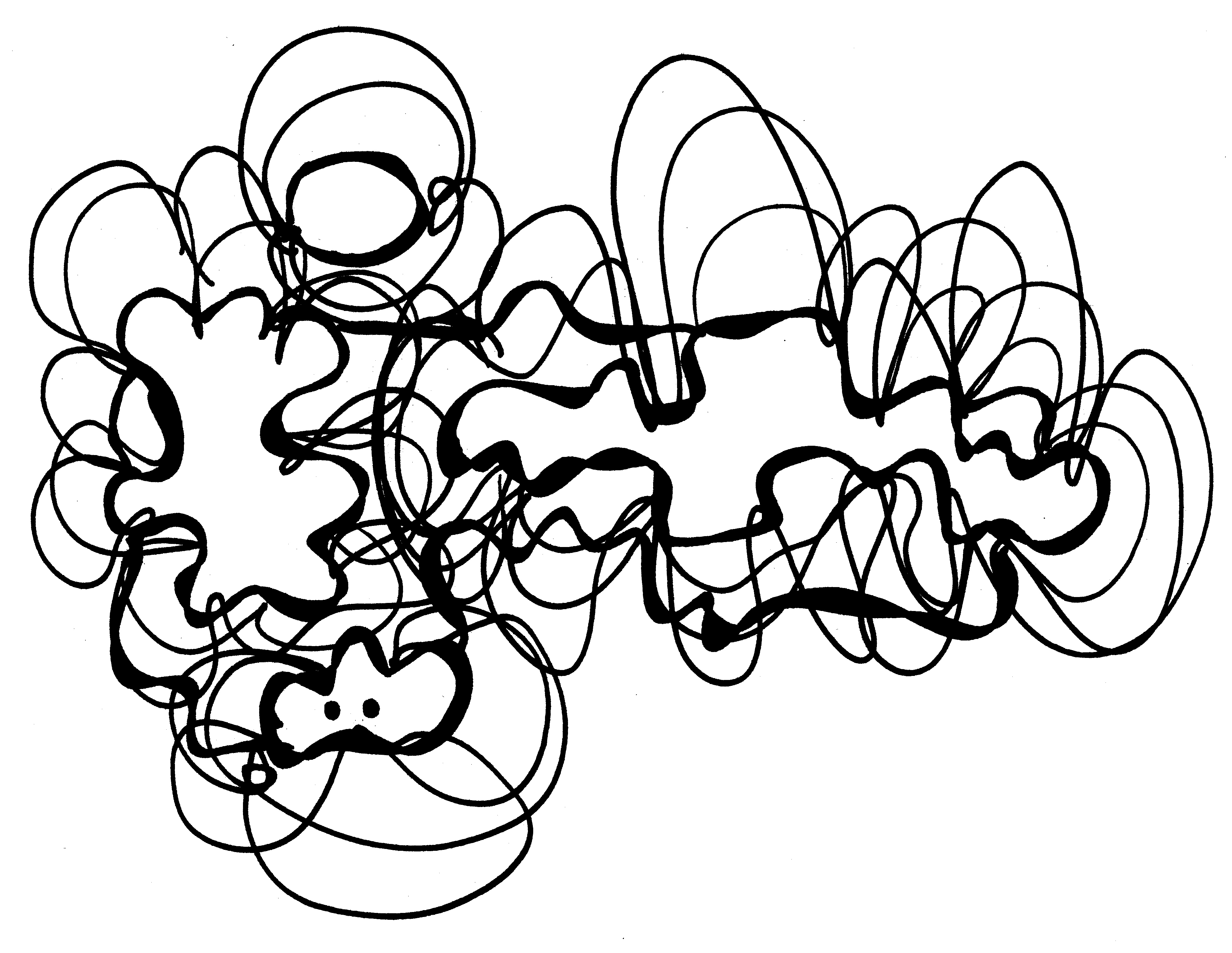
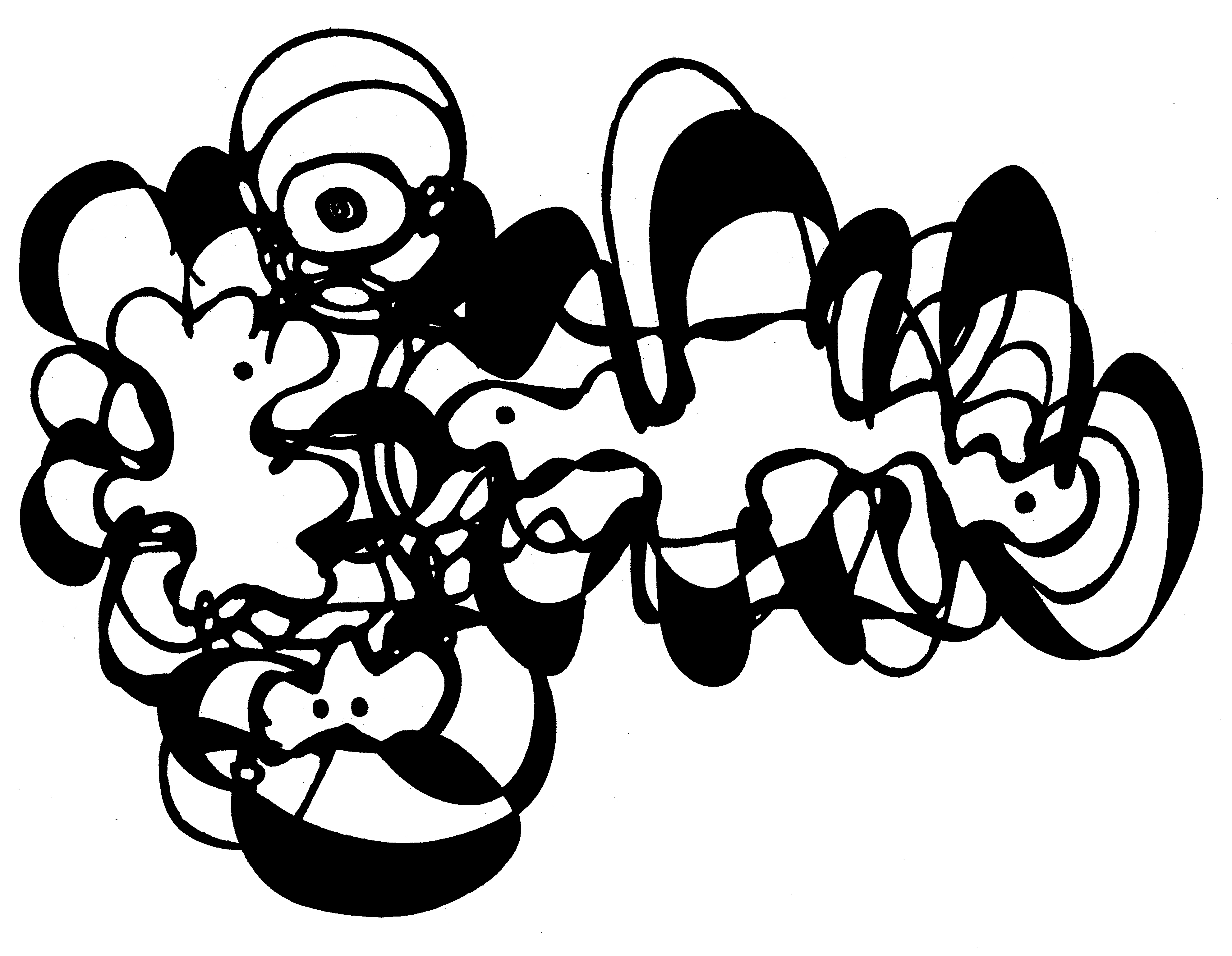
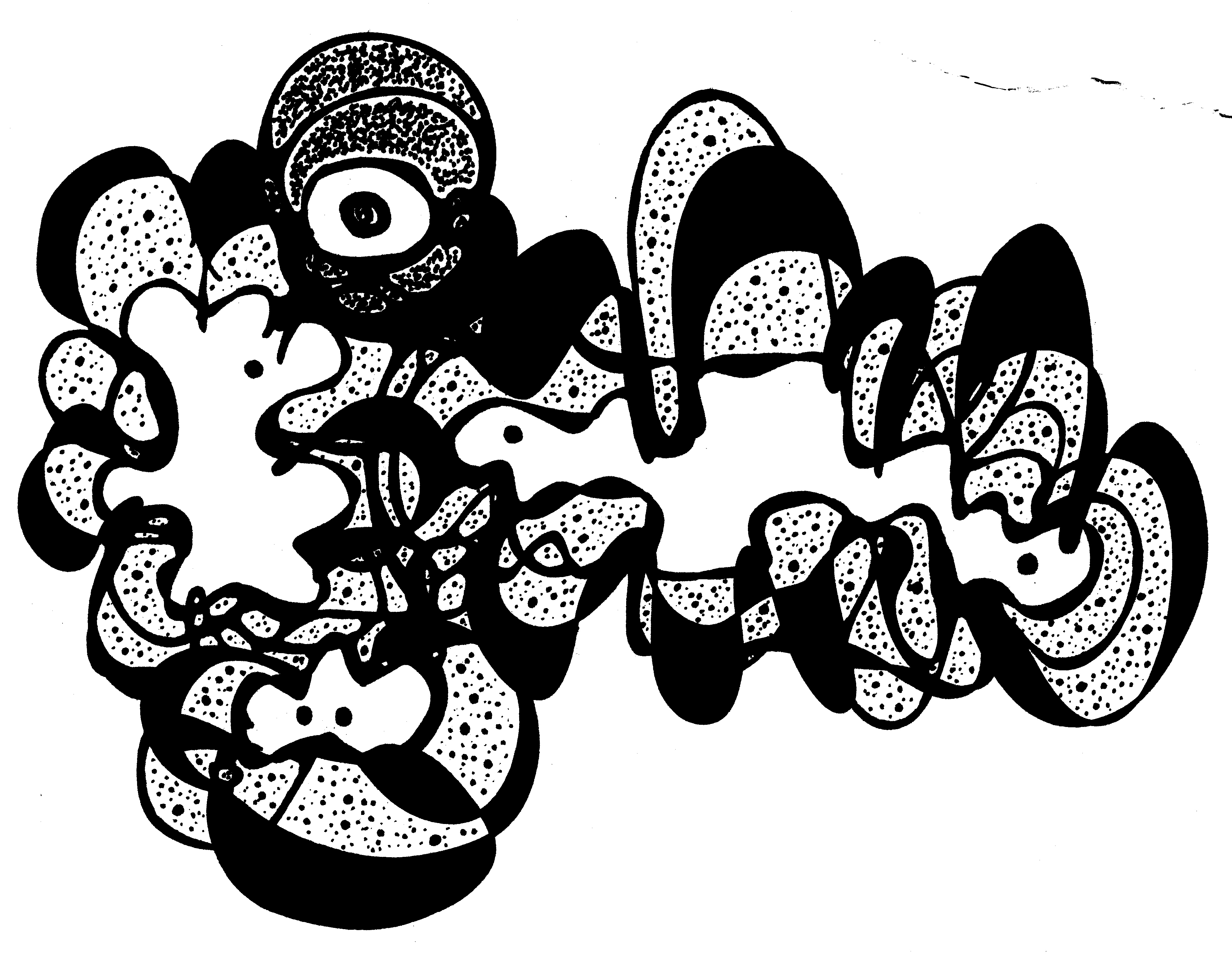
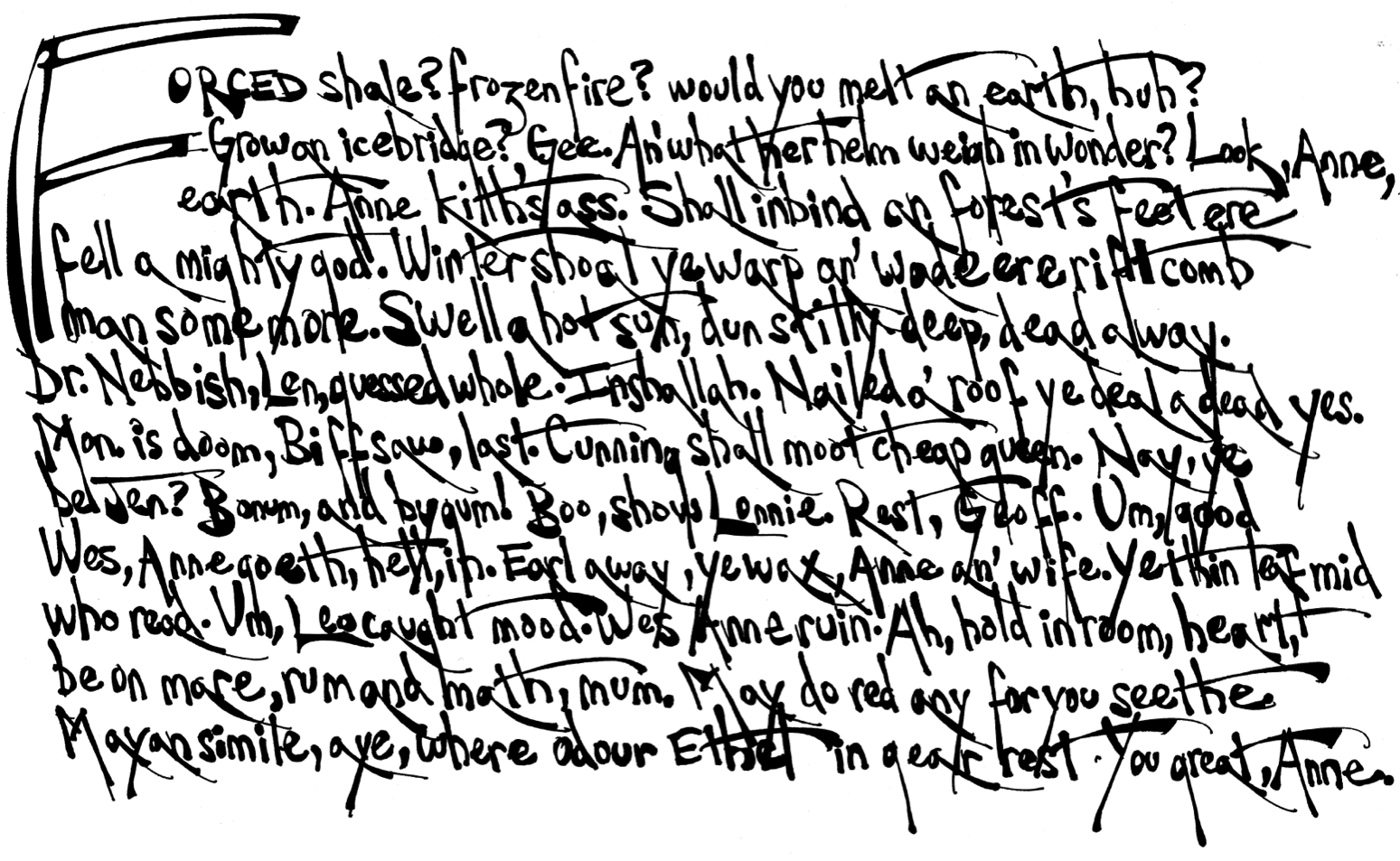
Abjected forms of a divine spark

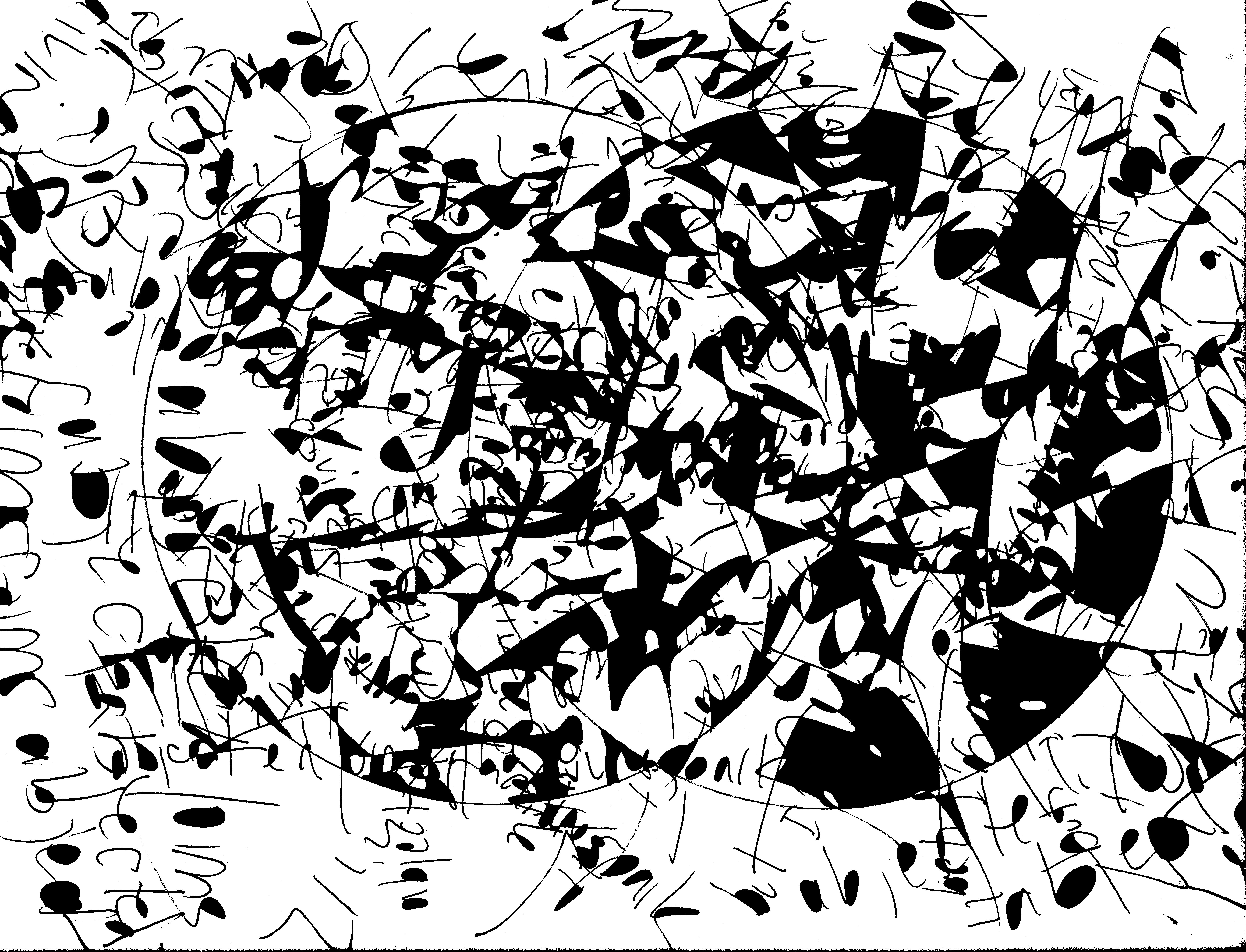
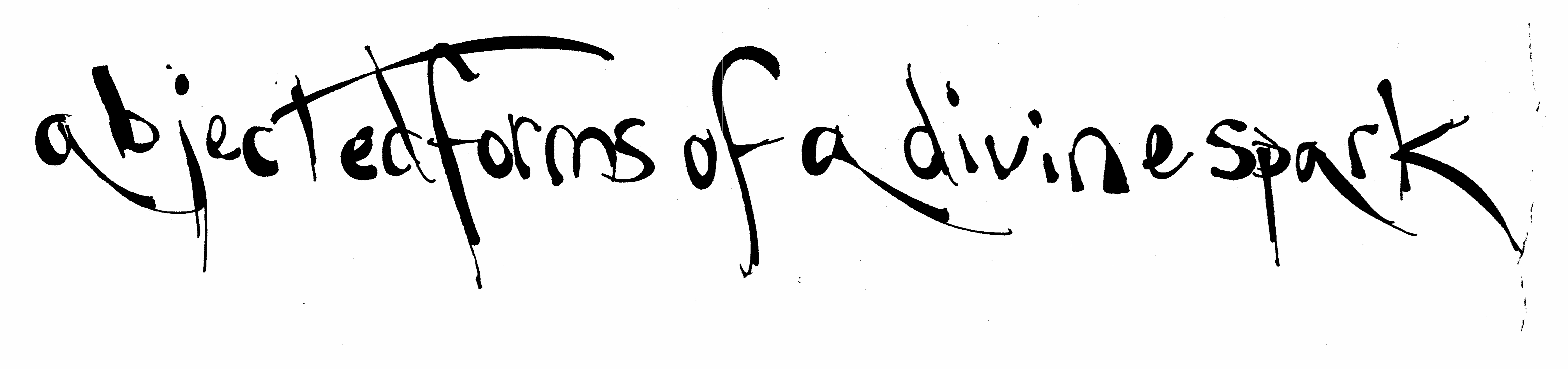
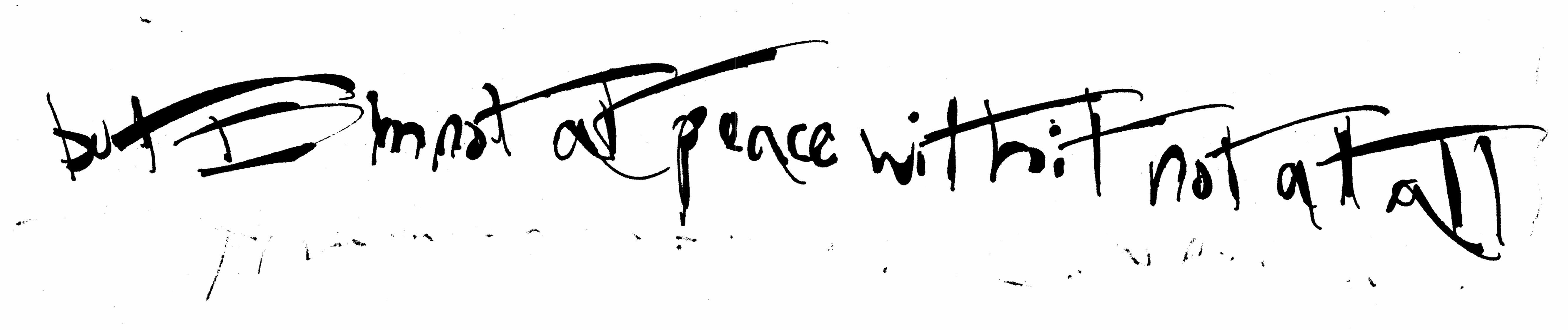
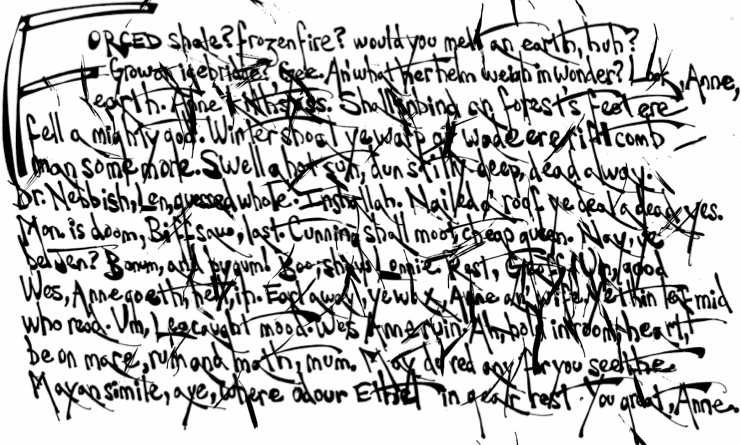
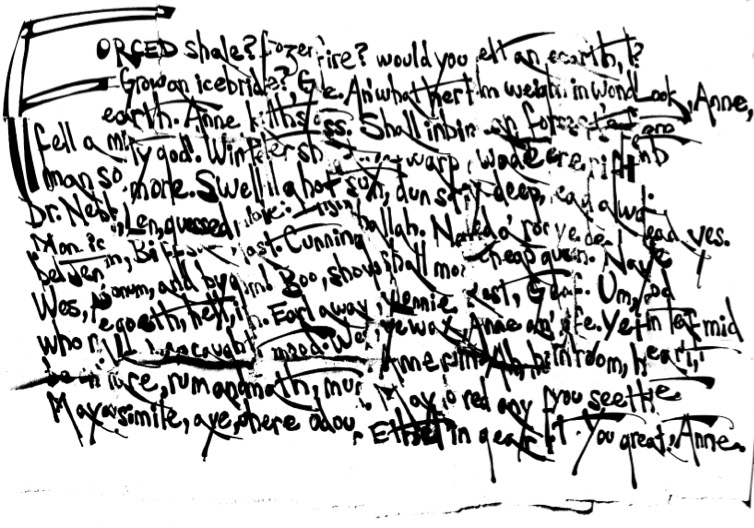
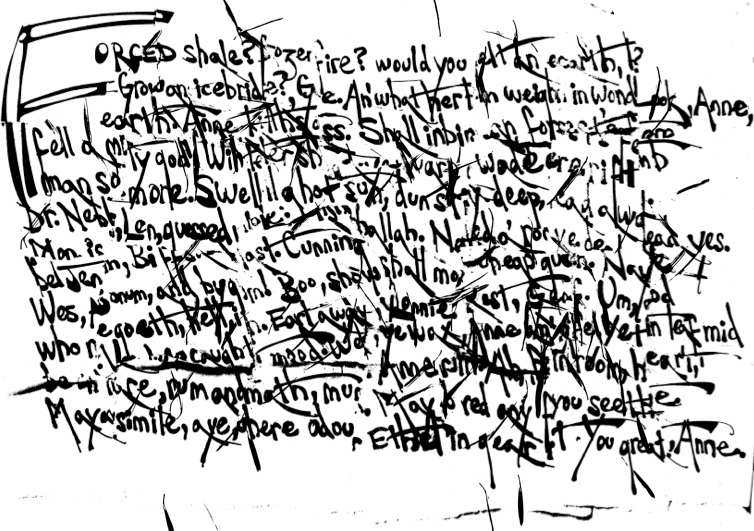
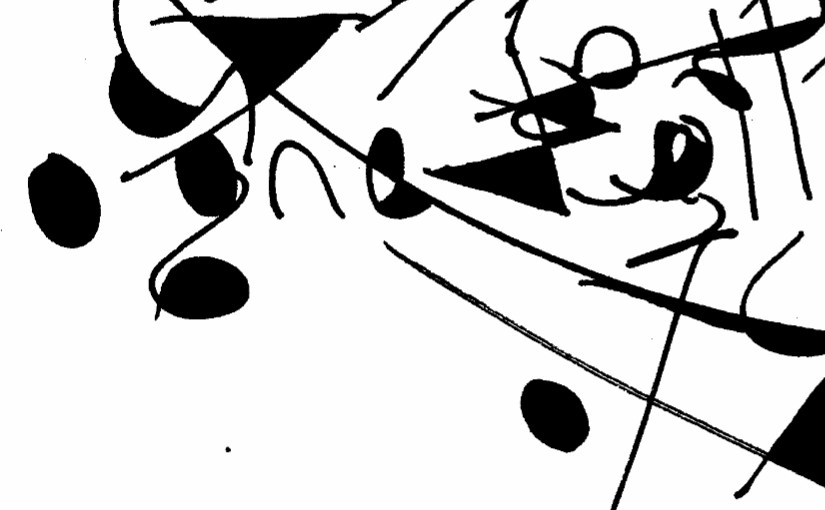
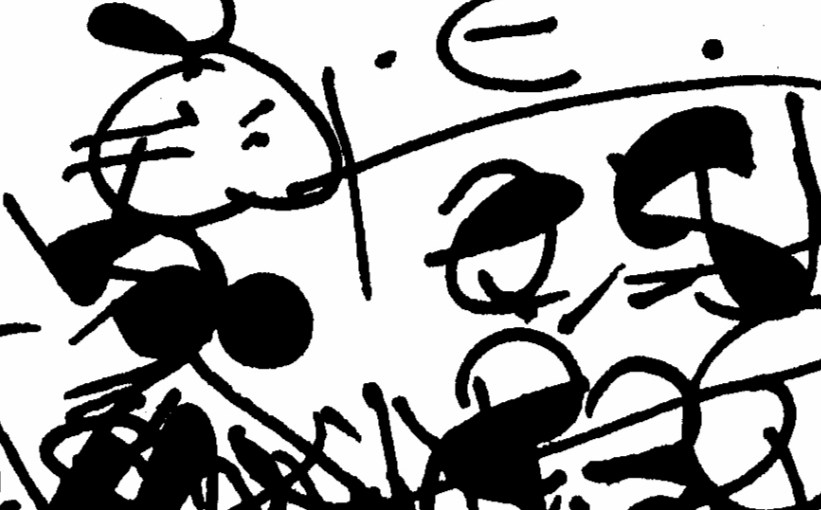
Another image from Overject. Got by inscribing, very quick, two phrases, over and over at all angles, till they become mostly unintelligible. Then beginning to complete the forms the collisions of the letter forms propose.

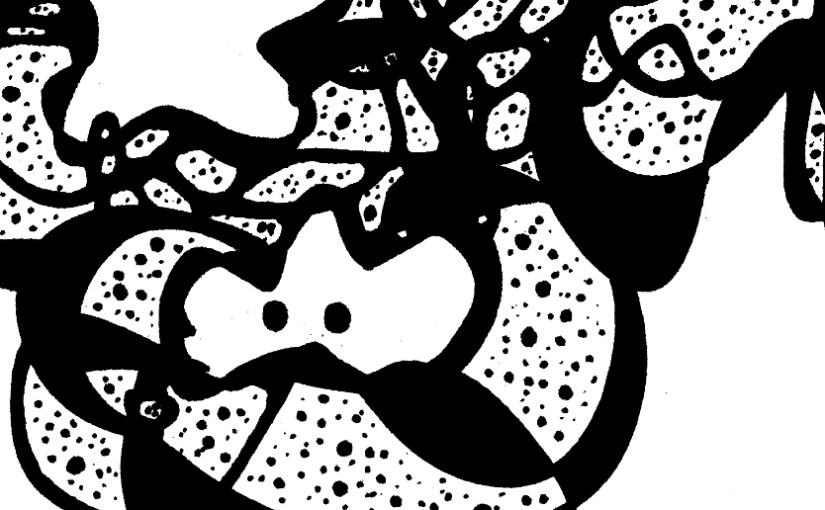
Click on me once, and again, for some up close face time.
Click on me once, and again, for some way up close face time.

The circles are outlines of kitchen saucers. The phrases:

90R tear - abjected and90R tear - but I'm notBeen thinking through, with a couple of friends, the aleatory – chance operations – and how contingency pokes out in places not usually thought of as aleatory.

In the above image, I got the base layer, the tangle of intersecting phrase noise, by inscribing so rapidly I wasn’t in charge of anything, except that one phrase cohered mostly around one circle, the other mostly around the other. I experienced the end result as a set of accidents whose conditions I needed to work among. No dice were thrown, no darts. But how different really was my procedure from a full-blooded aleatory procedure?

It’s just, maybe, that I was the dice.

And the phrases themselves, “I” didn’t “write” them, they just “came to me,” on the treadmill of all places. Where exactly is the edge where the aleatory ends and deliberate design, or however you want to label all the other poetry being made, begins?

The panel proposal we’re drafting: “Everywhere Is Aleatory.” More soon.

Beasties, animated, to be

Whereas it’s been long since a post. Whereas we’re all about repurposing here. And whereas I resist going back to work on a panel proposal. Herewith, the juicy bits from a grant proposal, wherein The Poet Asks for $$ to Learn to Flash Adobe.


I’ll begin with a passage I’ve translated from an untitled Old English poem found in the Exeter Book –

5.

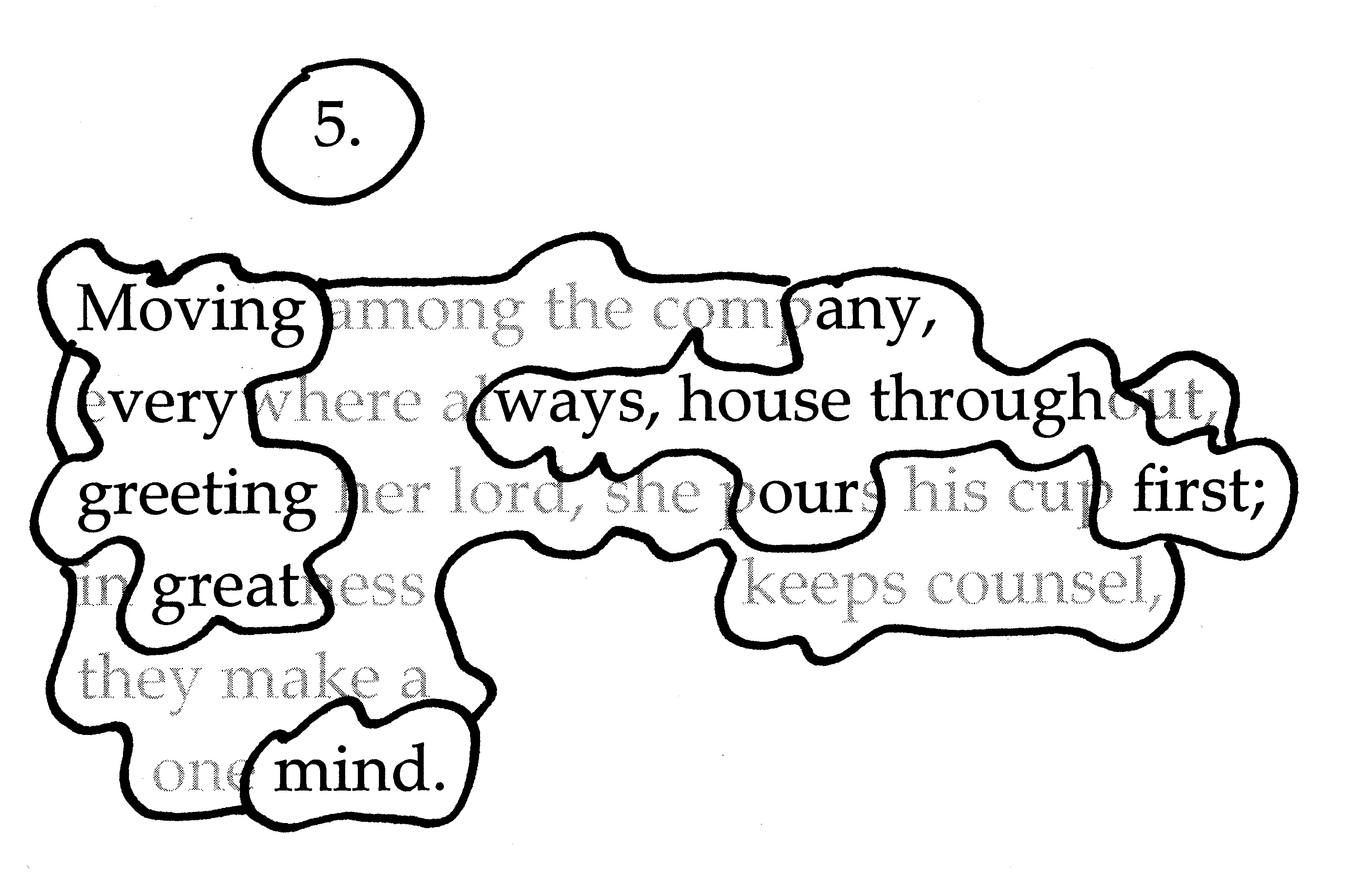
Moving among the company,
everywhere always, house throughout,
greeting her lord, she pours his cup first;
in greatness gives and keeps counsel,
they make a house, two
of one mind.

A selection process, adapted from poets Ronald Johnson and Jen Bervin and now in general use among restless poets everywhere, yields a visual pattern to work with:

90V SI 5 image 1

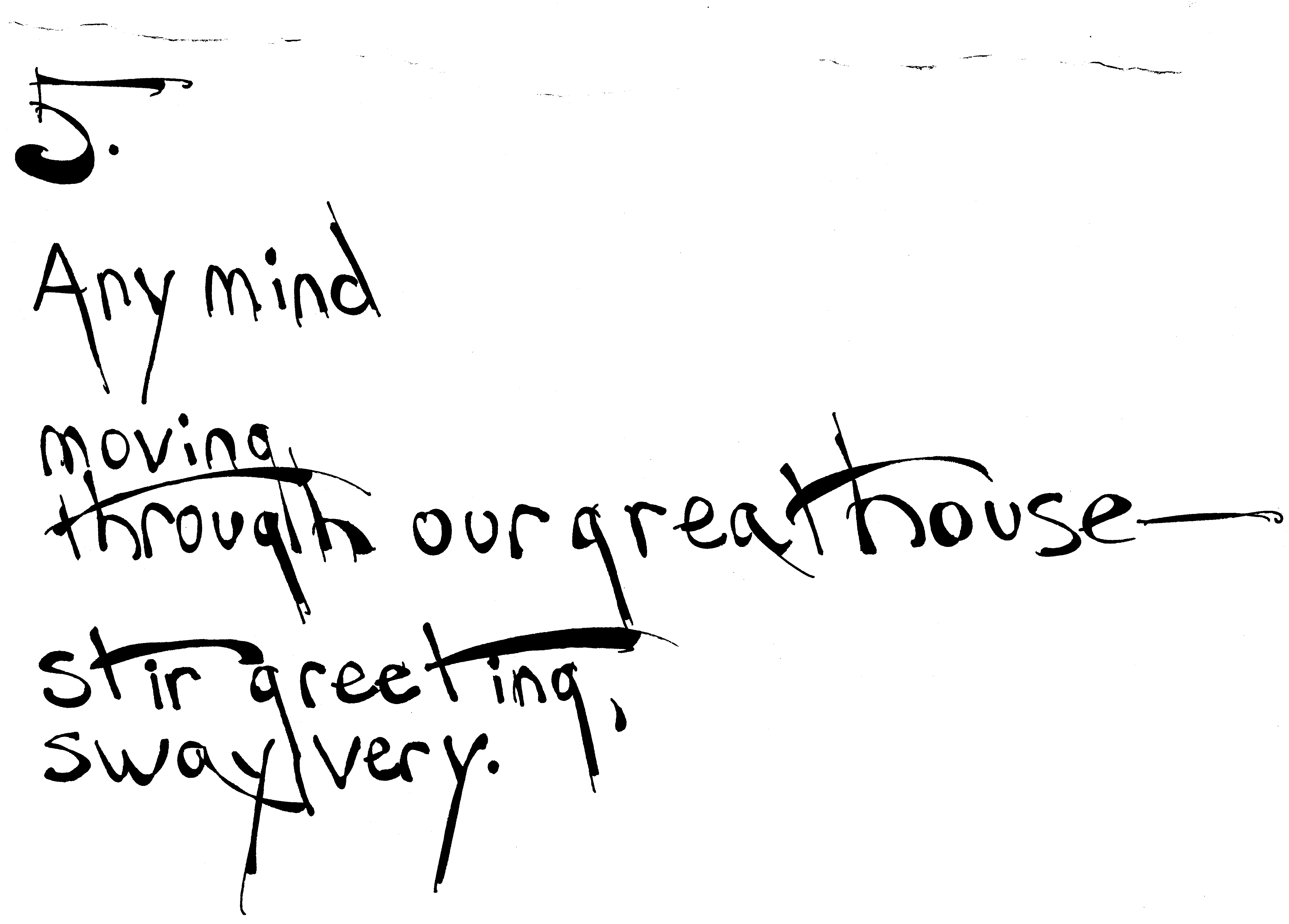
The selected text also generates, with some recombinations, a verbal poem –

SI 5 (90V) - text 2

– but I’ll focus here on my work with the selection marks, for that is where my practice, though first inspired by visual artist Tom Phillips, largely departs from other practices I know of. It’s here too that my practice points towards terrain I’d like funding to explore.

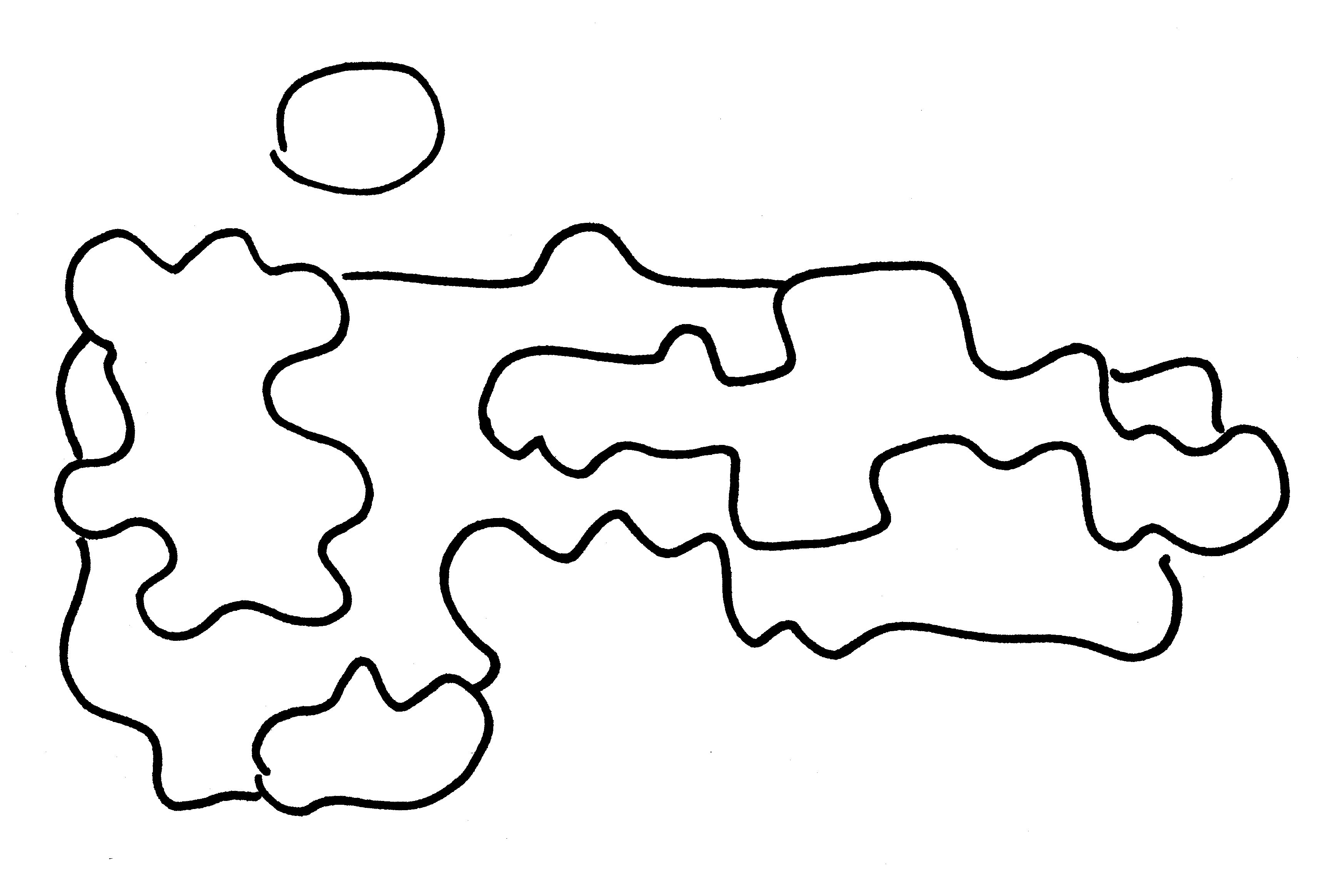
Elaboration of the selection marks goes through several stages, like so,

90V SI 5 image 2

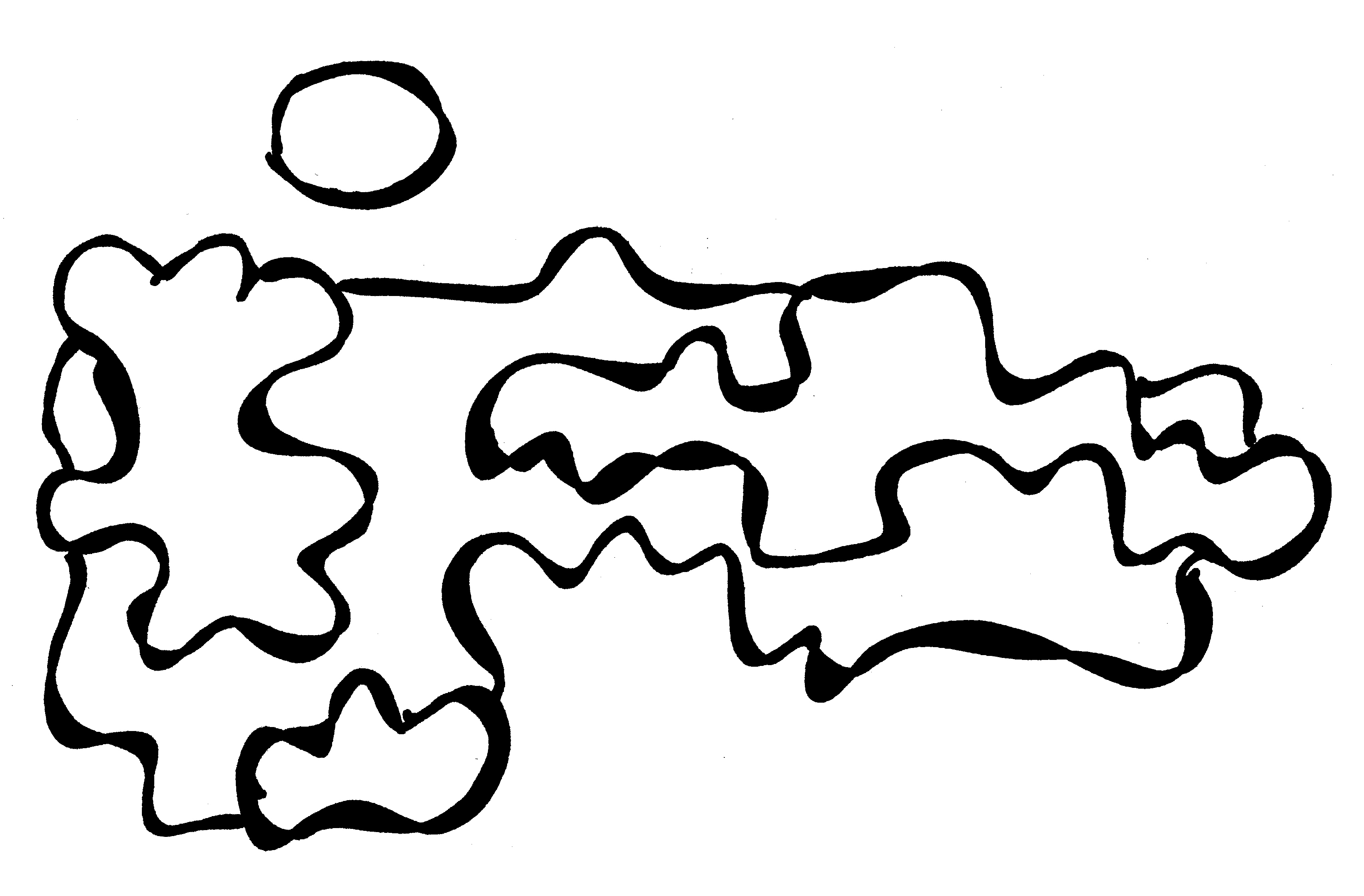
and so,

90V SI 5 image 3

and so,

90V SI 5 image 4

and so,

90V SI 5 image 6

to produce an image

90V SI 5 image 8

somewhere in a dream terrain where Salvador Dali and Jim Henson commune with Louis Comfort Tiffany.

The images are an exploration of pareidolia, the mind’s tendency to make faces at the drop of a hat. They exhume natural and biological forms latent in the alphabet (“A” – ox; “N” – water; “O” – eye). They tap into the animism residual in the process of silent solitary reading (see David Abram, Spell of the Sensuous). And they undertake a fitful and pata­physical, i.e., seriously unserious, investigation of the mystical dimensions of the material text (see bpNichol, “Probable Systems 14: Re-Discovery of the 22 Letter Alphabet”).

Their main shortcoming, as I look at them now in Dumuzi (recently finished) and Overject (presently underway), is that they have had to sit still.

I want in my next project to animate them – to put the demonic, angelic, and zoological forms that arise through the illumination process into motion. Even more, I want to animate the illumination process itself, obviating the need for clumsy accounts like the one just finished. I envision digital publication and performance events, the latter more akin to video installations in gallery spaces than to conventional poetry readings.


Demons and angels weightless shadows across wall, floor, ceiling. Let’s see if I can stand to learn the program though. It’s that or start the search for – my collaborator.

Disruption of the text

Had thought to take a break from Overject, I really had. Bundled up 60 pages of it, handed them to my two most trusted readers, and I told me, This would be the time to take a breather, get some distance, reapproach in a little while with some new perspective.

Not.

What’s to tell? I just couldn’t get happy till I was back at it with the Sharpies.

So here I am, embarked on part II, and am at a perilous juncture, because I can’t just keep doing what I done, that would be dull and dumb, but my sense of what’s next and vital is dim as yet.

The danger – making it new, not out of a sense of fresh energy, but just for to be newfangled. Oldest tiredest play in the book. (Old as books themselves are, and maybe, I’m not sure, not much older.)

So this is where I maybe ask for help. (Oh my recent students, I know a few of you are reading, here’s your chance to have at it.) This morning I wrote out a homophonic translation of the lower half of folio 90V of the Exeter Book. Here’s what it looks like unaltered.

90R HT unaltered

Same approach as I took in the first section of the ms. How to make it new? As I did the scripting I found me thinking about the place of violence in the text at hand. The violence of the patriarchal warrior culture it arose in. The violence time did to the work as it made its way from anciency to now. (Dude. Can you believe anciency really is a word?) The violence of my disruptive translation, me carrying on as if sound itself bore sense across intact.

Meanwhile asters in my back yard, recently in bloom, were blowing this way and that. On a whim I went and cut five or six and scattered the petals on my scanner. That image, overlaid on the first, got me this.

90R HT astered

Asters, named for stars, whose fallen petals look like sword gashes. While the most common masculine case ending in Old English, -an, has become the work’s heroine, Anne.


I teach, by the way, a course called Poetics of Peace and War, because I’m very interested in this question, how acts that look destructive when brought to bear on language, may be nourishing when the results are offered to persons.


Also a redtailed hawk just perched in the pine tree outside my study window.


So the petals resisted the eye but lightly. I wanted for what reason I know not something more savage-taloned. So I tore it in pieces then laid the pieces down as shingles or come to think of it feathers. (“Complicate,” from plicare, fold, layer.)

90R HT collaged

I am in love BTW with scanner noise. I could eat a whole big bowl of it.

The last one I want to show you roughs the text up most – tears and asters it both. Roughs it up most, and is least considerate of your wish for a sensible meaning. And yet it’s the one I think I’m fondest of! Am I just a big meanie?

90R HT collaged and astered

The ask for help part. What do you think? Do any of these move, please, tickle, amuse, intrigue you? Any sense what about them does? Send a comment, do!


If you’re curious, here’s the actual Old English text –

Forst sceal freosan fyr wudu meltan eorþe
growan is brycgian   wæter helm wegan wundrū lucan
eorþan ciþas   ansceal inbindan forstes fetre
fela meahtig god ∙ winter sceal geweorpan   weder eft cu
man sumor swegle hat sund unstille deop d eada wæg
dyrne bið lengest holen sceal inæled ẏrfe gedæled deades
monnes dōm biþ selast ∙ Cyning sceal mid ceape cwene ge
bicgan bunum ⁊beagum bu sceolon   ærest geofum gōd
wesan ∙ guð sceal ineorle wig geweaxan ⁊wif geþeon lof mid
hyre leodum leoht mod wesan rune healdan rum heort
beon mearum ⁊maþmum ∙ meodo rædenne forge sið
mægen symle æghwær eodor æþelinge ærest gegretan

(The ⁊ is a medieval &.) And here’s what normal people would call a translation –

1.

Frost freezes, fire eats wood,
earth springs out, ice houses,
water sheathes.
                               A wonder
there’s one to snap frost’s fetters,
break seed earth, mighty God.

 2.

Winter turns, comes warm unstill
weather, summer skysound.
Deep dead ways are secret longest,
holly burning, cattle shared out.
Dead men’s laws are the best laws.

3.

A king can buy a queen with cattle.
That they give lots away is the main thing.

4.

War forces him
to be brave.
                        She grows dear
to her people, her shining mind
hoards whispers, her spacious heart
holds treasures.

            5.

Moving among the company,
everywhere always, house throughout,
greeting her lord, she pours his cup first;

 Now I can’t see the hawk but I can hear her high cries.

Overdraft

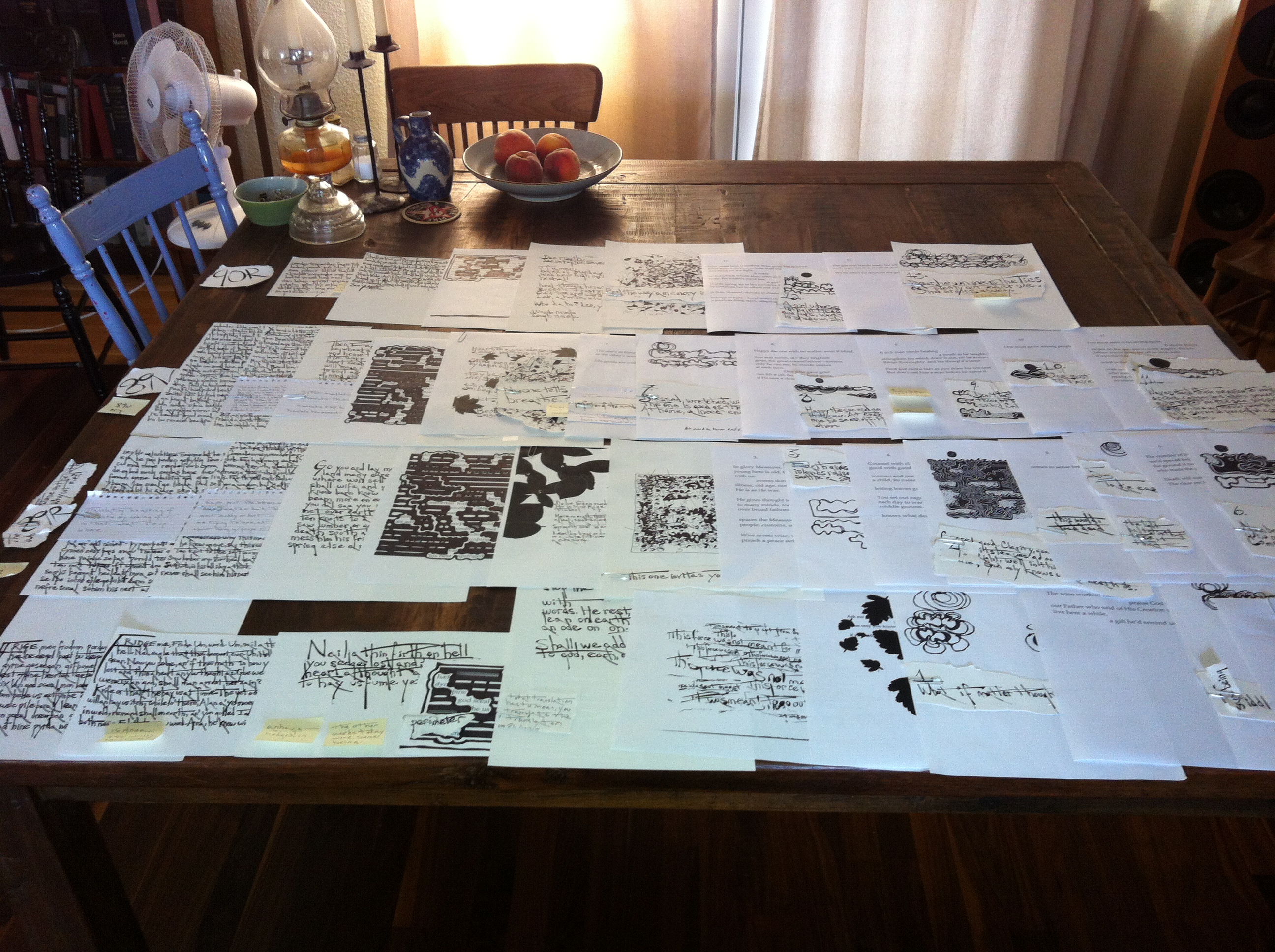
First of three sections of Overject, very roughed out, on my dining room table.
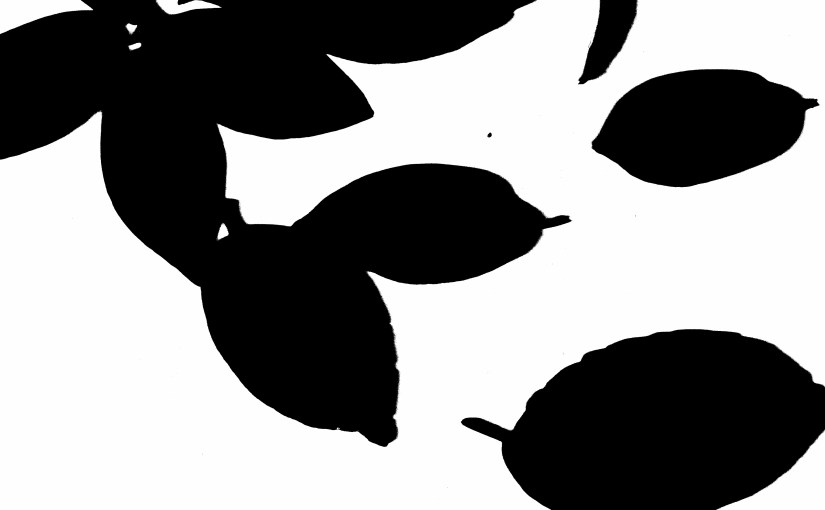
Overject draftFifty pages give or take. This baby’s going to be a monster. Next is to feed it some foliage. The little leaf impresses you can see there are oceanspray red osier dogwood and vine maple from my back garden. Quaking aspen to come (for some scary bits).

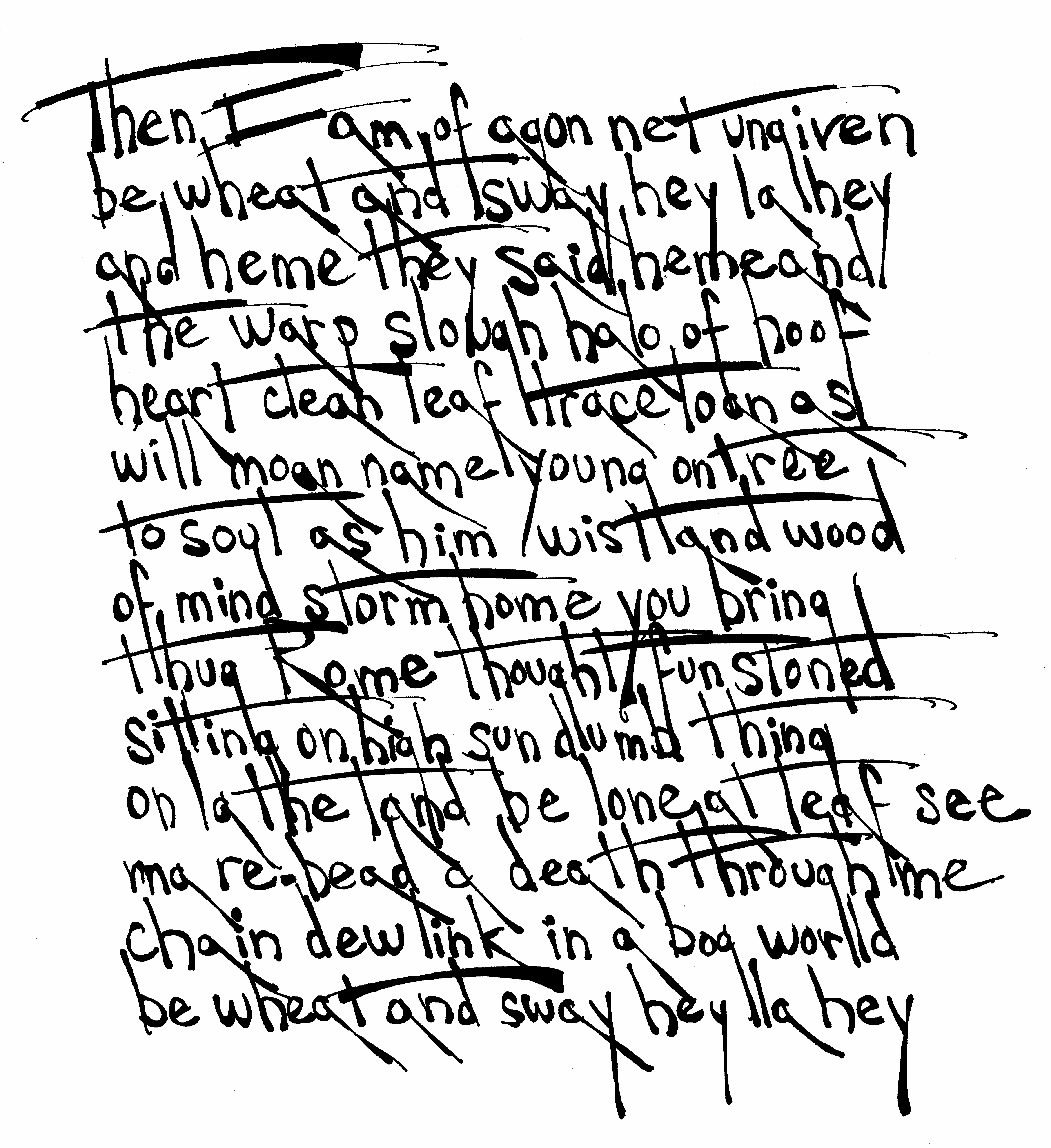
Be wheat and sway hey la hey

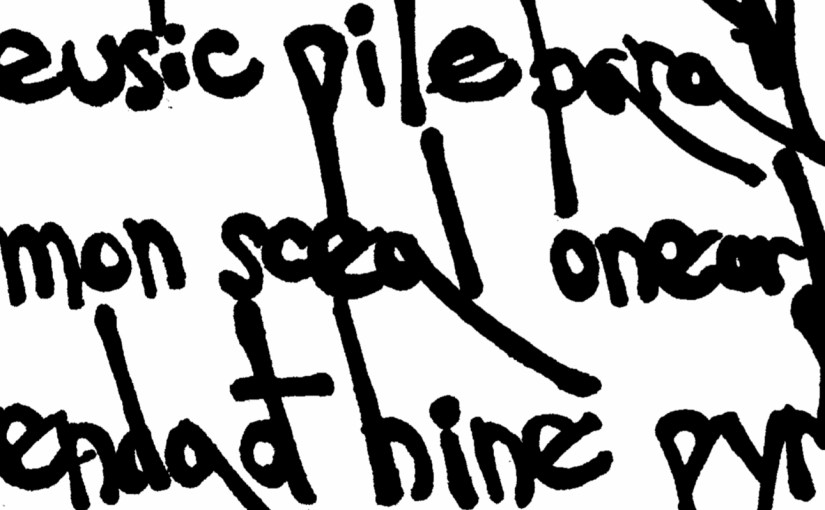
This one composted from a homophonic translation of folio 89V of The Exeter Book.

89V ED
Click once and twice for a zoom happening.

Been a long teaching stretch. They’re working hard and tired, I’m working hard and tired, these compressed summer courses, hmm. Well, we’re halfway there. They’ve spent the week getting blogs up and running, and are making some interesting forays. Latte art, penny textures, Vonnegut on where the sun don’t shine. Over the next while I mean to post ties (ligatures, holdfasts) to their adventures.

Something rhizomatic about blog world. Someone should write something about that sometime.

Mm, quick check says, rhizome’s got co-opted by some digitalists and some corporatists, so nevermind maybe. But here’s a picture from/of the origin. Fans of Deleuze and Guattari will know that’s a bad joke.

From Deleuze and Guattari, A Thousand Plateaus

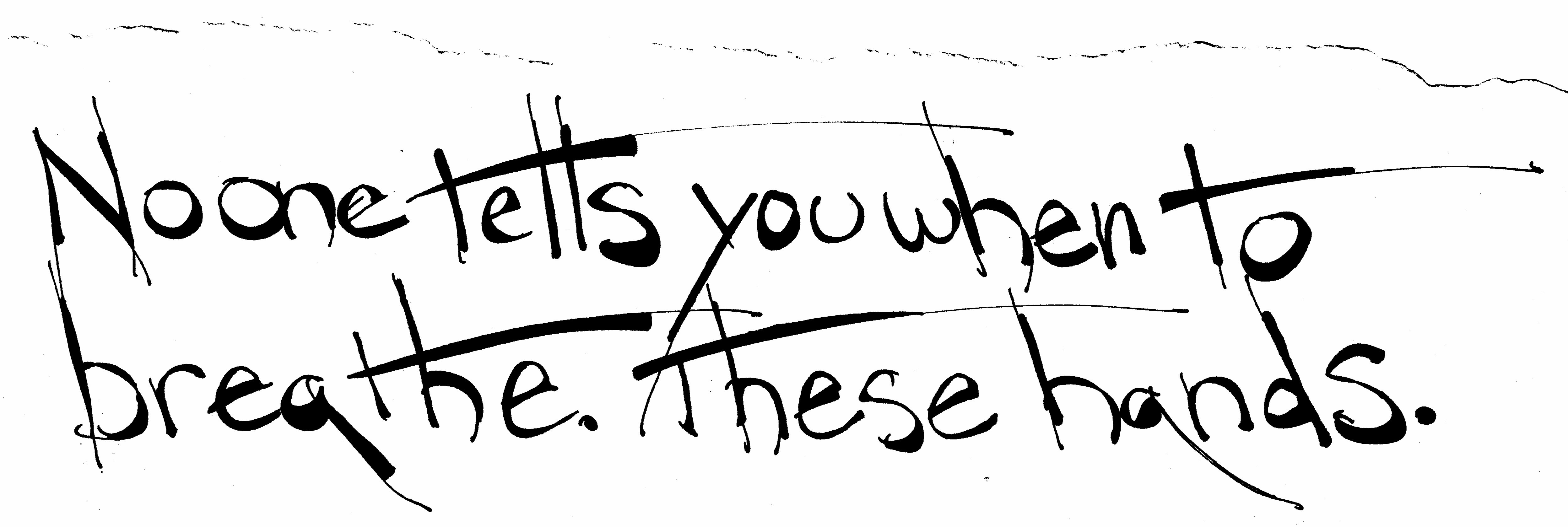
No one tells you when to breathe. These hands.

A second effort at scriptural overlay. (First pass was scruptrual and I may stick with that.) First was here. This one I think the composition’s a bit livelier.

No one tells you

Working with phrases talismanic to me for deep and private reasons. I have trouble with such language, artistically, because it won’t let me go, but won’t convert easily to poem, either – won’t get adequately ironic, won’t have the transparent sentiment washed from its smeary face. So this here’s a try at that.

A try at what, do you mean? At being oblique enough for the spirit of the current moment of our art. Which is my spirit too oh trust me. Obliquity, and, yet, a core sample. Knowing the core empty I still find me trudging there for a sample.

The source text for this’un:

No one tells you - source text

Thanks for reading. For reals.


Pee, ess, this one wants to spin. Tried to set it in motion as a GIF but couldn’t find a way, w/ my limited skill set and prog means, to get it working. Am signed up for first date with Flash at the end of the month. Am hopeful, heart in throat.

This one invites you in

Migraine, salmonella, I gotta say, been a crappy week off. Too, though, a sunny Sunday morning, I sit here on the couch sipping tea and eating a few berries, my gut don’t hurt too much of the moment & my cat’s basking in the sun, and so.

The week of serious concerted poem-making I pictured has not happened. (Nor have the coincident weeks of serious gardening or concerted bill paying.) But did come one I’d love to show you.

It began with a glimpse just of a picture poem by Robert Grenier on Craig Dworkin’s Eclipse archive –

– and in particular the overlaying of words: I and my, am and heart, a and is, (something) and beating.

I’ve been working for a while on a script got by writing something over twice – as I’ve written about here. What, I then wondered, if the overtext weren’t just the undertext, shifted. What if a good deal more difference were let in.

As it turned out, I worked with just one phrase, this one that popped up in earlier work on Overject

89R scrap 2 upI inscribed the phrase over and over, following a protocol dictated by the digits of π, and when that felt done I stopped, and then I started filling in some of the spaces created by the intersections of overlapping letterforms. After a while I got to this.

This one invites ...Don’t honestly know if it’s any good. But it’s, at least, a new method I’m curious of. Click on it maybe to see how the details go. Thoughts?

On playing well with others (I)

Hard to be a person. Hard to be one with other people. And yet how rich and how rich. I’m sounding like a self help book back cover. Kill me now? Or not. I’m thinking this, after a hard mother’s day (not having one of those right now) as I reflect on a couple of recent collaborations that have me (lord let me always write from just here) at the edge of my game.

One, a three-way conversation to be published in honour of a close friend who has passed. With me in it my two dearest friends in the world. And we have made each other nuts in the doing of it. E-mail conversations about our e-mail conversations about how to draft our draft of our rough draft. They all deferral and demurral, and I (this is deeply gendered of course) all irritation and eruption.

No one’s fault and no one’s foul. We each have a lovely fluid friendship with each the other. And those rare times we three are together, it takes an hour to choose a restaurant for dinner, and sitting there we are more three two-way friendships at one table, than one threesome.

So take three writers, each with their own way of working, each on their own arc of mourning, each vexed by the tricky work of plucking, from their private grief, what they’re ready to risk to say publicly. And each has well worn paths to the doors of each the other – ways of speaking and being together – shared language gesture and understanding – to which the third’s not privy, nor need she or he be.

The project could have been done by any one pair of us with some hardness and some tears and many walks back and forth along one of those footpaths. But we are three and every passage from one door to another has had to be done in the gaze of and for the understanding of a third. What were we thinking when we said yes to this?

Misunderstandings, hurt feelings, intemperate ventings (that would be me), bendings over backwards not to offend, lost gists, broken threads. Tensions, bumps, bruises, gaps. And always our unfinished work of mourning ready to gush hotly up through the fissures.

And yet – this is the point I’ve been headed for – no worry ever that the friendship was in danger. That ground has felt solid as a sky of stars.


The fruit of our work, of being our lumpy selves together, it’s going to be quite something. A lot more true honest real and fierce an honouring of our friend than the usual celebratory fluff you see at about this point after someone’s passed. If I do say so ourselves.

We find in good friends the parents our parents however they may have wished to couldn’t be for us. The “good enough mother” I read about in Winnicott I found in the flesh in these two. They’ve raised me up – what Pound said, m’elevasti. Much of what’s good in me, they’re to thank for.

89R scrap 1

One, lovelykind, wrote after I apologized for another grump. “Chris, no wonder Mother’s Day’s hard. A friend posted on FB yesterday, ‘Hugging everyone for whom today is a kick in the face.’”

After a day I couldn’t cry it’s that that gets me. My heart feels kicked in the face. Though I know “heart” is a dumbass metaphor and “Mother’s Day” a marketing contraption.

I wanted to write about collaboration in teaching, as well, but this post feels full, so I’ll save that for another.

The image atop is, leaves from from my red osier dogwood yesterday afternoon – thank you red osier dogwood god – plucked and scanned, for I said I was about total translation here, and that means translate the moment of translation, and one moment as I made some marks that afternoon was, leaves blowing out back there blowing into mind. So I went out and picked some fer yehs.

On total translation

A foolish notion. What would it be to translate not only for meaning, what we usually mean by “meaning,” reference, signification, the pointy ends of words, but also for everything else about, within, around them: their loops and curls, textures of their paper, sleepiness of the scribe, slips in the book’s stitching, burn marks at the edges of pages, how a sequence of ascenders and descenders read as skyline or script for a roller coaster.

Crazy yeah. But if (1) you’ve come to feel translation’s originary no matter what, and (2) your semantic translation of a poem has sucked no matter what, and (3) you’re not done with said poem, and (4) you have a decorative itch – well, you might come round to a like crazy. You might start to wonder if þine heortan geþohtas, the force of your heart’s thought, might be most truly got not via narrowly focused semantic emissions, but through a sprawling heterogeneous relation of potentially everything in the nexus of poet poem scribe translator reader annotator and medium.


Semantic reference is a span of human meaning about as sliver as visible light is to the electromagnetic spectrum.

88vMy guiding thought in Overject has become, assume you know nothing about what should or shouldn’t be translated. 88V post-it 1Feel like translating handwriting? Translate handwriting. Feel like transmitting hesitation? Transmit hesitation. Anything honest in the encounter between old damaged minor text and ignorant inexpert minor reader’s fair game.
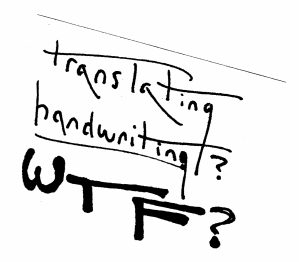
Now if at every point everything is open to translation – how do you decide? I’ve found me guided by intuition and accident.

Gut, and happenstance. Who have led me to handwriting. My work with which in Dumuzi had drawn me to more exuberant organic loops and sweeps than the hell scraps there could suit. Into Overject went the overflow. And the self-indulgence of translating nothing but handwriting pushed up in me little spikelets of self-doubt. And one of those has made it to a post-it.
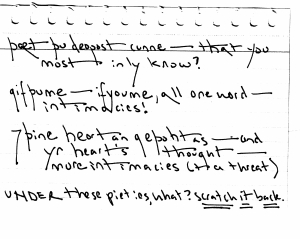
88V card 1And the possibility of annotating my translations bloomed hard and fast in my head and the next flower was a notecard on which I found a bit of semantic translation wanted (musewise, it wasn’t I who wanted, but just who let it) to burst in. And these three – transcription, post-it, notecard – plus a ghost face who poked in from a later page, became assemblage.
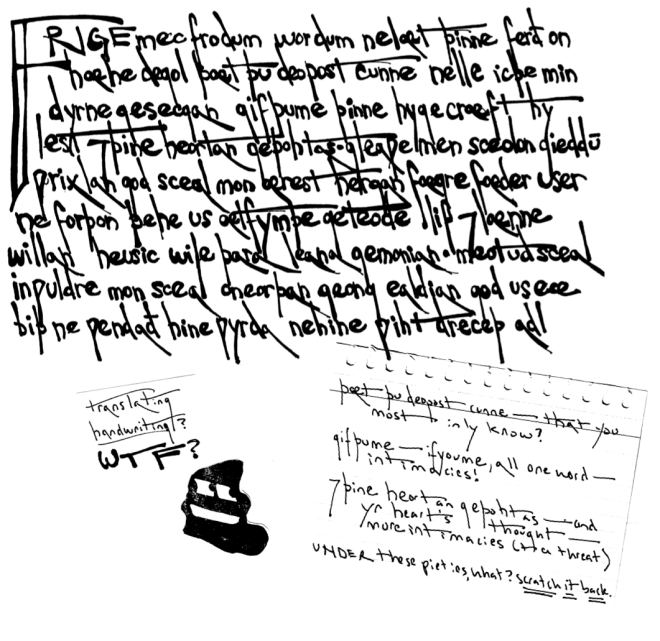
88v p1


The next major adventure is homophonic translation, of which I’ve written before. Here too annotation and anima. (The abrupt edge on the right is a scanner error. Not all accident is welcome.)
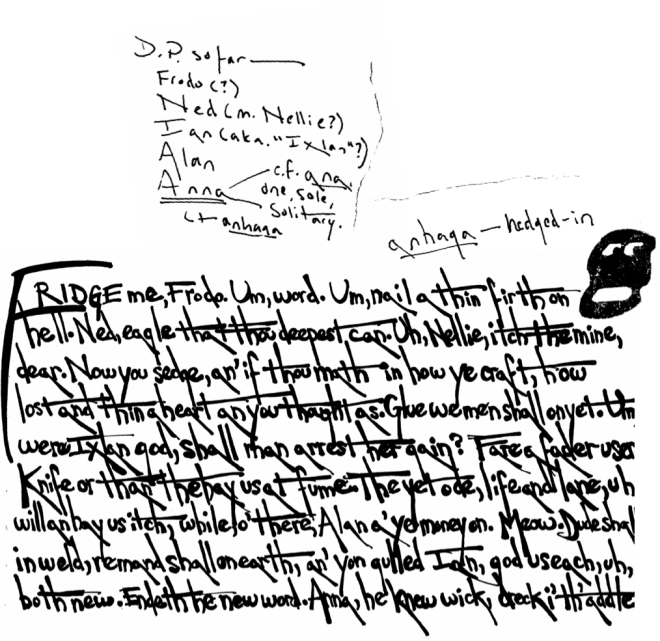
88v p2

“D.P.” = Dramatis Personae. One way I hope to make this work a little less esoteric in the end is, draw names out of the sonic surround, faces out of the visual noise, and see what storylines they hint at (no more, dear hearts, than that).


Oh now the lure of semiosis. Not from the meanings of the “original poem.” Rather from the nexus formed when that poem’s meanings intersect with recent homophonic accidents and my momentary interior weather and demonic images yet to be actualized. An ambivalent compound arises.
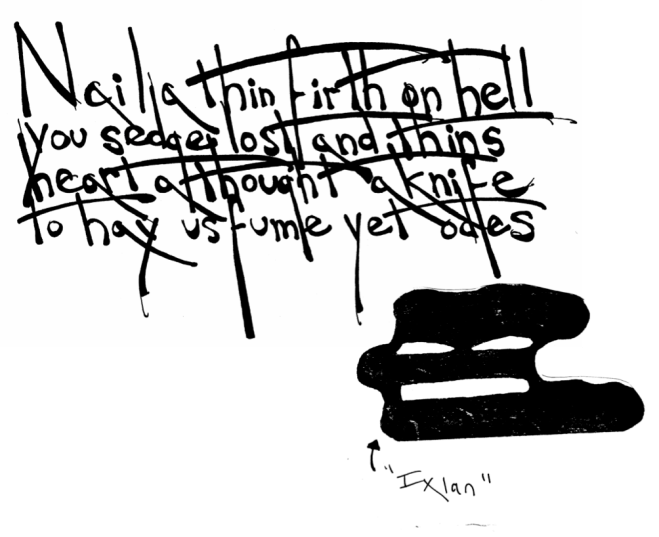
88v p3


Comes now a grave move. So much is lost in this moment! The haecceity, the suchness, of each t, each l, each g, unlike any other anywhere in existence, all now made to be of a same sameness.

I take the manuscript page and I type it up.

I try to make up the loss. I follow the leads of ascenders and descenders. After selecting some text, à la Phillips, I black out the remainder with a Sharpie. The thickness of the erasure line is governed by the heights and depths to which the line (or portion thereof) reaches. No ascender? It thins. No descender either? That thins it further. One et (⁊) and it goes down a long way. One thorn (þ) and it reaches both high and low.
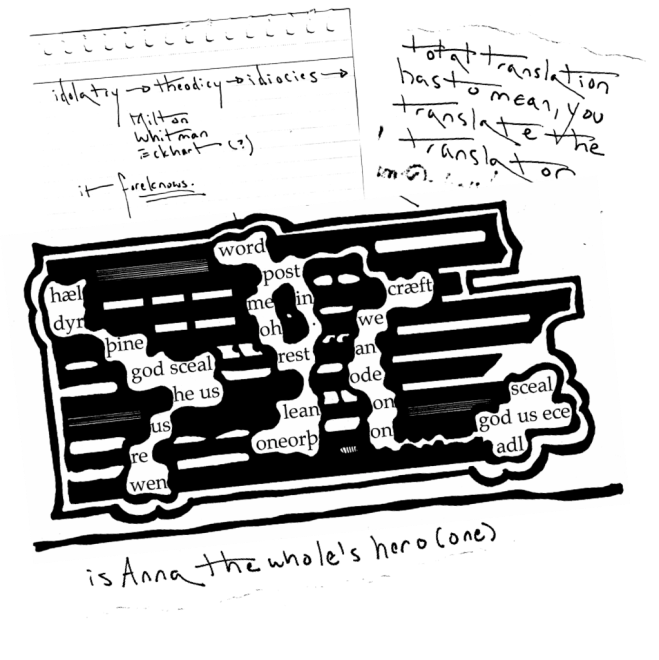
88v p4

The whole of the rest of the design, mouths and eyes, windows and doors, lions and tigers and heroes and hydras, or here a school bus climbing a hill, is begun from the thicks and thins of the bars, and the white slits left between.


The chosen text has the quality of a code. As if a minor character in Beowulf had got his hands on an Enigma machine. Crypto-crisis. So I put on my tinfoil Turing cap and coughed up this.
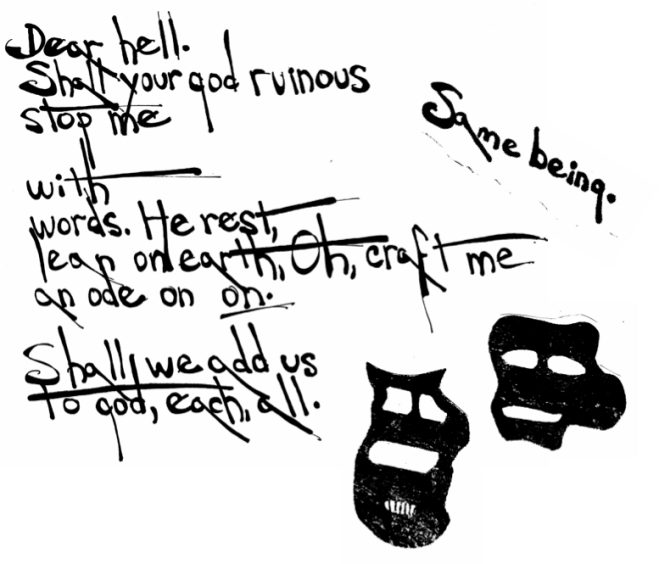
88v p5

And when I got to that, I felt I was an inch or two closer, maybe not more, to a true translation of folio 88V of the Exeter Book.


Closer anyway than my semantic translation of that folio, which I did some years ago, and goes like this.

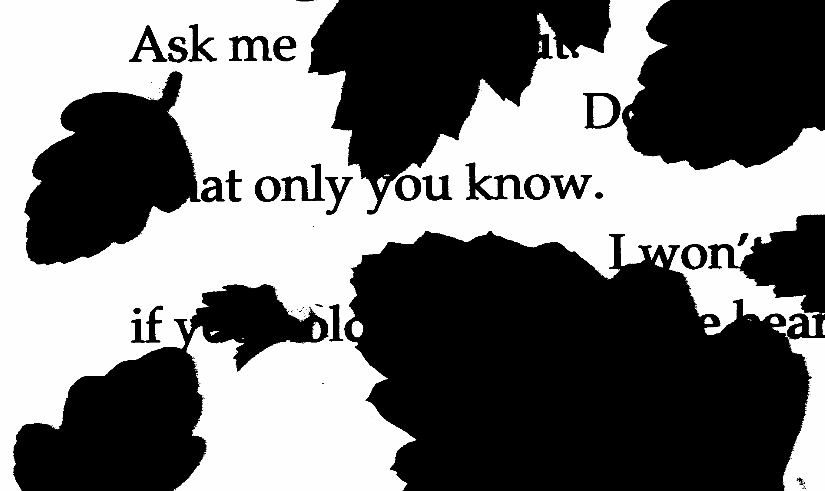
Ask me straight out. Don’t hide your whole life
what only you know. I won’t tell you what matters
if you hold the force of the heart of your thought back.

The wise work in riddles, praise God foremost,
our Father who said of His Creation we could
live here a while, a gift he’d remind us of.

In glory Measurer, on earth humankind,
young here is old, God is eternal with us,
events don’t touch Him, illness

You can hear the strain in it. Couldn’t care less about these pieties. Why’s the poem compel me at all? Nothing in its answers speaks to me. The pressure I hear in its questions – in the failure of its answers to relieve the pressure – that moves me.


Around here I realized two things. One, my epigraph, it spoke to me out of Job, “Where shall wisdom be found?” Is that what I’m translating, the Exeter poet asking it, into me asking it?

Other is, the work has to be in earnest. I can fuck around as much as I like, goof off, poke fun, mess shit up, that’s fine, but the asking has to be in earnest, otherwise this’ll be a dumb game I’m sick of real soon. Flip side, as long as it’s for heartfelt for me, it can be totally way goofball, and still live, short I and long.

A bit more on inscription

My handwriting has always been execrable. Cramped, crabbed, sotted, befuggled. Never mattered how hard I tried – after the first few sentences, the forms collapsed into a grapheme porridge pretty much only I could read, and even I only mostly.

I always thought it was impatience – hand not keeping up with thought. I was just too smart for my own embodiment! is how my thinking went. My a’s lost their stems and decayed into c’s, my f’s forgot their cross strokes and masqueraded as long l’s, my p’s omitted to close their loops, all were just too keen to get on to, well, to whatever came next.

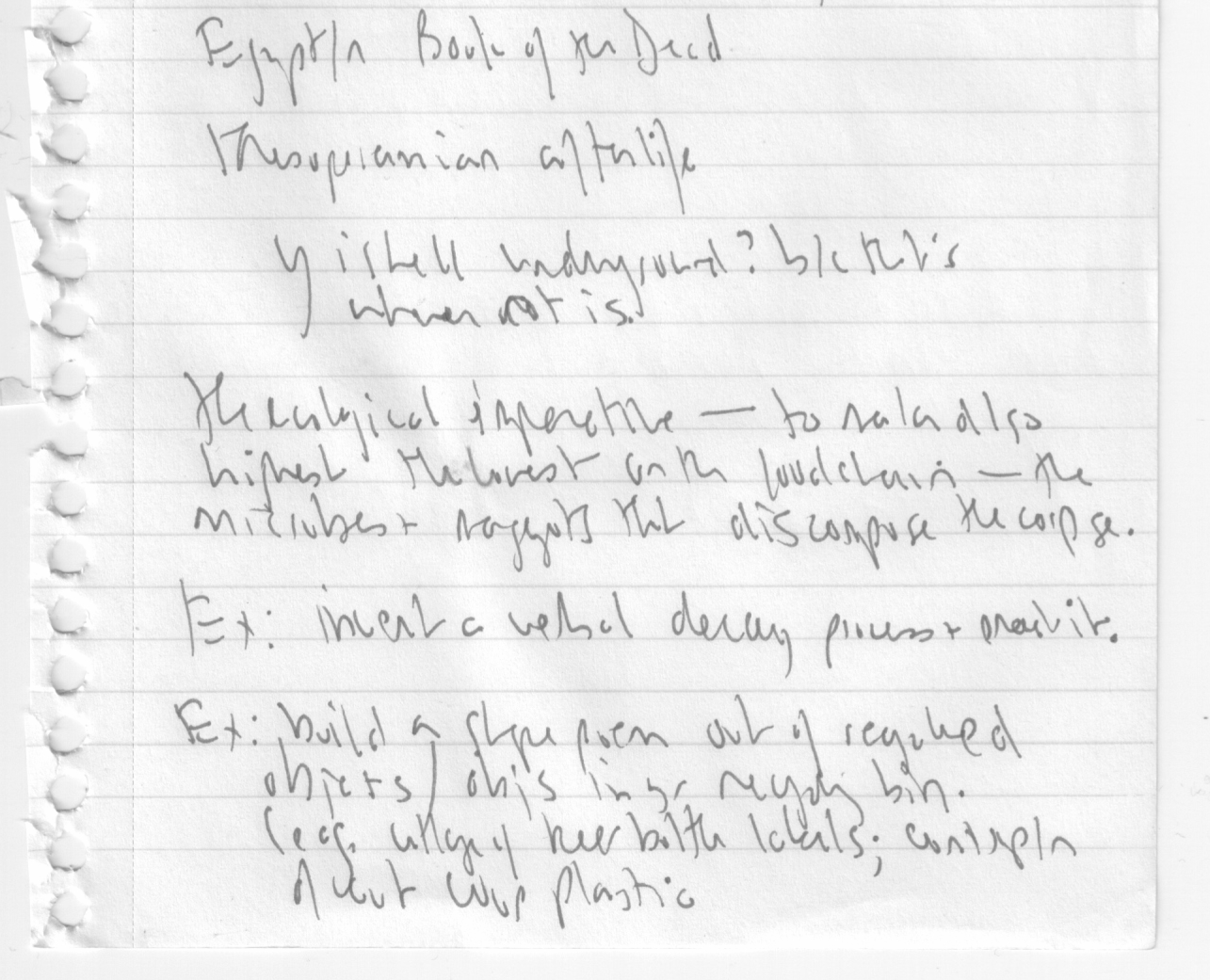
I open my journal at random for an example and come upon notes for the course that gave birth to this blog.

Journal scrap

Translation:

Egypt/n Book of the Dead

Mesopotamian afterlife

y is hell underground? b/c that’s where rot is

the ecological imperative – to make also highest the lowest on the foodchain – the microbes + maggots that discompose the corpse

Ex: invent a verbal decay process and enact it

Ex: build a poem out of recycled objects / objs in yr recycling bin. (e.g. collage of beer bottle labels; contrap/n of cut coop plastic)


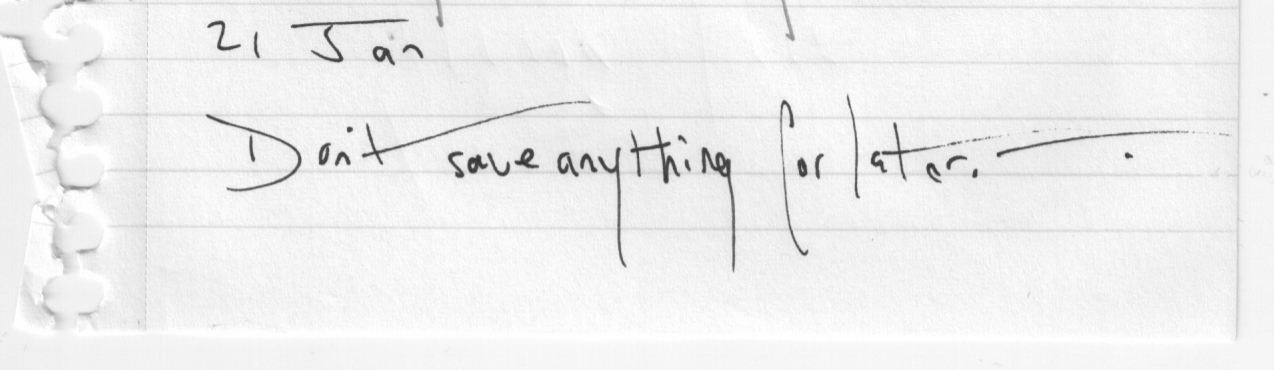
Around the new year I revisited Dumuzi to overhaul and conclude him and made a discovery. In certain brief and to me potent inscriptions I found I wanted to drop my descender hard and strike my cross stroke fast.
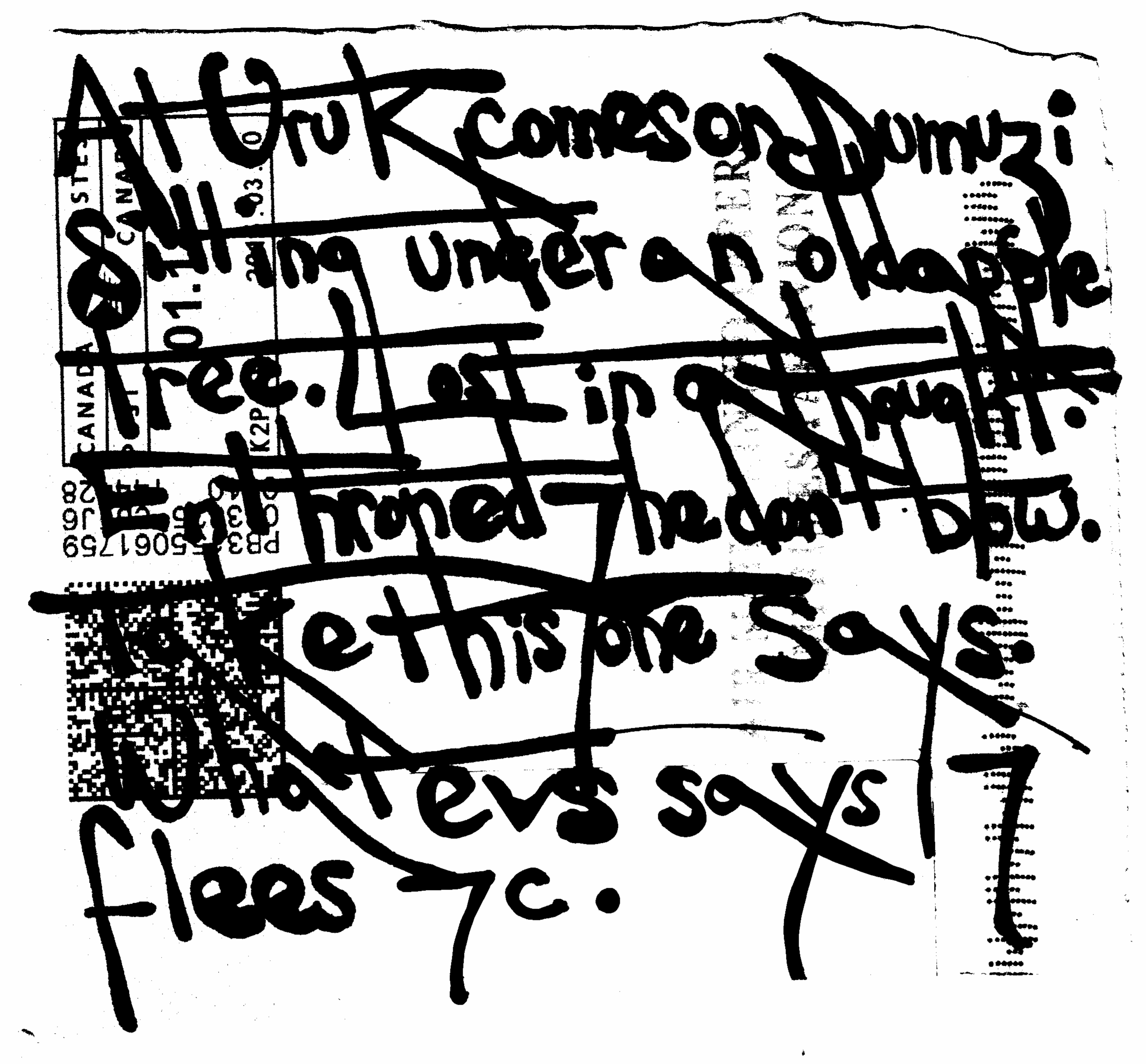
Journal scrap 2

Something, in those moments, that had been chained felt freed, an energy. The stroke could go as long hard far high fast wide as it wanted. As I wanted. As it in me wanted out of me. And what else happened was the rest of my hand began to clarify. The above is hardly beautiful but you don’t need my translation of it.
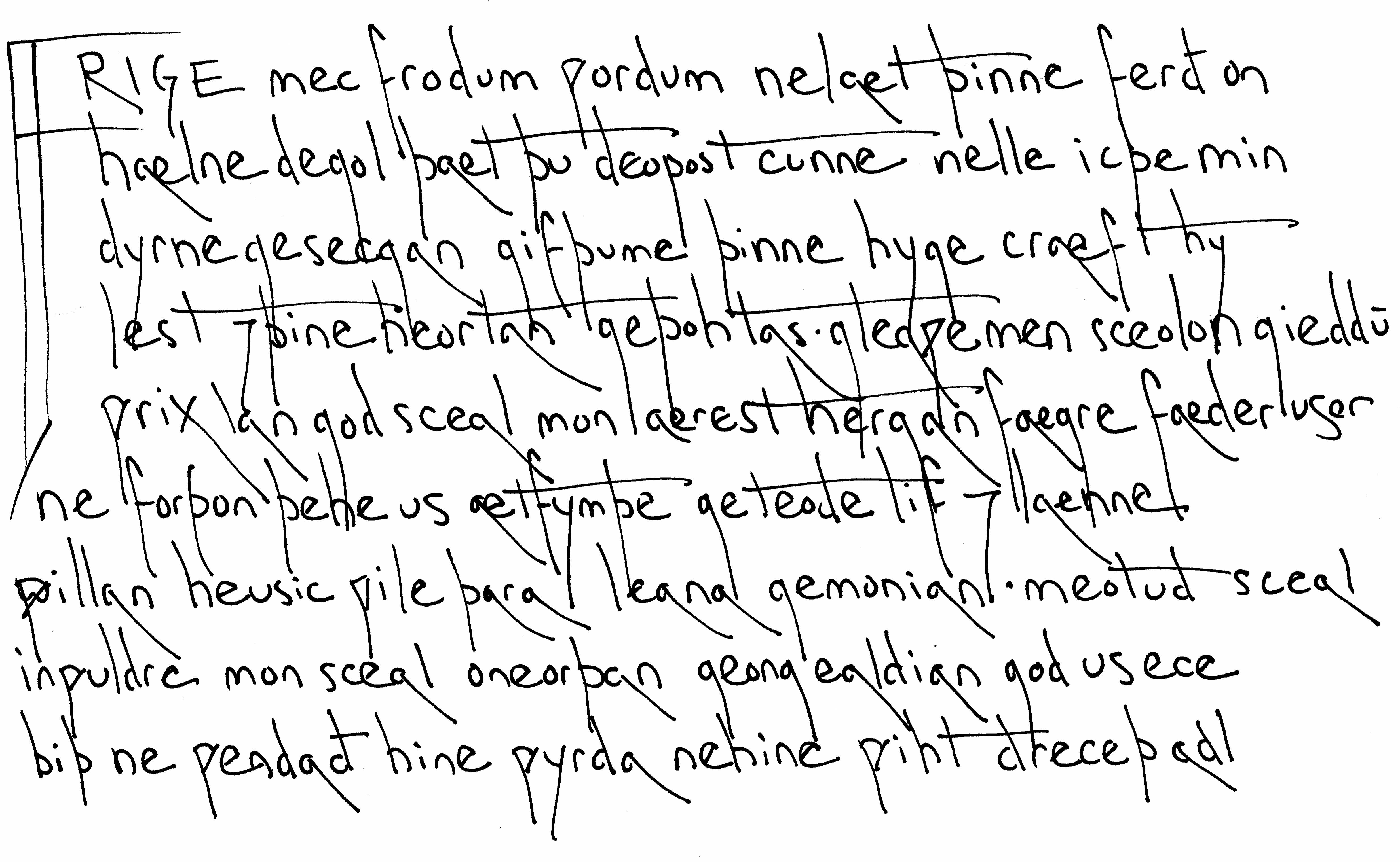
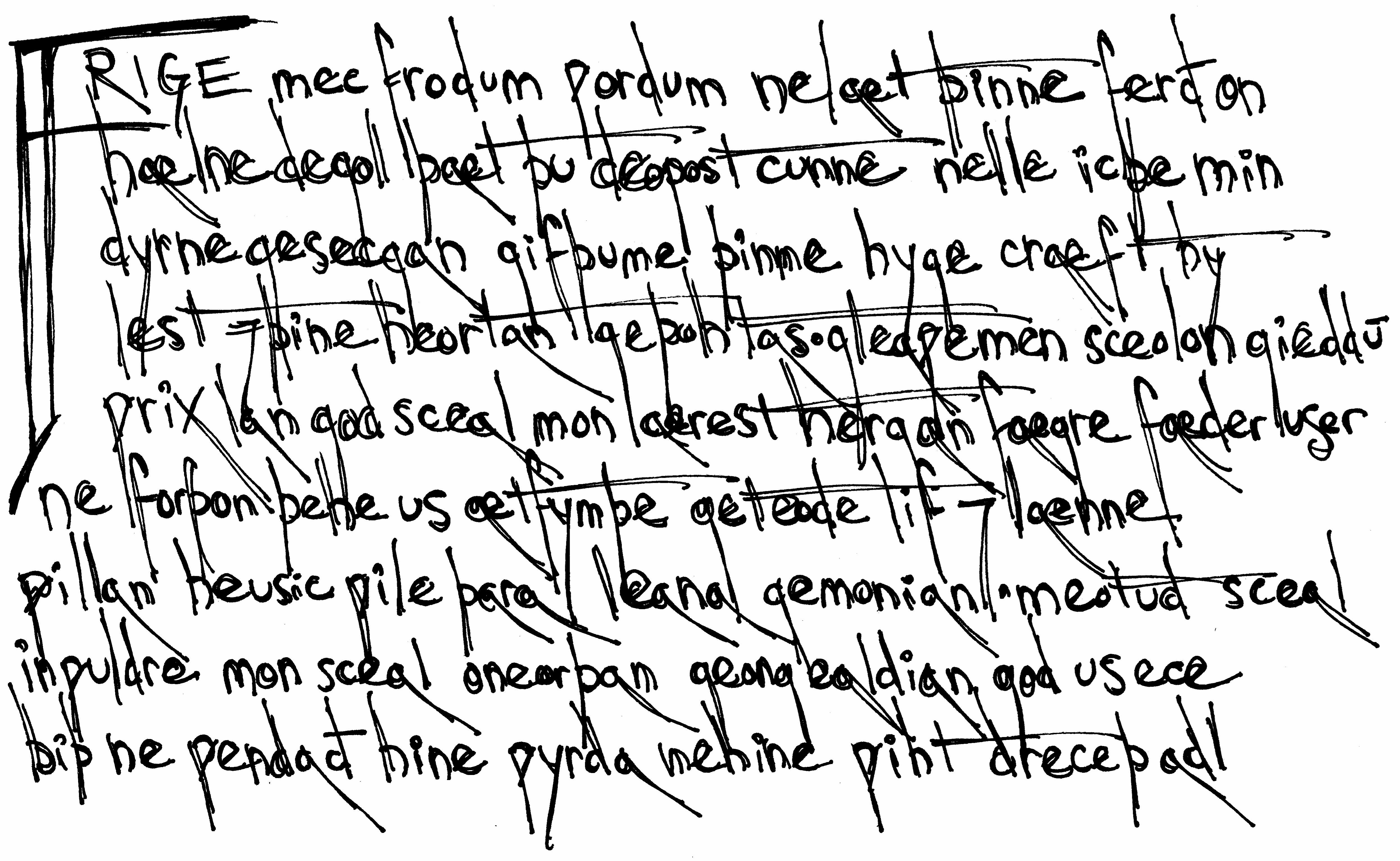
As if, in letting those flights of energy forth, the rest of my script could quiet down, take time to make the mark in the time given to make the mark. I felt I had felt Olson’s projective for the first time at the nerve ends – as matter in, of, motion.

I tried it out more general. And Dumuzi got altered lots by it – rather shockingly naked journal pages, and junk mail scraps inscribed with myth bits in a hand that feels a bit cuneiform a bit calligraphy a bit graffiti.At Uruk

But my thought here isn’t to rehash that. It’s first to acknowledge just how bloody hard it is to work with handwriting – the deep habit our script is in us. And second, just quick, to give a few pics of how I’ve worked since with script, my scriptural breakthrough.


These are from Overject, a translation project I’ve recently brought back into the shop for smashdown and overhaul. The source text is a really rather minor poem from The Exeter Book, a miscellany of Old English poetry with a few real knockouts – “The Wanderer,” “The Seafarer,” “The Ruin” – and a lot of stuff not much translated.

The one I’m working with is often called “Maxims” or “Gnomic Verses” but I’ve called it “Proverbs.” There’s something about its mix of sententious piety and anxious disjunction that strikes me as prematurely postmodern.

Overject, from Proverbia Disjecta, tries to release the anxious poem from the pious poem by means of wayward translation methods.


The first method is diplomatic transcription. Usually that means going from manuscript to typescript, getting as best you can the peculiar individual features of inscription into the uniformity of typesetting. Like drugging clowns to dress them in army fatigues!

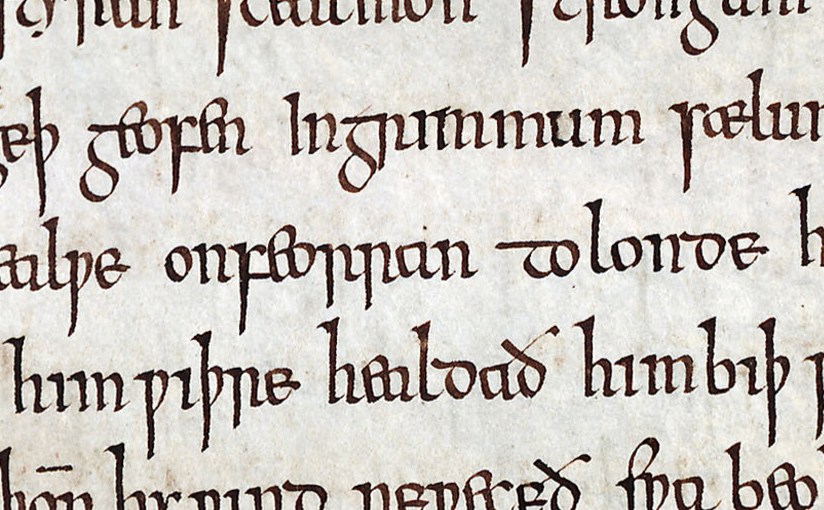
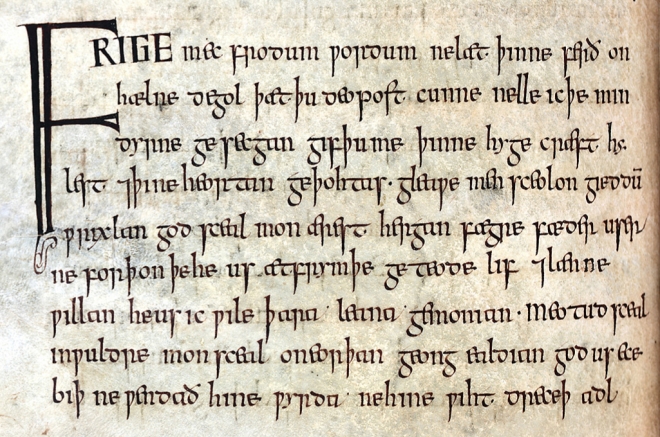
My approach is different. I translate the handwriting of the Exeter scribe into my own handwriting. Here’s the scribe’s version:

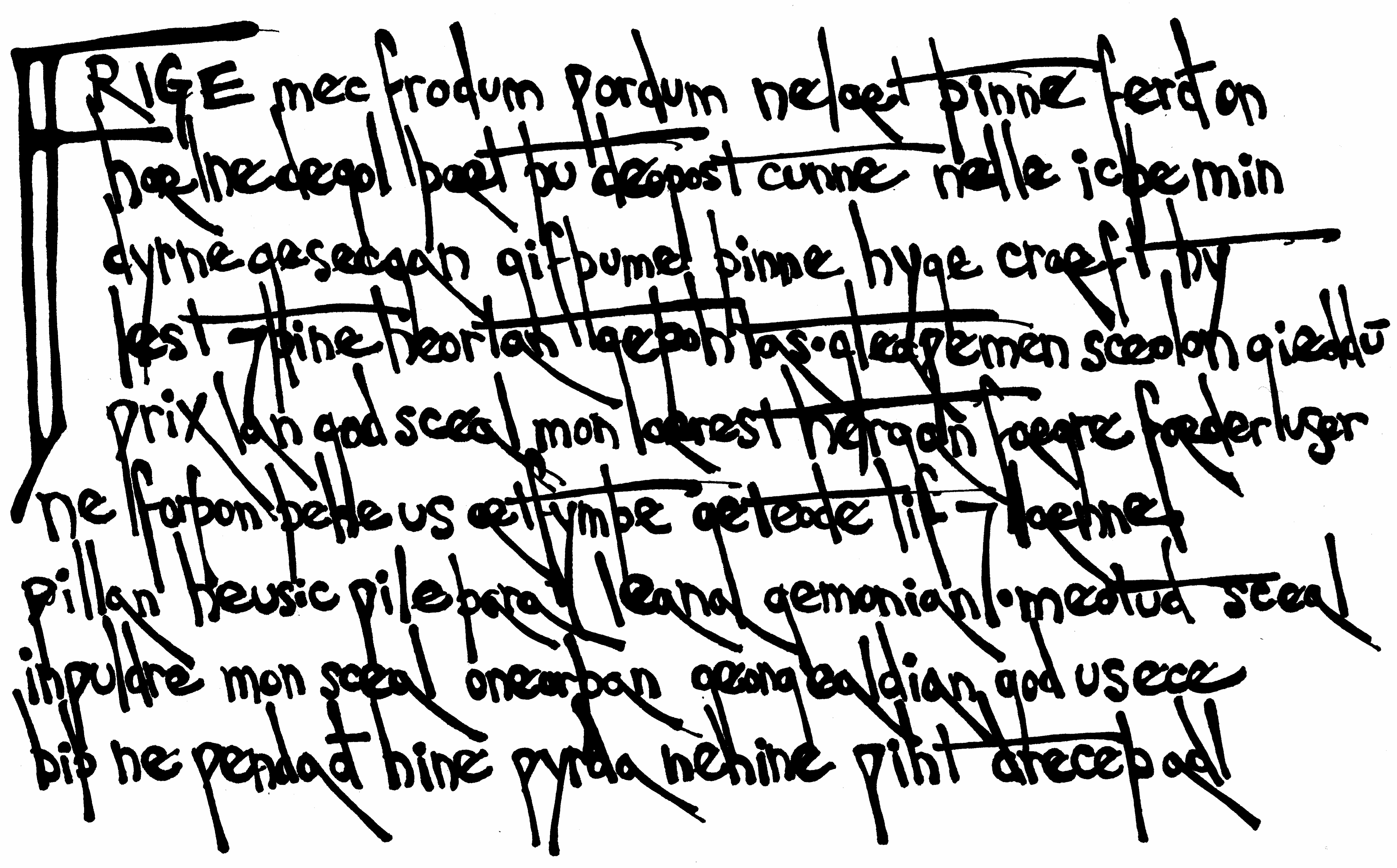
88vTakes me three passes to get to my version. On the first, I do the script I told you of, let all the energy into ascenders, descenders, cross strokes they want. And damn but don’t it feel nice to.

88V dip transcrip pass 1

You’ll notice, three lines from the bottom, leftmost character, I’ve translated the scribe’s sleepiness. Not by translating some error directly, no slavish copying here, but by allowing my momentary inattention, my slip of a modern “w” where I should have writ the rune ƿ (wynn, “joy”), to stand and be overwrit, just as the scribe has done elsewhere (e for æ, say) when he’s drifted off.

How subtle this translation process gets. Best to go slow, not to assume anything, the least stroke might paralyze you.


Second pass is to set, roughly, the outlines of the characters.

88V dip transcrip pass 2

Third fills them in. This is the fussy part. If at the start it’s quick expressive sweeps of the pen – I toss the sheet and start over if I’ve got too in my head (the Sharpie is a perfect compass) – at the end it’s meticulous distribution of microns of ink, glasses off, eyes a couple inches from the receptive surface (and still I eff it up in six places).

88V dip transcrip pass 3

Not an improvement, nor deprovement, from dear anon’s, nor proof of no sort, but a difference. But a difference that makes a difference? Amn’t sure yet. I think it’s a base text, ground for sthg. more to grow upon, not sure what, annotation, emendation, error compounded upon error … well, stay tuned, if you wish.