Exercise: Zukofsky’s word-flowers

This one came in three parts — a reading assignment, a journal assignment, a writing assignment. The first two meant as robust prep for the third. And I was right they would find it a hard exercise! Maybe the hardest of the quarter. It did ask them to set aside things they’d spent years learning to do well, e.g., staying on topic, making proper sentences.

The exercise (with some of their work to follow) —

1. Reading

A few pages from Louis Zukofsky’s late word-flower sequence 80 Flowers. Like that one and this one:

STARGLOW

Starglow dwarf china rose shrubthorn
lantern fashion-fare airing car-tire crushed
young’s churning old rambler’s flown
to sky can cut back
a crown transplanted patient of
drought sun’s gold firerimmed branched
greeting thyme’s autumn sprig head
happier winter sculpt white rose

MOUNTAIN LAUREL

Known color grown mountain laurel
broadleaf of acid earth margin
entire green winter years hoarfrost
mooned pod honesty open unvoiced
May-grown acute 5-petal calicoflower cluster
10-slender rods spring seed sway
trefoil birds throat Not thyme’s
spur-flower calico clusters laurelled well


2. Journal exercise

Metonymy is calling one thing to mind by naming another that’s habitually associated with it. For instance, the phrase “red wheel barrow” calls to mind a barnyard, and perhaps a pile of dirt, or hay bales. Pick two individual words in 80 Flowers and describe the metonymic resonance of each — the things it calls to mind by habitual association. NOTE: Some metonymic associations are personal and idiosyncratic — associat­ing a red wheelbarrow with Indians, say, because there’s a mural with the poem on Indian Street. Try to steer away from those associations, and towards associations you can trust would be shared by a typical reader.

(In a class soon after we looked at how context, a word’s neighbour words, draw some metonymic associations into the foreground, and let others recede into the background.)


3. Writing exercise

Each of Zukofsky’s poems consists of eight five-word lines. Instead of coming together into sentences, the words make a sort of kaleidoscopic image of the flower — fragmentary, unparaphraseable. In fact, you might say that the relationship between any two adjacent words is not syntactic but metonymic, interested not in making a statement, but in drawing out habitual associations. Write a poem that uses the same form: eight five-word lines, compound words as you please, words next to each other not to make sentence sense, but to make richly textured juxtapositions.
teaching portfolio

Student work: 101 word short story

I was struck by how well many of these came out. Their work with formal or procedural constraints in verse (anagram poem, phone number poem, found poem) seems to be paying off in their work in prose. Or that’s one way anyway of accounting for the leanness of these.

A lot of work to comment on tonight so I’ll post just a couple here. Two I find especially attentive to the shapes of their sentences. And while they are stories — they propose event — they also draw many of their flavours from the prose poem and the flash essay.


GREEN ON YELLOW

The yellow coat is missing a button — it has been for a while now. It just hangs on the rack over muddy rain boots.

Her father sews a new button back on but it doesn’t match the others. He pricks his finger; she plays doctor and dresses the wound in a pink Band-aid.

Arms slide into sleeves and she spins around in the coat like it’s brand new, save for the green button that breaks the yellow. (She picked the button out herself.)

Tugging on boots, she dashes into the rain. He’s in her footsteps, chasing her shadow.


MY NEW HOME

In the woods, around a creek, down a gravel road. I walk in to music, vibrations, occupied air.

I live with four boys. They throw apples at deer.

One is king of the trash fires. He stays up late with the trees.

One is a recluse gamer. With the deepest mind.

Another just shaved his beard and dreads. What a shame.

And then there is one that plays with his hair, while he smiles at me. Such a dangerous combination.

I think of how close I want to get, tension thickens the room. I spend my nights cold.

Exercise: 101 word short story

Read the short short story “Frontiers” by John Daniel, and write a story that has exactly 101 words — including the title. The story:

Frontiers

I’ve never been this far from home. I’ve never stayed up this late. I’m out west.

We rode the train. I slept upstairs. You put your clothes in a hammock. They have Dixie cups.

The world has mountains on the edge, where the sun sets, big black things, and that’s where we’re going.

I’m in the front seat with my mother. I’m five. We’re going to a dude ranch. There will be cowboys.

There’s a soft green glow on the dash board. My mother wears perfume.

I’m traveling. I’ve never been this old.

“The stars are ablaze,” I tell my mother.

Exercise: Fall haiku

First . . .

Read the haiku by Bash­ō (here are some). Notice that

  • most have a seasonal reference — something that tells you what season it is;all are three lines, but most do not obey the Japanese formal stricture (5-7-5 syllable count) — haiku tend to work better in English if they’re shorter;
  • they rely on image rather than on statement — they’re vivid to the senses;
  • they often juxtapose two experiences or impressions — sort of the way Pound’s “In a Station of the Metro” does—though there need not be any metaphor;
  • they are completely simple.

. . . and next . . .

Write five fall haiku for next class. Your seasonal reference, a traditional part of the Japanese haiku, should be to fall. Be on guard for clichés!

Draw each haiku from the world you see (and hear, taste, touch, and smell) around you. Rely on image rather than statement. In other words, let the image speak for itself.

Don’t pile on effects. Be completely simple. In the spirit of which — no more than one adjective or one adverb in each.


. . .  and soon to come.

Some of their fall haiku, after a round of rounding them down.

On disjunction (II)

Disjunction often comes of suddenness—may be suddenness itself, given body, a form found.


Had my students working Tuesday on deep description. Pick one from this clump of grape leaves and describe it with sufficient devotion that another here, given this whole lot of leaves, hearing your account of yours, could pick that one out, unerringly.

They did and did and all good. The followup: Tune your antennae to beginning now and pick one phrase in your description that resonates beginningness. Write it at the top of a new page. Now tune to ending and pick one phrase that sings endingness. It goes at the bottom of that same page. Now, moving quickly, the first thought then the next first thought, write the paragraph that gets you from top to bottom. One restriction—can’t be about a leaf.


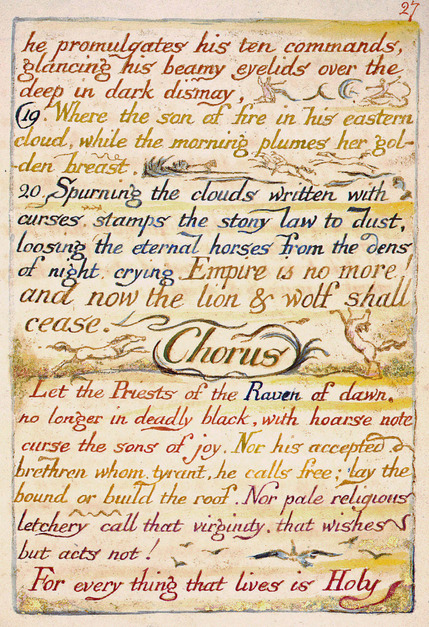
If each thing touches every thing (Indra’s Net) then disjunction is just in fun. No disruption except of our sense of disconnection. Blake’s Marriage of Heaven and Hell. Not everything but every thing. Means there’s all the space to move.

Blake - MHH plate 27


The way I put it in a poem that never found a public home.

The ease with each part touches each adjacent part.
Apples in a wood crate on a foldout cardtable.

Oh god he’s quoting himself make it stop.


Thought, as they worked away, too easy to sustain a through-line here, need to shake it up. OKAY I said STOP. On whatever word, or mid-word, stop. Draw a big dash. (Drew an em-dash on the board.) Put a period after it. (On the board.)


The way it came to me in mountains once when I was struck dumb by the perfect of each altogether and entirely open stone. You have all the space you’ve ever needed and have always had. You have all the closeness you’ve ever needed and have always had.

Snagged in a language of one who regathers himself after invasions and evasions as dimly as fiercely remembered. And, the insight didn’t keep me from being a somewhat total asshole to the woman I was there with and did stick with me through it, a year more, then she didn’t any longer, so.


A period after it and now pick up in a new place. Some other new subject, whatever, anything. Just don’t go on saying what you were. Day by day make it new. Day by day? Word by word.


To start, each word, anew. Meant to get to Tender Buttons. Sounds good, for another night than this, rain flying at my windows all.


POSTSCRIPT. After a dissipated start my afternoon class spent ten minutes talking about one line break and without repeating ourselves! The line:

Her

Student Work: 20 little poetry projects (II)

Some more fun bits from my students’ encounters with Jim Simmerman’s exercise.


The well-spoken gangster began to descend.
That gangsta-man was stepping onto the soil from flight, as he said.
“Carpe Diem” he said.
Even the wind howled back when he said this line.
The mountains didn’t soar as high as the gangster, the gangster who was I.

Usually these go better when they get off the topic, line by line, but here a disjointed narrative comes together (apart).


For the dead eye stars the struggle is real. Charlie Bradbury was absent from their event in Vancouver during which many a blue was tasted. We smelled what was right and what was wrong and we saw the reds that pretended to be the blues that were tasted.

Lovely parataxis here.


The trees decide to hug back,
Making the note-taking in fourth-grade science
Less of an assassination

Right at the end of the poem, that, a real surprise.


Arguments will be had but no points will be made
under a slimeball ceiling,
built by men who don’t create.
Papier pour moi, stylo pour vous?
Erasers eat lead.
Gummy belly-button on a pompous twenty-something.

One thing we noticed in class todays—abstractions can earn their place in a poem by sitting aslant each other—as in the phrase “the numbest kinds of pain” in Robert Hass’s prose poem “Museum.” Something similar goes on here in the first and third lines … abstract nouns and generic verbs become lively and specific through being at odds with their neighbours.


Some more on that poem by Hass to come. And haven’t forgotten my promise to follow through on disjunction. Just think though—the longer goes by, the more disjunctive the resumption. Word.

teaching portfolio

Student work: 20 little poetry projects

Some excerpts from my students’ work with Jim Simmerman’s exercise “Twenty Little Poetry Projects.” Good funs. Oh and I had them do a cutting-and-paring exercise on them … where those went especially well I’ll include the stuff cut.


Lemons are the sun.
Each yellow drop is a blinding, burning, ray in the green.
Wet tongue slides across teeth,
tasting squeezed citrus,
that sprayed lemon into my nose,
the slice of the knife in the skin is a whisper,
the yellow color tart and sweet.
My Nonna’s lemons turned to limoncello in the Italian sun.
Nonna died—those are my lemons.
The first time I lay on wet grass, I was barefoot.

Really effective cuts here opening up spaces that bring Tomas Tranströmer to mind. Only bit I might miss is “Nonna died …”.


I.

Yesterday
a little death. But
today. Rise. rise
get up
again.

II.

40 white teeth
a smiling hole
40 teeth each
Its mouth 
exploding
New Year’s Eve
Children smile
into the white
Everything knows
this white.

III.

Rancid milk steaming
In her eyes
one million orchids
opening
Irises white          blank
skin pressed against
night
with the last energy
turned to heat
all is
heat now
small crackles

Yeah good cuts here too. I admit I suggested some but the poet’s assent to them’s what matters. Again it’s about opening spaces. Here I hear tones of Stevens’s “Thirteen Ways of Looking at a Blackbird.” Just cuz of the roman numerals? Am I that susceptible?


Tom Waits for me, wishing he was in New Orleans.
Ain’t it a crying shame, he says just like that
except that isn’t the way it’s said at all—
after all, the only way to stay together
is to drive in opposite directions.

Echo here for me (that seems to be my track tonight) is Frank O’Hara. Specifically “A True Account of Talking to the Sun at Fire Island.” Specifically specifically the good cheer of the sun. It’s everywhere! How could it not be in a good mood! And that infects Frank and us. Poem as a high-pleasure construct.


A light crack on that little ankle bone on the inside that sticks out far, but the eleven floors otherwise treated her well in the last several seconds.
Zing was upset about the lag.
Effectively, they will no longer speak unless it is to reiterate the tension previously created, and this pact is now effective.

K that long line is just crazy. (Hard to set here. Read each sentence as its own line.) Whitman’s expansiveness, Ginsberg’s hypermania, Moore’s polysyllabism.

A few more …


This dismal abyss of cottage cheese Christmas
is just a fridge full of impulse.
Ms. Mary stole the cobweb from the shelf
Mama Tits has proof.

Where ballad meets blues meets Breton.


You are what you eat.
No purple antelopes here—
taste bitter roads and
hot rain, prickly on ends with
wafting scents of
mud puddles? Dark, but
cracked. Clicking nails
seeing Stairway to Heaven, la la
even Bill Nye believes in Jericho
where antelopes of purple hue
roam freely
from stars in galaxies afar
palooshing each other until
skidding off with fear.

A strange and sardonic turn on its opening truism. Most of the cuts sharpen the sense of line very nicely.


I cut off my arms and replace them with refrigerators.
And I taste my consciousness outside me
Excusez-moi, qui a pété?
I lift my hopes higher with my diamond-studded weasel arms.

Something of Lorca here …


Eu non podo deixar de chorar
I did not know I knew that.
Fate tips his hat and waves as he passes by.
The leaves fly out of my vision, whisked away by a stronger breeze, while I remain grounded.

No surprise, I guess, that a lot of these remind me of Spanish and American surrealists. Here, James Wright, the line at once taut and languid.


I fail horribly at taking a “selfie.”
Since my arms are short and my point of view is warped.
“I literally can’t even.”
The ridiculous clown and his pride ruined the atmosphere of the wake.
And your family was as accommodating as a state penitentiary.

Here I’m taken especially by the passages in quotation marks. As if the poem became aware briefly of its own language and raised a skeptical eyebrow.


He has the heart of a lion.
Does will do as does do.
Though he is not exactly what I would call courageous.
Okay, maybe he actually was.
Though he thrust his hands up in the air and shouted “YOLO!”

The cuts here have little lion hearts. Make bold to take out the connective tissue. The pun in line two liketh me much, acts, deers.

Some more to come later today. Thanks again to mes etudiants for allowing me to post ses leurs travailles.

teaching portfolio

Exercise: 20 Little Poetry Projects

(An exercise by Jim Simmerman, taken from The Practice of Poetry, Robin Behn and Chase Twitchell, eds. Will post some recent strangeness later.)

Give each project at least one line. You should open the poem with the first project, and close it with the last, but otherwise use the projects in whatever order you like. Do all twenty. Let different ones be in different voices. Don’t take things too seriously.

  1. Begin the poem with a metaphor.
  2. Say something specific but utterly preposterous.
  3. Use at least one image for each of the five senses, either in succession or scattered randomly throughout the poem.
  4. Use one example of synaesthesia (mixing the senses).
  5. Use the proper name of a person and the proper name of a place.
  6. Contradict something you said earlier in the poem.
  7. Change direction or digress from the last thing you said.
  8. Use a word (slang?) you’ve never seen in a poem.
  9. Use a piece of false cause-and-effect logic.
  10. Use a piece of “talk” you’ve actually heard (preferably in dialect and/or which you don’t understand).
  11. Create a metaphor using the following construction: “The (adjective) (concrete noun) of (abstract noun)…”
  12. Use an image in such a way as to reverse its usual associative qualities.
  13. Make the persona or character in the poem do something he/she could not do in “real life.”
  14. Refer to yourself by nickname and in the third person.
  15. Write in the future tense, such that part of the poem seems to be a prediction.
  16. Modify a noun with an unlikely adjective.
  17. Make a declarative assertion that sounds convincing but finally makes no sense.
  18. Use a phrase from a language other than English.
  19. Make a nonhuman object say or do something human (personification).
  20. Close the poem with a vivid image that makes no statement but that “echoes” an image from earlier in the poem.

The ones go best that let go, over and over, of whatever one thought to mean. Simmerman comments:

I created this exercise for my beginning poetry writing students who … seemed to me overly concerned with transparently logical structures, themes, and modes of development at the expense of free-for-all wackiness, inventive play, and the sheer oddities of language itself.

I created the exercise in about half an hour, simply listing, in no particular order, a lot of little sillinesses I had seen and liked, or had not seen but thought I would have liked, in poems here and there.

Here’s a poem by Simmerman that completes the twenty projects in order.

Moon Go Away, I Don’t Love You No More

  1. Morning comes on like a wink in the dark.
  2. It’s me it’s winking at.
  3. Mock light lolls in the boughs of the pines.
    Dead air numbs my hands.
    A bluejay jabbers like nobody’s business.
    Woodsmoke comes spelunking my nostrils
    and tastes like burned toast where it rests on my tongue.
  4. Morning tastes the way a rock felt
    kissing me on the eye:
  5. a kiss thrown by Randy Shellhourse
    on the Jacksonville, Arkansas, Little League field
    because we were that bored in 1965.
  6. We weren’t that bored in 1965.
  7. Dogs ran amuck in the yards of the poor,
    and music spilled out of every window
    though none of us could dance.
  8. None of us could do the Frug, the Dirty Dog
  9. because we were small and wore small hats.
  10. Moon go away, I don’t love you no more
  11. was the only song we knew by heart.
  12. The dull crayons of sex and meanness
    scribbled all over our thoughts.
  13. We were about as happy as headstones.
  14. We fell through the sidewalk
    and changed colour at night.
  15. Little Darry was there to scuff through it all,
  16. so that today, tomorrow, the day after that
    he will walk backward among the orphaned trees
  17. and toy rocks that lead him
    nowhere I could ever track
    till he’s so far away, so lost
  18. I’ll have to forget him to know where he’s gone.
  19. la grave poullet du soir est toujours avec moi
  20. even as the sky opens for business,
    even as shadows kick off their shoes,
    even as this torrent of clean morning light
    comes flooding down and over it all.

Examples from my students’ poems here and here.

teaching portfolio

Exercise: Phone number poem

From our unit on the line.

Write a poem using your own phone number, with area code, as the template. Specifically, the number of syllables in each line should match the corresponding number in your phone number. If your area code is 360, the first line has three syllables, the second line has six, and the third line is blank (a stanza break).

The poem should read naturally—as if it just took this shape of its own accord. Don’t worry about the subject, let the form lead you where it will. An example:

360-650-6354

How did you                                         3
find your way to this place?                   6
                                                                                     0
Oh, I was just thinking                          6
one day about toads,                          5
                                                                                    0
toads that look like stones, stones     6
that are toads                                                  3
when no one’s looking                          5
at them at all.                                    4

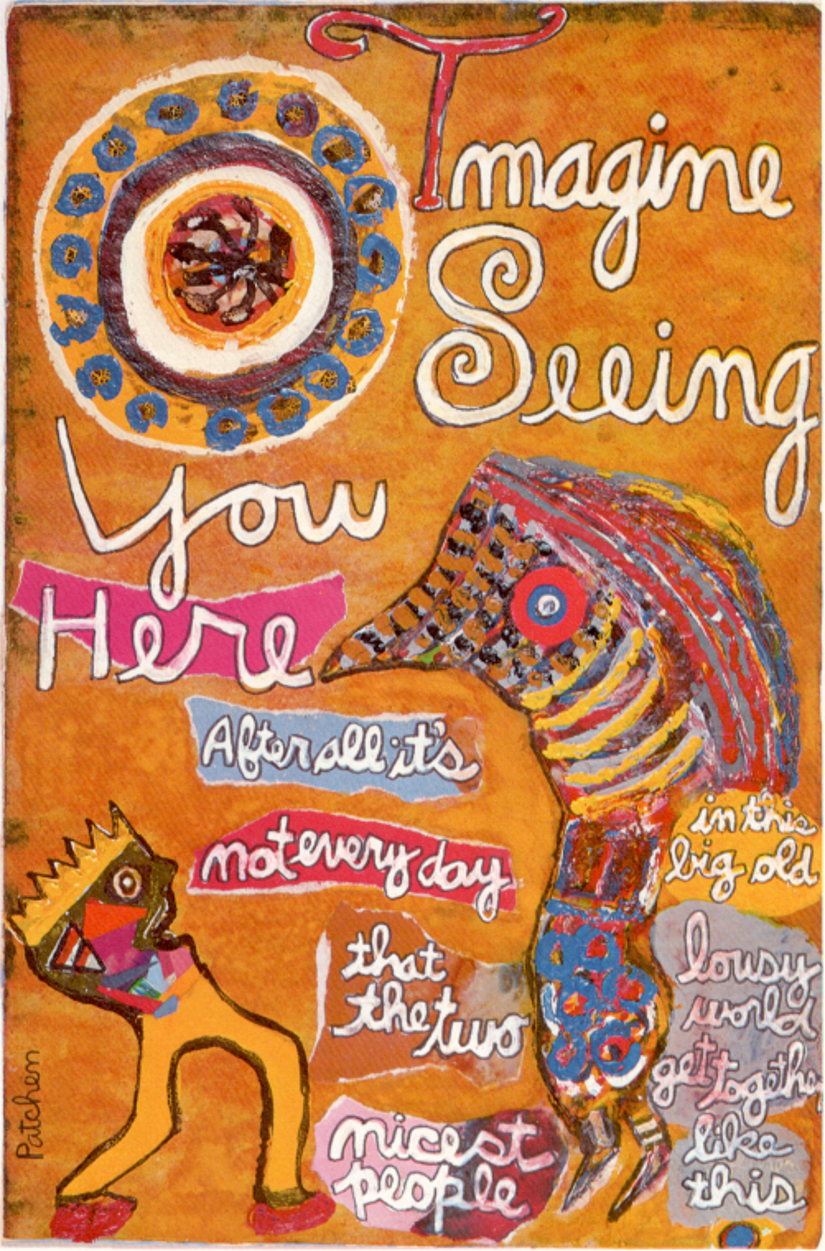
Not anyone’s actual number. Exercise adapted from Janet Burroway’s Imaginative Writing. Image up top is cropped from Kenneth Patchen’s “Imagine Seeing.”

Patchen – Imagine
In “The Argument of Innocence” (1976)

Imagine a rotary phone with 16 digits to range among. A computer dreams in hexadecimal . . .

teaching portfolio

Exercise: Found poem

A writing exercise from our unit on the phrase.

Write a poem made of found phrases. “Found” means you don’t make them up yourself—you see or hear them around you. “Phrase” means more than a single word, less than a full sentence. Choose one kind of source to take your materials from. A few possibilities:

  • bits of overheard (or misheard) conversation
  • first phrases of poems in an anthology
  • phrases seen in print ads (magazines, posters, billboards)

Avoid song titles and song lyrics—they tend to be clichéd and to make clichéd poems. Find a source that offers bits of language you feel eager to mess around with.

It’s okay to make small changes (e.g., removing a verb to turn a sentence into a phrase, or changing verb tense to make two phrases line up) but avoid introducing any words of your own.

You may not be able to make the sort of sense you wish to. Let the material lead and you follow. Instead of worrying about making sense—focus on setting up resonances.

An example, from John Ashbery’s “Title Search” (though not in fact a found poem it reads like one):

The Little Red Church. The Hotel District.
I’ll Eat a Mexican. The Heritage of Froth.
The Trojan Comedy. Water to the Fountain. Memoirs of a Hermit Crab.
The Ostrich Succession. Exit Pursued by a Turkey.
In the Pound. The Artist’s Life. On the Beautiful Blue Danube.
Less Is Roar. The Bicyclist. The Father.

(Most of these are phrases. Which ones aren’t?)