Exercise: Punctuation poem

Next week we turn to the gorgeous Gorgeous Nothings, a collaboration across oceans and generations by Emily Dickinson, Jen Bervin, and Marta Werner. My students’ first exercise will be:

Compose a poem made entirely of punctuation. Then write a short paragraph describing what the poem “means.” Treat the paragraph as a creative extension of the piece — as playful creative nonfiction, not straight-faced literary analysis. Be ready to present both the poem and your explanation to the class.

The examples they’ll have “read” are retrieved from Rasula & McCaffery’s Imagining Language — up next.

Exercise: Chasing your tail in the word hoard

Write the editors of Imagining Language, from which the passage [they’ve just read] from Joyce’s Finnegans Wake is taken:

At the center of the episode is a hen scratching open a letter in a compost heap…. Any proto-narrative aspect of the Wake is subordinated to its manifestly epic ambition, which is the production of a polyglot interlingua, a massive reservoir from which all languages derive and into which they ultimately return.

In other words, well, in other words. Language itself as the mother of all compost heaps. As in all compost heaps, there are lines of affiliation, lines of ascent and descent. This exercise gets you working with that. It’s some hard work first, and then some free play.

1. Research

First you create a research document. Start by going to the Online Etymology Dictionary at www.etymonline.com. Type in the search window a word you like. I’ll use “compost” (what else). I get several entries, but the one with the most interesting material is

compost (n.) late 14c., compote, from Old French composte “mixture of leaves, manure, etc., for fertilizing land” (13c.), also  “condiment,” from Vulgar Latin *composita, noun use of fem. of Latin compositus, past participle of componere “to put together” (see composite). The fertilizer sense is attested in English from 1580s, and the French word in this sense is a 19th century borrowing from English.

I boil this down to the material I think I can use—

Compost. From OF composte, “mix of leaves and manure for fertilizing land.” Also “condiment,” from VL componere, “to put together” (see composite).

That goes in my research document. You do likewise. And do the same with five more words, choosing each new word from the entry you just made. For instance, from my entry on “compost,” I might choose “condiment,” for which etymonline.com gives me this:

condiment (n.) early 15c., from Old French condiment (13c.), from Latin condimentum “spice, seasoning, sauce,” from condire “to preserve, pickle, season,” variant of condere “to put away, store,” from com-  “together” (see com-) + -dere comb. form meaning “to put, place,” from dare “to give” (see date (n.1)).

 Boiled down, that becomes

Condiment. From L, “spice, seasoning, sauce,” from “to preserve, pickle, season,” variant of “to put away, store,” from com– “together” + dare “to give” (see date).

I move from “condiment” to “season,” from “season” to “timber,” from “timber” to “domestic,” and from “domestic” to “despot.” Boiled down I have:

Season (v.). “Improve the flavor of by adding spices,” from OF assaisoner, “to ripen, season,” “on the notion of fruit becoming more palatable as it ripens.” Applied to timber by 1540s. In 16c., also meant “to copulate with.”

Timber. From OE timber “building, structure,” later “building material, trees suitable for building,” and “trees or woods in general.” From PIE *deme-  “to build,” possibly from root *dem- “house, household” (source of Greek domos, Latin domus; see domestic (adj.)).

Domestic (adj.) From MF and L “belonging to the household,” from domus “house,” from PIE *dom-o- “house,” from root *dem- “house, household.” Cognates include Sanskrit “house”; Greek domos “house,” despotes “master, lord”; Latin dominus ”master of a household”; Lithuanian dimstis “enclosed court, property.”

Despot. From OF despot, from ML, from Greek “master of a household, lord, absolute ruler,” from PIE *dems-pota, “house-master,” pota cognate with L for “potent.” “Faintly pejorative in Greek, progressively more so as used in various languages for Roman emperors, Christian rulers of Ottoman provinces, and Louis XVI during the French Revolution.”

2. Mess around

Do whatever pleases you with this research base. Take the most surprising synonym (e.g., that “to season” once meant “to copulate with”) and write a paragraph in which you use the one to mean the other. Write a poem that gets you from the first word in your research document to the last word (how to get from “compost” to “despot”? is there something despotic about compost? something composty about a despot?). Make a paragraph out of nonsense sentences generated by homophonic translation (e.g., for “domestic,” “Be long in thee, how sold, from dumb us, house, from pie …”). Or make a 5×5 panel of words gleaned from your entries, such as

court          timber        pickle         season        manure

potent        emperor     …

Or turn your research into a family tree in which words are arranged as parents and children and cousins and stray animals. Or write a couple of sentences in imitation of Joyce — wringing every possible pun out of every syllable. Or something not thought of here or ever before.


Exercise: Worm in the compost bin

We’ve talked [my students and I] about erasures that read horizontally and erasures that read vertically. The former preserve more of the gist of the source text. The latter create a more fully new thing, though some of the ground tone of the source, somehow, remains.

I’ve also proposed that composting, broadly construed, includes what we usually think of as “inspiration.” Because what is inspiration but suddenly, in a flash, connecting disparate elements of your own experience, and finding them transformed in each other’s company?

This exercise draws those two gists together: reading vertically, composting your own experience. First, find some of your own prose, between 75 and 150 words, and type it up as a column around three inches wide, give or take half an inch. You should sense a resonance in the prose, an electric charge, though it may fall here and there into cliché, overwriting, or banality.

Transcripts of dreams work well. So do journal entries that have a lot of concrete, specific detail. Here’s an example, a transcript of a dream:

A pathway, root-broken pavement, branches
hang down on both sides, willow branches in
new leaf with towering clusters of tiny white
aromatic flowers. I bring a branch to my face.
The scent is beautiful, pervasive, it floods me
and I begin to cry with a peace I suddenly
know has always been with me. I tell a doctor
on an island and he readies a needle over my
heart on a point called penetrating fragrance.

Kinda sentimenty, with that peace bit, but lots of concrete words to work with. Now, print your source text out, and burrow vertically for word sequences that please you, whether or not they make sense to you. (The pleasure they give is the sense they make.) You can select sequences by circling with a pen; I’ll approximate that in my example by greying the unselected text:

A pathway, root-broken pavement, branches
hang down on both sides, willow branches in 
new leaf with towering clusters of tiny white 
aromatic flowers. I bring a branch to my face. 
The scent is beautiful, pervasive, it floods me
and I begin to cry with a peace I suddenly
know has always been with me. I tell a doctor 
on an island and he readies a needle over my 
heart on a point called penetrating fragrance.

It took me several tries to get to that; print out a few copies, and go through as many times.

Once you have some vertically chosen text that pleases you, arrange it in lines, making what will look to an outsider like a poem received from the Muse, though you’ll know better. Finally, give it a title. In my example:

A PATH DOWN IT

A path down it
low beautiful cry ways
land to a point. Branches
branch tiny white branch to flood
sudden tell a fragrance

And there’s your poem. Composting? Inspiration? Who can say?

Exercise: Torn page (2)

This time you have a little more say. (One point of attention here is the play of decision and accident in the composition.) Take a page and tear it in half vertically. Find a language area you like. Begin reading from the (left or right) gutter and go as far as you like along the line (moving right or left). When you’ve had enough of that, jump to the next line, and repeat.

When you’ve made your selection, you can also make some small number of amendments, let’s say three. This came from William Carlos Williams’s Imaginations, looks like Descent of Winter, though I’m too lame to go check.

Again, transcribe the poem, as the act of making it your own.

And Coolidge said, let fenders
behind pine booths stead of the
old-time cake-thick faces! made
of some certain, how they shape for
the oven, the woven grey strips
wound pneumothorax pavement
office upon lights.

This one has at first the feel of being a sentence, but around “pneumothorax” it abandons the pretence of sentenceness and gives itself to its wordliness.

Exercise: Torn page (1)

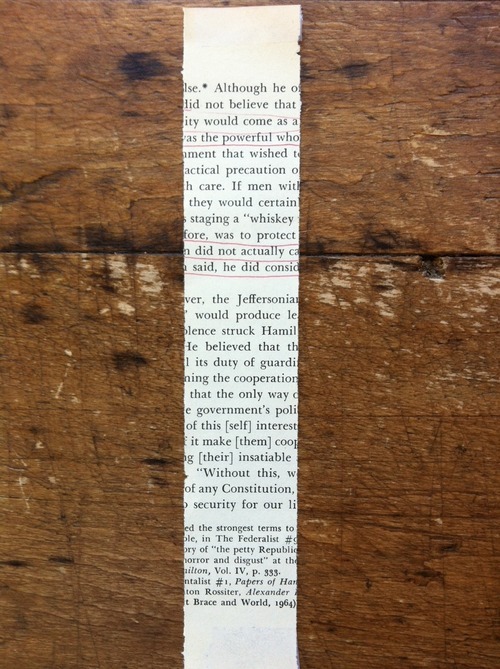
Cooked this one up an hour before class yesterday. Pull a page out of a book. Crease it well down the centre (from top to bottom) and tear it in half. Do the same with each half. You’ll have four strips of page, and eight stripes of language, if the page was printed on both sides.

Browse through them for a language column that pleases you. No changing anything — part words are left as part words, syntax is let be scrambled.

image

But do transcribe the language column you’ve chosen. That’s how it becomes your poem — by travelling from eye to brain to hand. Mine is called “else *”. As you can see it’s an ode.

else.* Although he o
did not believe that
ity would come as a
was the powerful who
nment that wished to
actical precaution o
th care. If men with
they would certain
staging a “whisky
fore, was to protect
n did not actually ca
said, he did consid

See also Tristan Tzara’s directions on making a Dada poem.

Exercise: Homophonic translation

(Another of the exercises I’m giving my Art of Compost class.)

In a homophonic translation, you translate for sound, rather than for sense. For instance, this sentence in French

Je vais aujourd’hui à la maison de mon ami.

sounds roughly like

 Juh vase oh zhour dwee a la may zon de moan am ee.

And so its homophonic translation might go

Juvie, so, sure, twee. Ah, lamb, he’s on demon, am ye?

Notice how a word in the French can become two in English, or the end of one word and the start of another, in the French, can fuse to form a single English word. In other words, don’t worry about preserving the boundaries between words.

Notice, too, that the translation isn’t exact—vowel sounds shift a little, and sometimes a voiced consonant (e.g., “d”) becomes unvoiced (“t”).

The exercise. Take a passage of 50-75 words, verse or prose, in a language other than English, and do a homophonic translation into English. It’s better to choose a language that you know how to pronounce, but if there aren’t any of those, just make your best guesses.

Examples follow. You might also check out David Melnick’s Men in Aida.

Louis and Celia Zukofsky, Catullus

Source Text (Latin)

Multus home es, Naso, neque tecum multus homost qui
descendit: Naso, multus es et pathicus.

Homophonic Translation

Mool ’tis homos,’ Naso, ’n’ queer take ’im mool ’tis ho most he
descended: Naso, mool ’tis – is it pathic, cuss.

Christopher Patton, Overject

Source Text (Old English)

Frige mec frodum  wordum   nelæt þinne  ferð on
hælne degol þæt þu deopost cunne  nelle icþe min
dyrne gesecgan  gifþume  þinne hyge cræft hy
lest  ⁊þine heortan  geþohtas ∙ gleawe men sceolon gieddū
wrixlan god sceal mon ærest hergan fægre fæder user
ne forþon þehe us ætfymþe  geteode lif  ⁊lænne
willan  heusic wile þara  leana gemonian ∙ meotud sceal
inwuldre  mon sceal  oneorþan  geong ealdian god us ece
biþ ne wendað hine wyrda  nehine  wiht dreceþ adl

Homophonic Translation

Fridge me, Frodo. Um, word. Um, nail a thin firth on
hell. Ned—eagle that thou deepest can. Uh, Nellie—itch the mine,
dear. Now you sedge, an’ if thou math in how ye craft, how
lost and thin a heart an you thought as. Glue we men shall on yet. Um,
were Ixlan god, shall man arrest her gain? Fare a fader user.
Knife or than the hay us at fume. The yet ode, life and lane, uh,
will an hay us itch, while, o’there, Alan a’ye money on. Meow. Dude shall
in weld, remand shall on earth, an’ yon gulled Ian, god us each, uh,
both new. Endeth he new word. An’ a he new wicked dreck i’th’addle.

teaching portfolio

Exercise: Fragment work (2)

Pick a fragment where most has gone missing and fill in the gaps. You don’t need to sound like Sappho here. Instead, sound how the few remaining words feel to you. For example, given

]anxiety
]ground
]
]

one might get to

And anxiety.
How the ground.
Rises to meet.
A body.

Drawing a blank I stole another move from Carson. Her “Life of Towns.”

Exercise: Fragment work (1)

Imagine you are time. Pick a fragment from Carson’s Sappho that looks whole and erase most of it. Use brackets and the space of the page, à la Carson, to indicate where things have gone missing. Aim for a fragment just as resonant after your treatment as it was before. For example

and gold chickpeas were growing on the banks

might become

gold [                                      ] wing