
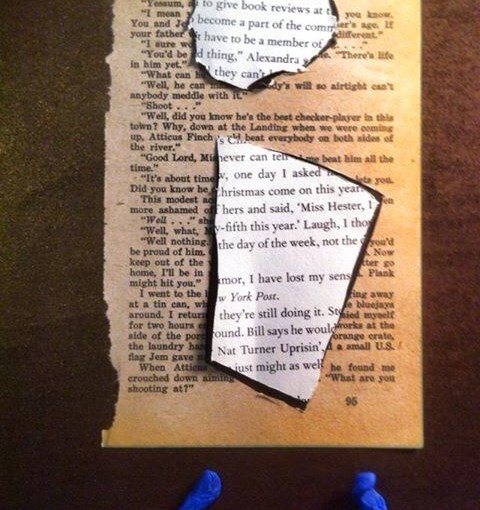
Some fine high play here with mockingbirds and finches. A reminder that for all that’s at stake morally and spiritually and politically in Lee’s so powerful novel and its latterly published and from all reports really pretty indifferent draft, her characters are ink on paper stirring forms in mind, there is no Atticus about whom to uncover shocking truths. Well that’s what I mean I don’t know if it’s what Theresa means. But her compositions here are provoking and provoked so check them out.
Tag: visual poetry
Marlise’s portfolio
Friends. (Oppen said something like, the poem that ends as it should, “ok,” the poem of the world. Tonight for me, it’s the post that begins as it should, “friends.”) I’ve meant to share with you a portfolio by one of my vis po students from this spring. She rides a badass wheelchair and her work is images of and round and beyond her condition, Friedreich’s Ataxia, a truly shitty degenerative neuro-muscular disorder.
I don’t mean to be sentimental here. That’s cheap to those who live with a disability. From here it seems, there are some who live with such visible cruelties, I’m using Marlise’s so apt word here, and others who bear cruelties invisible to all until they flame out horrible, and some who have the bad luck to be lucky till they’re not, and then they know not what the fuck to do.
Even all that considered though. This young woman has moved me no small measure with her guts and her mischievous gleam. So, here are, with her permission and a bit of anonymizing, some words and images of hers.
“One of my passions, my goals, and perhaps my purposes, is to help arts by and/or about the physically-disabled population to gain at least culturally standard recognition. This course has made me see visual poetry as a wonderful and effective forum to achieve this.
 “In creating my pieces, I was most inspired by our course text Nox, by Anne Carson. She delivers poignant messages about grief through photocopies of memorabilia about or featuring her late brother, while still leaving the concepts of familial love and loss open-ended and undefined.
 “Being physically disabled myself, I often think of myself and my as audience members, just insignificant observers of my disease’s progression, effects, and affects. This ‘outsider’ perspective is what I interpret as Carson’s purpose and message behind Nox, and it’s what I have striven to elicit for disability in this project.
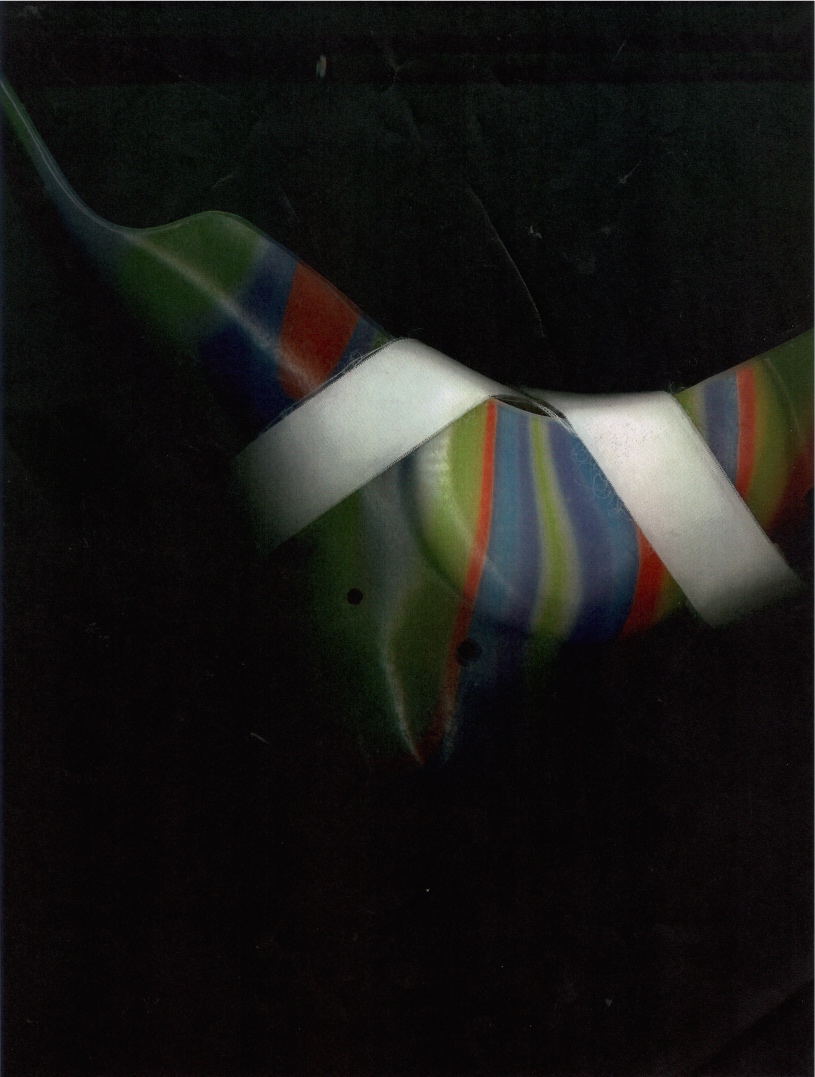 “I’ve explored the photocopy technique, implementing forms of handwritten pieces and material objects. Attempting to play with my method of choice in new ways, I photocopied in the ‘negative’ setting a couple of times to convey the stark labels put in visibly-disabled people, Another way I twisted the work via the photocopier was selection of reflective objects to photocopy.
“The first artifact displays the title of my disorder, Friedreich’s Ataxia (FA), through a bag that has one transparent side and one opaque, turquoise side. I chose this to hold the piece because I knew the photocopier because I knew the photocopier would reflect off the bag, and the resulting glare I wanted to evoke the unapologetic cruelty of my handicap.
 “Also, I thought the bright turquoise backing worked as representation of the crippling sadness or unashamed joy underlying nearly every part of disabled life. The writing is done in charcoal, and then smudged, translated to be the destruction of effort. Where I placed the artifact in the photocopier cut off the top fails-at-drawing-a-straight-line of th F, leaving a single, straggling line reminiscent of lives cut short by means of physical disability, including mine. Finally, I inserted the page into its sleeve upside-down to distance and simultaneously inconvenience the viewer, like disability effects everyone involved in the victim’s life.
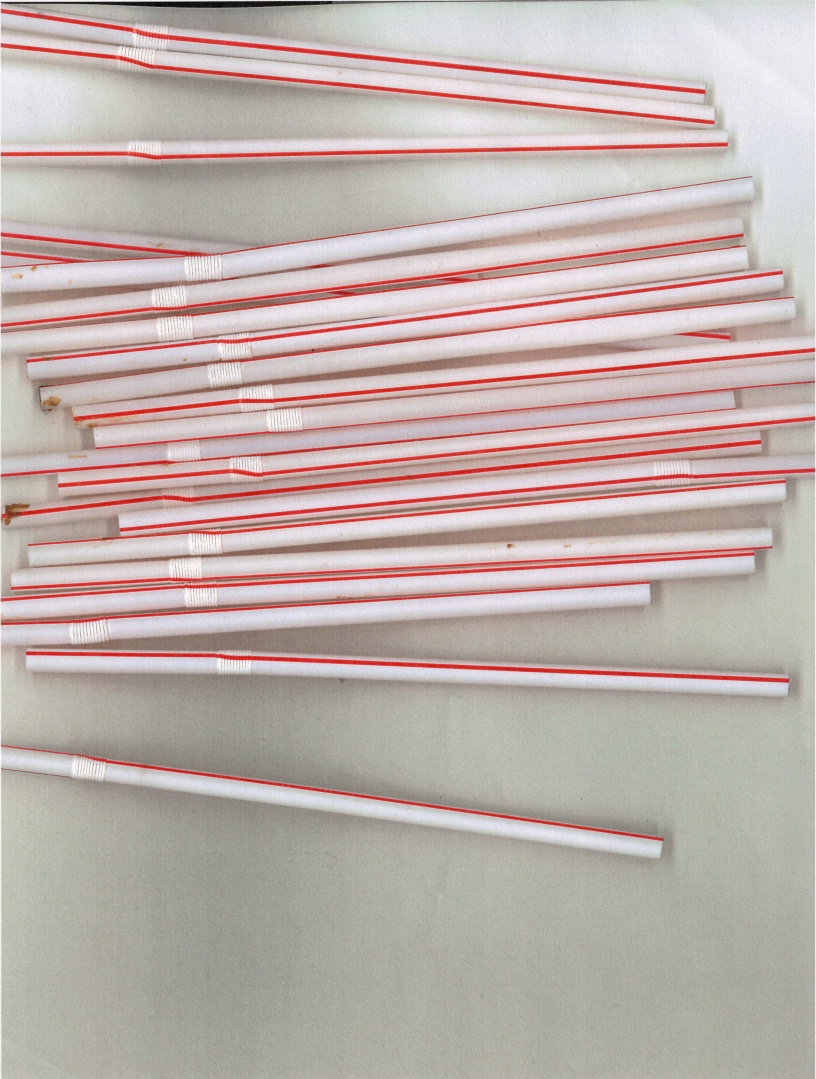
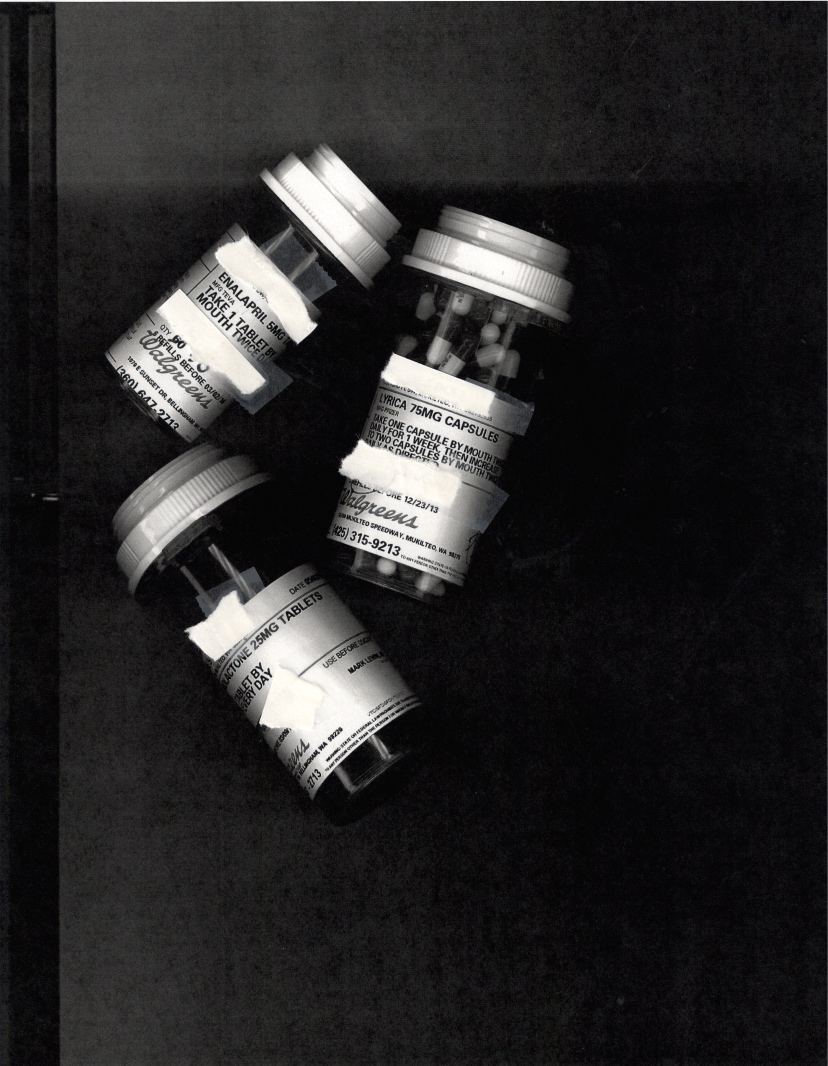
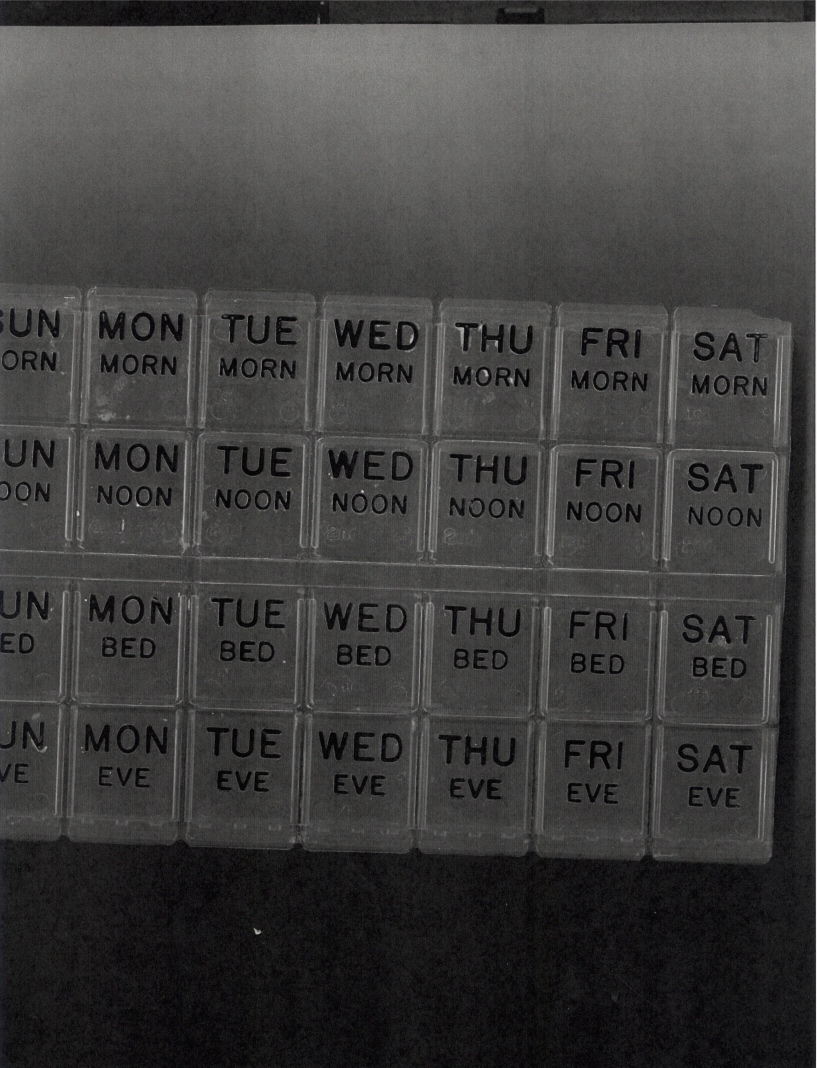 “As a visual element, I will steer the viewer’s attention to the cover art. There I have my prescription-medication bottles, showcasing the nameplate-labels. Not only do I associate paid-for treatment with disability, but I see this photocopy of personal and yet widely recognizable objects as the prime subject to introduce this portfolio, too. It compartmentalizes disability, and also starts the project’s accessible journey of disabled interpretation.”
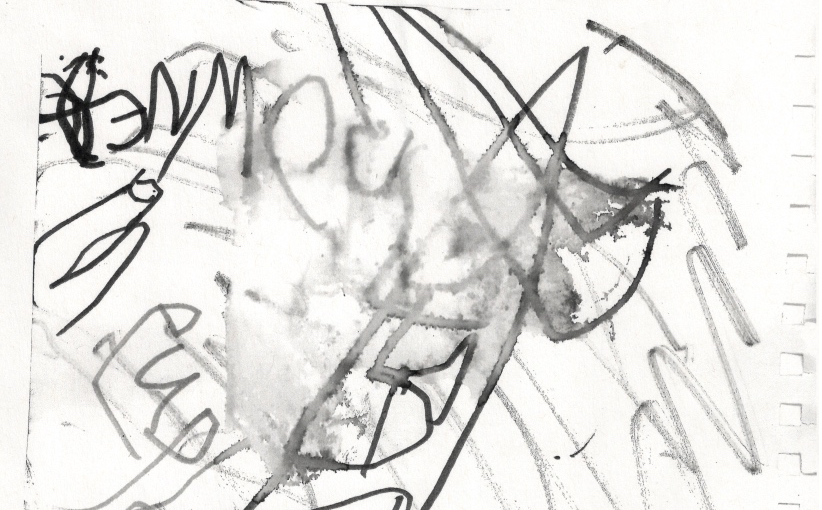
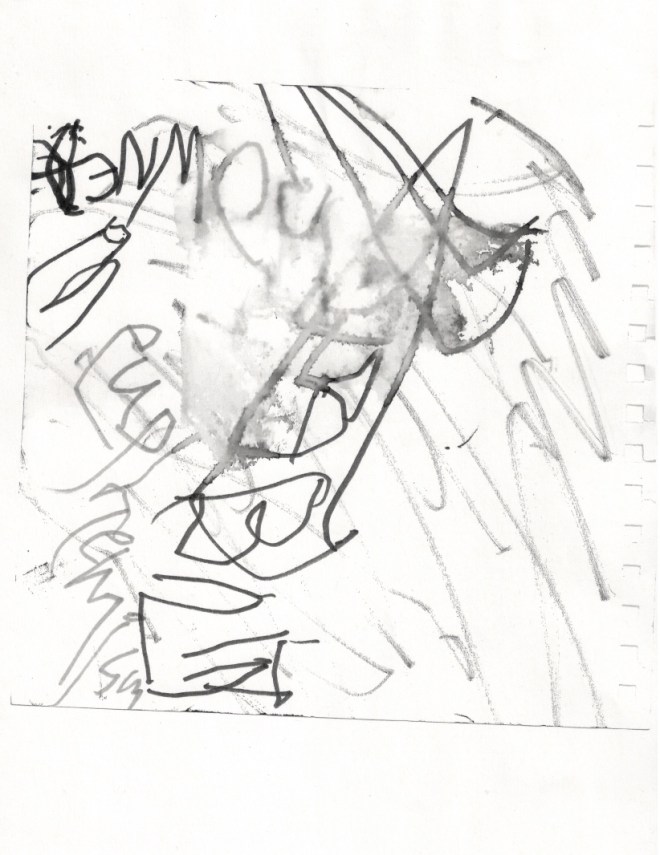
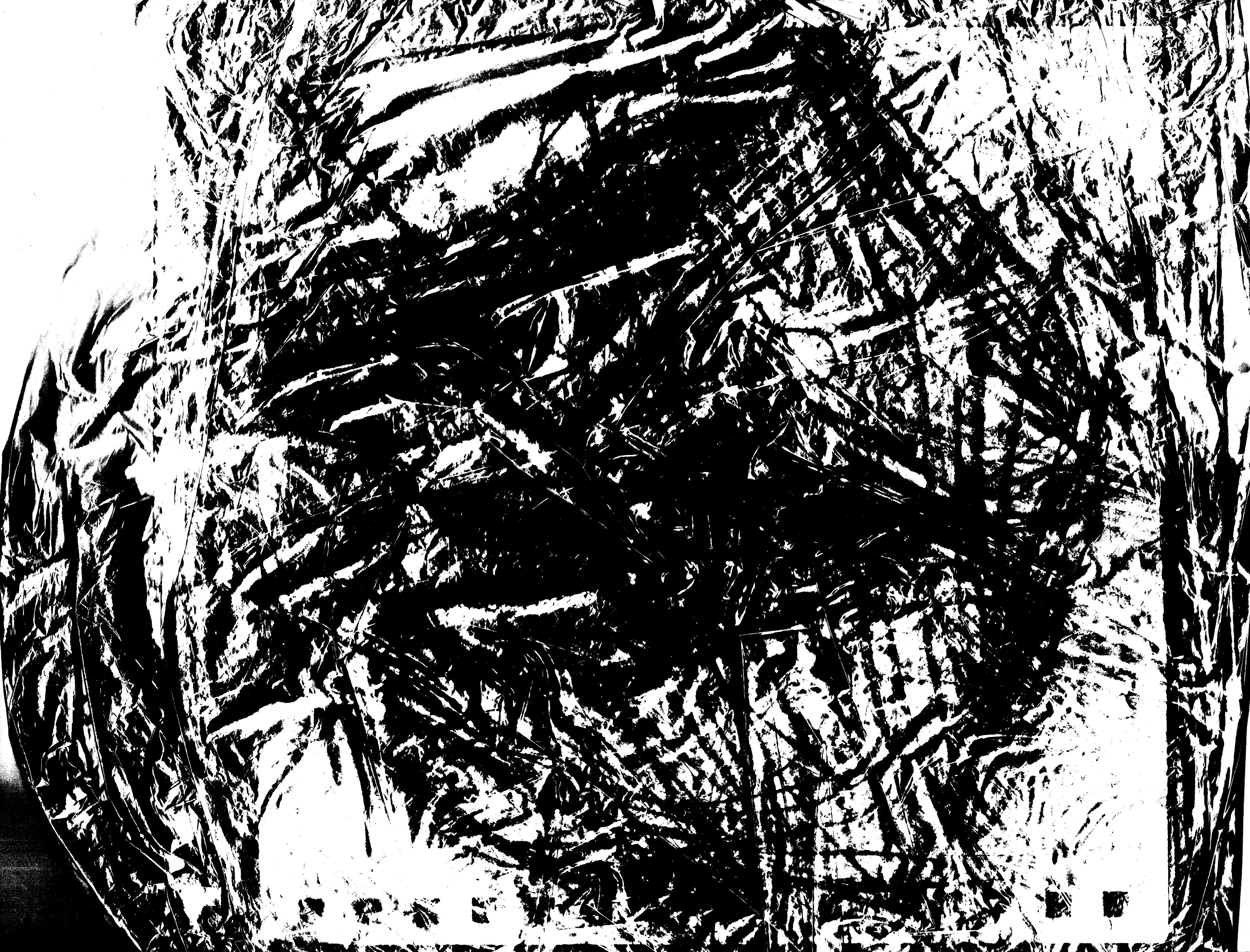
POSTSCRIPT. The cellophane technique I’ve been playing with BTW is thanks to Marlise, who on a handwritten poem assignment took my encouragement to view her handwriting as differently beautiful and handed this in –
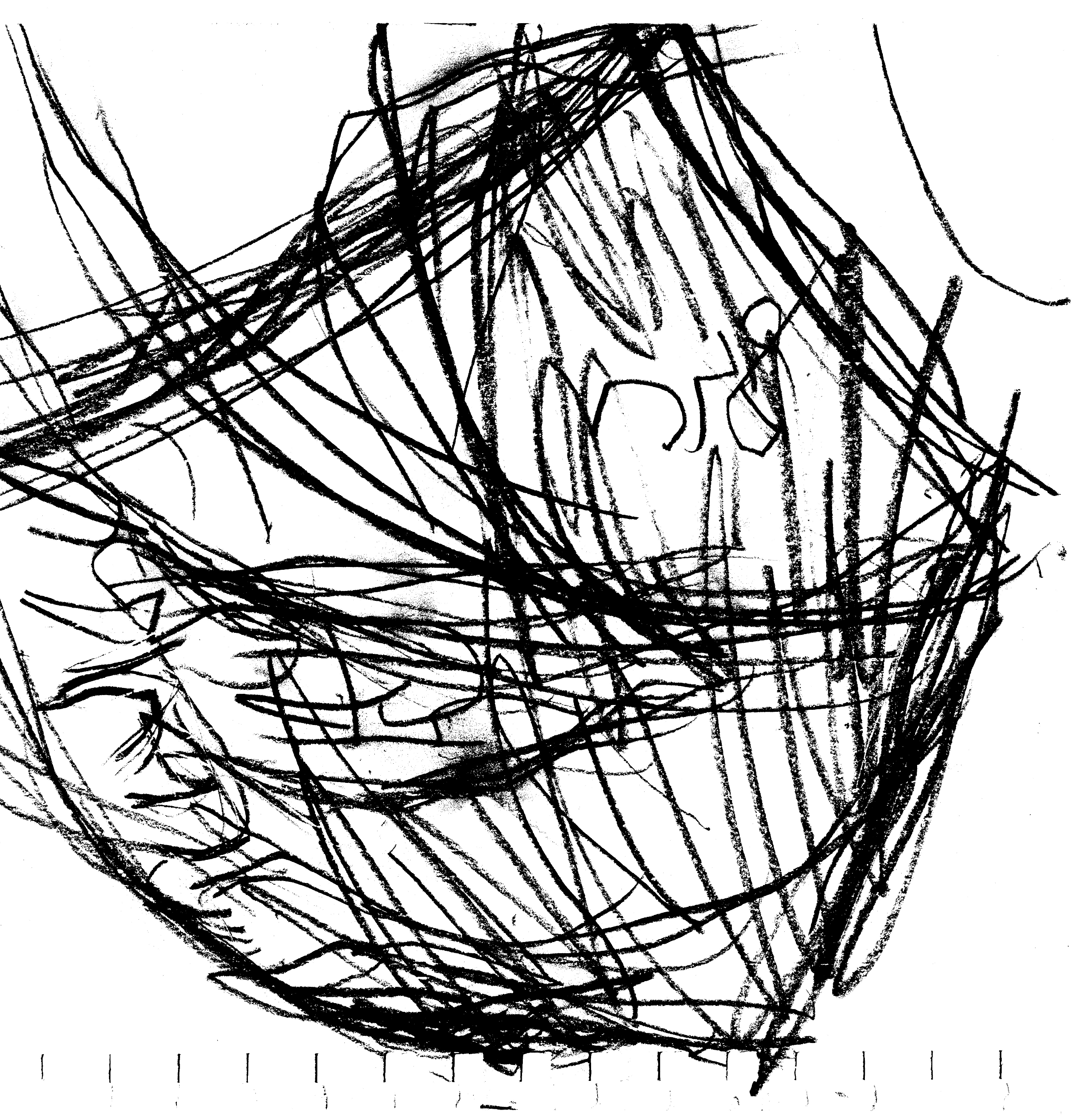
– but because the charcoal was bleary handed it in, considerately, in a plastic bag, which gave me an idea, so when I scanned it I scanned it in said plastic, with all those unanticipable opacities –
Whoever says teaching creative writing sucks from their creative work needs to check what they’re teaching.

One more for Elise Partridge
Hello friends. A three-way conversation between Barbara Nickel, Stephanie Bolster, and myself on the life and work of our loved friend Elise Partridge has now gone live at the Winnipeg Review. It’s to be found here.
And, if you’re curious, I wrote a bit about the challenge and wonderment of the conversation itself here. You can read some more about Elise herself here. And Barb’s wonderful blog is here. Steph doesn’t have a blog but here’s her publisher’s page here. Enjoy, please, do.
I hope Elise’s spirit won’t mind me appending this.
I was invited to a celebration of Rosh Hashanah tonight and we were asked as part of our lovely evening to express an intention for the year to come. Mine was, to be more patient with others and myself. What’s this have to do with Elise? She wasn’t especially patient with herself or others. In fact I loved her impatience, it was was wise, it was holy! At least when she was skewering someone’s pretensions it was, very.
But my impatience is most often crap. (And that, that’s impatience with impatience. Yeah baby gotcha.) And I’ve just now started sitting zazen again, after years off the cushion, and I’m feeling what a difference it makes to be okay with not getting it exactly right all the time. And a little bit more patient with me, I’m a little more so with some other, too. Does seem to go that way.
Came as this a few ago
 Kshanti paramita = the perfection of patience, or patience beyond patience. Patience so sunk in itself you might not recognize it as patience. That was Elise, too. Barb, Steph, tell me, wasn’t it?
Death’s a dog w/ dragonbreath
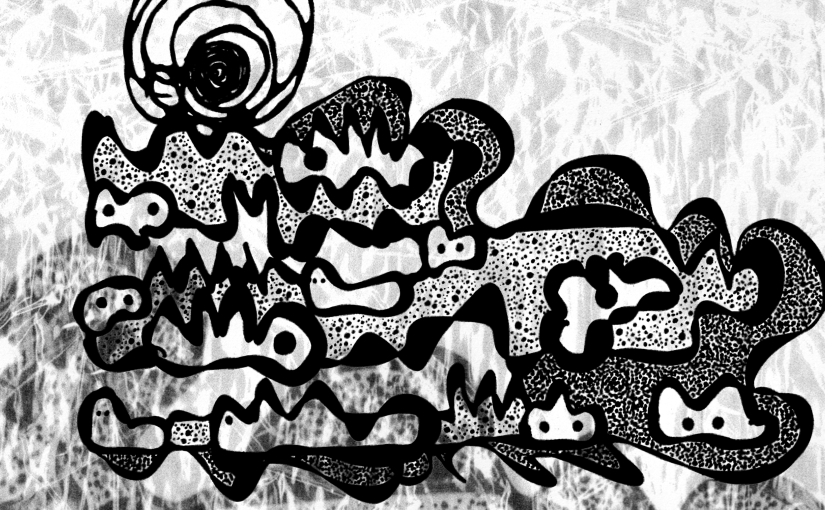
Okay, still working away at erasures and illuminations of that minor poem in The Exeter Book, and I think I nailed something, check these moves out, yo.

Source text for this one, you’ve seen before (along w/ a short account of how these images get made):
5.
Moving among the company,
everywhere always, house throughout,
greeting her lord, she pours his cup first;
in greatness gives and keeps counsel,
they make a house, two
of one mind.
Next up (I thought for a while, these could fall in any order, but they seem to want the order of their first making):
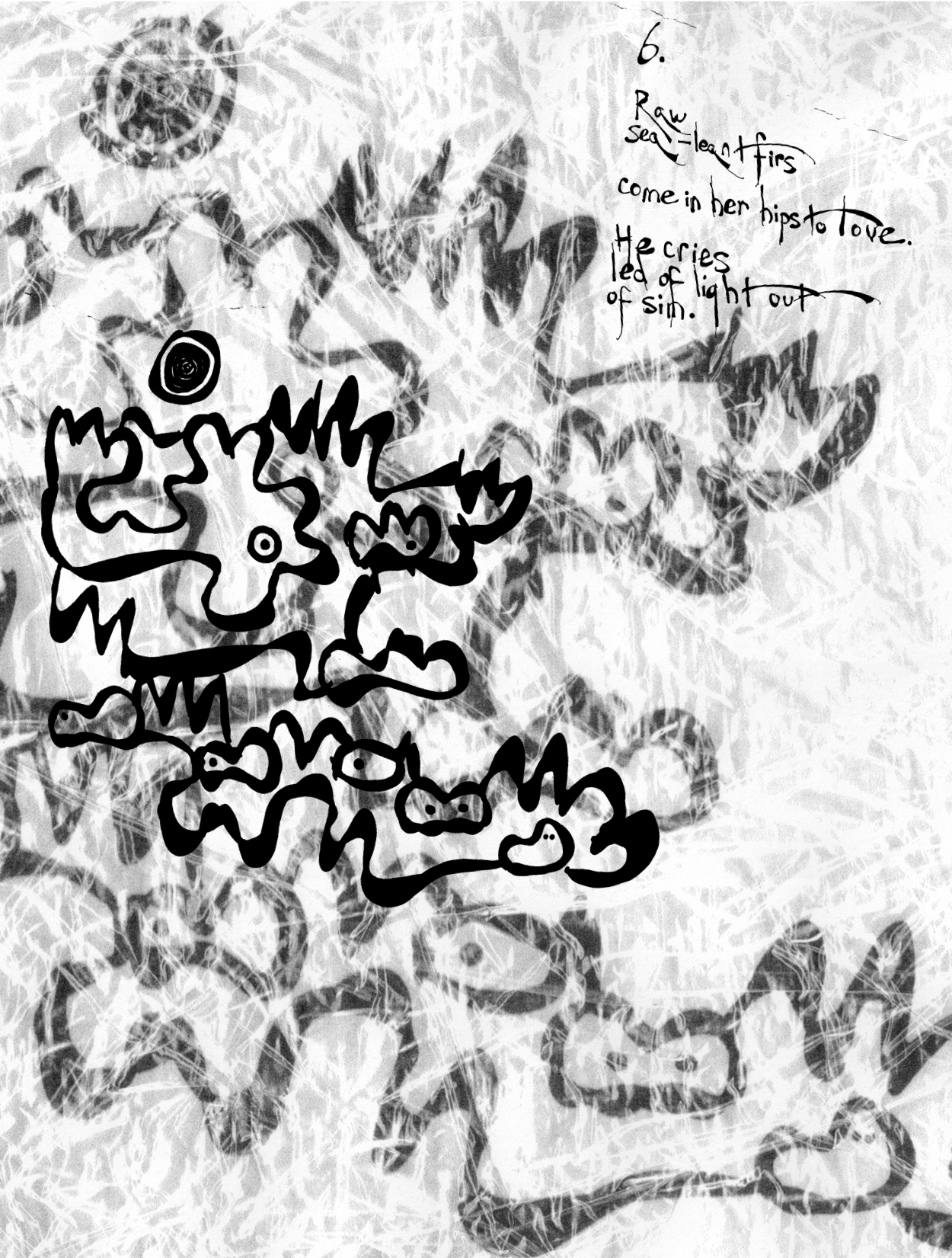
You’ve seen that one before too, as well as this one:
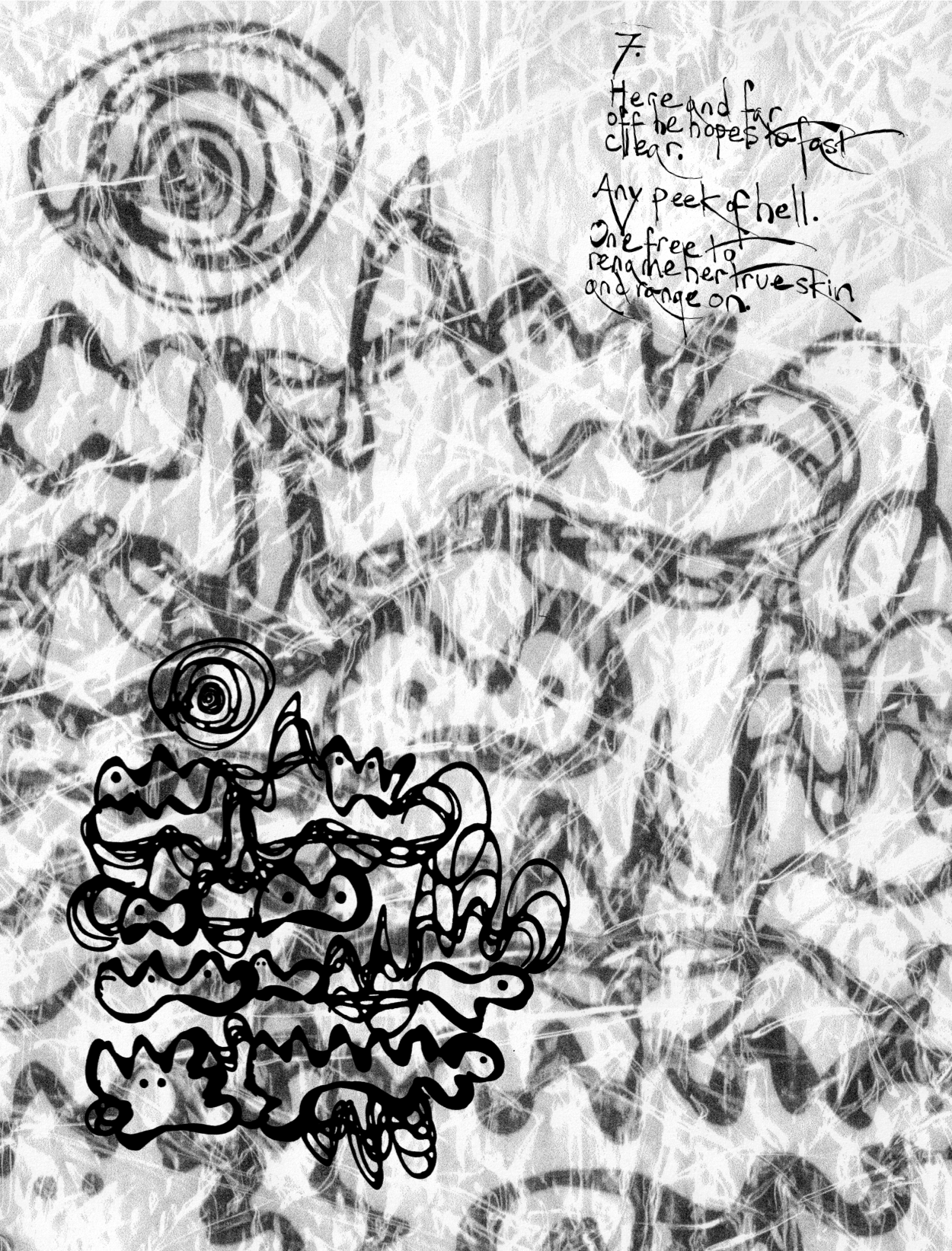
Haven’t posted this one yet tho –
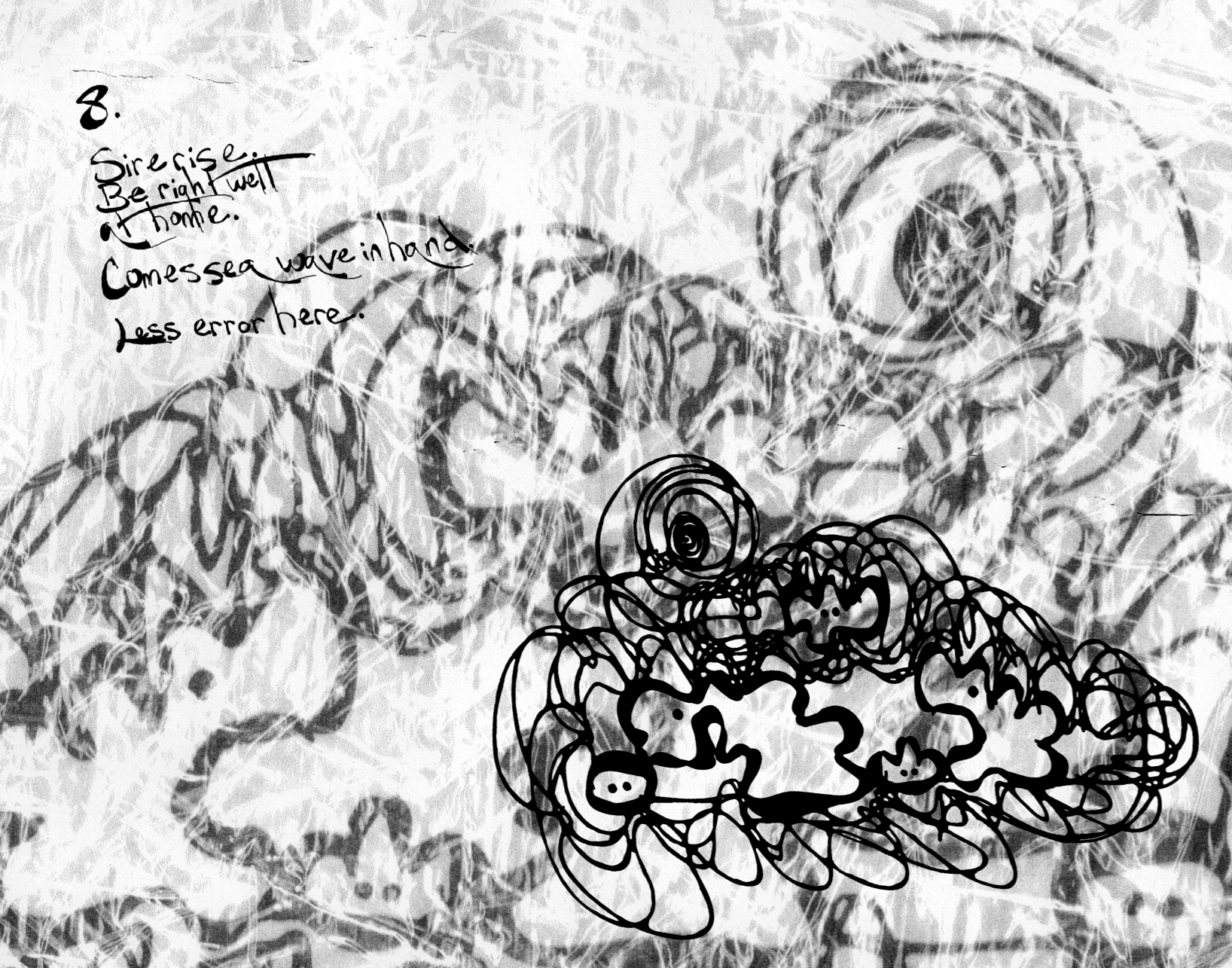
– for whom the source text is:
8.
When the time’s right,
he comes home whole—unless
the wave swell bears him elsewhere;
sea has him in hand, desire’s terror’s pleasure.
(I’m sure that last line’s a mistranslation – the Old English, very obscure, the translator, me, very shaky.) And one more also new to the blog –
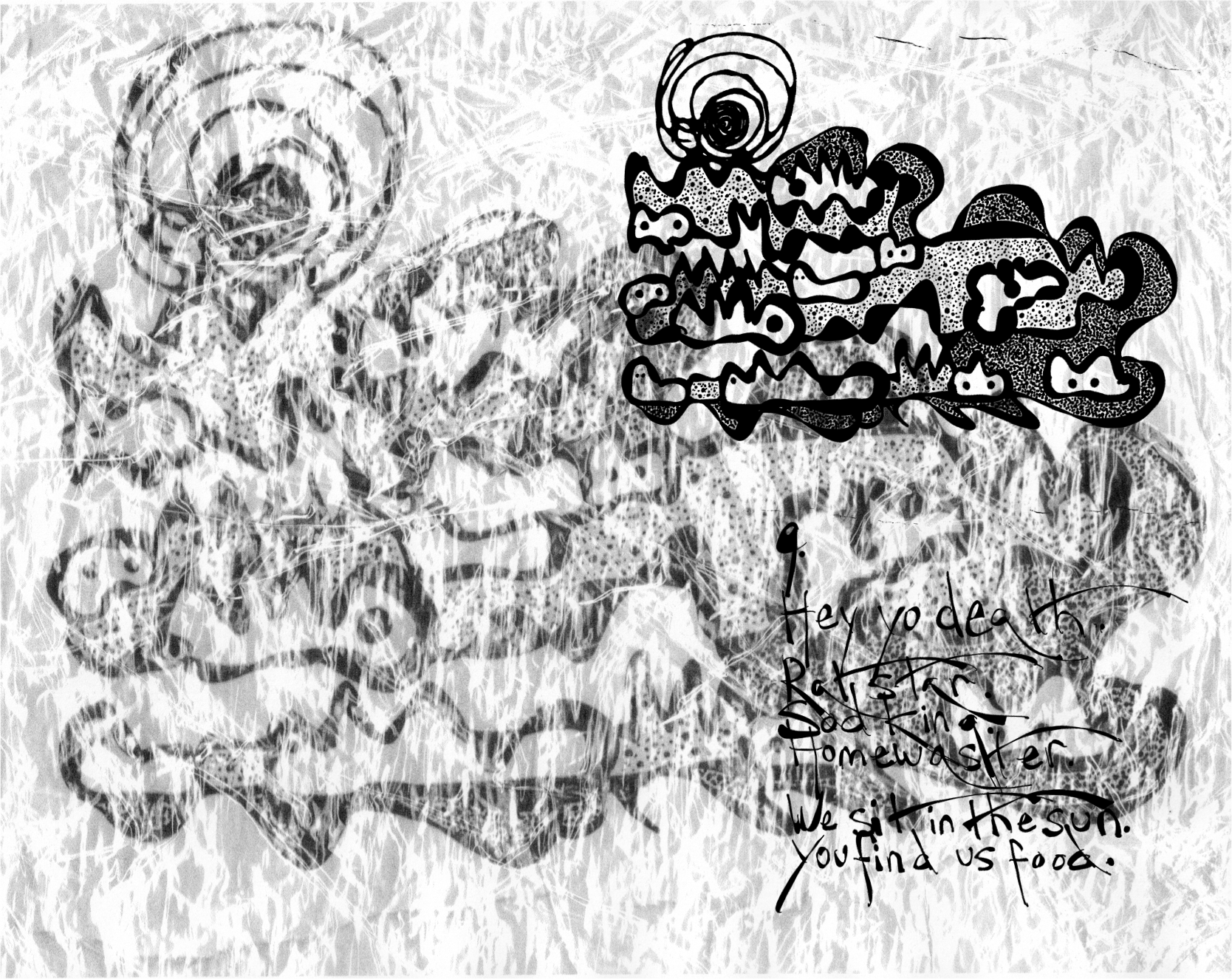
Source text for this one is:
9.
A man his goods, king in castle,
they both sell you crap.
Summer comes,
you take to the home woods and waters offer
and find food, before you’re too weak to.
You can sit in the sun and still starve to death.
To get the streakies I photocopied the drawing on the lightest setting through four layers of cellophane.
I owe the move to one Marlise, a student in my vis po course this spring, whose portfolio made me cry and the whole of which I mean to post soon.
Till then, wishing you joys in your labours.

Shadow w/o the slick
Okay, trying to get that shadow effect, without the slicky quality. Good people (or bad people, I like bad people, too) tell what you think.
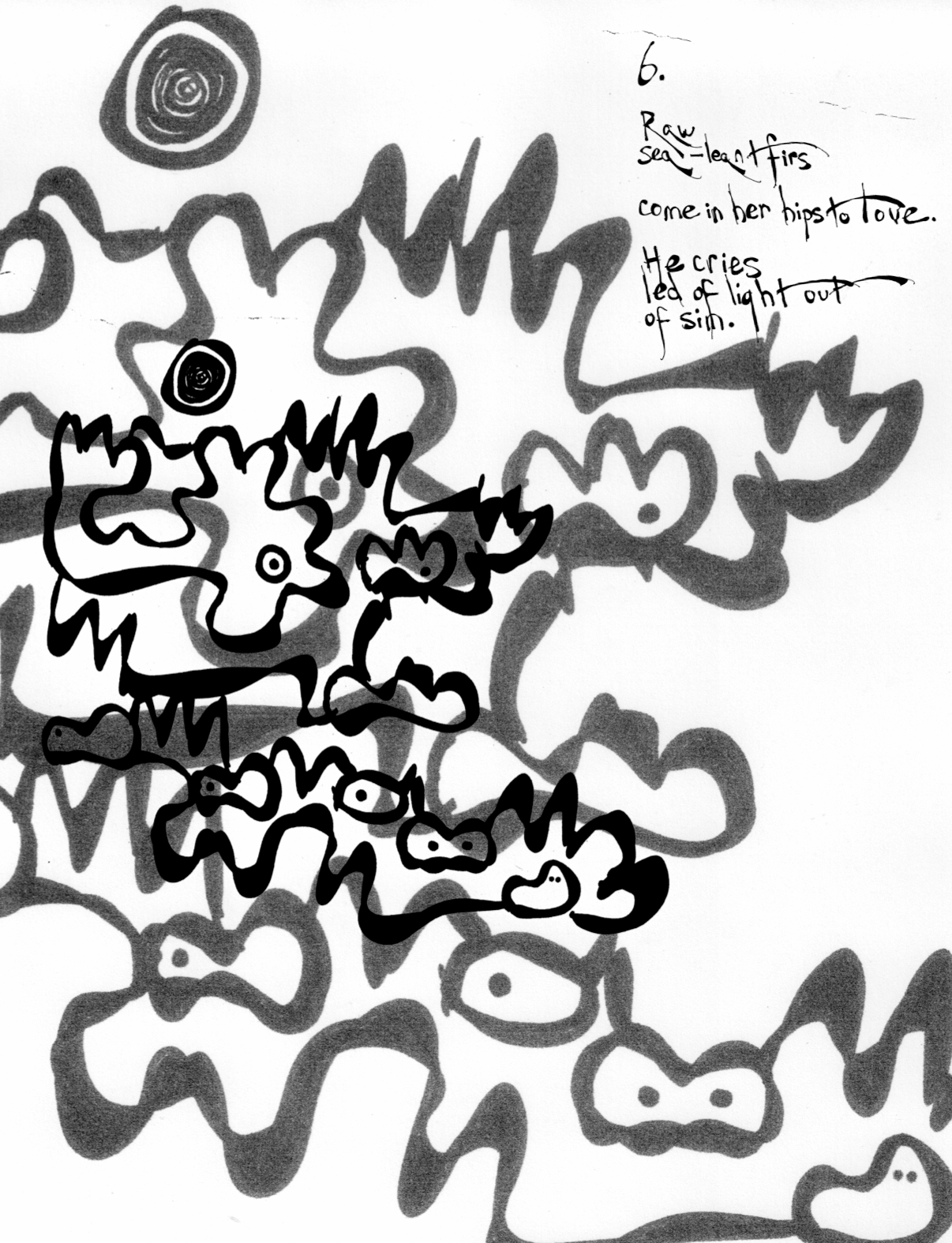
The diff? Paled it with the photocopier, instead of by MSWord’s “wash out” filter. More imprecision, gets more imperfection, gets more texture. Mistah Plato, he dead.
Why the poem’s so affirming, the main face so scary, I dunno. Am not in charge of the contradictions. Source text, for those to whom such matters:
6.
Ship is nailed, shield bound
in staves of light linden wood –
her love comes to the Frisian
wife, keel draws near,
breadwinner home
she cries
out to him
rinses the sea
from his shirt, finds him clean clothes,
offers on land what his love asks of her.
Have not, as yet, taken up Theresa’s totally solid suggestion to free the shadow man (or free the shadow, man?) and am curious as to my resistance. Am I yet beholden to M. Plateau after all?
But there’s something persistent in this project about doublings. All the characters are made, e.g., by filling in the gap between a letterform and an imperfect iteration of it. And something compels me about one of these glyphs, broadcast large and pale, being the landscape the mind that thought it gets to wander a while.
Maybe the shadow ain’t ready to be quite that free just yet. Interesting. As I believe Wile E. Coyote said to the air rushing up below him.

Here and far / off
Another made by the erasure & illumination practice I been telling you about.

The source text for this one (that same minor poem late in the Exeter Book):
7.
She’ll stay true to him.
He’ll keep her name clean.
Many are steadfast,
some curious
and one too free with a stranger.
Far off, he thinks of her, hopes
where he cannot compel.
The relation of source to the poem I get to – always mysterious to me. (Just as is, the relation of those two, to the image that arrives, just as much.) But I suppose I, or someone in here, wanted to get under the surface of the sexual jealousy story, ask, what makes this he and this she tick, as they surely do.
If I’ve a worry with this one, it’s that I’ve used a filter to wash out the image so I can post it, big, to the background. A sort of move I’ve mostly foresworn. I don’t want no clipart looks here, and no Photoshop tricksies. I try to get my pretty effects from low tech – Sharpies, tree leaves. When I use high tech for effects I go for fails and distortions – scanner noise, leaf stem blur.
But I just so love how the image, blown that large, makes a surreal hillscape, and it’s gotta be grey. Left black it’s too chunky and too foreground.
Have I sold out? Thoughts, any?
And just a note to self. If I do end up feeling okay about the enlarged and greyed out forms – they have real potential for the animations. Surreal backgrounds and vertiginous shifts of scale.

Abjected forms of a divine spark
Another image from Overject. Got by inscribing, very quick, two phrases, over and over at all angles, till they become mostly unintelligible. Then beginning to complete the forms the collisions of the letter forms propose.
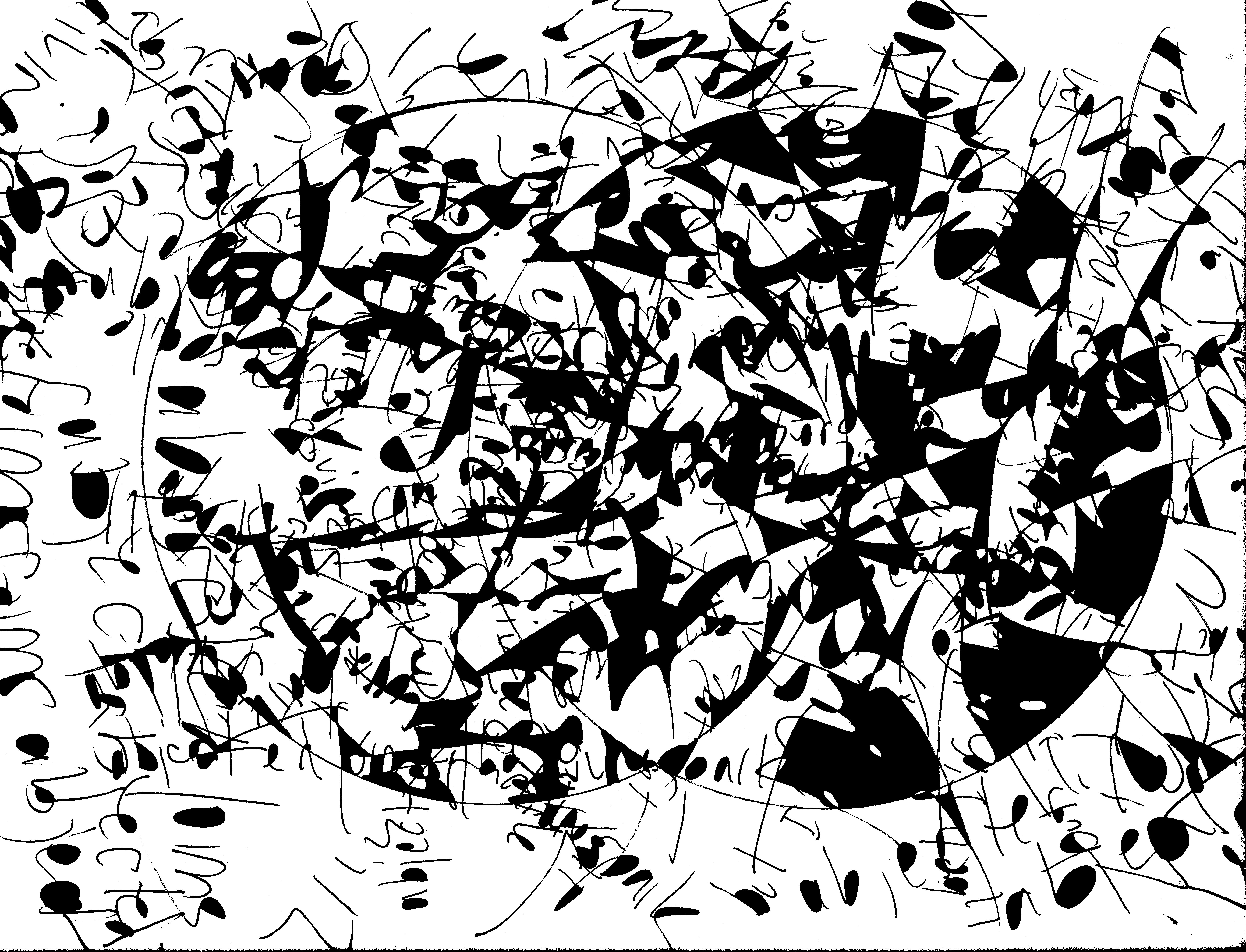
The circles are outlines of kitchen saucers. The phrases:
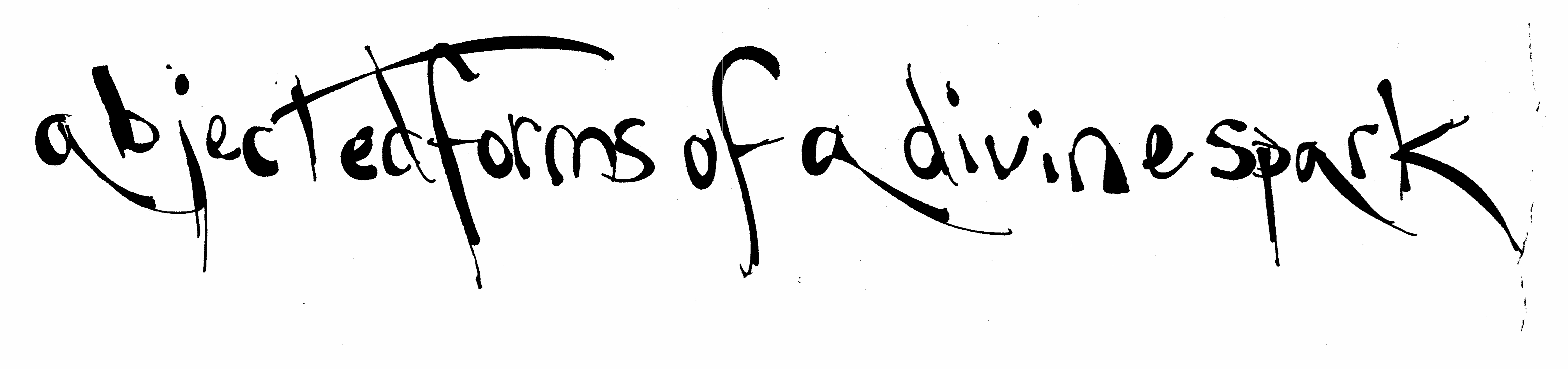 and
and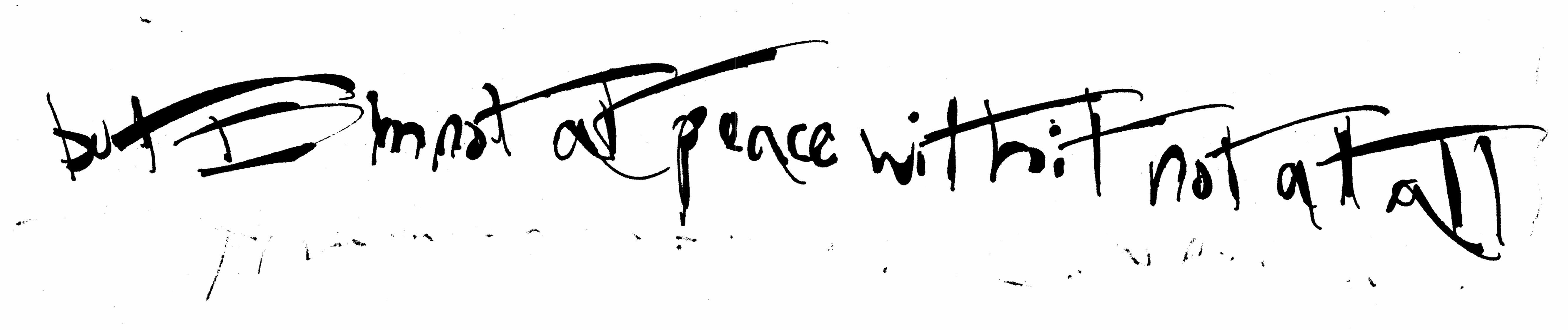 Been thinking through, with a couple of friends, the aleatory – chance operations – and how contingency pokes out in places not usually thought of as aleatory.
In the above image, I got the base layer, the tangle of intersecting phrase noise, by inscribing so rapidly I wasn’t in charge of anything, except that one phrase cohered mostly around one circle, the other mostly around the other. I experienced the end result as a set of accidents whose conditions I needed to work among. No dice were thrown, no darts. But how different really was my procedure from a full-blooded aleatory procedure?
It’s just, maybe, that I was the dice.
And the phrases themselves, “I” didn’t “write” them, they just “came to me,” on the treadmill of all places. Where exactly is the edge where the aleatory ends and deliberate design, or however you want to label all the other poetry being made, begins?
The panel proposal we’re drafting: “Everywhere Is Aleatory.” More soon.
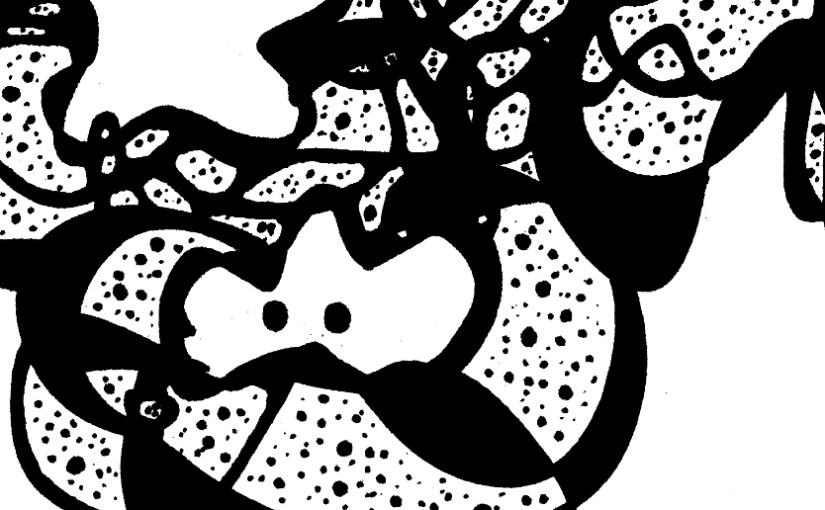
Beasties, animated, to be
Whereas it’s been long since a post. Whereas we’re all about repurposing here. And whereas I resist going back to work on a panel proposal. Herewith, the juicy bits from a grant proposal, wherein The Poet Asks for $$ to Learn to Flash Adobe.
I’ll begin with a passage I’ve translated from an untitled Old English poem found in the Exeter Book –
5.
Moving among the company,
everywhere always, house throughout,
greeting her lord, she pours his cup first;
in greatness gives and keeps counsel,
they make a house, two
of one mind.
A selection process, adapted from poets Ronald Johnson and Jen Bervin and now in general use among restless poets everywhere, yields a visual pattern to work with:
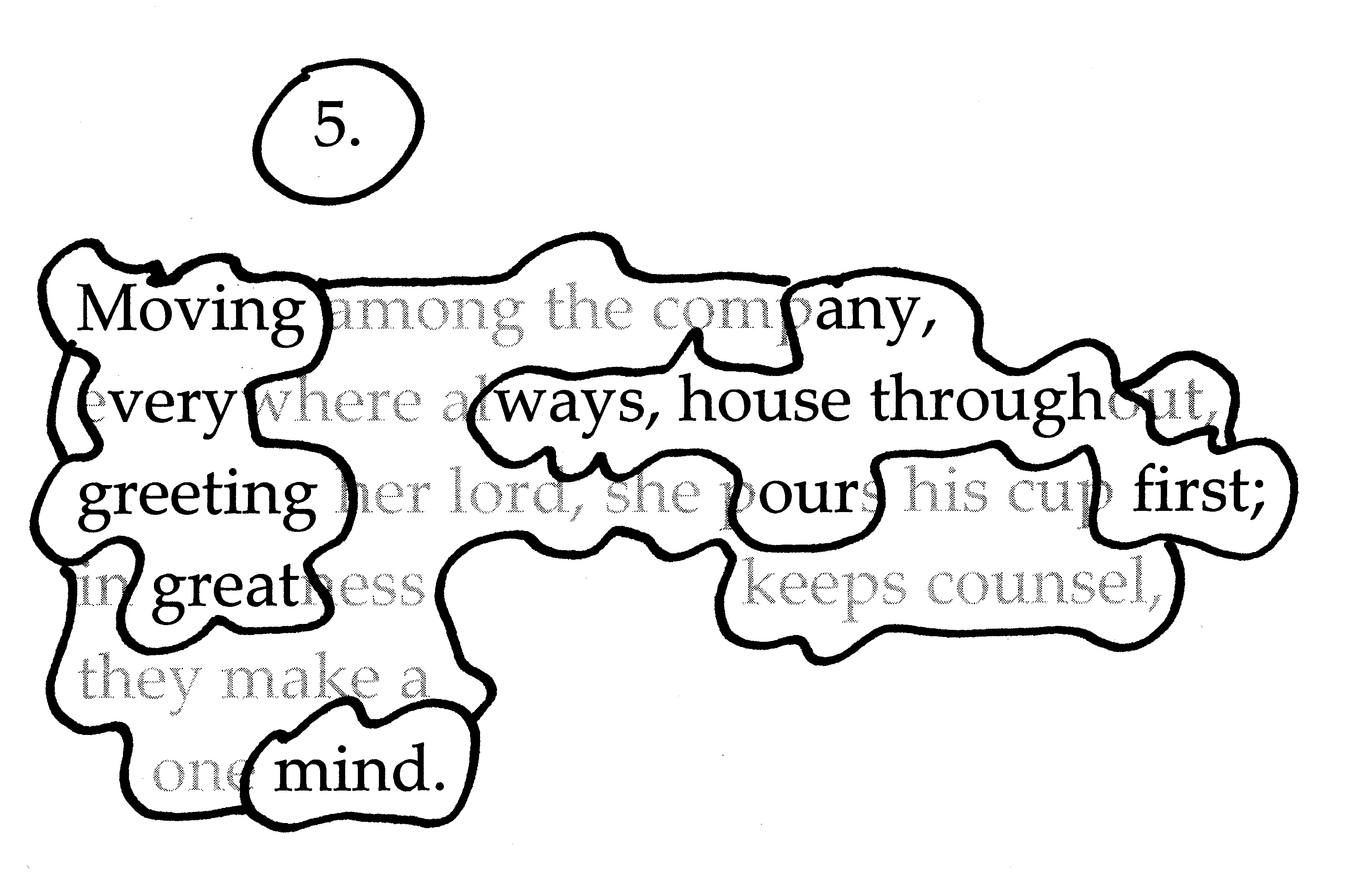
The selected text also generates, with some recombinations, a verbal poem –
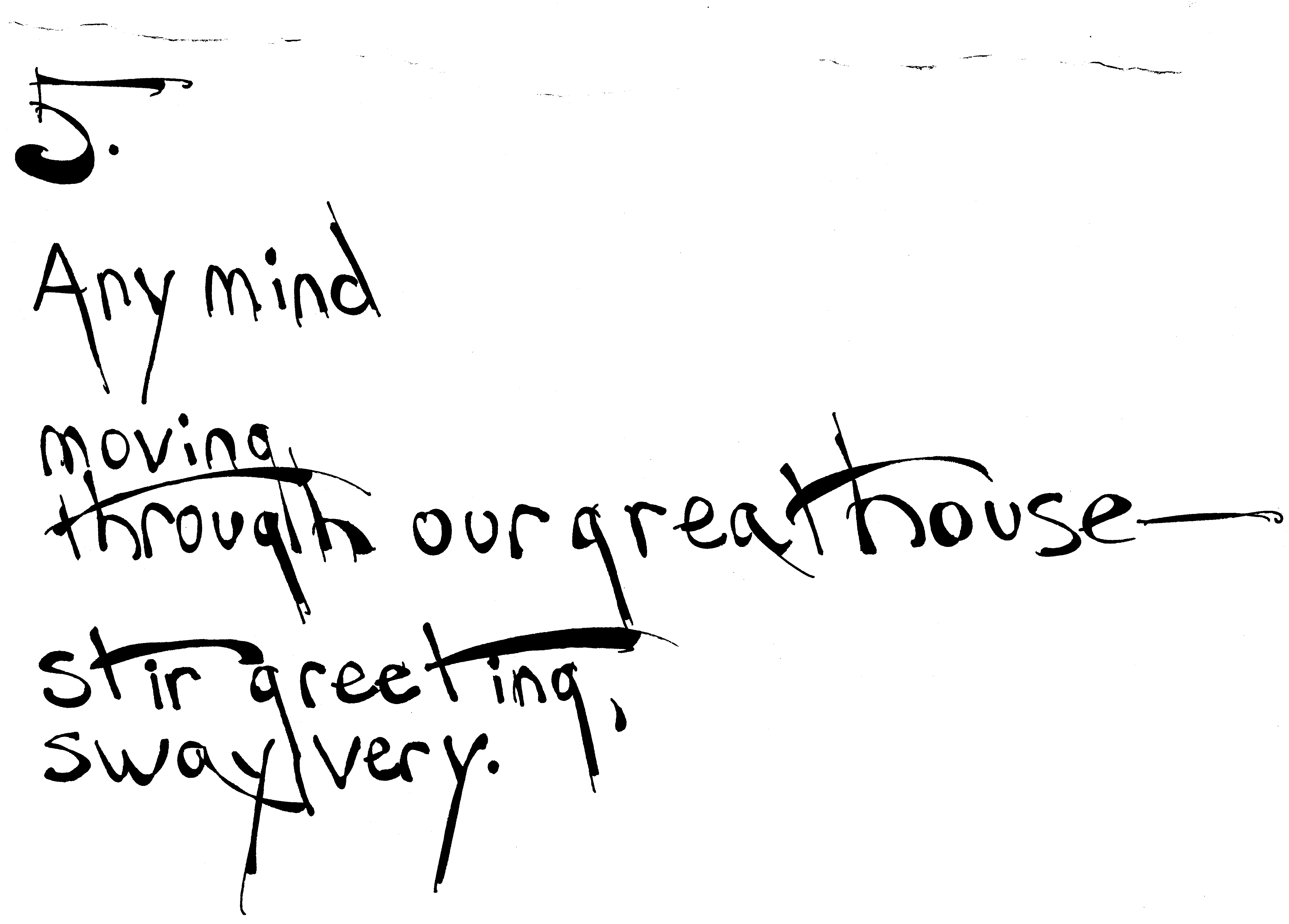
– but I’ll focus here on my work with the selection marks, for that is where my practice, though first inspired by visual artist Tom Phillips, largely departs from other practices I know of. It’s here too that my practice points towards terrain I’d like funding to explore.
Elaboration of the selection marks goes through several stages, like so,
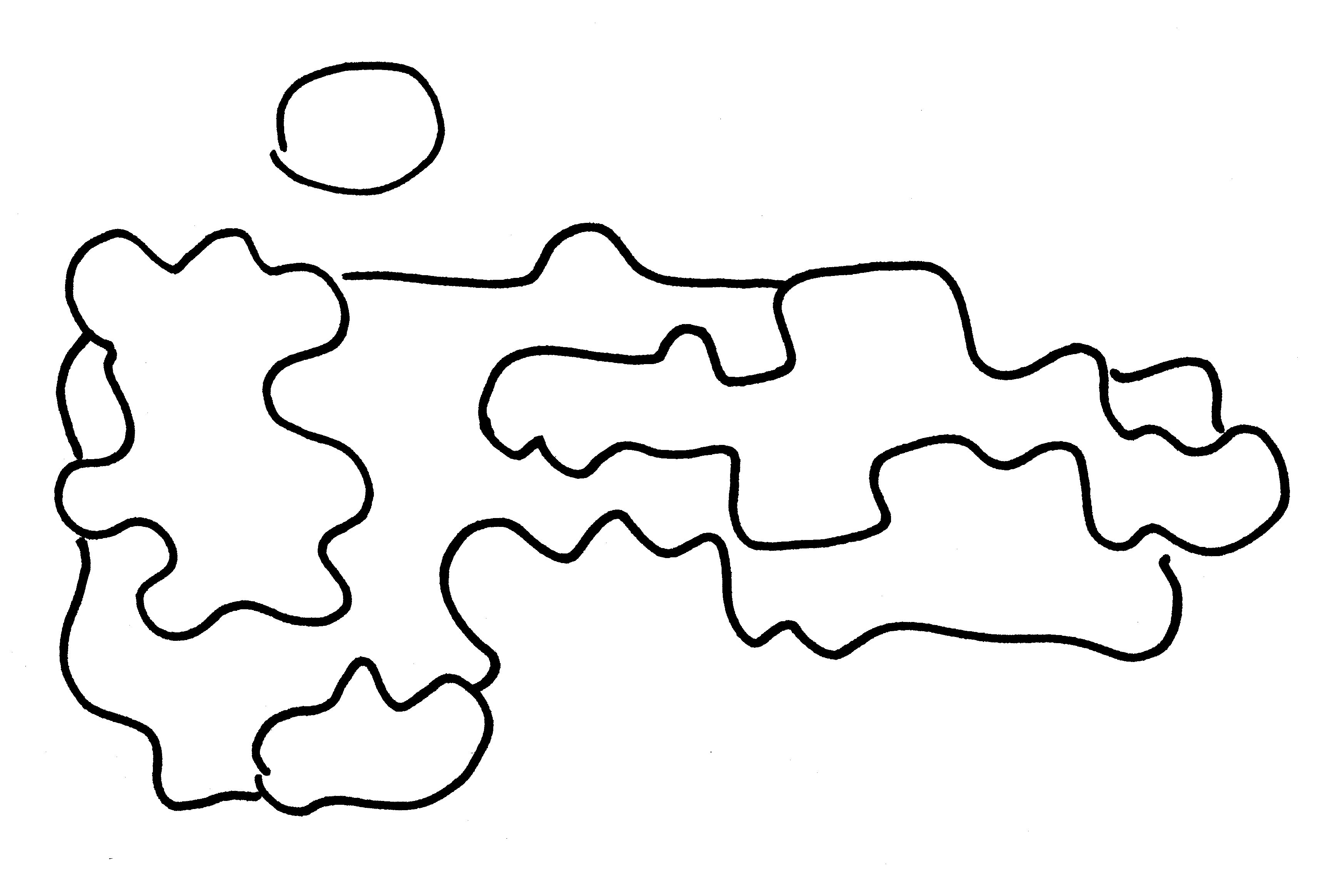
and so,
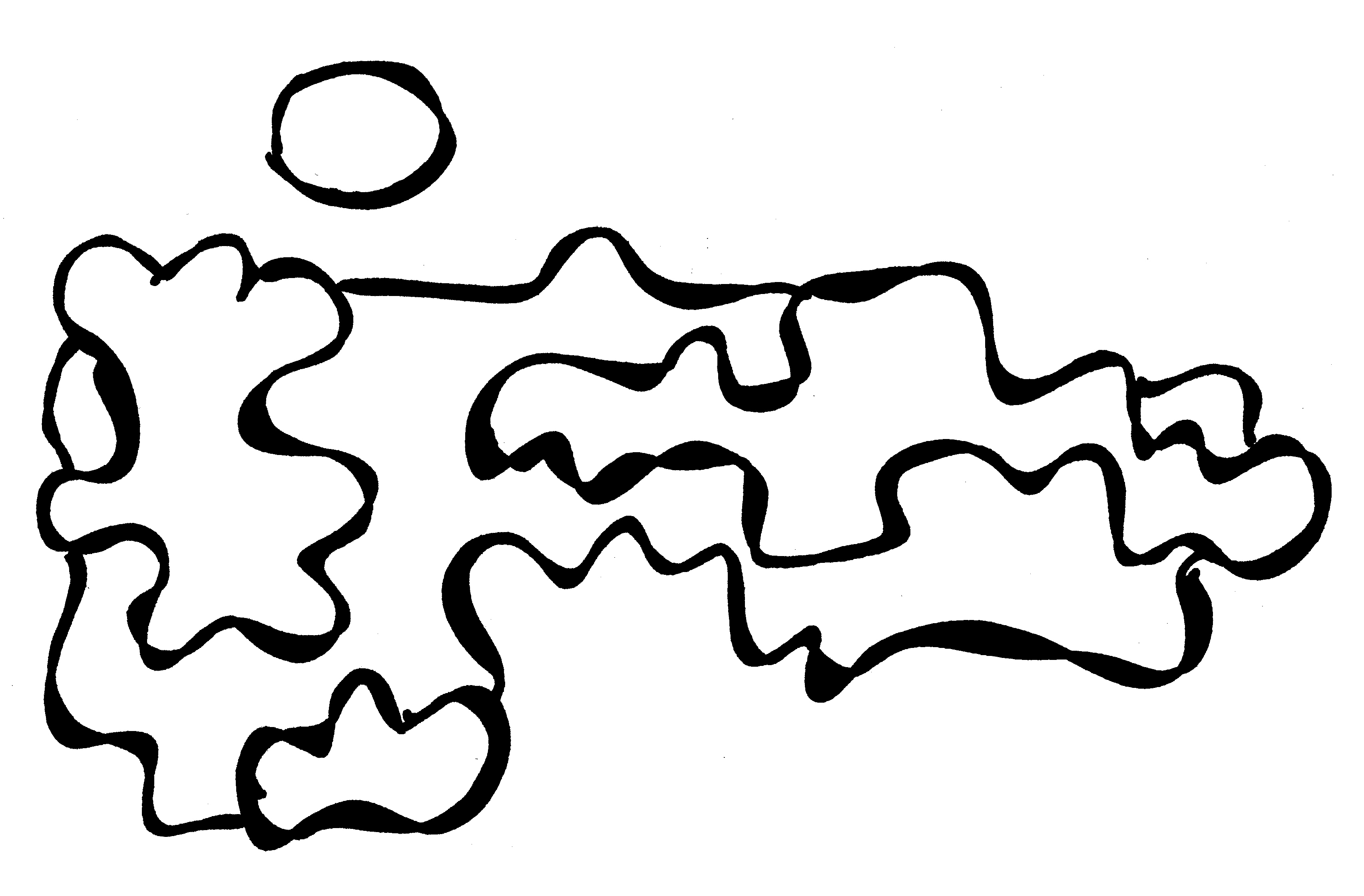
and so,
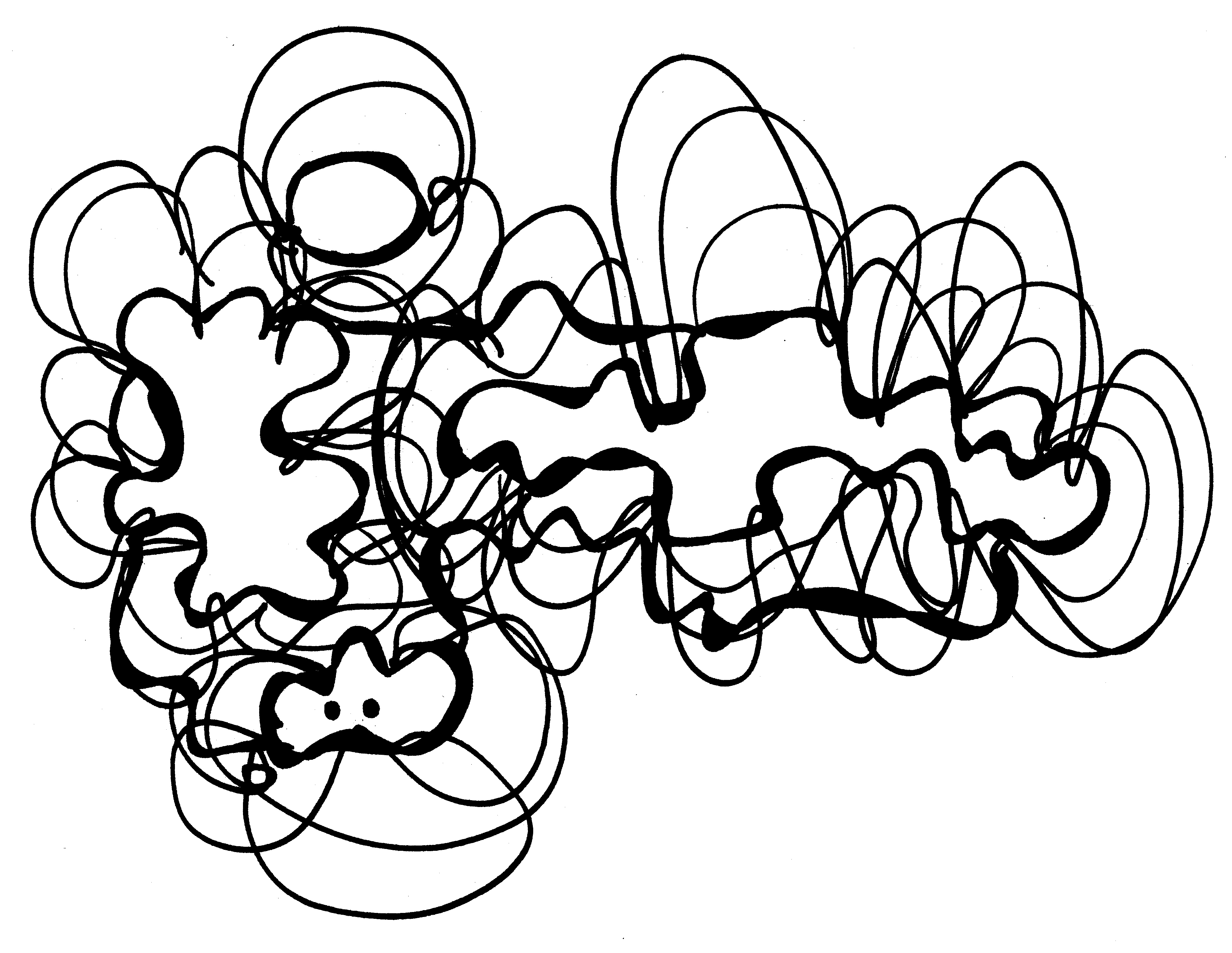
and so,
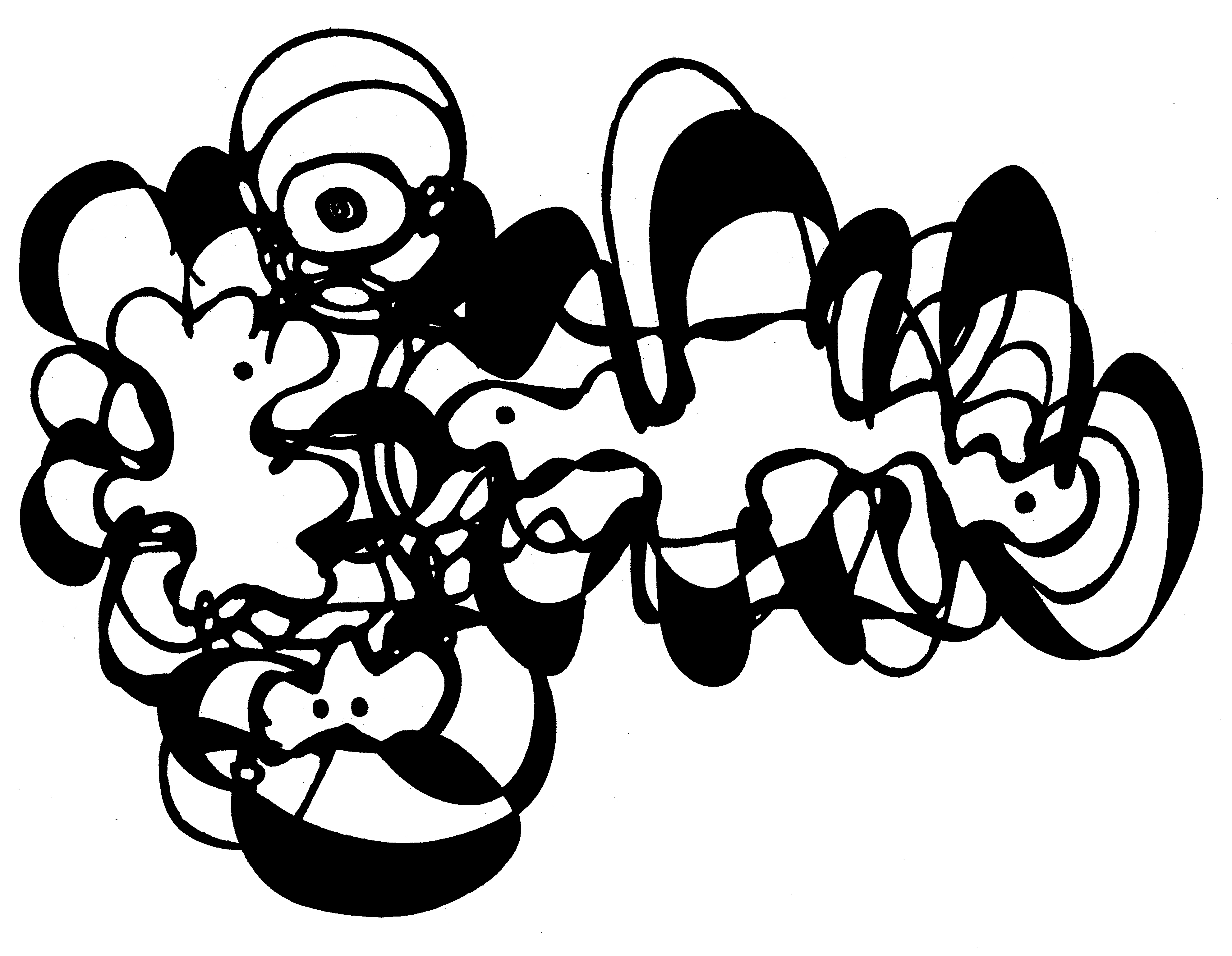
to produce an image
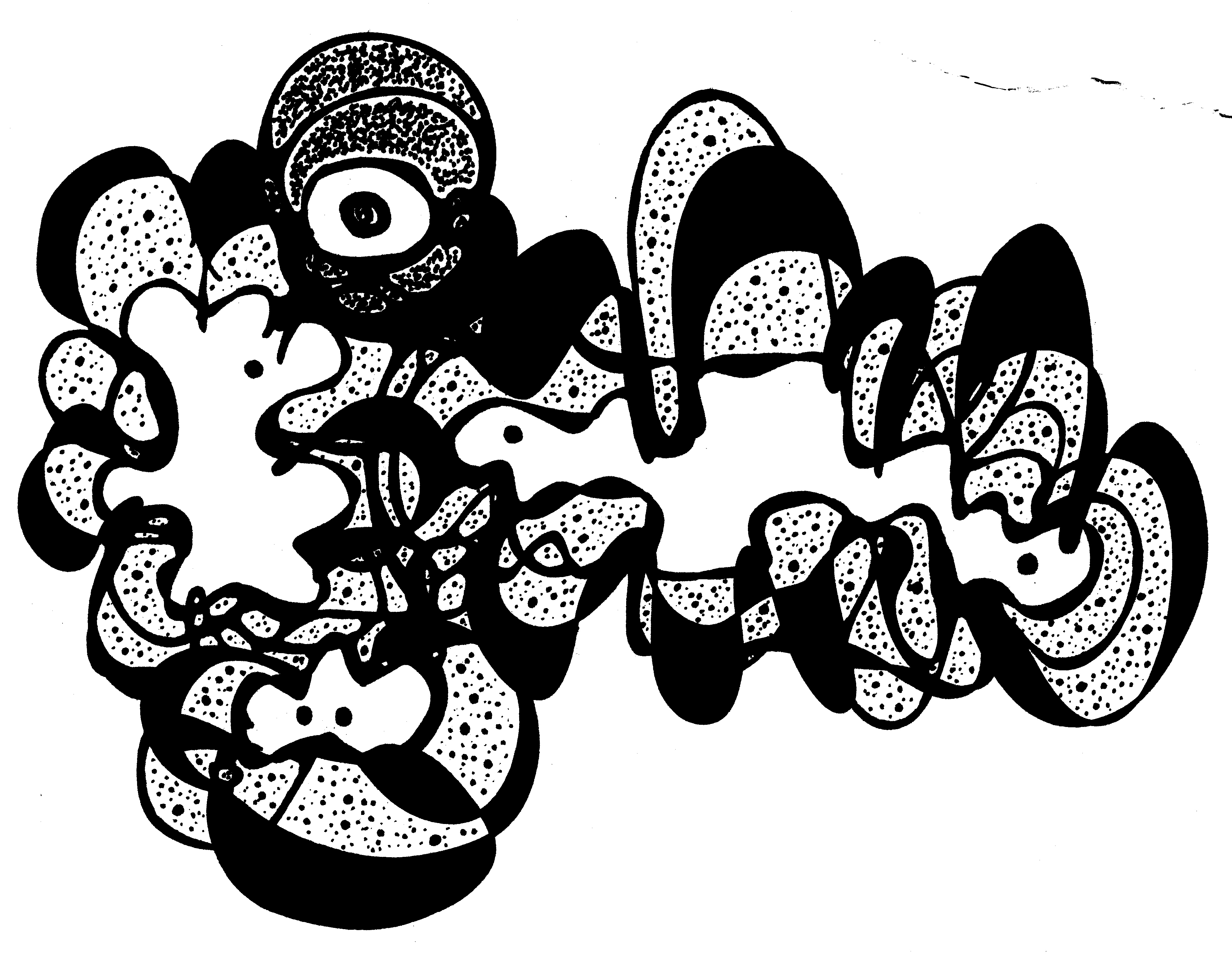
somewhere in a dream terrain where Salvador Dali and Jim Henson commune with Louis Comfort Tiffany.
The images are an exploration of pareidolia, the mind’s tendency to make faces at the drop of a hat. They exhume natural and biological forms latent in the alphabet (“A” – ox; “N” – water; “O” – eye). They tap into the animism residual in the process of silent solitary reading (see David Abram, Spell of the Sensuous). And they undertake a fitful and pataphysical, i.e., seriously unserious, investigation of the mystical dimensions of the material text (see bpNichol, “Probable Systems 14: Re-Discovery of the 22 Letter Alphabet”).
Their main shortcoming, as I look at them now in Dumuzi (recently finished) and Overject (presently underway), is that they have had to sit still.
I want in my next project to animate them – to put the demonic, angelic, and zoological forms that arise through the illumination process into motion. Even more, I want to animate the illumination process itself, obviating the need for clumsy accounts like the one just finished. I envision digital publication and performance events, the latter more akin to video installations in gallery spaces than to conventional poetry readings.
Demons and angels weightless shadows across wall, floor, ceiling. Let’s see if I can stand to learn the program though. It’s that or start the search for – my collaborator.

Disruption of the text
Had thought to take a break from Overject, I really had. Bundled up 60 pages of it, handed them to my two most trusted readers, and I told me, This would be the time to take a breather, get some distance, reapproach in a little while with some new perspective.
Not.
What’s to tell? I just couldn’t get happy till I was back at it with the Sharpies.
So here I am, embarked on part II, and am at a perilous juncture, because I can’t just keep doing what I done, that would be dull and dumb, but my sense of what’s next and vital is dim as yet.
The danger – making it new, not out of a sense of fresh energy, but just for to be newfangled. Oldest tiredest play in the book. (Old as books themselves are, and maybe, I’m not sure, not much older.)
So this is where I maybe ask for help. (Oh my recent students, I know a few of you are reading, here’s your chance to have at it.) This morning I wrote out a homophonic translation of the lower half of folio 90V of the Exeter Book. Here’s what it looks like unaltered.
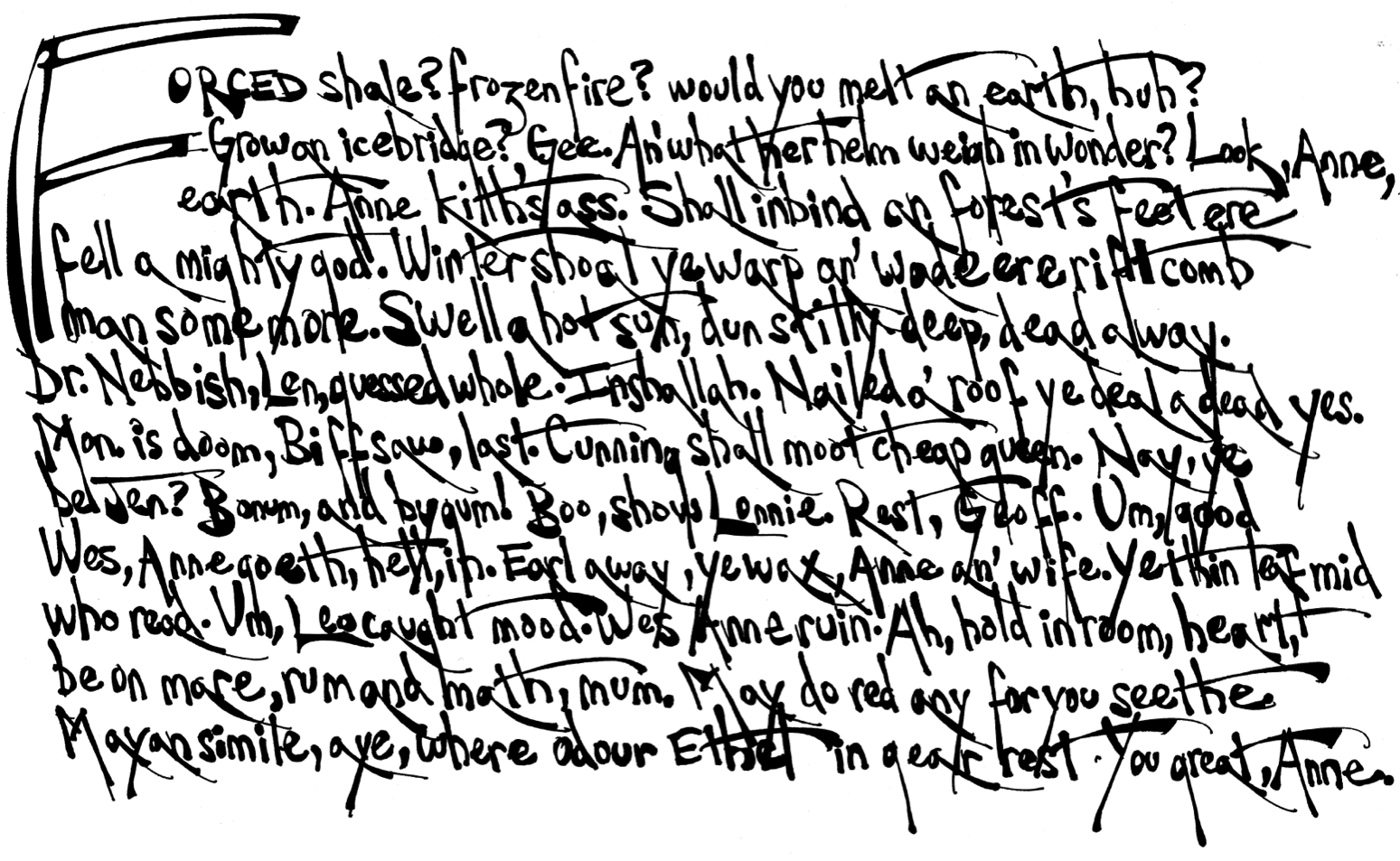
Same approach as I took in the first section of the ms. How to make it new? As I did the scripting I found me thinking about the place of violence in the text at hand. The violence of the patriarchal warrior culture it arose in. The violence time did to the work as it made its way from anciency to now. (Dude. Can you believe anciency really is a word?) The violence of my disruptive translation, me carrying on as if sound itself bore sense across intact.
Meanwhile asters in my back yard, recently in bloom, were blowing this way and that. On a whim I went and cut five or six and scattered the petals on my scanner. That image, overlaid on the first, got me this.
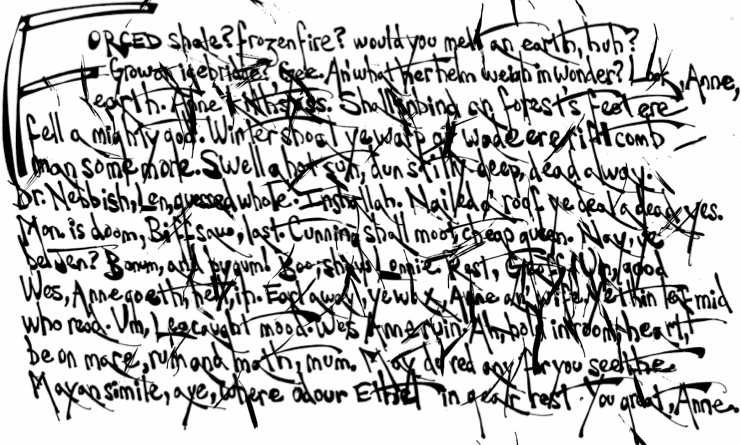
Asters, named for stars, whose fallen petals look like sword gashes. While the most common masculine case ending in Old English, -an, has become the work’s heroine, Anne.
I teach, by the way, a course called Poetics of Peace and War, because I’m very interested in this question, how acts that look destructive when brought to bear on language, may be nourishing when the results are offered to persons.
Also a redtailed hawk just perched in the pine tree outside my study window.
So the petals resisted the eye but lightly. I wanted for what reason I know not something more savage-taloned. So I tore it in pieces then laid the pieces down as shingles or come to think of it feathers. (“Complicate,” from plicare, fold, layer.)
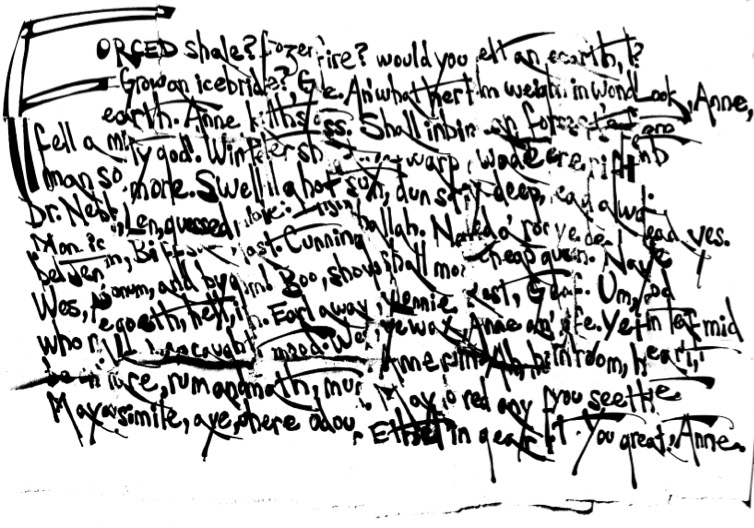
I am in love BTW with scanner noise. I could eat a whole big bowl of it.
The last one I want to show you roughs the text up most – tears and asters it both. Roughs it up most, and is least considerate of your wish for a sensible meaning. And yet it’s the one I think I’m fondest of! Am I just a big meanie?
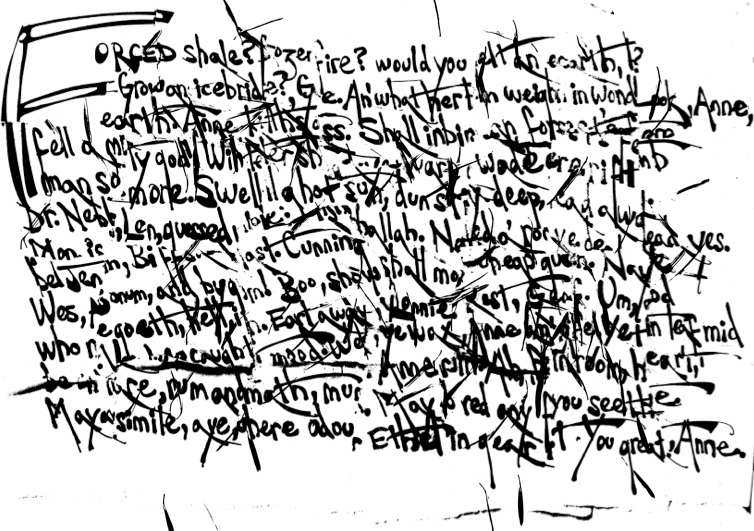
The ask for help part. What do you think? Do any of these move, please, tickle, amuse, intrigue you? Any sense what about them does? Send a comment, do!
If you’re curious, here’s the actual Old English text –
Forst sceal freosan fyr wudu meltan eorþe
growan is brycgian wæter helm wegan wundrū lucan
eorþan ciþas ansceal inbindan forstes fetre
fela meahtig god ∙ winter sceal geweorpan weder eft cu
man sumor swegle hat sund unstille deop d eada wæg
dyrne bið lengest holen sceal inæled ẏrfe gedæled deades
monnes dōm biþ selast ∙ Cyning sceal mid ceape cwene ge
bicgan bunum ⁊beagum bu sceolon ærest geofum gōd
wesan ∙ guð sceal ineorle wig geweaxan ⁊wif geþeon lof mid
hyre leodum leoht mod wesan rune healdan rum heort
beon mearum ⁊maþmum ∙ meodo rædenne forge sið
mægen symle æghwær eodor æþelinge ærest gegretan
(The ⁊ is a medieval &.) And here’s what normal people would call a translation –
1.
Frost freezes, fire eats wood,
earth springs out, ice houses,
water sheathes.
A wonder
there’s one to snap frost’s fetters,
break seed earth, mighty God.
2.
Winter turns, comes warm unstill
weather, summer skysound.
Deep dead ways are secret longest,
holly burning, cattle shared out.
Dead men’s laws are the best laws.
3.
A king can buy a queen with cattle.
That they give lots away is the main thing.
4.
War forces him
to be brave.
She grows dear
to her people, her shining mind
hoards whispers, her spacious heart
holds treasures.
5.
Moving among the company,
everywhere always, house throughout,
greeting her lord, she pours his cup first;
Now I can’t see the hawk but I can hear her high cries.
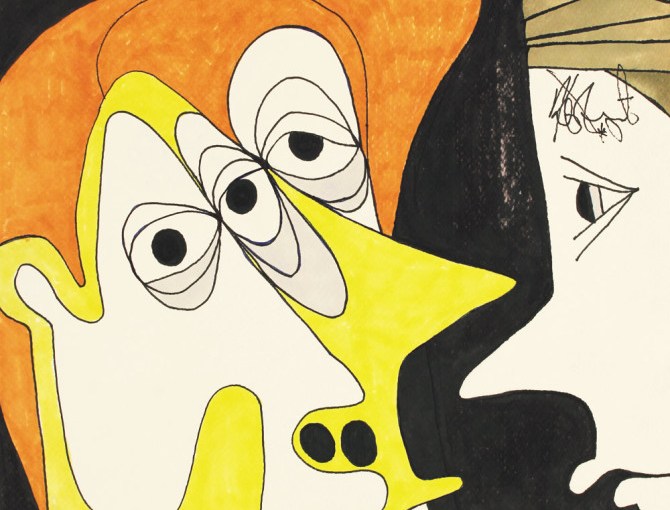
Master Grand Doodler
One more for now, then I’ve had all the caffeine my bloodstream can take, and I gotta move on. More to come – tomorrow?
(The awesome gallery of Vonnegut’s doodlery isn’t coming through here … you’ll need to go to the home blog for it. Do!)

So we all know Vonnegut can write, right? I think anyone reading this blog can attest to that (and if you can’t, let’s have a chat). But many people, including some avid readers, aren’t aware of the man’s knack for the visual arts.
Yeah, sure, anyone who’s read Breakfast of Champions or even Slaughterhouse-Five has seen a few of his doodles, but Vonnegut was much more than this—

Much, much more than this.
In “Fates Worse Than Death”, Vonnegut wrote about his practice of drawing—
My own means of making a living is essentially clerical, and hence tedious and constipating…. The making of pictures is to writing what laughing gas is to the Asian influenza.
I’d like to think Vonnegut would’ve enjoyed visual poetry for that reason. Maybe it would’ve given him an outlet for writing that didn’t feel quite so robotic, one that married his talent for visual compositions…
View original post 34 more words
 The Art of Compost