

In Unlikeness Is Us: Fourteen from the Exeter Book, I’ve translated a few greatest Old English hits, Wanderer Seafarer and such, also a smatter of riddles, and a sequence of maxims hardly anyone has done whole cloth.

All the poems are from the Exeter Book, a miscellany of OE verse thrown together by persons and for reasons unknown. It suffered obscurity lange wile – enduring because useful for storing gold leaf, and as a cutting board, beer coaster, rest for a hot poker. I imagine one day translating it start to cindery end.
Unlikeness comes with critical intro plus commentaries and textual notes. The intro covers basic features of Anglo-Saxon verse (alliterative line, parataxis, kenning, that good stuff) and tackles, too, a tension the poems suffer between their investments in the tangible world (not to mention their own thingliness, & haecceity, as poems) and their express and to me oppressive yearning for some deity outside the sky.
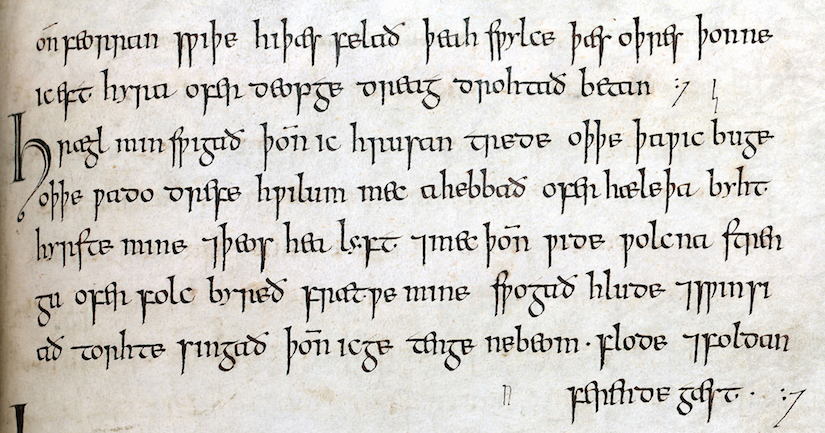
Here’s a poem usually called “Wulf and Eadwacer.” In Old English it goes
The Wolf
Lēodum is mīnum swylce him mon lāc gife.
Willað hȳ hine āþecgan gif hē on þrēat cymeð.
Ungelīc is ūs.
Wulf is on īege, ic on ōþerre.
Faest is þæt ēglond, fenne biworpen.
Sindon wælrēowe weras þǣr on ige;
willað hȳ hine āþecgan gif hē on þrēat cymeð.
Ungelīce is us.
Wulfes ic mīnes wīdlāstum wēnum dogode.
Þonne hit wæs rēnig weder ond ic reotugu sæt.
Þonne mec se beaducāfa bōgum bilegde,
wæs mē wyn tō þon, wæs mē hwæþre ēac lāð.
Wulf, min Wulf, wēna mē þīne
sēoce gedydon, þīne seldcymas,
murnende mōd, nāles metelīste.
Gehyrest þu, ead wacer, uncerne earmne hwelp
bireð wulf tō wuda.
Þæt mon ēaþe tōslīteð þætte nǣfre gesomnad wæs,
uncer giedd geador.
and in translation (a woman speaks):
The Wolf
As if one had made the people an offering.
They will receive him if he comes in violence.
Unlikeness is us.
The wolf is on an island. I am on another.
Mine is secured and surrounded by marsh.
The men on that island are glad at war –
they’ll receive him if he comes in violence.
Unlikeness is us.
I have borne a wolf on thought’s pathways.
Then it was rainy weather and I sat crying.
When the war-swift one took me in arms,
the joy he gave me, it was that much pain.
Wolf – my Wolf – thoughts of you
sicken me. How seldom you come
makes me anxious, not my hunger.
Listen, overseer, to our miserable whelp
a wolf bears to woods.
Easy to part what was never joined;
our song together.
I drafted this for the jacket:
So. Here are fourteen translations of Old English poems from the tenth-century Exeter Book. Some are well known and widely loved: “The Seafarer,” “The Ruin.” One, “Maxims I,” is hardly ever seen whole; when it is translated, small crucial marks in the source are ignored, and the deft shape of its thought-in-action is lost. Christopher Patton’s translations, which draw the alliterative Anglo-Saxon verse into a richly patterned four-beat line, convey the projective qualities of the poems more than is usually done. He emphasizes their concrete, tangible being as they are bedded in matter – scribal errors, fire damage, irreducible ambiguities – over the otherworldly values some of them espouse. With critical introduction, commentaries, and notes.
Post Holes
Some blog posts about & from the book.

An Anglo-Saxon #metoo?
The Wolf, with commentary, notes, & thoughts on ties to #metoo
Ancestral White Interiors
Translating poems from the pre-dawn of white supremacy
Constructions of Whiteness
Anglo-Saxon ties to Ta-Nehisi Coates, the Stó:lo Nation, John Cage

Augustine, whiteness, alienation
The Exeter poems do speak to Trump’s America
Vagrant introduction, first para
Vagrancy, diversity, ADHD as formal practice

On The Seafarer
Commentary on the poem, & on Ezra Pound’s translation of it
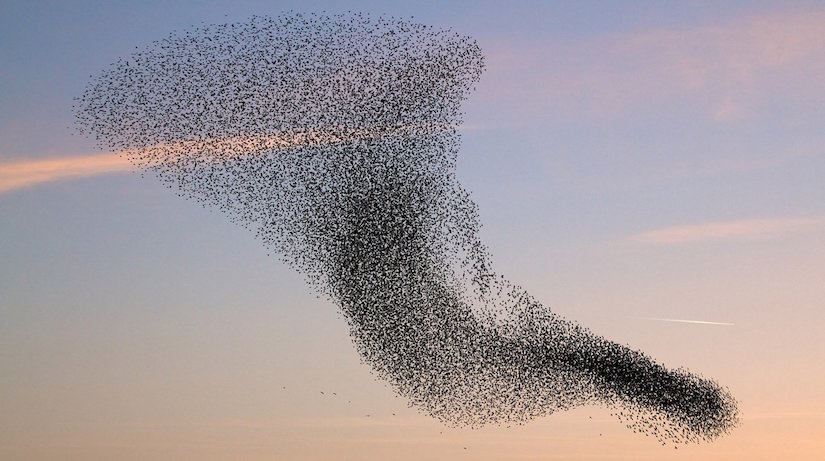
A clutter of starlings
Riddle 57 (starlings) with commentary & notes

A bookworm
Riddle 47 (bookworm), with commentary & notes
The Swan
Riddle 7 (swan), with commentary & notes
Messages across seas
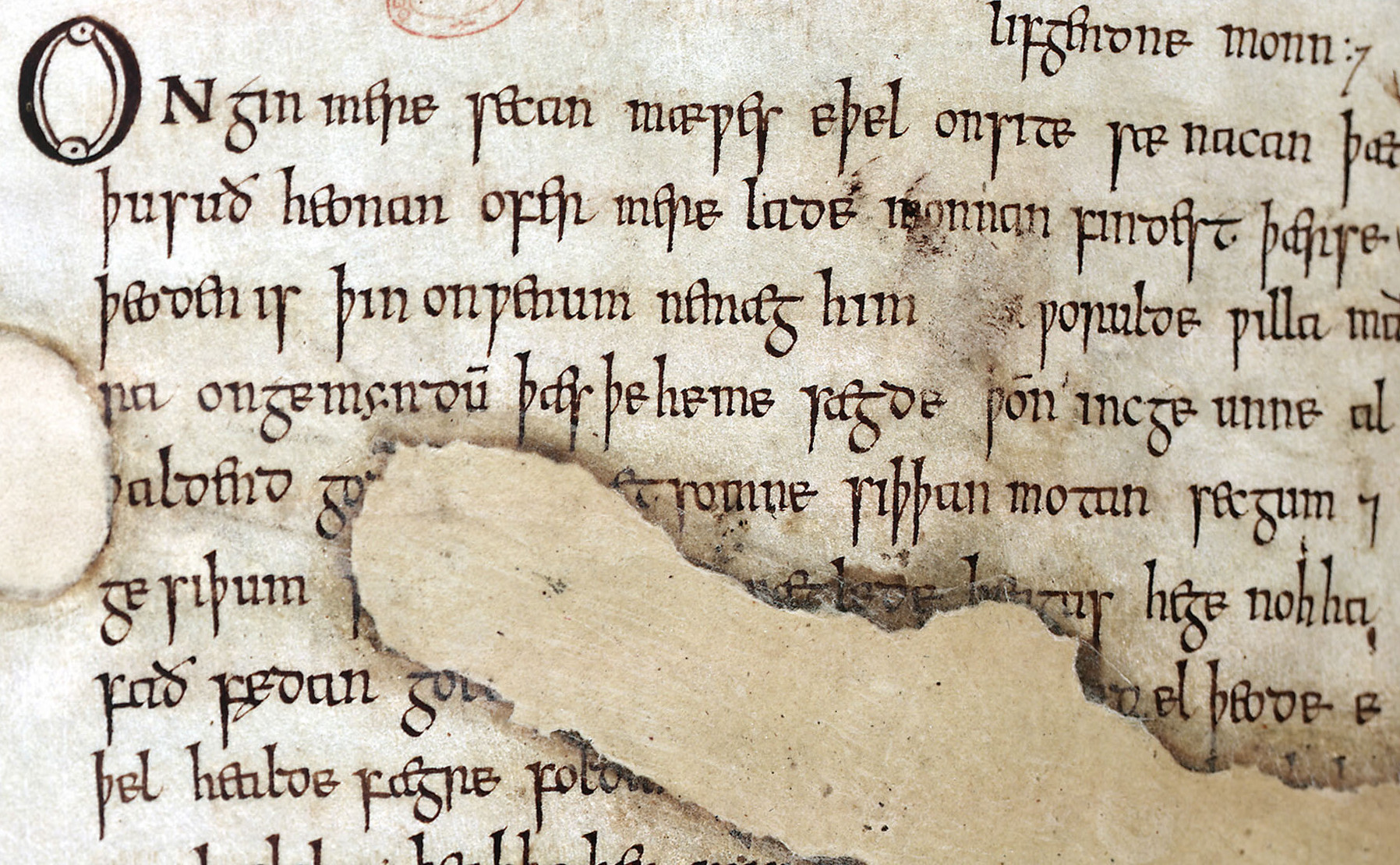
A setting in Asymptote of His Message (aka The Husband’s Message)
 The Art of Compost