David Brooks 1 Lao-Tzu 0

David Brooks, writing on the DC shutdown, got a good one-two on Democrats and Foucault tonight, I laughed out loud.

Democrats focused all their energies on those all-important Michel Foucault swing voters. When Democrats get all excited, they go into a hypnotic trance and think the entire country is the Middlebury College faculty lounge. The American story is a story of systemic oppression. Since the cultural discourse that privileges white hegemony is the world’s single most important problem, of course it’s worth shutting down the entire government to take a stand on DACA.

I mean, I had thought maybe it was, but he has a point? But then he had to go and fuck with a sacred text.

Democrats devised a brilliant Tao Te Ching messaging strategy. The ancient Chinese master informs us, “Being and not being create each other. … Before and after follow each other.” In this way, he teaches the paradoxical infinity of ultimate truth.

The Democrats captured this same paradoxical profundity with their superb messaging over the weekend: We bravely shut down the government to save the Dreamers even though Donald Trump is responsible for shutting down the government.

The ancient Chinese master bows in respect.

Friend, I know you were writing to a deadline and all, but aside from the not really much getting it, that’s just, and these are not words I use lightly, some nasty racist shit, for a cheap laugh.

David Brooks 1, Lao-Tzu 0.

Lao-Tzu wins it.


The column, in which he enjoins us to listen to the non-racist angels of our nature, here.

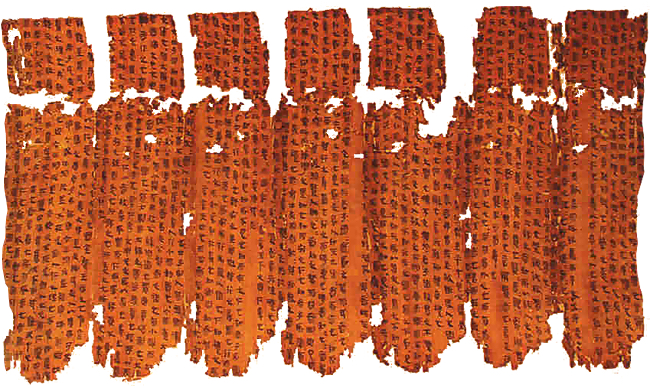
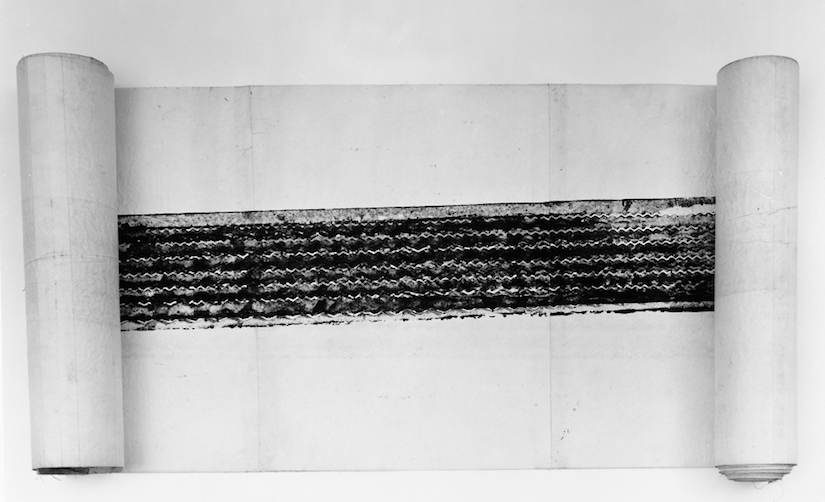
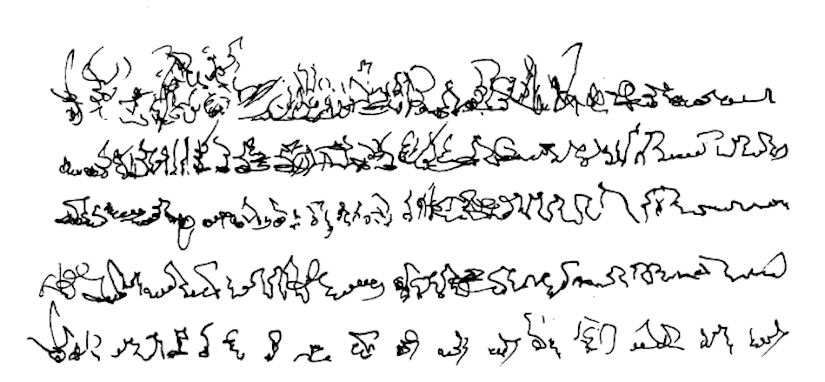
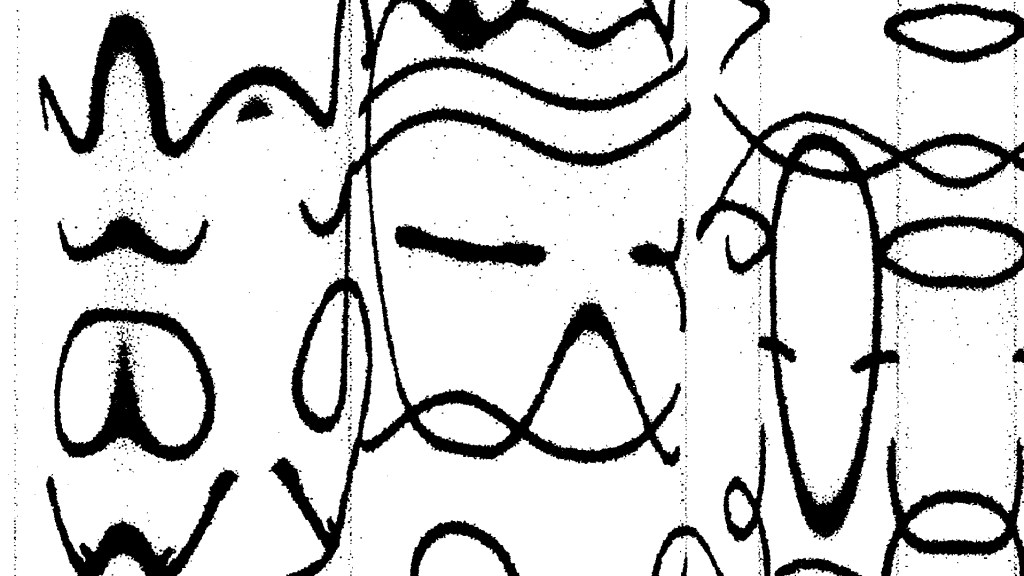
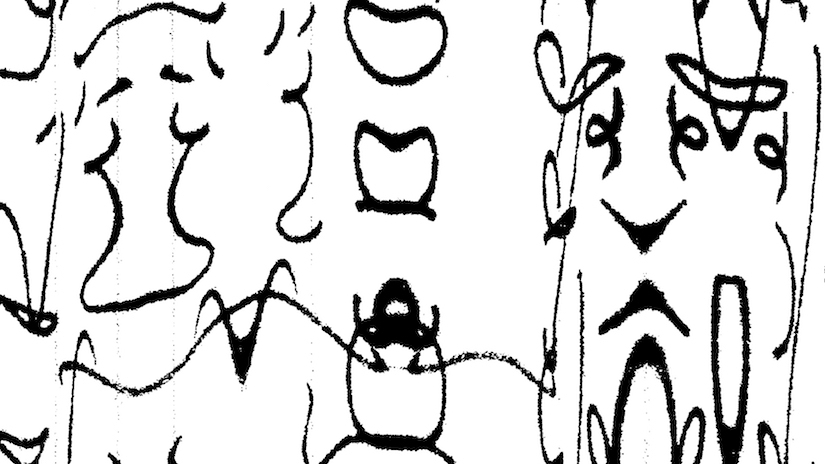
The image atop, one of the silk manuscripts of the Tao Te Ching, recovered at Mawangdui, more here.


Okay, PS PS, then I go to bed. Close read, à la Foucault, DB’s first para, he uses all twice in one sentence, thrice in two. Who’s it getting overheated, mm?

Major Authors Seminar: Pound and Williams

Description for a spring course I’m way excited to teach again.


We know Ezra Pound and William Carlos Williams for a few hit singles

The apparition of these faces in the crowd.

so much depends
upon

and maybe a few sayings fit for a bumper sticker. Go in fear of abstractions. No ideas but in things. What these soundbites miss is each poet’s complex and ongoing self-reinvention. Both started as Imagists, rejecting the sentimentality they found in late Victorian verse, instead carving small hard moments of perception. From there, the two diverged, Williams becoming more invested in the local, the scruffily irregular, Pound in archetypal patterns that for him made ancient history current, distant cultures present. Both remained committed, however, to reinventing the epic, and to bringing mythic awareness to the crush of modernity.

Pound read mythology as if it were the morning newspaper.
Williams read the morning newspaper as if it were mythology.
                  —Donald Revell

Between them they initiated strands in the web of American postmodernism that continue to spread and bear fruit and further ramify to this day. Be ready for close reading of sometimes very difficult texts; the postmodern epic, there’s no mastering it, only entering and being swept through and by it. Assignments will include regular critical responses; a seminar paper to be presented to the class and revised for final submission; an allusion chart mapping a chosen passage from The Cantos; and line-by-line meticulously close reading of a chosen passage from Paterson. Our texts: Pound, selected early poems from Personae, Cathay, selections from the Cantos, selected critical writings; Williams, selected early poems, Spring and All, Descent of Winter, Paterson books I-III, selected prose.


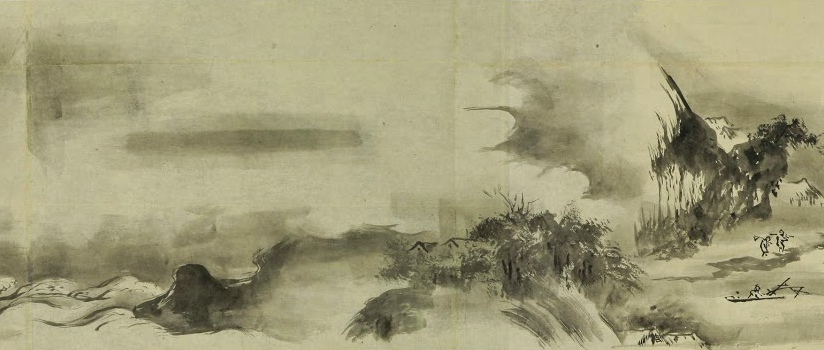
The image atop, a detail from Eight Views of the Xiao and Xiang Rivers (Sho-Sho Hakkei) by Sesson Shukei (1504–ca. 1590). A time-honoured theme in Chinese and Japanese landscape painting; one such series was inspiration for Pound’s “Seven-Lakes Canto,” Canto XLIX, still point in the book’s burning wheel.

Not, as far as I know, Shukei’s; it’s just for instance. The whole of it


SESSHU-Shoshohakkei

teaching portfolio

“Stunningly statistically beautiful, a monument”

This posted just recently by a treasured friend from grad school (an excerpt)

In moments like these, I’m visited by the ad for Joi, the holographic lover of the replicant blade runner called K. The generic Joi towers above me, stunningly statistically beautiful, a monument to our alienation from the material fact of ourselves. As she comes toward me, her steps make no sound. Even at her scale, she doesn’t displace the air with her movements. She carries no scent. A few feet from me, she stops and  crouches to bring her eyes more to the level of mine, but because of her height she still has to look down at me. She says, “You look like a Pepper.”

Read the whole of it, Aethon, which means blazing, also gut-devouring eagle, also also a scary robot corp, do!

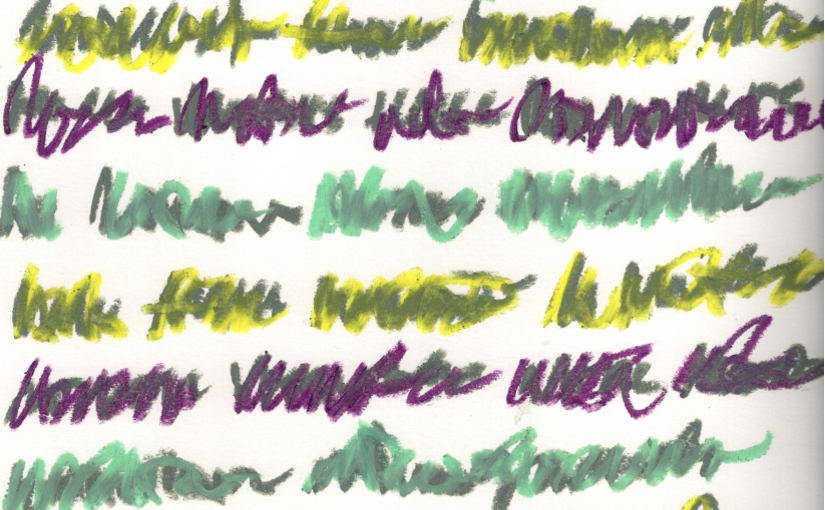
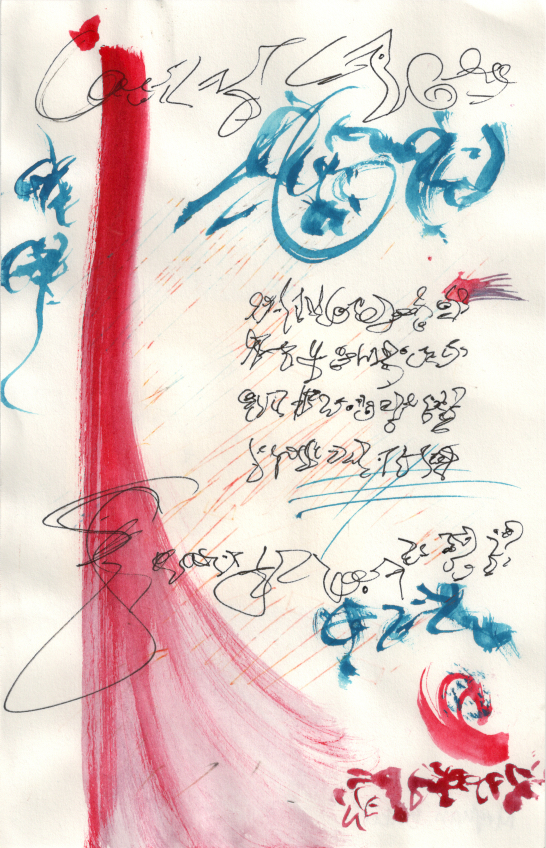
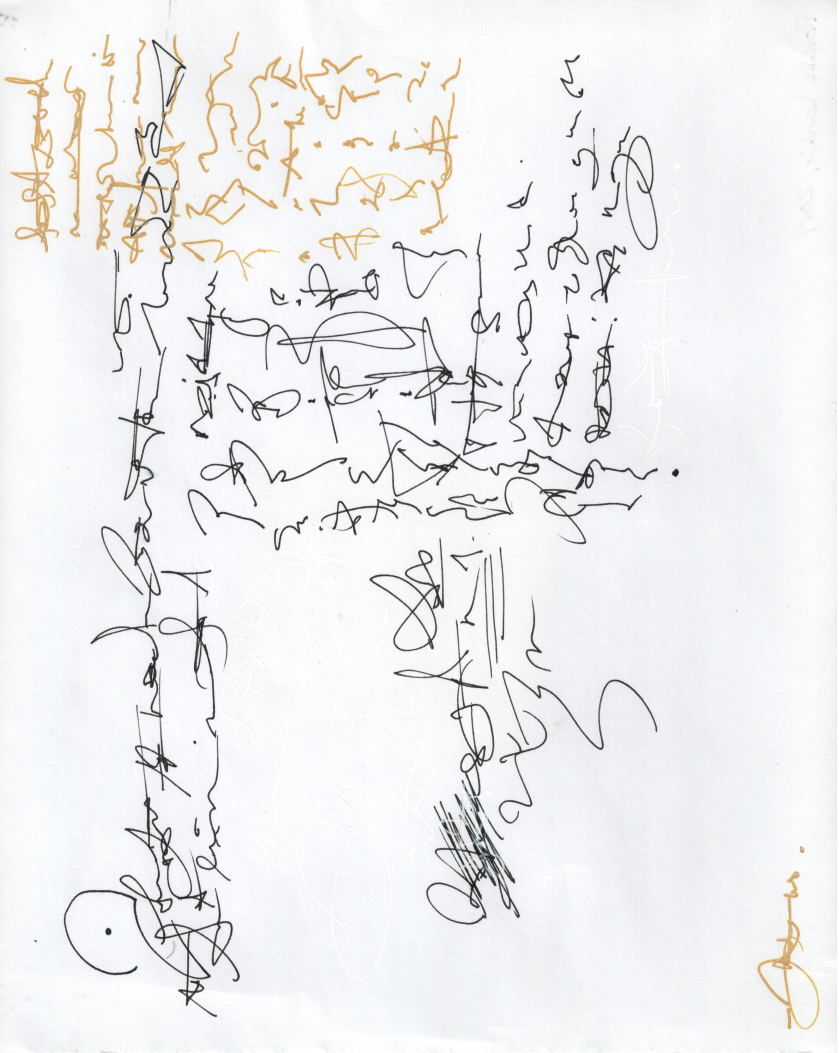
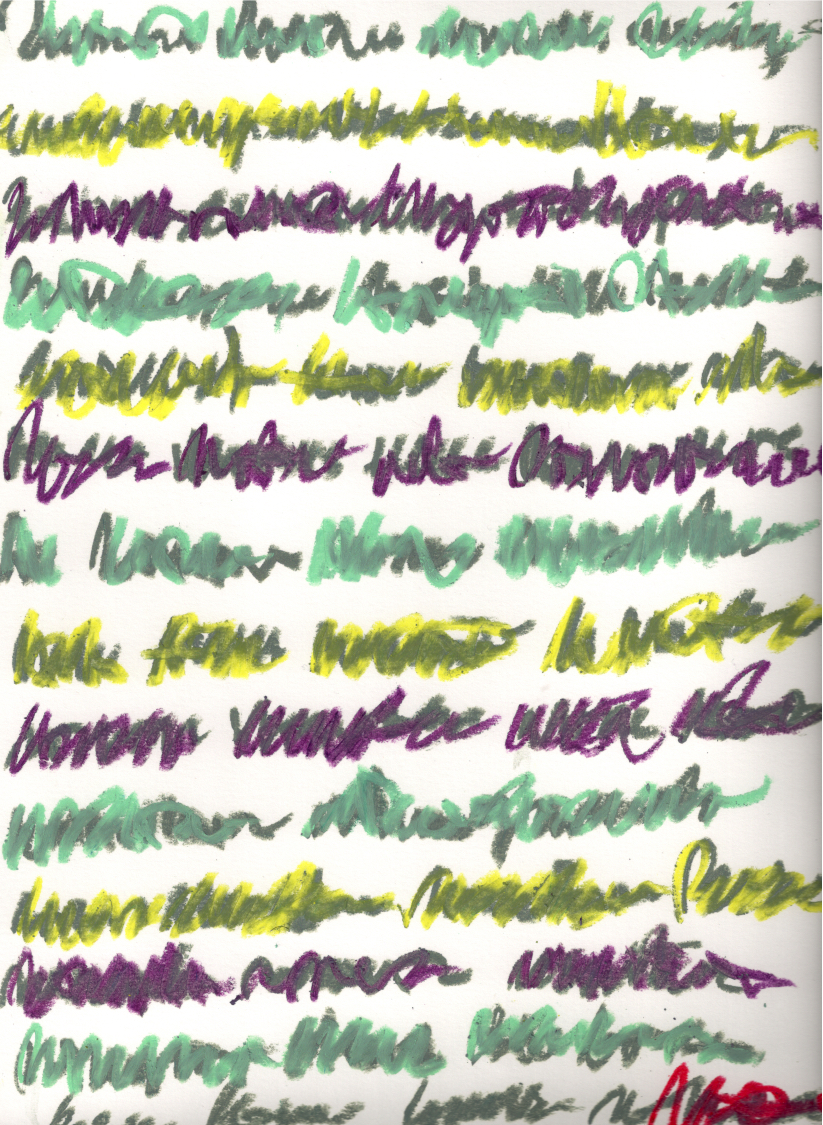
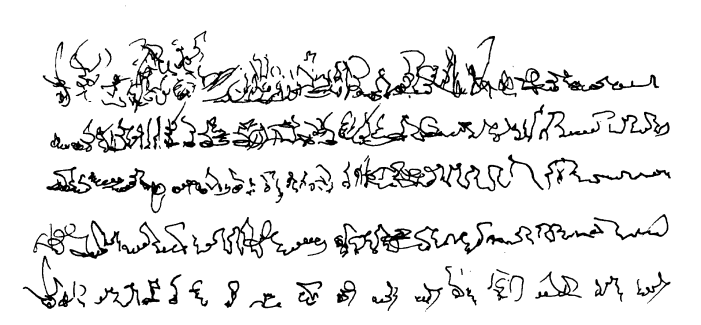
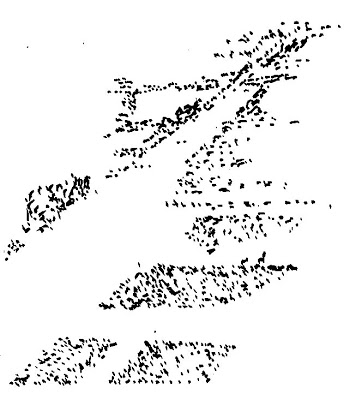
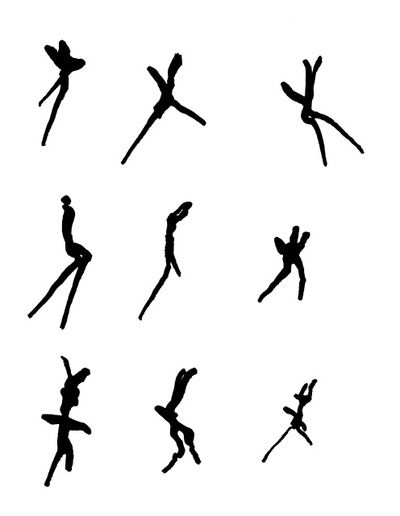
Student work: Asemic page

Last day of my poetry workshop today. We ended on a sweet sad silly happy blue note, or several of them, everyone is feeling lots, and it’s all good. Delicate uncertain care. I’m honoured to be in the presence of so much true feeling. The texture of such a moment can’t always be got across – though, poets, we try – in words. Thank goodness there are for these occasions unwords!

Strained transition but man I’m blasted. Sometime when it’s over I’ll write why. Right now I want to share a few of their asemic compositions.

The exercise: Compose a page of asemic writing. The post I wrote round it here.


This first one is peacock. And bravery and has such boldness in its made mark. I love it for that and learn from it. Some of its sworls – that big blue swoop with the edge of a robin’s egg, e.g. – are not just proto-charactery but the prelim of true things.

Then there’s that centred square of no-sense going on as if it were all the order in the world – ain’t no thing, just move on. Five by five, or almost, like a Tang dynasty poem. But yet not. This poem is but yet not.

MB


This one to me marks an opening for its author. Every crook and curve is of note, as if it belonged to a musical score. And her work after, it got smaller, sharper, every syllable counted (literally – she grooved to syllabics) and enjambments suddenly heartbreakingly present. 

Every student in this striking group had a breakthrough poem. I do think this was hers. Look how even as it proceeds it opens and bravens. 
HS


This one touches the spirit of Oulipo, or something ‘Pataphysical, geometry of a universe soon to be invented. And of all the ones that came in, it took the most care with the page as a material object, which like a universe has more than one side, is all turnings.


This one is wholly free in its spirit of gesture and direction. The poet said she didn’t think much of it but what I love is she didn’t think much in it she just did it. Her not-thinking transmits with no loss of energy her embodied gesture to this embodied eye and the mind of it.

AP

Dōgen: “When Yaoshan was sitting, a monk asked him, ‘In steadfast sitting, what do you think?” Yaoshan said, ‘Think not-thinking.’ ‘How do you think not-thinking?’ Yaoshan replied, ‘Non-thinking.'” This is that!


My conversation with the poet of this one went something like

—Why does this work so well??! (me)

—I don’t know! (her)

—I don’t either but it does!

—I know!

It’s barely more than scriggles. But that it gave me a word, scriggles, totally for free, means lots. It’s second-order creative; it creates creativity; it’s generative. Those earth and vegetal tones are life-in-potential. (Even what colourblind I thinks to be purple, the chlorophyll of the low-light set.) Just as asemic writing itself is meaning-in-potential.

ES

A student in my other class, damn but I love her ambition, and so see myself in it, wants to elicit from Marvell’s “A Dialogue Between the Soul and the Body” the whole mind-body problem, link back to the Buddha on that and connect forward to modern materialist theories positing mind as an emergent property of material systems. Had to say, that’s an MA thesis, not a ten-page critical research paper. But emergence is where it’s at, complexity, new reals irreducible. (Why the eff am I advisor to a journal called Occam’s Razor?) And I trust her to find a scope to make it work. And – point of the digression – emergence is what’s here, too.

I do love this teaching thing. However good I may be at it, it is better to me. I only wish I knew how to explain to a blind inertial institution what it means to want to teach from prajna.

teaching portfolio

Constructions of Whiteness

A panel proposal put together by the best triangle I’ve ever been a corner to. (Side note, do you know how hard it is to persuade a room of undergrads that a three-legged stool can’t wobble? I do know now. I mean, you get it, or you don’t, how to explain it?) For next summer’s CCWWP convention (that mouthful’s the Canadian Creative Writers and Writing Programs) in Toronto. Has a thematic focus whose statement starts like this

As we live this moment of intensifying racial and gendered violence, discourses and policies of intolerance, and environmental crises, we are also bearing witness to and participating in a broad surge of resistance, resilience and reclamation as evident in movements like Idle No More and Black Lives Matter. Literature has always had a role in responding, intervening and shaping the historical and cultural present. We believe literature is a way to interrogate anew what it means to be human and living in shared humanity on this land and in this time. Literature creates opportunity for the difficult conversations between us that might address our historical present, how we are haunted and how we can proceed.

and can be read whole here. We wanted to speak to the theme without presuming to speak from anywhere other than where we were. And so this.


In Between the World and Me, Ta-Nehisi Coates calls out the people “who have been brought up hopelessly, tragically, deceitfully, to believe that they are white.” He suggests that race is a shared fiction, one that served and serves the powers that wrote it, slavers, imperialists, eugenicists, white supremacists. Our ongoing shared belief in the fiction makes it real and lethal to Black kids on American city streets, Indigenous women of Canadian cities and prairies, countless others. This panel consists of three poets who, being white, can’t help but take part in the construction of whiteness. They’ll read from works-in-progress that ask whether whiteness might also be witness – how construction might also be re- or de-construction – and then open the room to questions and discussion.

Last summer, as Christopher Patton wrote the critical introduction to his book of translations from Old English, white nationalists were marching in Charlottesville, VA, and the air in Bellingham, WA, where he lives, was white with cross-border forest-fire smoke. His thinking sharpened some about ties between those thousand-year-old poems and white supremacy and climate change. Race wasn’t a thing when the poems were composed – tribe and ethnicity, yes, foreignness yes, but not race as we live in it now. And yet what were their warrior ethos and fear of the other, their love of gold and roiling suppressed anxieties, but raw material for the later construction of whiteness? Add profit motive and oceangoing ships and stir. Can a translator put such values back out in the world without validating them? What help is it, that other values run countercurrent in the poems, self-inquiry, dialogue, empathy for the outsider?

In the weeks and months after Hurricane Katrina, Robert Polidori entered hundreds of ruined homes alone, with his camera. Stephanie Bolster resisted writing about these haunting, voyeuristic images for years, before accepting that the only way out was through; her project, Long Exposure, began in the interrogative mode, with her own voyeurism-once-removed. Evolving politics intensified the questioning and made her see her witnessing as white. In the New Orleans thread of her manuscript, she writes from empathy with the (mostly poor, mostly Black) former residents of these homes, but her recognition of her own subject position means she knows others may see that empathy as trespassing – or, worse, slumming. Can good art arise from, even overcome, guilt? How to strive for aesthetic authenticity amidst this complexity? How to write while wondering what one has the right to see, to say, to feel? Yet how much worse to be silent.

Barbara Nickel witnesses daily the loss of a body of water; she lives on lake-bottom land. The former Sumas Lake in the Upper Fraser Valley of British Columbia was drained in the 1920’s to create farmland. Named “reclamation,” the drainage was an act of irrevocable violence against the land and the Stó:lo people whose lives had depended on the lake. When Barbara discovered that Mennonite settlers from the prairies were some of the first to farm the newly drained land, the tension of her own witness was increased to include the complicity of her own people. Her response is made from vestiges – poems found in historical and contemporary voices, texts and other more visible remains – sandpiper in a museum drawer. As she writes over/in/of the lake’s ghost, she questions her right to do so, asks which roles are authentically hers – inquirer, trespasser, artist, friend?


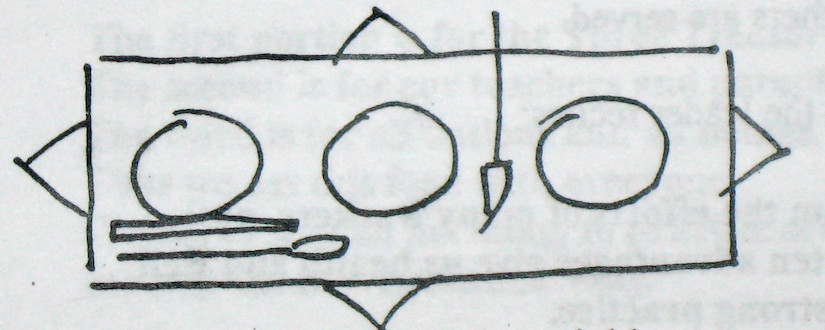
I was browsing Robert Rauschenberg’s white paintings, hoping for something with enough texture visible to work in that upper heaven, top of the post, and came to this. Am caught by how all context is. Context of Black Lives Matter, the image is wake-up appalling. Context of Black Mountain, it’s American mid-century innocence enterprising. Phaidon‘s text on its generation, the painter collaborating with John Cage composer:

Rauschenberg said that Cage was the only driver in Manhattan willing to collaborate on such an unusual scheme. Perhaps this is a suitably flip comment to accompany so brisk a work. When asked if the work is a little like a musical stave, the artist demurred, preferring to compare it to a Tibetan prayer scroll. Yet, Cage drove over Rauschenberg’s scroll in the very same Model A Ford that he had carried him to Black Mountain College in a few years earlier; and doesn’t this single track bring to mind a little something of Cage’s featureless score for 4’33” – the silent work that’s never quite rid of the world’s noise?

A few closeups from it:

Road music. Rowed music. Rode music.

That innocence, it’s not gone, it ne’er was.

Exercise: Asemic writing

Today I gave my poetry workshop an exercise in asemic writing. First time I’ve tried it & they done good. Here’s the exercise, with prelims. (And, at the end, some asemic resources.)

First, some con(structed) scripts

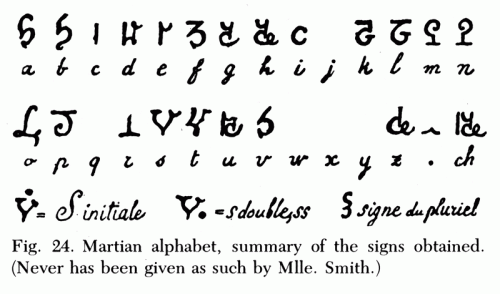
In class, showed some alphabets invented or divined. Hélène Smith‘s Martian:

Smith

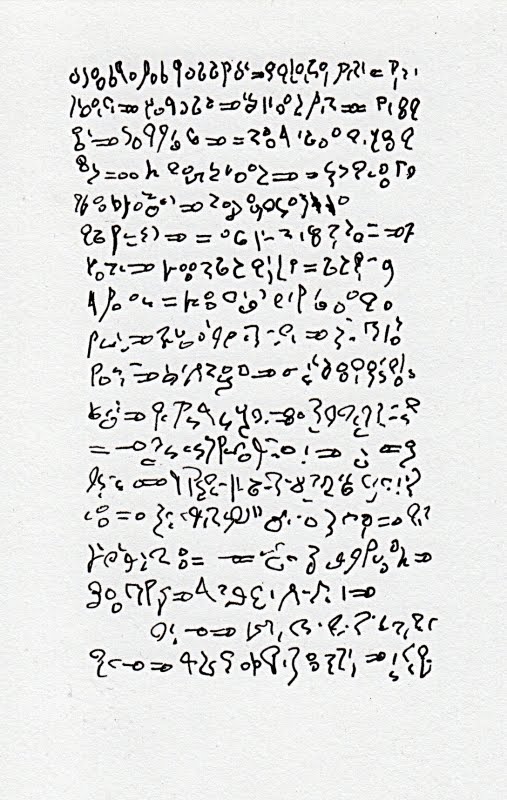
Something cool by Andrew Clark I found:

Clark

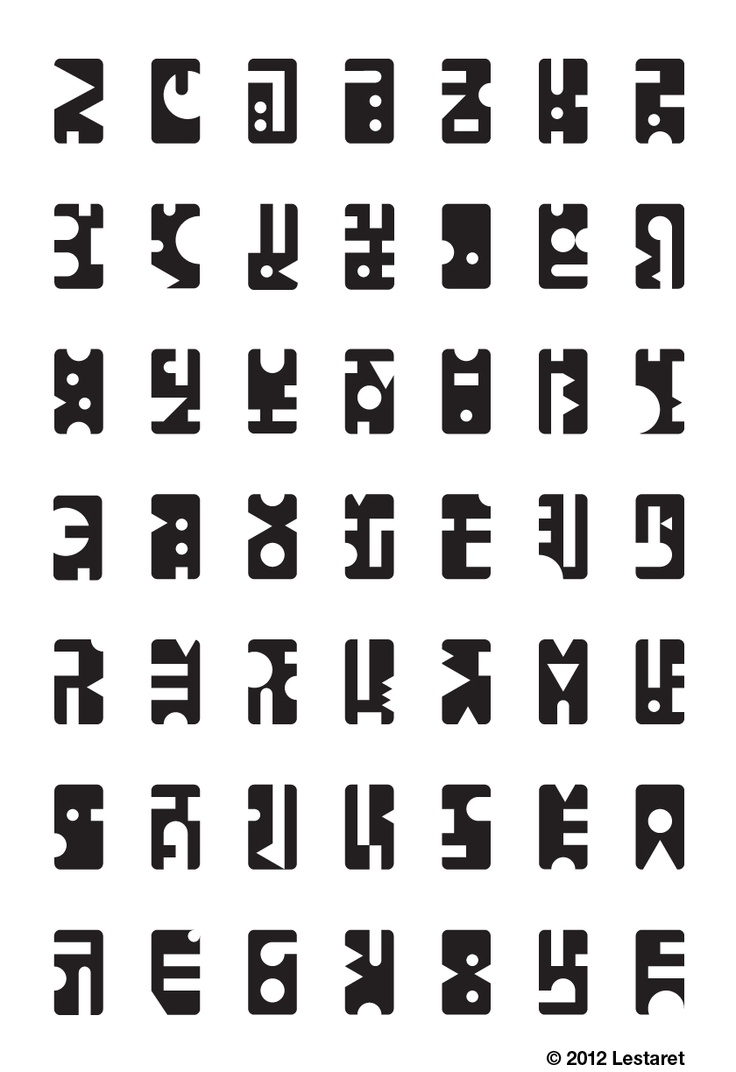
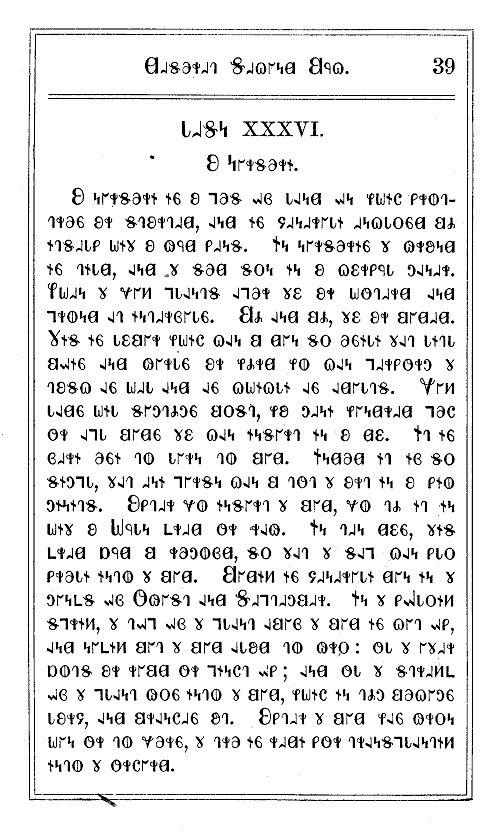
Razorsharp letterset, with pareidolia, by Christopher Skinner:

Skinner

Wish I’d remembered the Deseret writing created by Brigham Young:

Deseret

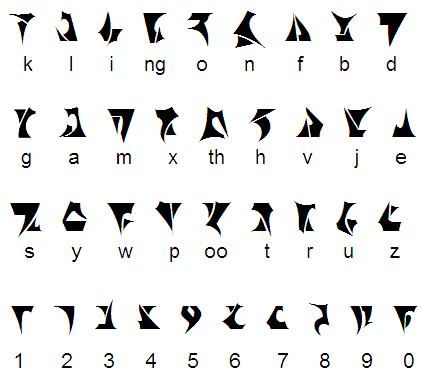
More widely used perhaps is Klingon:

Klingon

next, an in-class exercise

Create a new alphabet. You have 15 minutes.

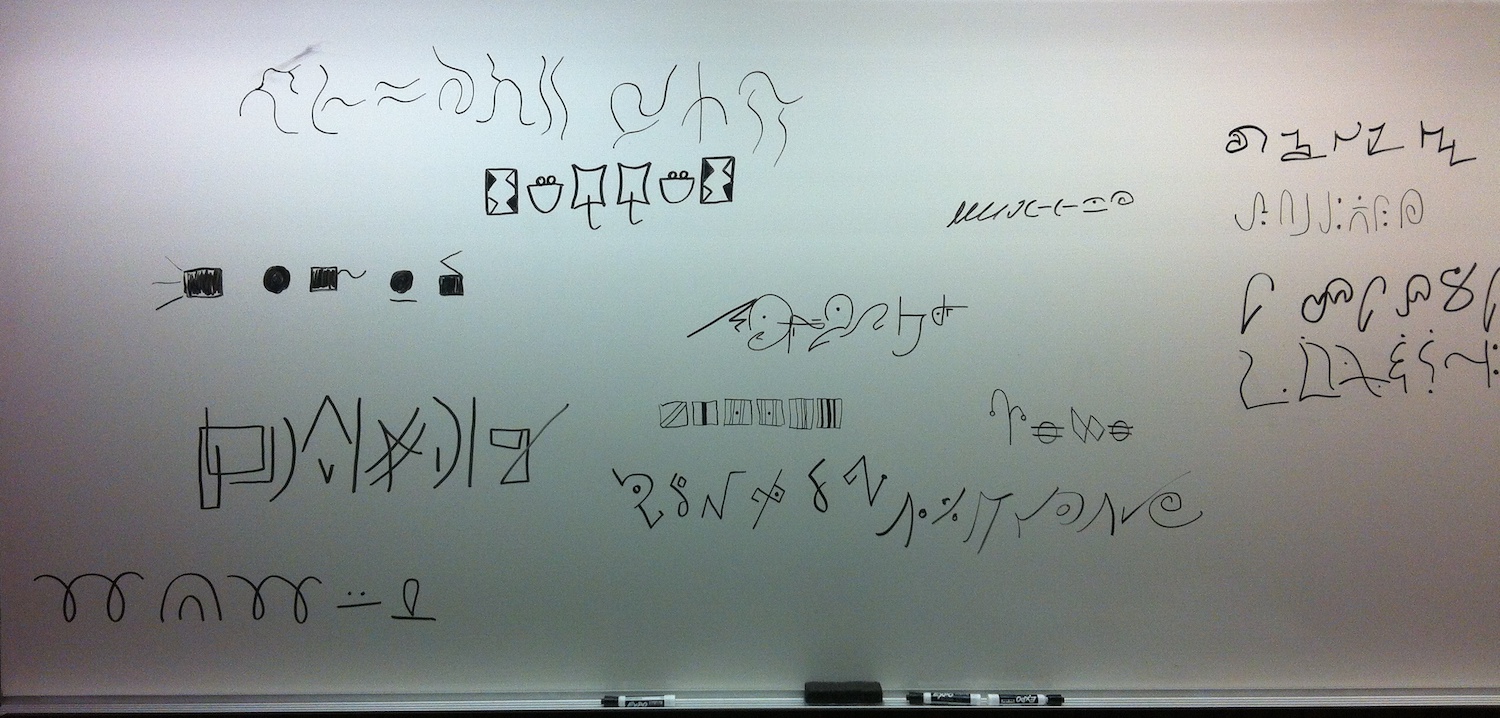
When done, they wrote their names in their alphabet, and put them on the board.

photo (9)

The characters are illegible but full of character. I can almost tell, weeks later, whose letters are whose. (Of course the palindrome’s a giveaway.) And that’s asemic writing for you: all the meanings semantic meaning was veiling, when we were distracted by it, shiny toy, creep forth, peek out.

And now, the exercise, asemic writing

At home, compose a page of asemic writing.

And man did some come out good. I will post, haste.

To those who had trouble with the ex, I said, try it again, with your eyes closed.


Examples of asemic writing I had for them, who now are you, to look at.

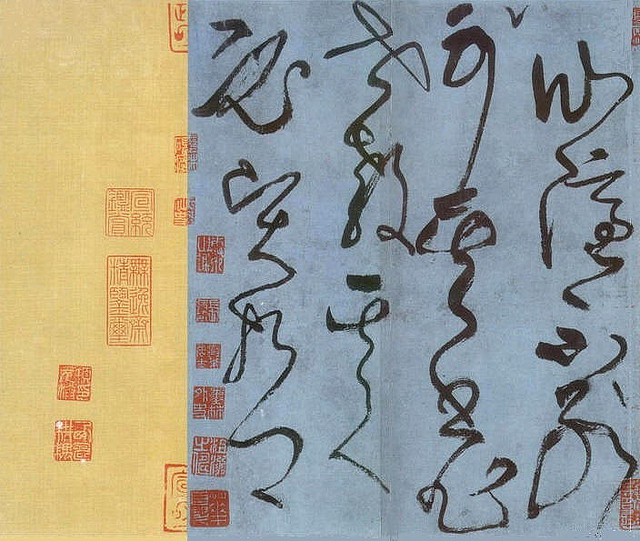
Zhang Xu‘s “wild cursive,” or loosely (or wrongly) “wild grass cursive”:

Zhang_Xu_-_Grass_style_calligraphy_(4)

A few by Henri Michaux:

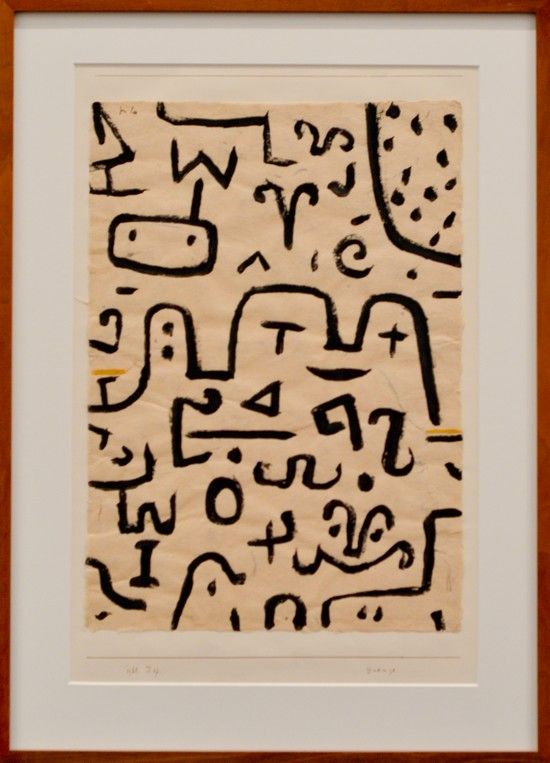
A couple by Paul Klee:

And this wonderful ongoing project, The Geranium Lake Properties, by Lyn Tarczynski, maybe my favourite asemic compositor out there.

And this bed of asemic misadventure, The New Post-literate, edited by one of the mode’s current progenitors, Michael Jacobson.


Also had them read these good orientations on the practice:

Tim Gaze on asemic writing.

Michael Jacobson on asemic writing.

Minnesota Center for Book Arts, “Making Sense of Asemic Writing.”


Postscript. Orientations, orient, Orient, Orientalism. Can’t help but wonder, worry a little, as I play around in the asemic stream, what kinds of othering might be going on. It’s pleasing to make a script one recognizes and doesn’t, cognizes and doesn’t. It gets fantasy circuits firing without any durable duty to, I dunno, the actual world of beings bedded in history. Sort of the way paintings of Turkish harems might have got Euros turned on in the 19th C?

Play’s okay, we all need to sometimes. But while most of the asemic stills in SCRO, my current project, are redolent of leafs and bugs and unraced faces, there are those that might mind one of an ethnographic rattle, or petroglyphs I saw somewhere, and others please me maybe for imping the fluidity of Arabic.

What the fuck am I redoing the Mikado for the 21st C or something? I don’t mean to, but do I get to claim the privilege of not meaning to? A couple friends and I are putting together a proposal for next year’s CCWWP Convention, theme of necessary conversations in a time of racial and gendered violence. Had thought to propose on this – show some, say my self-questions, see what other questions flew. (Our thinking’s gone another way, another post on that.)


Post-postscript. Are many Arabics gorgeous and asemic to me meaning God.

In the name of Allah
“In the name of Allah beneficent and merciful”

There needs to be room for play of equals. That astonishing face is full of play.


Post-post-postscript. The book that got me started on this whole misadventure – erasure, asemia, the limen, the lumen, the clinamen, compostery even I’d maybe say, is Imagining Language, eds. Steve McCaffery and Jed Rasula. I met Hélène Smith there, e.g. Now out of print. SAD!

teaching portfolio

Bruce Beasley’s Soul Parts

This weekend I had the pleasure of introducing Bruce Beasley as he read from his new book, All Soul Parts Returned, at Village Books here in Bellingham, WA, on the blue wet coast of America. I’ve learned uncountably much from Bruce over the years. Not least he exemplifies to me how to speak to folks as who you just is. He’s one of the most authentic readers I’ve ever encountered – venues! book him! – and though I don’t come anywhere near that, it’s partly thanks to him I have an inner sensor for when I’m in actual contact with, at one and the same time, my core and those I’m talking to – cuz that’s the trick of it – and when I’ve lost that spirit tripod and am on bullshit autopilot. Well here’s give or take what I said.


It is an honour and a delight to introduce Bruce Beasley, who’s going to read tonight from his book just published by BOA Editions, All Soul Parts Returned.

One thrill of Bruce’s work is how he holds a word or phrase up and turns it a little this way, a little that, to see what light glints off it. “Ordinary of the Mass.” “Torn-to-pieces-hood.” “I have taken leave of several of my senses.” Then he breaks the whole apart to see what light the pieces might have in them.

I’m going to see if I can say something about his book by doing that with his title. And so here we go. All Soul Parts Returned.

Part the first. All soul. All is soul, all spirit – very nice, very idealist. Or all is sole, S-O-L-E, all is alone – so lonely. Or maybe all is alone because all is one, that’s the etymology – “alone,” all one. (If you think I’ve left the book behind you should buy it and read it because I really haven’t.) Now what about All Souls’ Day, because that’s called to mind too, day after the day after Halloween, when the spooky bits are over, and the Saints have had their day – now is when the ordinary faithful departed are honoured and remembered.

In one poem, through the sort of linguistic shattering and regathering I’m talking about, Bruce carries a forgotten Scots couplet

The speaned lambs mene their mithers
As they wimple ower the bent

through mediations and mastications and yet somehow arrow-straight to

The speaned man
menes his mither
as he wimples
ower the bent.

“The grown man mourns his mother as he falls in folds over the field.” That’s not the only way to read the verse, of course, that turn and return. These poems multiply. Multi-ply, many folds.

Part the second. Soul parts. Well doesn’t it just. It just keeps on going off somewhere. Except, off from whom? Wait, aren’t I the one, the soul, from whom the soul would go? (That’s kind of the question of the book.) Or, the soul parts, as in splits, into parts – but how can I be fractured from myself? (That’s sort of the question of the book.) Also, sole, S-O-L-E again. Are we talking sole and uppers, and we’re in a shoe repair workshop? “All sole parts returned.” Buy this book, toll-free, 1-800-SANDALS.

Finally, parts returned. Turned then turned again, re-turned? Are the parts spun round and round? “Turn,” when a poet says it, has to mean verse, has to mean poetry. A turn is a line break, a poem is to turn and re-turn. Are our soul parts being turned round, line after line, till they’re dizzy like kids at a piñata? From “Me Meaneth”:

We could trace it if we wanted to: the dictionary’s
words line up like children in a rush,
blindfolded, to bash

a piñata. We could track
T. S. Cairncross himself,
and his lost poem, and his lambs,

the words that merge
into his last name –

Cairn, cross. This tracing has no beginning and it never ends, marking the markers, death, loss, our observances.

I might seem just to be making up some dumb shit here. But this is the sort of crazed linguistic refraction Bruce’s poetry invites you to. Language in his world is a guide who keeps on ducking behind a screen then jumping back out at you wearing a clown suit and juggling deckchairs jellyfish and metaphysics. Then, just when you’ve got used to that, it steps out wearing a mask of oblivion.

Because the work is, meanwhile, also, terrifying. Nothing escapes question here. Not language, not the self, not whether life here on earth deserves it. (That would be Schopenhauer’s contribution. That philosopher is Bruce’s Satan in the forty-day desert.)

Nothing escapes question except maybe ordinary affection. Before and through and after all the play, affection is ordinal, a compass bearing. Affection for language, affection for wife, and son, and this astonishing biosphere, and a loving appalling God who may or may not – .

It’s an affection as true as the spiritual travail it allows is at times harrowing.

The factual stuff. All Soul Parts Returned is Bruce’s eighth book of poetry, following Theophobia, also published by BOA, in 2012. Other recent books include The Corpse Flower: New and Selected Poems (University of Washington Press, 2007) and Lord Brain (University of Georgia Press, 2005). He has won three Pushcart Prizes and has seen his work anthologized in Lyric Postmodernisms, The Pushcart Book of Poetry, and other collections. His work has appeared in Yale Review, Kenyon Review, Southern Review, New American Writing, Field, and many many other journals.  He’s a Professor of English at Western where he teaches courses in poetry writing, slam poetry, dreamwork, and the ontology of monsters.

Bruce has been a teacher, mentor, guide and friend to me, more than half my life now. I can’t tell you what an honour it is to introduce him to you (although I did just try).

Please join me in welcoming Bruce Beasley.


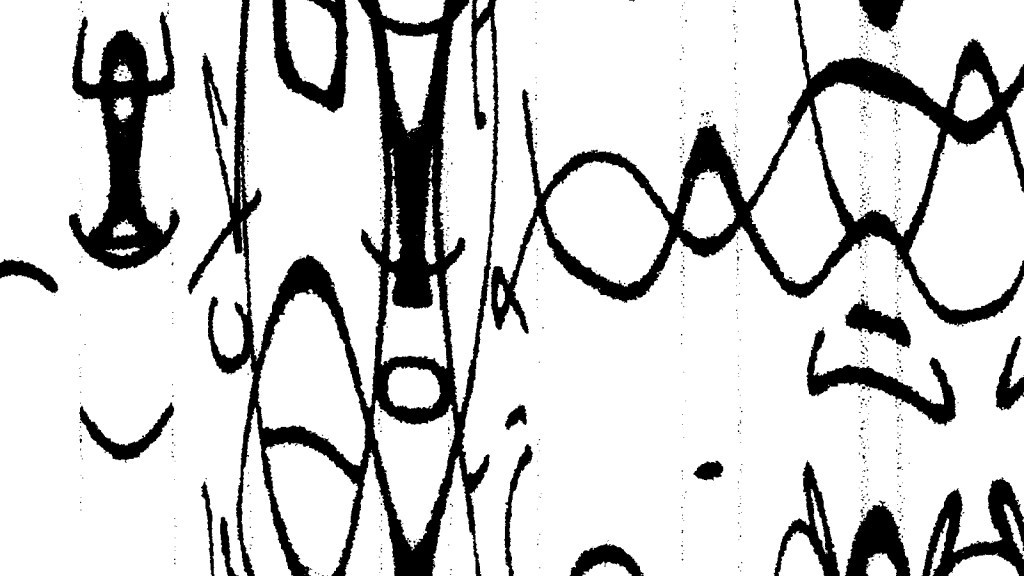
The image up top is by J. B. Murray, (bio here) untitled. One of his astonishing images graces the cover of All Soul Parts. Here’s another that dovetails with my poetry workshop’s current recent pass through asemic writing –

JBM+154

Valentine’s Shirt in Heaven

Zazen last night at Red Cedar for the first time in some weeks. My mind was a drifty sleepy jello, nothing new there. I moved from following my breath to following sounds. No alertness for me there so I switched to taking refuge

I take refuge in the Buddha
I take refuge in the Dharma
I take refuge in the Sangha

one on each exhalation. Just the utterance for itself, not trying to connect with what it means, I don’t know what they mean, honestly I don’t. I mean, I could try to explicate it, but phhhht. Nothing special happened and I left before service, tired after a long day and under the weather.

What we want’s so simple. To be loved. It’s so little and so much.

This morning, two poems by Jean Valentine, facing pages, saw me face to face.

OPEN

I lay down under language
it left me and I slept

—You, the Comforter, came into the room
I moved my head—

my blood, my mouth
all buttoned away—

Makers of houses, books, clothes-
makers, goodbye—

and

A LEAF, A SHADOW-HAND

A leaf, a shadow-hand
blows over my head
from outside time
now & then
this time of year, September

—this happens—
—it’s well known—
a soul locked away inside
not knowing anyone,
walking around, but inside;

I was like this once,
and you, whose shadow-hand
(kindness) just now blew over my head, again,
you said, “Don’t ever think you’re a monster.”

That Comforter, that kindness, I know them, & not just in memory.

& not only, please let it be, their recipient.


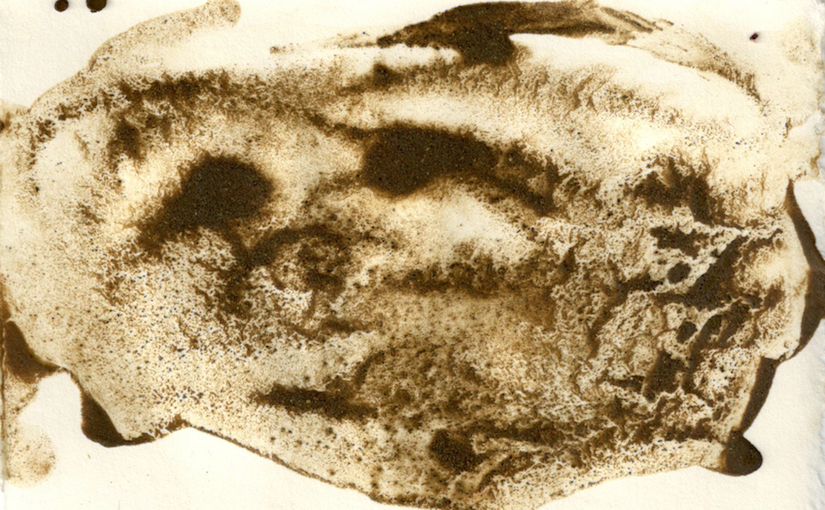
Image above, from a work still incipient, Dura Mater. Click to go bigly:

Image 1 col

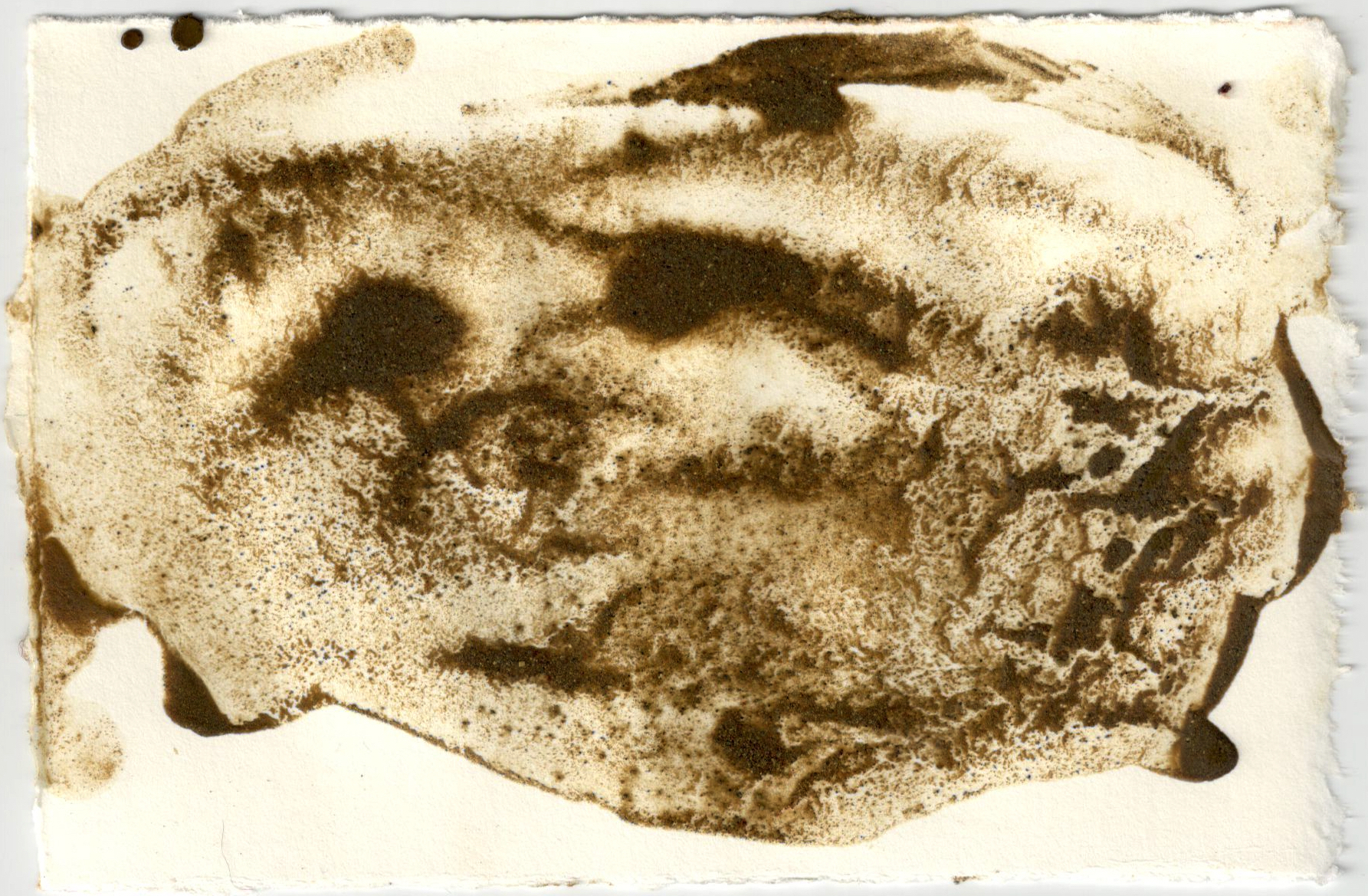
Sumas Mountain ochre, olive oil, egg yolk, water on paper.

Happysad snowday

This just in from SCRO.

Watch full screen for the best hit.

I think it’s a sort of breakup poem? Long after the fact but a fresh wave of it.

Oh yes, lotsa wish, loss, yearning, resolution. This little heart wants so much!

Snow’s all round today – air, ground, sky, quiet, lovely.
Yesterday a hummingbird in the snow at the lavender flowers.

Whether “life goes on,” I don’t always know, but living goes on, I do see it.

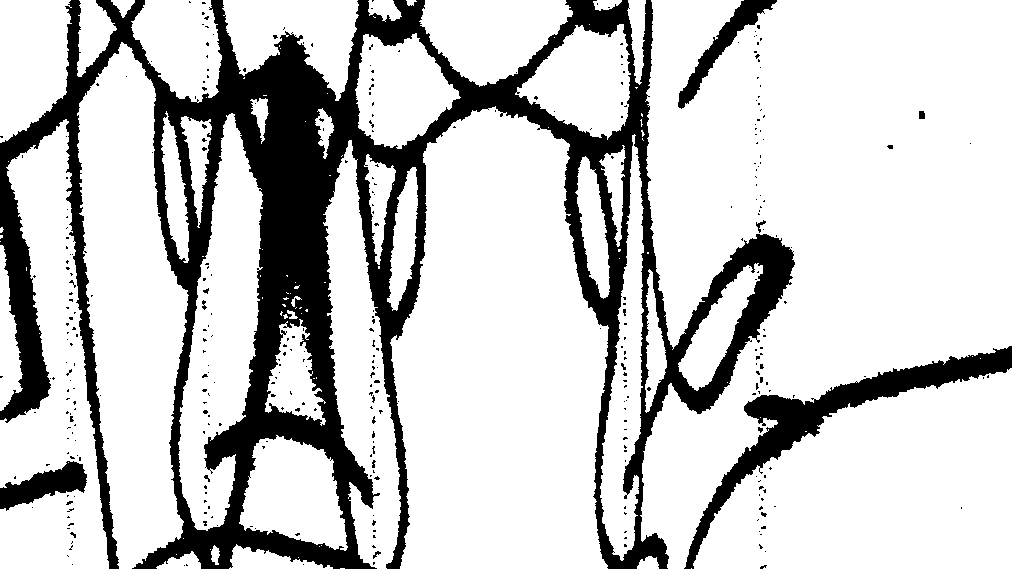
Image up top, tilt your head sideways. You’ll see the left side of the sad face is the word happy. It made the round forms in the middle, heartlike, applish, insecty.

Go, figure.