

Trying out a new scheme, wd be glad to hear your thoughts, esp. as I’m colourblind, yes it’s true, that bird to me in the leafage is movement first, red in green only after you’ve told me. So—waddya think? (I got tired of the purple green and sans serif myself. Like an unhip aubergine.)
Category: looking
One more for Elise
I thought I would post here, with her husband Steve’s most kind permission, the remarks I made at the memorial this weekend for Elise Partridge. It was a beautiful occasion, the afternoon. Our seats arranged such that our seeing went out the frames of the windows and frames of wood and frames of stone and frames of shore pine and out over ocean into the frameless mountains. (I have it in mind because two days later Stephen Burt spoke in that same space, differently em-placed, on the poetry and poetics of place.) One might almost feel one was a spirit passing through bodily frames, one, another. The words I said were about these.
In the weeks around Elise’s death I’ve been talking with some of my students about animism. The thought — to be a bit simple about it — that the world is alive. Every part of it and the whole of it. Which I think might mean, if it’s true, that when you go, you’re not really gone, you’re just differently here.
I start with that because I haven’t been able to get my head around it very well. Elise — here. Elise — gone. It’s the most elemental thing. We get to live so we’ve got to die. And, as Elise leaves the tangible world, I am finding it makes almost no sense to me at all. I keep looking for ways to find her not gone but instead differently here. And so maybe all I’ve got for you is four and a half more minutes of magical thinking.
It’s a sort of thinking Whitman was fond of. And Steve’s asked me to read a late poem of his. And so I guess through him Elise is asking me to read a late poem of his. It’s called “The Last Invocation” and it goes like this.
1.
At the last, tenderly,
From the walls of the powerful, fortress’d house,
From the clasp of the knitted locks — from the keep of the well-closed doors,
Let me be wafted.
2.
Let me glide noiselessly forth;
With the key of softness unlock the locks — with a whisper,
Set ope the doors, O Soul!
3.
Tenderly! be not impatient!
(Strong is your hold, O mortal flesh!
Strong is your hold, O love.)
Whitman, who said we could find him underfoot. I don’t think of Elise as under our boot soles — I think she’d find the notion undignified — so much as behind our eyes. Entering our vision to sharpen it with us. Forgive me for going back to my class but they’re on my mind because they had to bear with a teacher thrown off his game for a while by grief. I might put it to my class this way. If the proposition of animism is, oh, when you go, you’re not really gone, the problem for us moderns is, yeah, we’re here, but we’re not really here.
That’s a problem Elise concerned herself with. In her work, in her life. Maybe the problem though I don’t want to presume. What, every one of her poems asks, stands in the way of seeing more clearly, hearing more kindly, touching more tenderly, feeling more feelingly. And go — the poems say, to whatever that what is — go stand somewhere else, there’s a life to be lived, fully, lived well, lived lovingly. The first lines of the first poem of her first book —
Nothing fled when we walked up to it,
nor did we flinch.
What a note to start a life in poetry on. “Everglades” is the poem. It has a vision of that swamp as a wild and wildering democracy —
Tropical, temperate, each constituency spoke —
the sunburned-looking gumbo-limbo trees
nodded side by side with sedate, northern pines.
“Gumbo-limbo trees”! What better evidence of a life well lived? (The phrase, I mean.) The line following —
Even the darkness gave its blessing
A darkness from which I’d like to think Elise blesses or raises an eyebrow at us.
I wanted to touch on her e-mails, how they quivered with joy on one’s behalf, and with outrage at banality, idiocy, herd mind, also how they made the exclamation point safe for human perception again — there may have been seventeen of them but you knew each was uniquely meant — but I’m about out of time.
Just this — a postcard from years back, after Steve and Elise had looked after my house and cat on Salt Spring, one of many times. I still have it on my fridge. It’s a photograph of Robert Creeley taken by Allen Ginsberg at a diner in Boulder, CO.
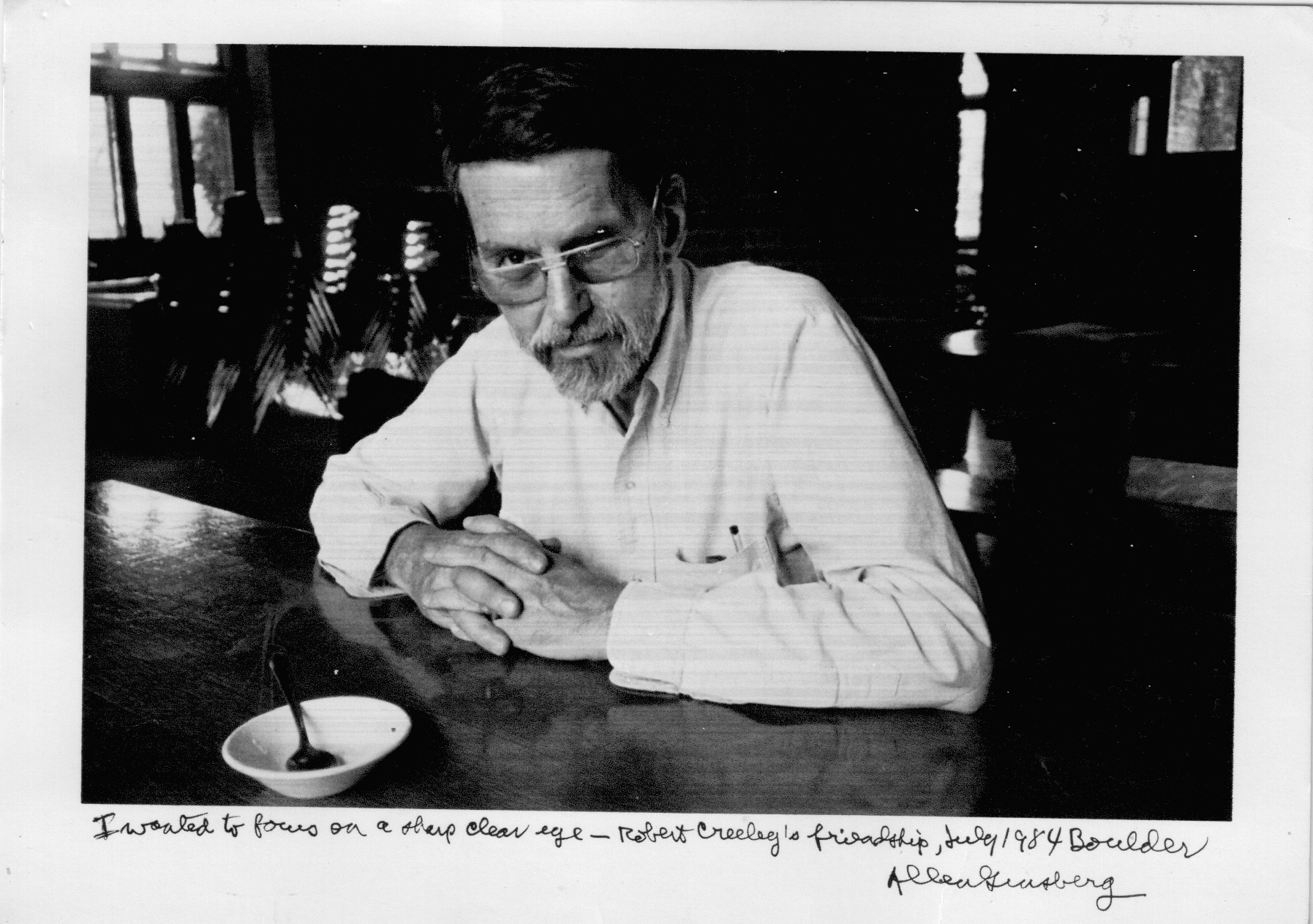
Ginsberg’s inscription: “I wanted to focus on a sharp clear eye — Robert Creeley’s friendship.” Elise’s inscription on the back begins: “Hello Chris! I admire your poetry! —Robert Creeley.”

Elise and I had gone down different paths aesthetically, and at this point in our friendship, she was feeling really kind of pretty unsure what the hell I was up to. And yet she found a way to express, with grace and class and decency, and without dishonouring her own instincts, encouragement and faith in me.
That’s love. That’s the love of a friend for another. It’s a rare thing and it doesn’t die. I don’t think it does, I really don’t.
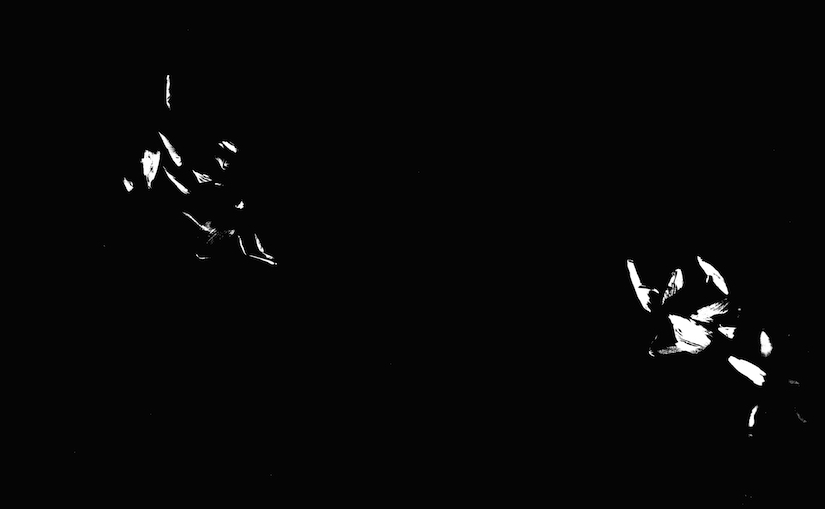
Paperwhites, for Elise
An exercise I give my poetry students: “Write a flower. Don’t write about a flower. Just write a flower.” Heh heh. Evil sumbitch I am. But I think I might have done that this morning. I had vaguely in mind to cut some paperwhites (narcissus) I had growing indoors from bulbs when they first began to falter and bring them to the photocopier and see what they had by way of elegy in them.
So I did. This one’s I think the best to stand alone. If I keep thinking so it’ll end Dumuzi as Paperwhites, for Elise.
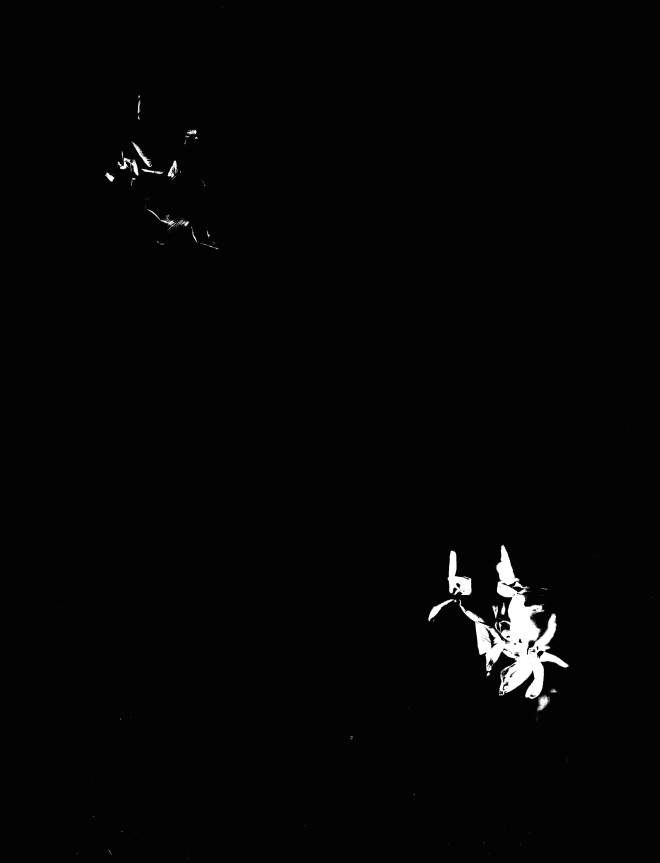
Elise was always a bit scandalized (and skeptical and intrigued and mortified and drawn) by my drift in this direction (“Chris, you’re not going to abandon MUSIC, are you?!?!?”) and I offer her this elegy in the cheerful teasing spirit in which our overlapping divergent aesthetics met. I’ve rarely loved disagreeing, being disagreed with, so much.
(Really. That many ?s and !s and more. Of how many people can you expect to say you’ll miss their e-mails acutely?)
Of the two dozen or so scans I made, quick quick, little thinking, the latter half come together as a tableau I think, and elegy. And something about ones and twos and threes, and how when you’re close to yourself there are more and fewer than one there, just as when you’re close to a friend there are more and fewer than two there.


More with Elise
Stunned by how hard this is. Made it through a day of teaching and mostly held my shit together — even managed to tell the nice coffee lady why I was sad without breaking even one tear — but I’m stunned by how much this hurts. Have I hurt this much before in my adult life when no rejection, zero, was involved?
On some level I’m just baffled. Elise was here, now she’s gone — wha? I was JUST talking to her. I mean, it’s the art of fucking compost, people, you’d think he’d get it, decay, metamorphosis? Heraclitus, hello?
Thought I had in a calmer moment. Part of growing into mind is what they call object constancy. Mommy went out of the room but she still is. Toy rolled under the couch but it still is. Epistemology of peekaboo. Death points in the other direction. Is that part of the hard of it, that it cuts against the grain of the growth of thought, how our thought grows up?
Also feeling, I’ll share with you, intensely mixed feelings about blogging this. Elise is becoming a public commodity — becoming, as I think it was Auden said of Yeats, her admirers — and I resist it, she had a texture, a grain, a personhood inimitably her own, and I hate seeing it already being made something consumable.
The thought that I might contribute to that galls me. So does the thought that I might be pimping private feelings at a public wall. And yet. Even with all that I feel moved to say what she meant and means to me. Even if most of what I’m saying is mostly inchoate.
I’m growing a poem in some glass drops I’ll post when it’s ready. In the meantime this by Jean Valentine I wanted to read her when I saw her last. We didn’t get to it — we read a few poems by Bishop instead and it was lovely to me to live with her a spell in the touch of the light sharp seeing they shared — so here it is.
DOOR IN THE MOUNTAIN
Never ran this hard through the valley
never ate so many stars
I was carrying a dead deer
tied on to my neck and shoulders
deer legs hanging in front of me
heavy on my chest
People are not wanting
to let me in
Door in the mountain
let me in
Elise Partridge
My dear dear friend Elise Partridge passed away yesterday evening. She was a marvellous poet and an even more so person. Warm loving acute witty skeptical wry and humane. I am sort of reeling with it (though her death was known to be coming for a while) and don’t have much more to offer than that right now. Here though the first lines of the first poem (“Everglades”) of her first book (Chameleon Hours) —
Nothing fled when we walked up to it,
nor did we flinch
Not a bad note on which to open a life’s work. No fear and no frightening. God I’m going to miss her.
Hawk 1 Drone 0
I don’t usually do this but. I take a pleasure I should spend some time looking at in watching the incoming talons.
Another pleasure, differently guilty, seeing the thing act done twice, second time in slo mo. Nature, art. Art, nature, nice to meet ya. Not opposed but apposite saith Williams.
(Found at Slate.)
Paper cutouts
Article in this morning’s NYT about a show soon to open at MOMA of Matisse’s late paper cut-outs.
 Is it totally college-dorm-room of me to love the clarity and ease in them? A sense of having come all the way through struggle.
Writes Holland Cotter of a detail from Two Dancers, from a design for a production by the Ballet Russe de Monte Carlo:
Puncture marks that dot the slivers are records of the many times each had been pinned, unpinned, repositioned and pinned again. For Matisse, it seems that trial-and-error rawness, some evidence of struggle, validated the work.
Traces of process. Linking Matisse to footpaths formed by the acts of animal and human feet and to the lines of horses and bison laid down once and again on cave walls in the south of his country. We’re never not close to the heart of compost.
Monoskop archive
This just in from a student — an online archive of avant-garde and Modernist journals. Looks like a treasure trove.
Blast, Little Review, Apollon, Der Dada, Poesia … enjoy!
11 11 16

OMG that’s beautiful. Just checking links on my CV and came to it. Splash Image © Lenguarayada (Tongue Twisted). Blanka Amezkua, 2009. And here’s their very fine journal.
Howl, phonetical

From bombmagazine:
Seven posters from The Singing Posters: Allen Ginsberg’s Howl by Allen Ruppersberg (Part I), 2003, 14 × 22 inches.
These are pretty. Got nothing much more to say than that right now. Oh and they bring bill bissett’s hypercool phonemes to mind. Oh and they confirm that each line of “Howl” really is a page —
 The Art of Compost