One more torn page

One more from Barb (she’s on a tear).
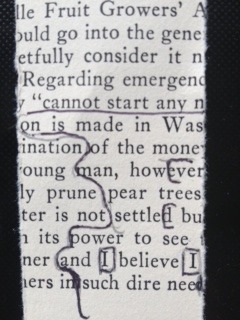
image

And transcription:

(old men)no books (3)

on is made in Was—
of the Mone.

Man how pear trees
settle power

to see and believe.

(such
dire
need)

I think I mentioned I came up with this exercise 10 minutes before the first meeting of my Art of Compost class this summer when I saw in my notes “exercise: something with torn pages” and realized I hadn’t worked out what “something” was.

William Carlos Williams famously wrote, “write carelessly, that nothing that is not green survives.” Not sure the same always applies to lesson planning but here it worked okay.

The pages we tore in class were from a battered second copy I had of his Imaginations.

Torn Page

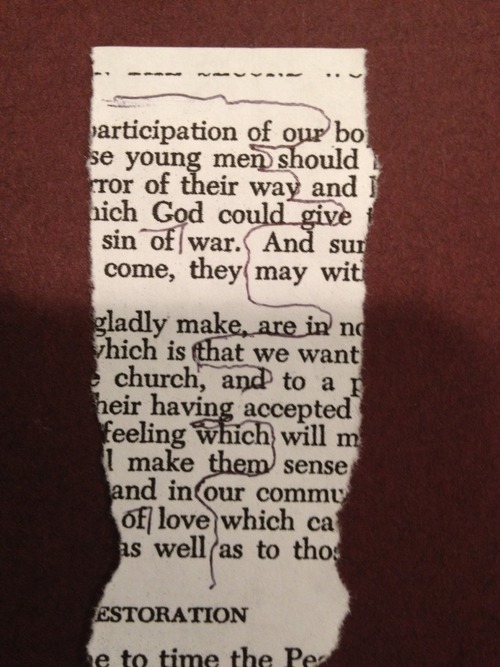
This just in from my dear friend Barbara Nickel. A torn page poem along lines I suggested however many aeons ago (~ seven weeks give or take).

image

Which she transcribes as:

(old men)no books (1)

participation of our
young men
ror of their way
ich God
could give sin-war

come, they gladly
make, are in
which is church
and eir,
having feeling
which make them
and in love
well

Exercise: Compost mural

From a 20 foot mural my class made today in 50 minutes (give or take). The prompt: using only the materials you have on hand, or can forage from the surrounding environment without breaking the law or hurting anyone’s feelings, express your understanding of “the art of compost” (course title). In other words, a crash course in targeted bricolage.

Book and string

This from erikkwakkel:

Smart page with string

These pages from a late-16th-century scientific manuscript share a most unusual feature: they contain a string that runs through a pierced hole. Dozens of them are found in this book. The pages contain diagrams that accompany astronomical tracts. They show such things as the working of the astrolabe (Pic 1), the position of the stars (Pic 4), and the movement of the sun (Pic 6). The book was written and copied by the cartographer Jean du Temps of Blois (born 1555), about whom little appears to be known. The book contains a number of volvelles or wheel charts: revolving disks that the reader would turn to execute calculations. The strings seen in these images are another example of the “hands-on” kind of reading the book facilitates. Pulling the string tight and moving it from left to right, or all the way around, would connect different bits of data, like a modern computer: the string drew a temporary line between two or more values, highlighting their relationship. The tiny addition made the physical page as smart as its contents.

Pics: London, British Library, Harley MS 3263: more on this book here; and full digital reproduction here.